Oh, there is history here! The Romans built the first fort nearby, from which Caernarfon derives its name; in Welsh, the place was called “y gaer yn Arfon”, meaning “the stronghold in the land over against Môn”. Following the Norman conquest of England, William the Conqueror turned his attention to Wales. When the person nominally in charge of (northern) Wales was killed by the Welsh (1088), Norman control was re-established by building 3 castles, one of them here at Caernarfon. It would have been a motte and bailey castle – the easy-to-build but militarily formidable fort of the time, with a protective ditch and a timber palisade enclosing a courtyard (bailey) and wooden keep on a raised earthwork (motte), similar to that shown at Lincoln Castle (post “The Lincoln Castle, Bishop’s Palace, and the Magna Carta“). The Welsh recaptured the area in 1115, and this original Caernarfon castle became the property of the Welsh princes – until war broke out between Wales and England in 1282. England’s King Edward I invaded and marched through northern Wales, capturing Welsh castles and starting his own at Conwy. Several months later in 1283 the last Welsh castle fell, and Edward began building a new castle at Caernarfon, replacing the pre-existing motte and bailey structure. The castle was intended to be the definitive chapter in King Edward’s conquest of Wales, constructed not only as a military stronghold but also as a seat of government and royal palace. The defenses were built on a grand scale with a deliberate link to Caernarfon’s Roman past, the striped and angular walls designed to echo those of Constantinople, the imperial power of Rome. The pictures below are from the internet.


Part of the castle’s fame comes from its association with the English title, “Prince of Wales”. According to legend, Edward got the angry Welsh to submit to the Crown by promising them he would name “a prince, born in Wales, who spoke not a word of English”. To the surprise of the Welsh, his son Edward II was born at Caernarfon in 1284 (speaking not a word of English – or any other language), and was created Prince of Wales in 1301 with control over Wales and its incomes. Since then the title has traditionally been held by the eldest son of the monarch. Prince Charles was “invested” with the title in Caernarfon Castle in 1969.
 A schematic of Caernarfon Castle is shown here. As you can see, it’s all walls and towers; construction was stopped in 1330 before it was completed. Although there were once interior buildings, none have survived.
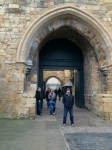
The main entrance to the castle, shown in the left picture below, is the town-facing King’s Gate; the right picture is a drawing of the unfinished


rear of the King’s Gate. Had this twin-towered gatehouse been finished, it would have been protected by two drawbridge, 5 sets of doors, 6 portcullises, many murder holes above, and arrow loops to the side. You can see from that drawing above that there was a chapel above the gatehouse passage. It had double sinks for holy water, and slots in the floor to allow raising of the portcullises. The whole second floor was intended to be a large hall; the windows and remains of finely sculpted heads finishing off the roof supports show that it was designed for stylish living.
Closer views of the castle walls are shown below.


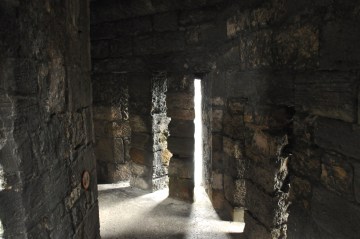 Arrow loops are everywhere in the walls, creating a veritable medieval machine gun. These arrow loops were high-tech for their time: not only were they angled to allow each archer to cover a wide area, they also had an angled central pillar in the center of each loop to provide extra protection.
The impressive walls of the town and castle survive largely intact, but all that remains of the buildings within the castle are the foundations. In part that’s because the buildings within the castle were never completed; money for construction was diverted to repair town walls damaged in the Welsh revolt of 1294; more money was diverted for Edward’s invasion of Scotland (post, Stirling Castle); and Edward died in 1307. Further, when the Tudor’s (of Welsh origin) ascended the English throne in 1485, the Welsh were treated better. Hostilities eased, castles became less important, and consequently they were neglected. By 1620 only the Eagle Tower (shown later) and King’s Gate had roofs, and the domestic buildings had been stripped for building material. Still, the interior is impressive! The two pictures below look toward the unfinished Queens Gate. In the first


picture, the large bare rectangle on the right is where the Great Hall once stood. In its heyday the Great Hall would have been impressive, featuring fine architecture. On the other side of the courtyard, the three joined brown rectangles are the foundations of the kitchen. During the castle building, these kitchens would have fed up to 600 people. A


large part of the diet was boiled meat (doesn’t that sound English?); the kitchen had fitted cauldrons and running water supplied by pipes from the Well Tower, as indicated above by the illustration and the picture of the ruins. There was also a waste disposal chute that went through the castle wall.
 Returning to the Caernarfon Castle overview, re-shown here, the jutting structure behind the kitchen site is the unfinished rear of the King’s Gate, and across from that the Chamberlain Tower, with the North-East Tower, Watch Tower and Queen’s Gate in the background. The pictures below look in the opposite direction toward the huge three-


turreted Eagle Tower. In the first picture, the leftmost tower is the Watch Tower, then the Chamberlain Tower and the Eagle Tower. Note at the left edge of the right picture above, and in this  picture of the Granary and North-East Towers, that there are notched walls ready for an expansion that never came.
Although the castle was never finished and never really used, King Edward (and other officials and overseers) did visit and were housed in completed royal lodgings on the upper floors. When Edward and wife Eleanor visited in 1284 to have their son, the Eagle Tower was likely completed (up to the 2nd floor) and had the grandest


apartments. Had Caernarfon been completed as intended, it could have contained a royal household of several hundred people.
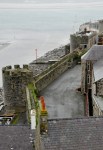
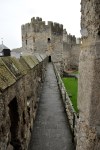
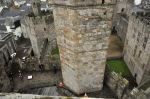
City and castle walls are shown below.
When we were there, Caernarfon had a street fair. Nice! Among the highlights were a really cool (and momentarily convincing!) velociraptor moving through the crowd, and a


very cute calf. Awwww! Can I take him home?? And how about dining on super-fresh street seafood at the harbor under the shadow of a castle? Crab anyone? This kind of


experience is why we tolerate some of the discomforts of traveling. Are you jealous, stay-at-home readers? I’ll finish with pictures of the Caernarfon harbor.


Next post – Northern Wales III: Beaumaris




 a good overview of the castle. Notice that it’s divided into two sections, a front and a back. The front was the working part of the castle; the back had the royal apartments. The castle was at the cutting edge of military technology, with thick walls, rounded towers and turrets providing lethal fields of fire, a solid rock base, and royal apartments that could be defended separately. Well supplied with fresh water from a spring-fed well, 91 feet down, and with its own dock, it could withstand sieges indefinitely. Nothing on this scale had been seen before in Wales, which at that time had no real cities. The last picture above and the picture to the left show how intimidating it still is.


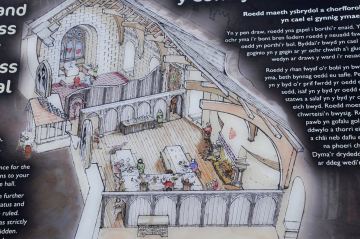 and the Great Hall dining area, shown in the lower right picture. A representation of how the chapel and dining hall looked in the 1280’s is shown here on the left. People ate here regardless of rank; status was indicated by distance from the top table (and the further away, the plainer the food).


 Not all went well on this trip to Conwy; descending a castle stairwell, perhaps foolishly in sandals, I slipped on a wet step and fell backward. I protected my camera, but alas, not my hand, as shown in the x-ray. I apparently sat on the hand, and the buns of steel did the rest; two fingers with spiral fractures. Broken fingers are bad enough, but worse, that’s the end of the plan to climb Mt. Snowdon. What a disaster! So back we go to poor Britt in Lincoln.
 You may remember from our first Lincoln post (The City of Lincoln) that in 1068 William The Conquerer built Lincoln Castle as a very visible symbol of power at the top of Steep Hill. This picture, taken from the Lincoln Cathedral, shows the Cathedral’s Exchequer Gate in the foreground, and in the background, the walls of Lincoln Castle. It may be a small town, but it is not a small castle!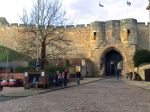


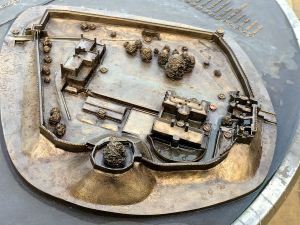 This model of the castle shows how roomy it is inside the walls. The barbican entrance shown above is on the right side of the model. The castle has been re-purposed over the centuries, and nothing on the inside, other than the walls and towers themselves, looks anywhere close to its 1068 roots. Below is the view of the courtyard from the castle wall above the main entrance. That building straight ahead is the Courthouse, built in 1826. Lincoln Castle was always a seat of justice,


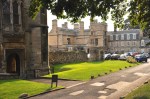


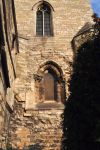


 the west-facing entrance. The previous Norman churches were short and thick-walled, with small windows resulting in dark interiors. The Gothic style made churches bright and spacious, but during the building of the Lincoln Cathedral the architects were writing the rule book, and it was literally trial and error (you’ll see some of this in the interior). As shown in the picture to the left, the
 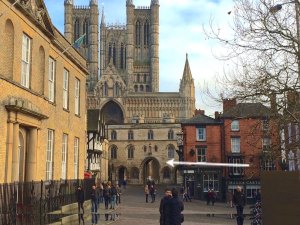 Exchequer Gate that was the main entrance to the Cathedral close (arrow) does a great job of blocking the view of the stunning front of the Cathedral – particularly the preserved Norman (lower) structure. Further, as you can infer from the picture, once inside the gate you’re too close to get a good overview. Ah well, here’s the best I can do for the Cathedral entrance.


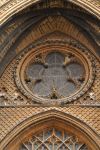


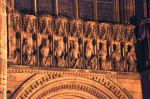

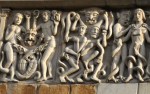


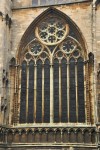



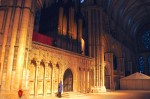
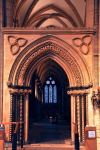


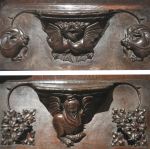
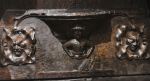






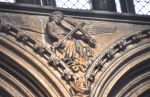
 called a citole. A famous stone carving in the Angel’s Choir is the Lincoln Imp. According to legend, two mischievous imps were sent by Satan to do evil work; after causing mayhem elsewhere in England, the imps came to Lincoln Cathedral where they smashed furniture and tripped up the Bishop. An angel appeared in the Angel Choir and ordered the imps to stop. One imp sat on a stone pillar and threw rocks at the angel, whereupon the angel turned him to stone; there he now sits.

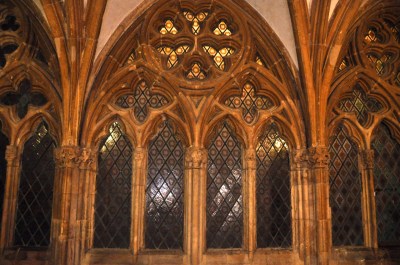 Now to the cloister. Access is via this impressive windowed corridor that duplicates the cloister design. The cloister itself (shown below) has a recent history – it was used for filming The Da Vinci Code, standing in for Westminster Abbey (which refused to permit filming).



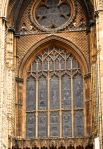


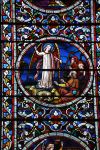
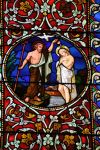
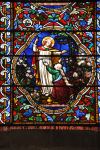
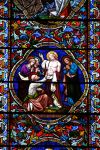
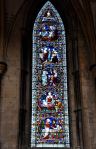
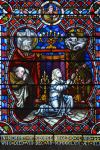
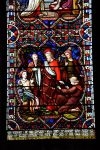
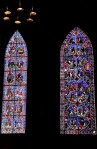
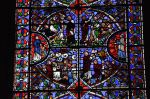
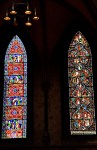
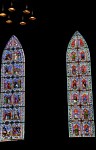
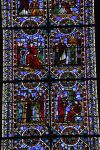
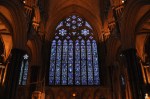
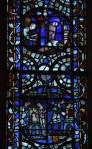
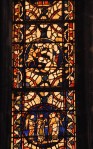
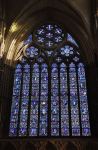
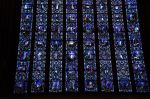
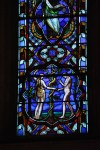
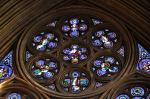
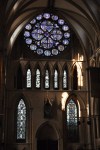
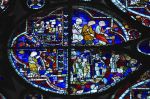
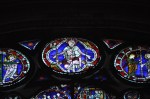
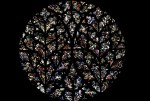
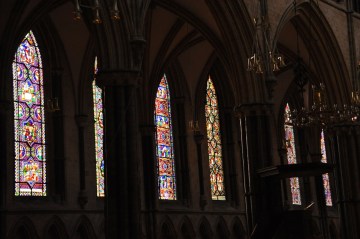 There are many, many windows in the nave. Like most churches, the stained glass is mostly from the mid 1800’s, following a rebirth in its popularity. There’s too much to show, so I’ll just do a little (which will still be a lot). Although the windows do not present the life of Jesus sequentially, it seems that all the stories of the New Testament are here, examples shown below. The windows are gorgeous, aren’t they?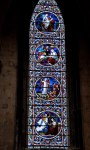


























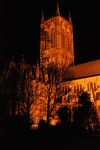
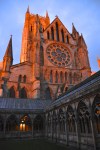
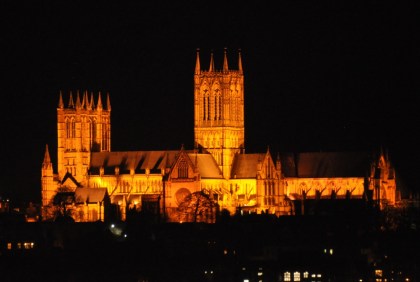 Cathedral at night. It is stunningly beautiful.
 trekin' time