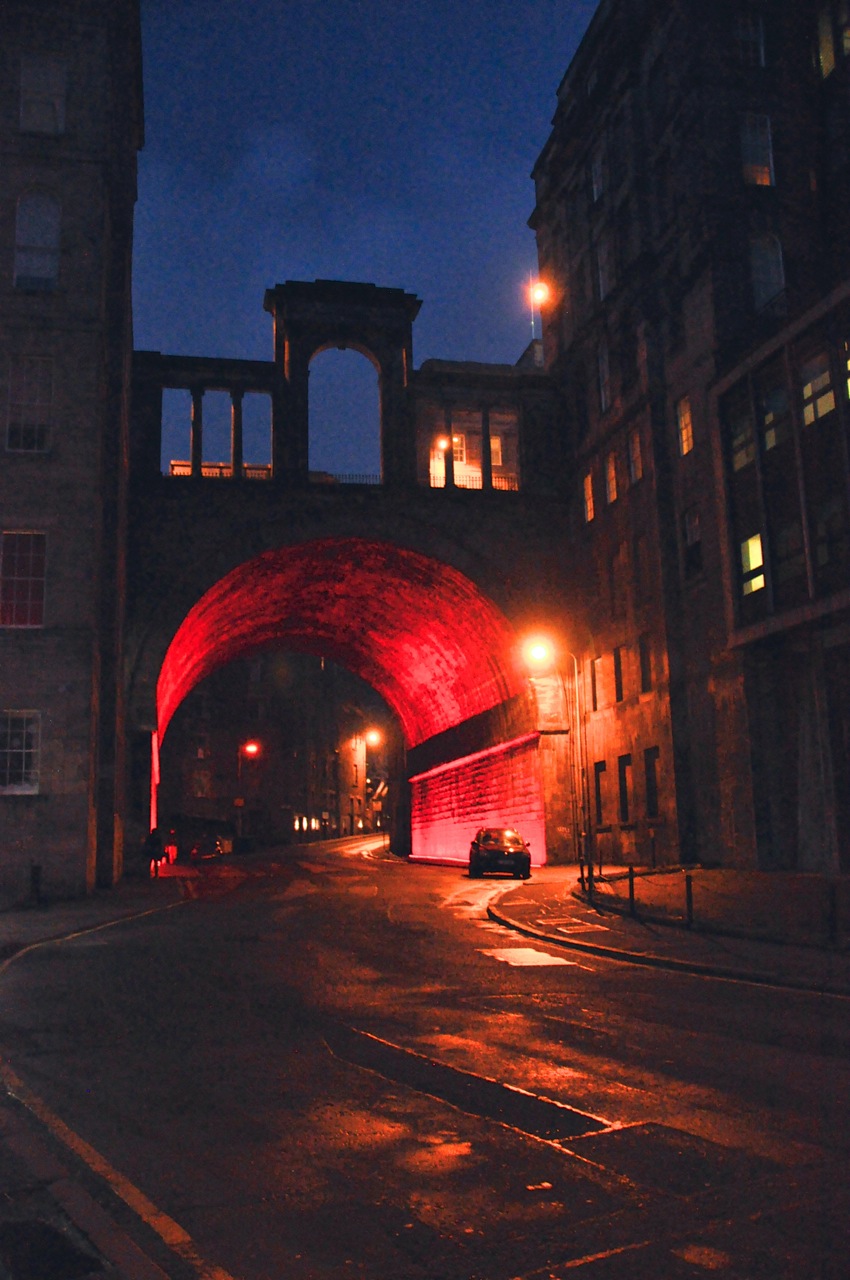
Edinburgh I

We went to Edinburgh twice, once a quick in-and-out to catch the Scottish Ballet, and once at Christmas to explore this city more fully and, wonderfully, to share it at New Year’s with the kids, who came to visit.  So this is Edinburgh in two parts; Part I will include all our first visit and a bit of the second.

Edinburgh castle looms over the city

Edinburgh Castle looms over the city

Edinburgh has been the capital of Scotland since the 1400’s.  With a commanding 10th century castle, it was a medieval powerhouse in its time.  It was once the most crowded city in Europe; with rich and poor living on top of each other, it was famed for its medieval skyscrapers – and for its filth and stench (its nickname was “Auld Reekie”).  In the 1700’s it expanded into “New Town”, an area of magnificent Georgian buildings where the upper crust could separate themselves from the rabble.  The Old and New Towns are both listed as World Heritage Sites.  Today Edinburgh is the home of the Scottish Parliament and is the second most popular tourist destination in the UK after London.

In our whirlwind 1st trip we barely saw the city, but we were impressed; impressed not only by the city itself, but also by the number of tourists there in October!  Below are pictures of New Town and Old Town (on the Royal Mile, which goes from Edinburgh

Castle to the Palace of Holyroodhouse).  The Royal Mile in particular is lined with historic buildings, including St. Giles’ Cathedral, Scotland’s most important church.

That impressive crown steeple is from 1495; the exterior is Neo-Gothic from the 1800’s.  We didn’t go inside this time – but just wait, we’ll visit it later!

Interior, National Museum of ScotlandWhat we did take in was the National Museum of Scotland (interior shown on the left), which had some really cool stuff.  Its primary focus is Scottish arts and history, but there are amazing things from other places, such as those shown below.  On the left is a relief from Assyria – gorgeous, isn’t it?  It’s from the late 800’s BC, from the palace of King Ashurnasirpal II, showing the King as a bearded high priest facing a court official and listing some of his military victories.  It was excavated in 1840 and owned by a Scottish obstetrician.  On the right is a fabulous Chinese vessel depicting a battle scene – alas, I don’t know it’s age.

OK, back to Scotland’s history.  At the beginning of the first century AD, much of Britain was occupied by Celtic Britons; and above them in Scotland, the Picts.  When the Romans invaded in 43 AD, they pushed the Britons west but had little success against the northern folk they called “Picti”, or “painted people”.  Thwarted, they instead built Hadrian’s Wall to keep the Picts out (post of Feb 1o, “Hadrian’s Wall“).  In the AD 5oo’s, Angles from northern Europe invaded and pushed the Britons further west (eg, Wales), but the Angles also had no luck against the Picts.  It would take centuries of warfare before the Picts and the descendants of the Britons and Angles would form a more or less united kingdom.

Pict symbols from the 600's or 700's.Not much remains of the Picts.  Their language survives only in the names of places, but evidence of a developed culture can be seen in their art, which consists of symbols (of unknown meaning) engraved on metalwork or carved on stone (shown on the left).  The purpose and meaning of the carved stones are poorly understood.  Earlier stones may have served as personal memorials or territorial markers; after Christianity spread to the Picts, the stones fell more easily into categories like gravestones.  In the AD 800’s, stone markers were commonplace in Scotland (examples shown below).

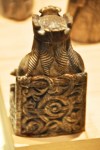
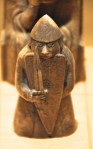
And now my favorite from the museum, the Lewis Chessmen.  They were carved from walrus ivory in the 1100’s, and they’re fabulous.  They were found (700 years later) on the Isle of Lewis, one of Scotland’s Hebrides islands that was still under Norse rule in the

1100’s (it had been captured by Vikings in the 800’s).  When found, the hoard contained 78 chess pieces; 10 are here, the rest are owned by the British Museum.  Aren’t the pieces gorgeous??!  I love them!

I’m going to group these next items due to their similar age.  The distinctive tall cross from the 1300’s is from the Argyll Islands of Scotland, where Gaelic tradition held fast.  The middle picture is called “The Declaration of Arbroath”, from the “Letter of the Barons of

Scotland” to Pope John XXII, 132o, “in the name of the whole community of the Realm”, declaring their determination to maintain Scottish independence and support King Robert Bruce.  It reads “As long as only one hundred of us remain alive we will never on any conditions be brought under English rule.”  This sentence is written in big letters on a wall of the museum!  No hand-written letter under a glass case here!  There is definitely an undercurrent of Scottish nationalism that we encounter in many small ways.  The last picture shows a two-handed sword from the early 1500’s called a claymore (from the Gaelic for “great sword”); its distinctive hilt was used only by the Highlanders.

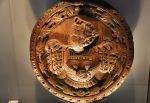
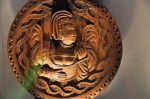
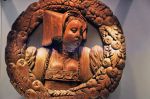
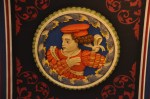
I’ll close our museum trip with 3 more pictures.  The first is a painted ceiling from Rossend Castle, done in 1617 in honor of a visit by King James VI (post August 4, 2015, “Stirling Castle“).  The clothes are a doublet and trunk hose, in silk and silver, from 1660.

The last is actually relatively modern – 1904 – a harp case with Celtic designs carved in Art Nouveau style.

I should also mention the museum had the stuffed body of Dolly the sheep, the first successful clone of a mammal from an adult cell.  But y’know what?  It looked like a sheep.

These next few pictures are from our return trip in December.  We’re staying at the edge of New Town (Princess Street), and from our apartment window we can see into this

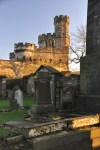
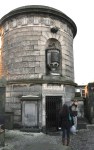
fascinating, really old cemetery at the base of Calton Hill – so off we go to visit.  One of the finds is the resting place of David Hume, an extremely influential  Scottish philosopher (eg, his “A Treatise of Human Nature”, 1739, written at age 23, is regarded as one of the most important works in the history of Western Philosophy).  Actually born David Home, he got tired of the English screwing up the Scottish pronunciation of his name and so had it changed.  Also visible is the Palace of Holyroodhouse, parts of it dating from the 1300’s.  Scottish royalty preferred it over the blustery castle on the hill.  The last picture shows a view of Calton Hill from below.

Calton Hill also gives a nice overview of this part of town, as shown below.  The picture

on the left shows how hilly this city is.  From Edinburgh castle on the top of the hill, the (obscured) Royal Mile in Old Town moves off the picture to the left.  New Town starts with Princess Street, angling down to the lower right corner.  Between them is a valley, now the Princess Street Gardens.  Previously this valley was a lake – the town’s water reservoir, sewer, and place to drown witches (~17,000 in 250 years; if you survived the tied-to-a-chair dunking, you were clearly a witch and were burned at the stake).  The clock tower in the picture on the right (above) is a historical building, now a (very) expensive hotel.  The triangular building behind it is the impressive Sir Walter Looking up at Princess StreetScott Monument.  And behind that, perhaps you can see the very large Ferris wheel, part of the holiday celebrations at the Princess Street Gardens.  Now let me show you hilly!  Doesn’t Princess Street look like “street level”?  It certainly seems to be when you’re on it, but remember earlier in talking about Edinburgh I said “… rich and poor living on top of each other …”?  That was literal!  There’s another whole city below your feet, as shown by the picture to the left.  It’s taken near our apartment – that’s Princess Street up above, with the columns!  The poor lived in underground warrens – often without windows – accessible down (literally down) alleys (where chamber pots were emptied).

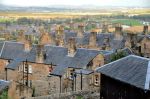
Today Edinburgh is quite a delightful city, full of life (and tourists).  The pictures below

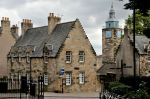
give you a feel for its architecture.  Below are some interesting buildings, including the

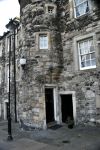
purported “John Knox house” from 1490.  Given the city’s age, there are of course a lot of historical structures, such as the ones below.  The first picture is the Mercat Cross,

where royal proclamations were read since the 1300’s (and many an execution was held).  This structure is actually from the later 1800’s, but is close to the original site.  The Scots do love their traditions – in 1952 a town crier proclaimed from here that Britain had a new queen, 3 days after the event took place – (traditionally it took 3 days for a horse to gallop here from London).  The other two pictures are of a neighborhood wellhead, no longer used.  Before buildings had plumbing, citizens got their water from these wells, piped from a reservoir near the castle.

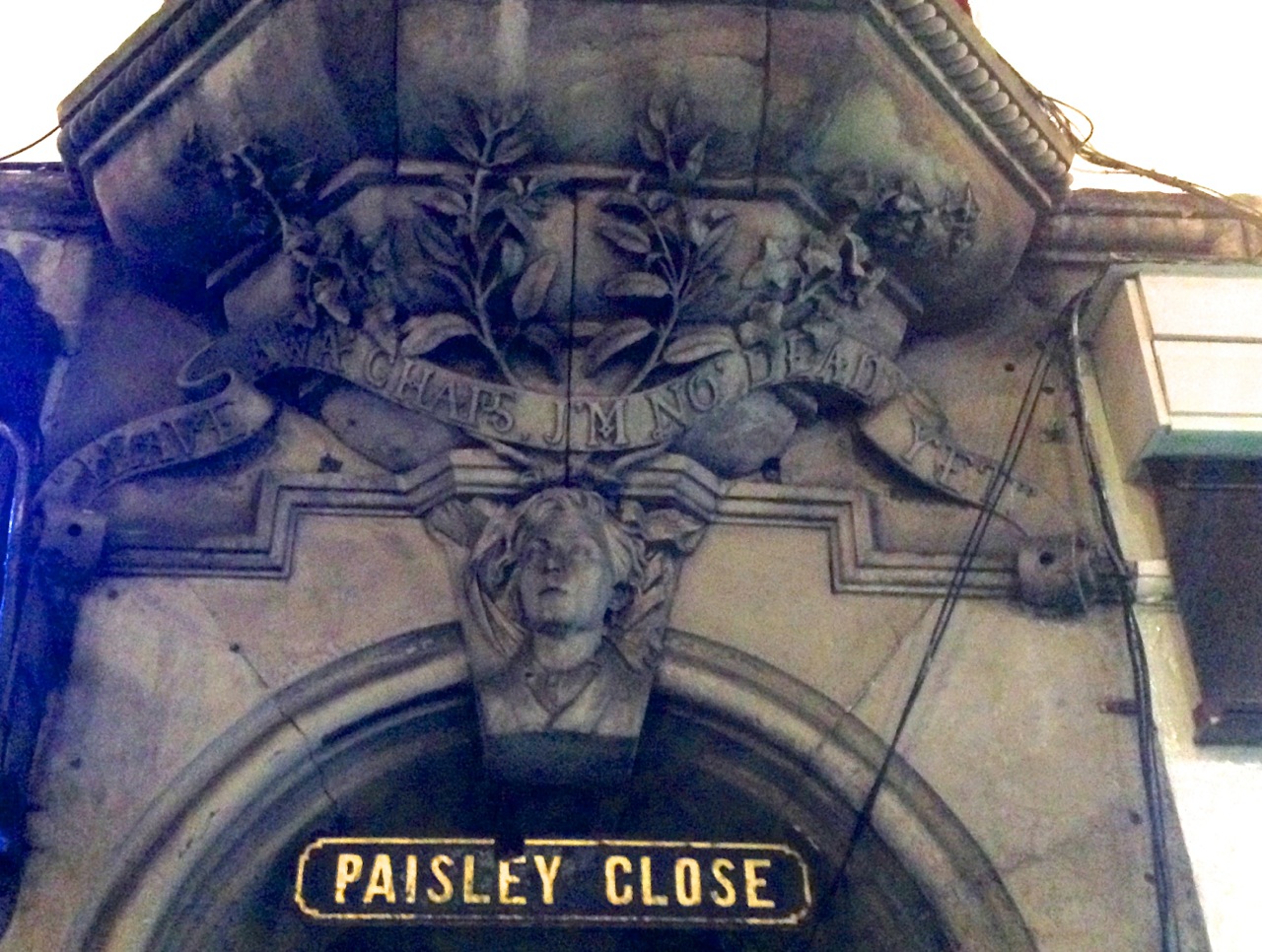
Embellishment over an alley ("close") built in 1861Our last historical picture is an embellishment over a “close” (tiny alley between buildings).  Here, just off the Royal Mile, in one of the worst slums in 1861, several 250-year-old houses collapsed, killing 35.  As the debris was being cleared away, came a shout from a young lad underneath: “Heave awa’ chaps, I’m no’ dead yet”.


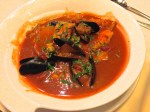
I haven’t mentioned Scottish cuisine yet.  It is very good!  Scotland is everywhere close to the sea, and we took advantage of that, as shown below.

To finish, this last picture St. Giles' Cathedral spires at sunsetshows the top of the beautiful St. Giles’ Cathedral off in the distance, kissed farewell by a beautiful sunset.

Next post: Edinburgh’s Castle, St. Giles Cathedral, and the Hogmanay, Scotland’s world-famous New Year’s festival.


Doune Castle

Doune CastleWe loved Doune Castle, not because it’s grand – it isn’t – but because it’s “real”.  Yes, it’s ruined, but it’s still one of the best-preserved medieval castles in Scotland.  By escaping restorations in later years, particularly those done with Victorian trimmings in the late 1800’s, it has remained true to its original plan, and thus allows us to see what “home life” was like for a very important man in the late 1300’s.  We should note that we are not the only ones enamored of the “realness” of this castle.  Back in 1975, the famous British comedy film Monty Python and the Holy Grail was filmed here; more recently, exterior and interior shots of the castle were used for Winterfell during the Game of Thrones’  first season.

Although Doune Castle is only about 5 miles from Stirling Castle (the “crossroads of Scotland”; see the Stirling Castle post), it’s nowhere close in terms of historical importance.  Still, history swirled around Doune Castle.  The castle is thought to have been built in the 1260’s but damaged during the Scottish Wars of Independence (also described in the Stirling Castle post).  It was rebuilt in its present form by Robert Stewart, the second son of Scottish King Robert II and great-grandson of Robert the Bruce.  The castle was at least partially complete by 1381.  Set on steeply sloping ground and surrounded on three sides by two rivers, the castle was strong and defensible, yet it was also built with luxurious accommodation. In an age when the conspicuous display of wealth and status were seen as vital in maintaining authority, no expense was spared on Doune.

The early Stewart history is pretty interesting, so I’ll share a bit of it here.  King Robert II, an aging and unpopular king, was removed from direct rule in 1386; his eldest son was politically weak, so his second son, Robert Stewart, became Regent (Guardian of Scotland), making him basically King of Scotland in all but name.  Doune thus became a virtual royal castle.  Then the intrigue began!  With Robert II’s death in 1390, Stewart’s older brother ascended the throne as King Robert III.  However, Stewart’s astute (read: ruthless) political maneuvering allowed him to retain his role as Regent.  In 1393 power was returned to King Robert III, who was to rule with the assistance of his eldest son, David.  In 1399, owing to the King’s “sickness of his person”, young David was appointed Guardian of Scotland in his own right for a period of 3 years; but, due to his youth (did you guess it?), he was supervised by a special parliamentary group dominated by Robert Stewart.  David, however, did his own thing, including circumventing proper procedures and confiscating various revenues in different parts of Scotland.  As soon as David’s Guardianship expired in 1402, he was arrested and imprisoned in Stewart’s Falkland Castle where he died from neglect and starvation; somehow Stewart was cleared of blame in his nephew’s death.  King Robert III feared for the life of his 12-year-old son James, now heir to the throne, and decided to send him to France for safety.  However, before James could reach France his ship was captured by pirates, who delivered him to King Henry IV of England (no, I’m not making this soap opera up!).   Robert III died two weeks after James’ capture, making the imprisoned boy King James I of Scotland; by default Robert Stewart once again became Guardian of Scotland.  James was imprisoned in England for 18 years; Stewart, of course, was not eager to ransom him back to Scotland and thus ruled as “Scotland’s uncrowned king” until his death in 1420.  His son Murdoch Stewart succeeded him as Guardian.  When King James I was finally freed in 1425, he executed Murdoch and Murdoch’s two sons for treason for failing to ransom him earlier.  Doune Castle was forfeit and became a royal possession.

Subsequently the royal family used Doune Castle as a royal retreat from the burdens of state and a pleasant summer residence where they could relax and hunt in the nearby forests.  Later it was also used as a “dower house” for the widowed wives of Kings James II, III and IV.  Both Mary Queen of Scots and King James VI stayed at Doune castle on several occasions in the 1500’s.  However, wars and strife began to take their toll.  Doune was held by forces loyal to Mary during the brief civil war which followed her forced abdication.  The Castle was involved in a number of religion-inspired conflicts with James VI and Charles I, and was the site of plots and captures and imprisonments.  Only when King James VI left for London in 1603, to become James I of England, did Doune’s role as royal retreat effectively come to an end.  Royalists occupied the Castle in 1645 during the English Civil Wars, and a skirmish occurred there against Cromwell’s occupation of Scotland.  Government troops were garrisoned within the Castle during the Jacobite Risings of the late 1600’s and late 1700’s.  The Castle was occupied by Bonnie Prince Charlie and his Jacobite Highlanders, and it was used as a prison for captured government troops.  By 1800 Doune Castle was a roofless ruin.  Well!  Hope you enjoyed that brief history of the intrigue that swirled around Doune Castle!  Back to our visit.

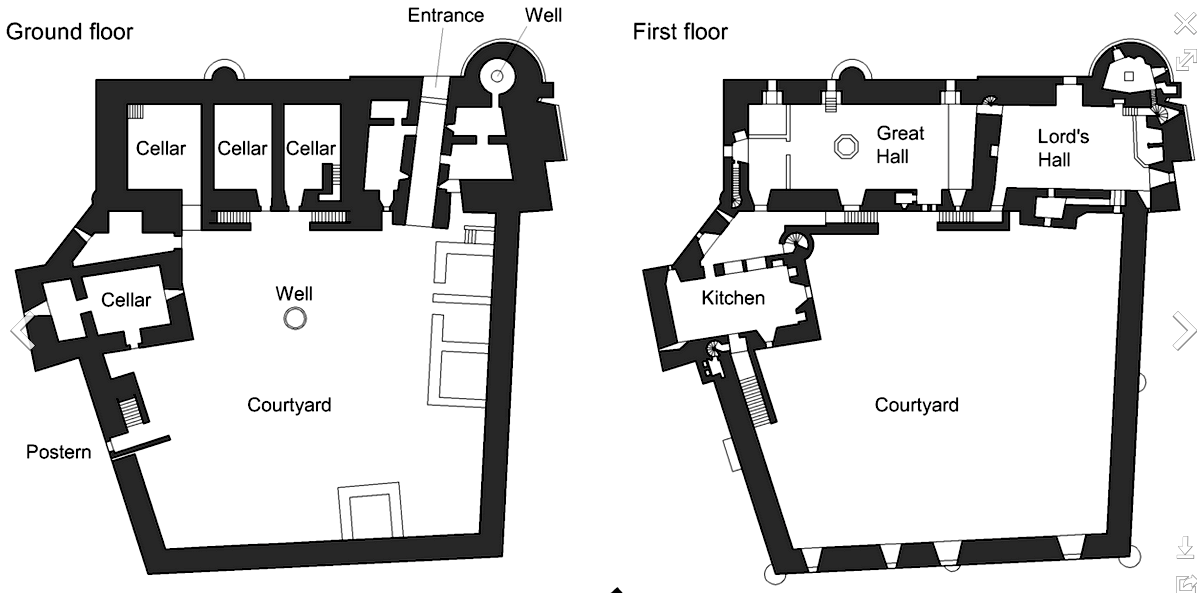
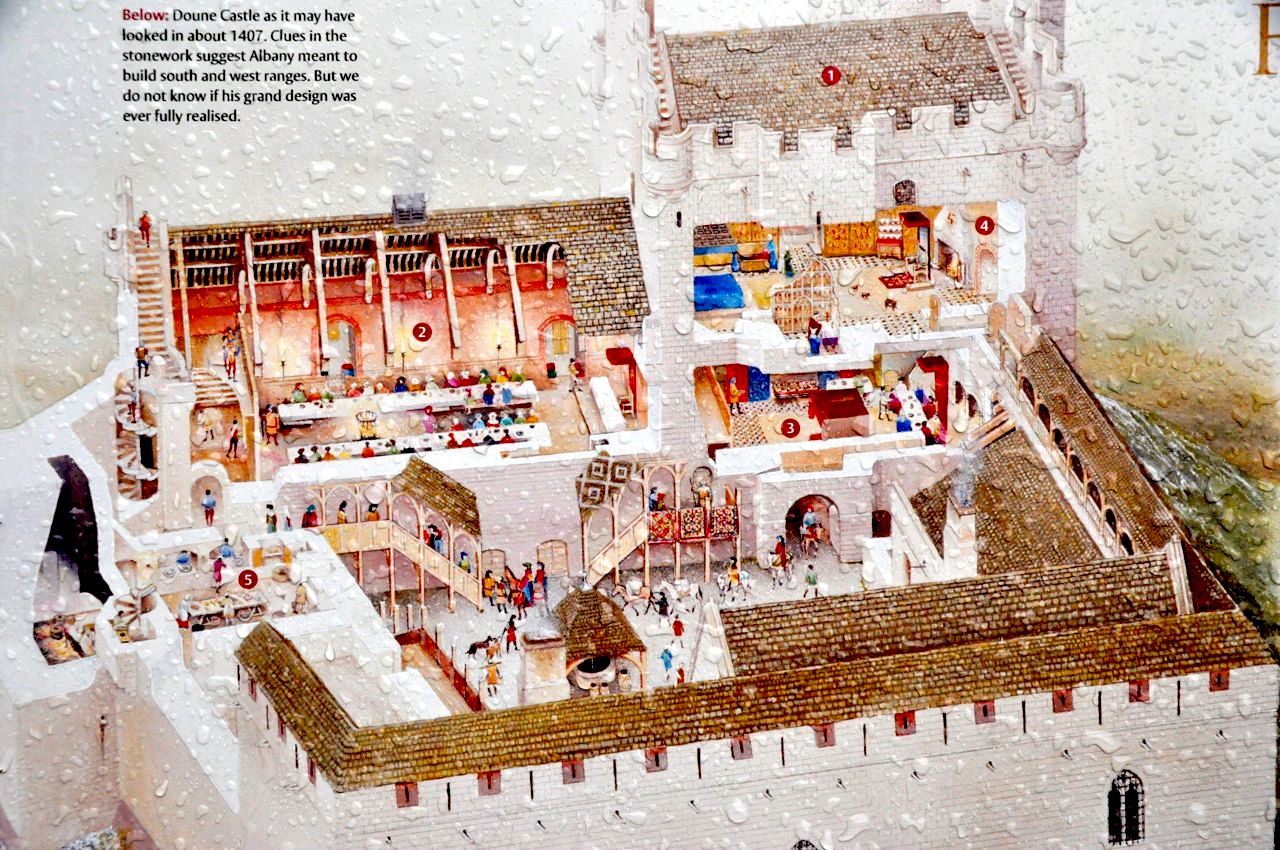
Happily the castle was structurally still in good shape.  Restorations in 1880 primarily repaired or replaced structural elements (the timber roofs and some internal floors) without adding too many “Victorian” details.   The Castle was originally planned Doune Castle Floor Planas a courtyard with buildings on all sides, but only the buildings on 2 sides were completed.  As shown in the castle floor plans, there was a tower house over the entrance containing the rooms of the Lord and his family, and a Artist's view of Doune Castle in 1407 (ignore the raindrops)separate tower containing the kitchen and guest rooms.  The two were linked by the Great Hall.  An artist’s rendition of what the Castle would have looked like in 1407 is shown to the left.

So let’s go look at this cool castle!


The most striking feature of the castle from the outside is the 100 ft high gatehouse (or The Duone Castle "Lord's tower" (and entrance)“the Lord’s tower”) shown in the first picture of this post and again in this picture.  In addition to being the entrance to the castle, the tower also houses, vertically, the Lord’s Hall and three further stories of chambers that were the duke and duchess’ apartments.

The gatehouse entrance was well defended with 2 solid wooden doors and a massive cross-barred steel gate that could be raised and lowered.  Alas, I missed getting a picture of the entrance, but I cribbed

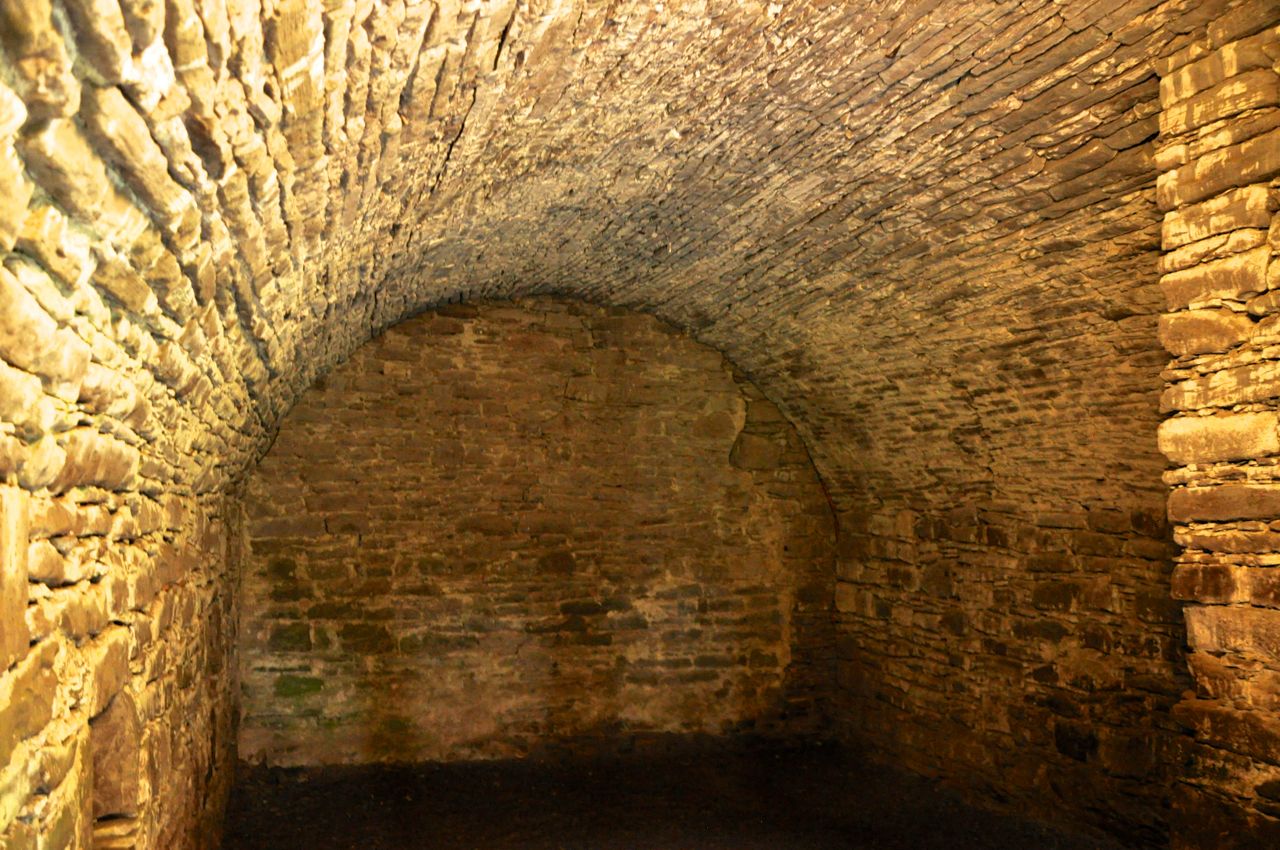
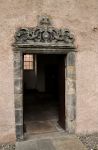
one from the internet, shown above.  The entrance is quite long and has guardhouses on both sides.  The courtyard picture above shows entrance stairs leading to the kitchen on the left and to the Great Hall on the right; it also shows one of the two wells in the Storage Cellarcastle.  All the ground-floor arched doorways visible in that picture, such as the two at the far right of that image, are storage cellars; an example is shown to the left.  In fact, the entire ground floor of the castle building was taken up by storage cellars.

The stairs from the courtyard lead to a triangular lobby, shown in the first picture below.  On your right is an arched entrance that leads to the cathedral-like Great Hall, the main reception room used for

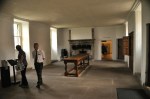
feasts and large gatherings.  It’s one of the best preserved Great Halls in Scotland.  Heat for this large room was provided by a central “fireplace”, an area in the middle of the floor for burning fuel.  There was no chimney – only a smoke hole in the roof.

From the Great Hall one could enter Robert Stewart’s “Lord’s Hall”, shown below.

It has an unusual double fireplace. The floor tiles and paneling are additions from the 1880 restoration.  This room may have been Robert Stewart’s sleeping quarters, but his

private chamber could also have been the room above (although that room might have belonged to the duchess).  There is another nice room or apartment above this one, including an en suite bathroom.

A really cool kitchen is conveniently located just across the triangular lobby from the Great Hall.  The kitchen is virtually a tower house itself, and was one of the best-appointed castle kitchens in Scotland in its day.  It has two large serving hatches with unusual elliptical arches for passing food from the kitchen to the Great Hall.  In the picture below, you are standing inside the kitchen looking through the lobby into the Great Hall.  Think

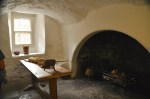
big feasts!  The kitchen had an oven and an incredibly wide (18 foot) fireplace, shown

above.  Think REALLY big feasts!  The distance from the fireplace to the serving hatches is just a few feet, so the food would arrive piping hot in the Great Hall, for sure!  A stair turret leads from the lobby to two stories of guest rooms – probably warmed by the kitchen fires on cold winter nights.

Finally, there are cool gargoyles on the castle walls.  The ones below are on the Lord’s Tower, on the courtyard side.

We hope you enjoyed this castle like we did.  Although it is a ruin, there is so much of it left, unchanged from 1381, that we could very much imagine what it was like to live in a castle in those times – secure, but far removed from the comforts of our modern life!

Next post – Edinburgh, Scotland.


The Highlands II – Glencoe Valley

Having traveled across Scotland through the Highlands to Oban on the west coast (Oban and the Highlands I), we now turn around and hightail it back to the Lowlands and the east coast, to Edinburgh.  Why do that, you ask?  Well, we do want to see more of the Highlands, for sure, but we also want to catch the Scottish Ballet, which, like us, travels around.  We’re feeling a bit culture deprived here on the road, and getting the Ballet and us in the same city at the same time is a challenge.  So we book ballet tickets and head off to the big city, deciding to backtrack by a different Highland road that goes through Glencoe Valley.  Edinburgh is far south of us, but to get there via Glencoe Valley we have to go north.  It’s not too bad, though, because it takes us Stalker Castle, with a view of Loch Linnhepast pretty Lochs Creran and Linnhe.  As an example of the surprises that Scotland has to offer, we stop at a roadside restaurant for lunch in the middle of nowhere and discover, off to the side, this unanticipated view!  It’s a tower house; no sign, no path, just part of the Scottish scenery.  Wouldn’t it be cool to wake up to that view?  And wouldn’t it be a great fixer-upper?  Your very own castle?  I just had to go looking for this castle on the internet – it’s called the Stalker Castle, built around 1446, and now in private hands.  When the tide is in, it’s totally surrounded by water, making pictures of it even more evocative.  The castle and this area have a long history of wars between the clans Stewart, MacDougall, MacLaren and MacDonald, mostly precipitated by murders or raids.  Later, King James IV often stayed at this castle on hunting and hawking trips.  It seems everything in Scotland has an interesting history, though you might have to dig a bit for it.  Scotland and England do not allow billboards along the roads, unlike the US where it’s hard to see the scenery for the flashing roadsigns saying “George Washington Slept Here”!

Below are some other gorgeous views as we head north along the Lochs.

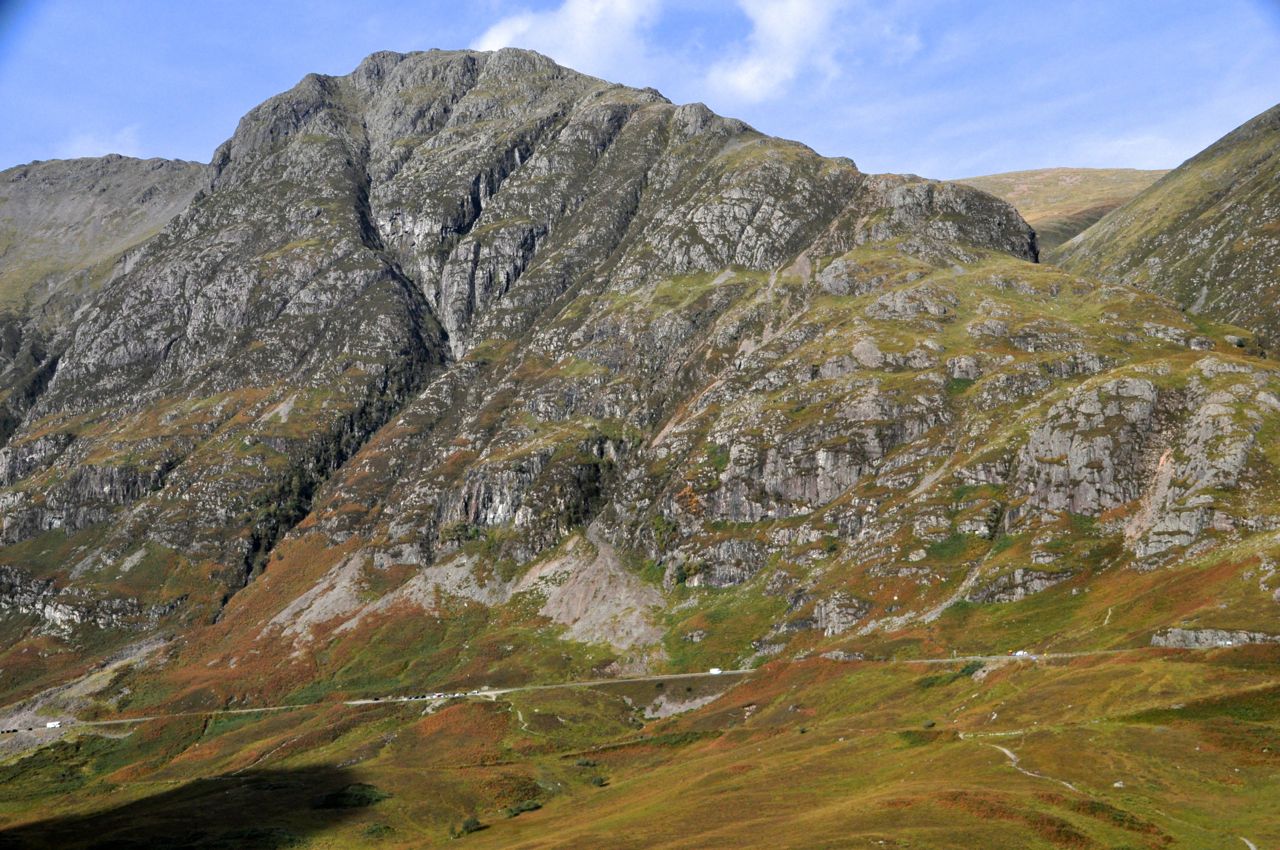
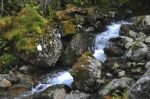
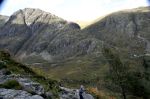
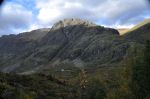
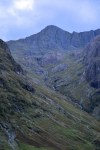
Glencoe ValleyAt last we turn south and head inland into Glencoe Valley and the Highland moors with their craggy hills and heather.  The nearly complete lack of trees on the hills is remarkable; consequently, people burn peat here, not wood.  As you can see, the view is on a grand scale, quite striking in its austere way.  Hopefully you’re as impressed as we were.  It’s beautiful!

Part way through Glencoe Valley, we decide to do what’s billed as a 3-hr hike to the Lost Valley of Clan MacDonald.  The View of area to be hikedtrailhead is poorly marked on a gravel pull-out directly off the main road, and there are not many hikers in sight.  It looks more like a spot for gawking than for hiking as we start up the trail.

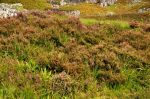
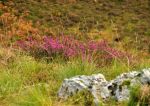
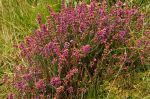
We were hoping to see the mountainsides covered with heather, but we’re here at the tail-end of its season.  The extensive heather patches – they’re everywhere – are mostly covered with dead flowers and seed heads, as shown in the first picture below.  There are occasional patches still blooming here and there, and it is pretty, but clearly we have missed the “Wow!” time.

The trail goes down to a beautiful stream,

then starts seriously up.  Pretty, though!

At this point the trail alternates between being reasonable (first picture below) to being uneven and dicey (sometimes very dicey!) as indicated by the two vertical pictures both above and below; actually, there’s more of the dicey than the reasonable.  Scotland’s

trails are far removed from the highly engineered, trenched and staired trails we found in New Zealand!  These Scots are tough!  Like their whiskey, their trails are not for wimps!

We find occasional unexpected flowers along the trail – not many though, since it’s early October and a bit late for blooms.

A look back at the trailheadThe trail is steep and we’re going up fast.  This is a look back at the trailhead.  The trail there at the lower right snakes back to those parked cars on the road.  We’re already pretty high up!

As we enter the notch between the mountains, the trail stops being just “up” and now becomes up and down.  Oh joy.  Going down can be quite tricky, as Ginger demonstrates.

The trail follows a very pretty and a very happy stream as it bounces and burbles down the mountain that we are struggling up.

There are numerous small waterfalls coming off the mountain that add to our stream in picturesque ways.

Unfortunately, the clouds overhead are now dark gray and moving fast, and Ginger is concerned about rain.  The Eternal Optimist doubts it, but if it does rain, the steep parts of the trail will be really tricky to negotiate as we head back down, and remaining daylight is getting short.  Surely, though, we’re near the “Hidden Valley”?  We’ll go just a little further.  Soon the trail arrives at a spot where we need to ford the fast-moving stream – and for

sure we’ll get our feet wet since the few stepping stones are too far apart (and there’s not a friendly log in sight).  Getting across isn’t that bad at the moment, mind you – probably just a single foot kerplunk, maybe two – but if we get some rainfall it will be a lot trickier coming back.  Witness what’s feeding this flat spot, just 2 feet upstream, shown in the right picture above.  So discretion wins over valor, and we decide to turn back.  We meet a couple coming down from a higher, diverging  trail (1 of only 2 couples we meet the whole trip), who describe our intended destination as simply a level meadow nestled between the mountain peaks.  So the “Hidden Valley” doesn’t sound hugely exciting (and the grapes were probably sour anyway).  Really, the hike has been pretty enough to keep us happy.

The bank is made of peat, many feet thickAs we hike back, we note this bank of solid peat on the left.  The stuff is many feet thick!  It fascinates me that one can burn what looks like dirt for fuel here, but as noted earlier, with few trees, there’s not much alternative.

As we retrace our steps, note the dwindling light, shown below!  Hmmm.  With the mountains in the way, twilight comes pretty early here.  Glad we turned back.  I suspect there are times when optimists should be shot on sight.

As we drive further through the Highland moors, the landscape becomes increasingly stark and desolate, but still awe-inspiring.  This is Rannoch Moor, a large expanse of boggy land

that is unrelentingly bleak, almost hostile.  For long distances the only man-made thing is the road;Beginning to leave the Rannoch Moor apparently just building a road across this stuff was really difficult.  The scenery only begins to look a bit more friendly when we enter Trossachs National Park again.

That’s it for this part of the Highlands.  Hope you enjoyed it.  We’ll see the Highlands one more time, when we traverse a different part later in our travels.

Our next post will be a visit to one of the best-preserved medieval castles in Scotland.  Doune Castle, near Stirling Castle and Edinburgh, is our favorite so far.

Oban, and the Highlands I

We’re  off to tiny Oban for several reasons:

  • it’s in the Scottish Highlands
  • it’s a resort town on the ocean
  • it has a ceilidh house (pronounced KAY-lee, for you non-Scottish speakers) where they perform Highland music, song and dance (and they also teach visitors a basic ceilidh dance)
  • and, most important, it has a Scotch whiskey distillery to tour

If you remember from a previous post (Melrose Abbey, Scotland (and Greenknowe Tower), February 25, 2015), one of my goals on this tour of Scotland is to become knowledgeable of one of mankind’s more famous drinks, the single malt Scotch (Ginger gamely joins in, but is not a big fan).  Oban was on the whiskey map in that previous post (“Oban 14 yr old”); good enough reason to visit.  So off we go!

The southern end of Loch LomondThere are a number of different roads that go through the southern/central Highlands, heading northwest.  We choose the route that goes past Loch Lomond, the largest inland stretch of water in Great Britain and the centerpiece of Scotland’s Trossachs National Park.  You’ll recall that traditional Scottish song “Loch Lomond”:

By yon bonnie banks, and by yon bonnie braes,
Where the sun shines bright on Loch Lomond,
Me and my true love were ever wont to gae,
On the bonny, bonny banks of Loch Lomond.

Chorus
Ye’ll tak’ the high road and I’ll tak the low road,
And I’ll be in Scotland afore ye,
But me and my true love will never meet again,
On the bonny, bonny banks of Loch Lomond.

It’s a familiar old song, but I never knew it’s history or meaning.  There are several slightly different interpretations, but most are connected to the Jacobite Uprising of 1745 in support of Bonnie Prince Charlie [discussed in the last post (Stirling Castle, August 4, 2015)].  Two Jacobite soldiers, captured by the English, have different fates: one is condemned to death while the other, his friend, will be set free.  The song by the condemned man is based on the old Celtic myth that the soul of a Scot who dies outside his homeland will find it’s way home by the spiritual, or “low” road.  Doesn’t that make the song so much sadder?

It’s a long lake, 24 miles, and there are many opportunities to take a picture.  It’s a cloudy

day (of course; this is Scotland) and the lake itself seems sad.  Soon we climb into more

rugged and wildly beautiful territory.  And it just gets better, as shown below.

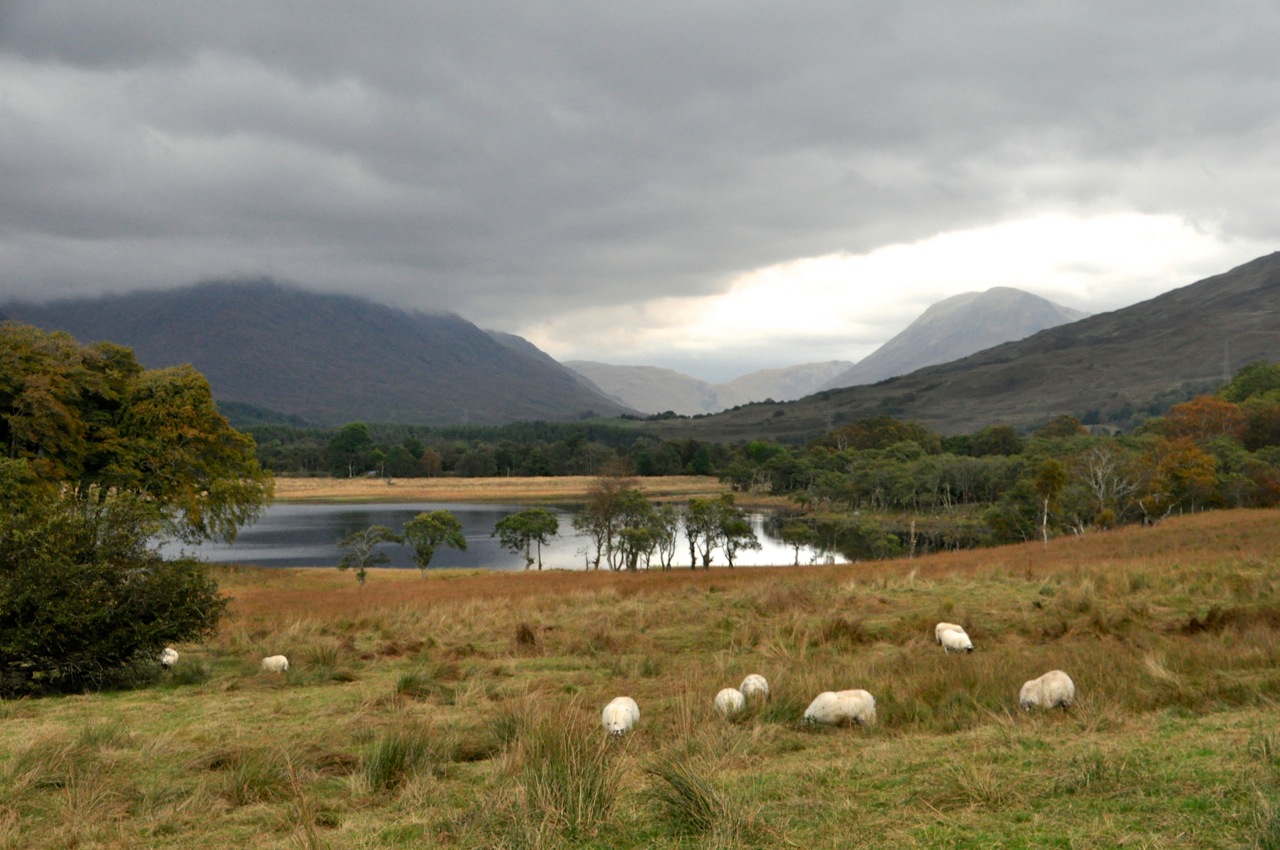
The Highland country sceneMy favorite view of this part of the Highlands is the bucolic scene to the left, with looming mountains, a picturesque small lake, and busy, contented sheep.  Lucky sheep, with such a view!
Aren’t the Highlands beautiful?  Wait ’til you see more of them, in subsequent posts!
After all that stark beauty, the ocean town of Oban was disappointing.  It’s a small (and low key) resort with gravel beaches and a winding promenade lined by small hotels.  Here

Scotland’s train system meets the ferry system to the Hebrides Islands; Oban’s center is a harbor, with huge boats.  Still, it’s pleasant enough, and it does have some great seafood restaurants!  Oh my gosh, if I’d been able to get a picture of one of the restaurant’s seafood platters, you’d be booking a plane ticket now.  Below are some views of the harbor.

Oban really has no important sights (other than a distillery!), but a short walk away it does have the ruins of a small castle (Dunollie) on a commanding spot overlooking the harbor.

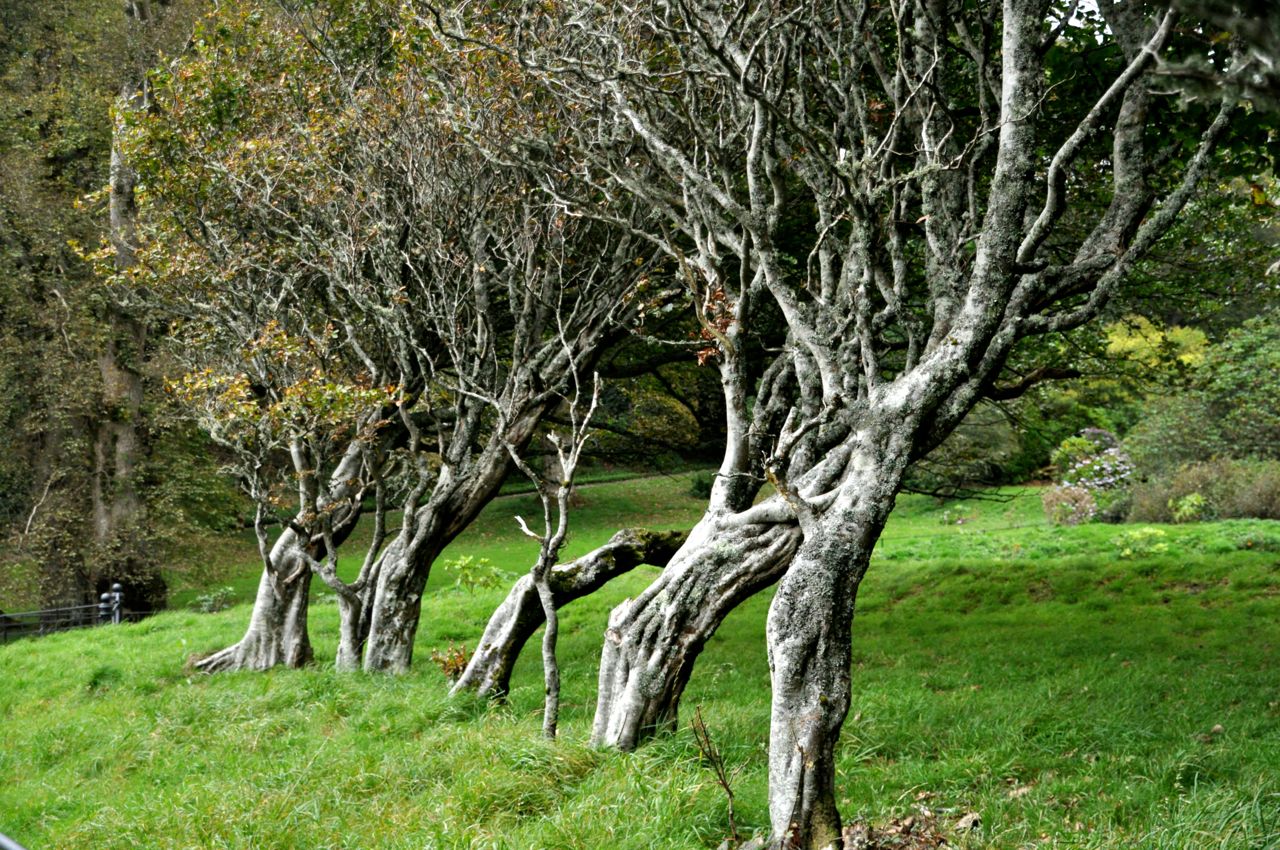
It was the home of kings (Clan Chiefs, really) in the kingdom of Lorn for a thousand years, and the seat of Clan MacDougall from the 12th century (the clan held 7 other castles and a fleet of galleys).  Dunollie Castle was captured by Cromwell, who garrisoned troops there; during the first Jacobite wars, it was besieged; and it was finally abandoned for good in 1746.  Today it just adds historic atmosphere – Wind-swept trees near Dunollie Castle something that Scotland (and England!) are very good at. And, speaking of atmosphere, there is an area near the castle called “The Witches” because it is forested with twisted old trees, some as old as 400 years, that show the effects of the high winds here.

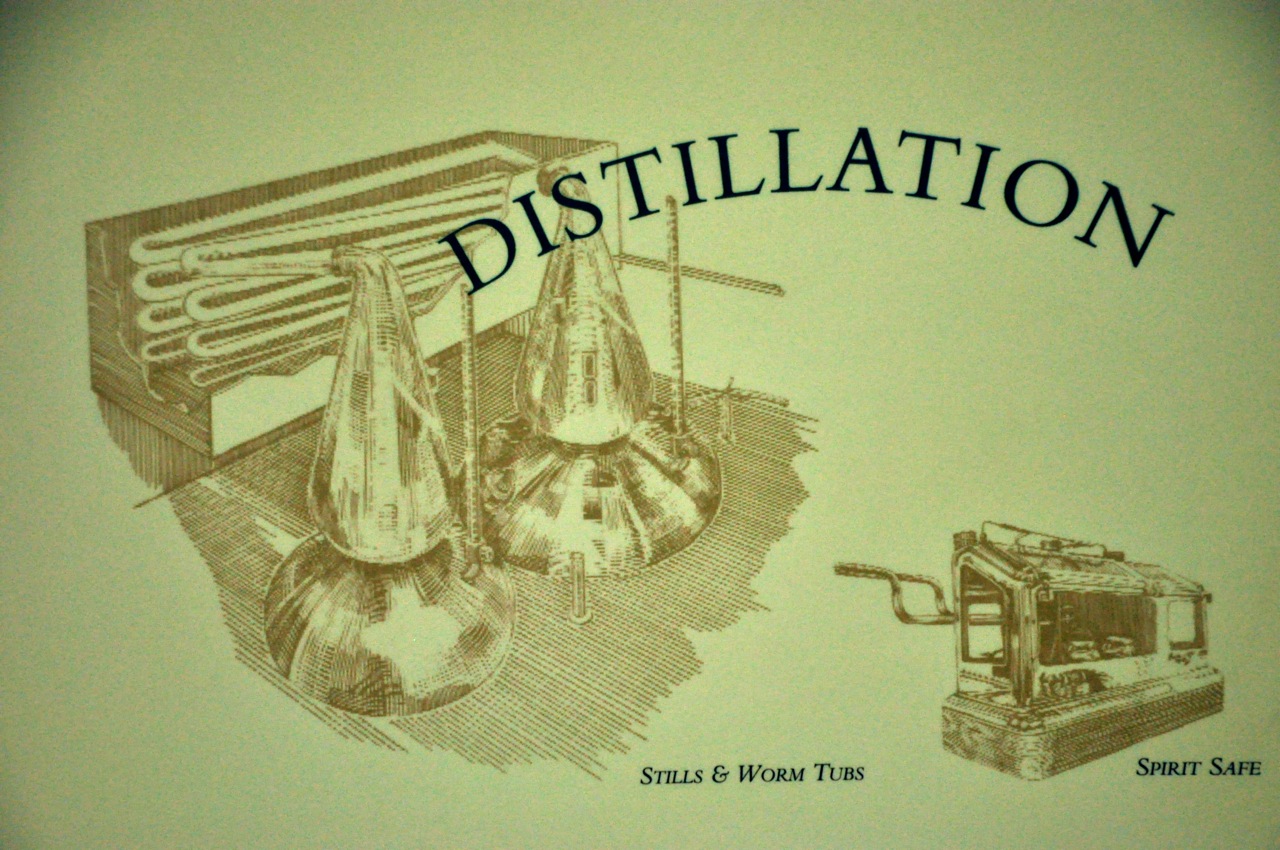
OK!  Time for the whiskey tour!  The Oban distillery is a Yep, it's old!block off the harbor in the middle of town, which is very unusual; most distilleries are off in the country.  In this case, Oban itself grew up around the 200-year old distillery.  That’s a small problem for the distillery – it can’t easily expand!  The Oban Whiskey Distillery produces a West Highland malt scotch.  In the map of Scotland below, different colors denote regions of Scotland making distinctive flavors of Scotch – there Regions of distinctive Scotch single malt whiskeysare about 5 of them.  Oban is near the middle of the various flavor profiles, with a touch of peat, a touch of salt, and a touch of honey in taste.  They make 4,000 gallons of Scotch a week (a lot of which goes to the US).  The process for making a single malt Scotch is pretty much the same throughout Scotland, and quite interesting!  Single malt Scotch is made from barley, water and yeast.  Sometimes peat smoke.  That’s it.  The diversity of flavors comes from the locally sourced ingredients, the skill of the master distiller, and subtleties in the production process.  All true, but the real revelation to me was that the real flavor of Scotch whiskey comes from America!  Fascinating!  Don’t tell a Scotsman that, but you’ll see.  Alas, most distilleries seem to think they have secrets, and photos are not allowed!  So I’ll just give an overview of the process.  Water is added to the barley to start germination (starch release), and then the barley is dried by heating in a kiln (in some distilleries, with smoking peat).  This is “malting”.  The malted grain is milled to a defined mix of powder-to-piece, hot water is added in a big stainless steel (or wood) vat, and the starch is converted to sugar (the wort), a process called “mashing”.  The wort is cooled, yeast is added, and fermentation occurs for 2-4 days (the time has a big effect on flavor), producing the “wash” – approximating a strong beer.  The "Candy Kiss" shape of the copper stillsThe wash is then distilled in two sequential copper stills that look like those on the left side of this picture – they look something like Hershey Kisses, only about 15 or 20 feet high.  The size and shape of the stills have a big effect on taste due to the liquid interacting with copper – the more the interaction, the lighter the Scotch (the liquid extracts copper).  The final distillation “cut” is about 68% alcohol, and goes to oak barrels to age – a minimum of 3 years to call it “Scotch”, but usually for a decade or more.  And this is where America comes in!  Those oak barrels remove harsher tastes and add flavors; and where do those oak barrels and flavors come from?  Why, 1-year-old used American bourbon barrels!  By (American) law our bourbon has to go into new oak barrels, so what to do with those used bourbon barrels?  The Scots buy them, knock them down, ship ’em to Scotland, rebuild the barrels, and add their Scotch to take on those yummy tastes!

Finally, our visit to a ceilidh.  This is the tail end of the tourist season, and we’re at the last show of the year, with just one other small group in attendance.  It’s probably a tailored-down show, but fun nonetheless!  After the band (2 people) plays Highland tunes, a singer sings Highland songs, and a young lady does very graceful, ballet-like

Highland dances, the audience gets to participate – both in song and in something like a line dance.  Some in the audience seem to know the steps; we do not.  The brief instruction was a little helpful, and the ensuing chaos was a lot of fun.  Although it seemed touristy, apparently people in Scotland grow up doing the ceilidh, and locals enjoy going.

Next stop – the Highlands II, Glencoe Valley.


Stirling Castle

“He who holds Stirling, holds Scotland”.  The quote refers to Stirling Castle, which was the center of Scottish history for centuries.  The castle was all but impregnable, surrounded on 3 sides by nearly vertical rock cliffs with sweeping “I can see forever” views.  The castle’s importance, however, was due to those sweeping views overlooking a bridge over the River Forth, the primary passage between the Lowlands and Highlands.  Due to its strategic location and  invincible fortifications, it was both a focus for conquest and a safe refuge for royalty.  So much history occurred around this castle that I would be remiss not to mention some.  I promise a rather quick sketch.  In depth, the history reads like a trashy novel – victories, banishment, plotted returns, intrigues, murder, assassinations, a son waging war (and killing) a father, imprisonments, escapes, revolts, beheadings ….  The kings led interesting, if short, lives.  We won’t go there (much), though – just a bit of history of the castle.  This will be a long post, so feel free to skip to the pictures that follow!  However, I think the history provides very useful context.

Stirling Castle’s written history began in 843, when an historian noted that Kenneth MacAlpin, the first King of Scotland, besieged Stirling Castle during his successful fight to unite the Picts and Scots into the kingdom now known as Scotland.  At some point it became the home of Scottish royalty; in 1110 King Alexander I dedicated a royal chapel there, and his successor King David I made Stirling itself a royal city.  Skirmishes with England became common, and Stirling Castle was the football.  In 1174 the Scottish King William I invaded England but was captured at Alnwick (Alnwick Castle, February 14, 2015); to gain his freedom he ceded Stirling Castle to English King Henry II.  In 1189 he got it back when English King Richard I came to the throne.  Then came the Wars of Scottish Independence, which lasted for 60 years.  The outline below shows how the war centered around Stirling Castle.  Notice how the castle ping-pongs between the two countries!!

1296 – Stirling Castle was captured by English King Edward I.
1297 – The Scot William Wallace (a.k.a. Braveheart) defeated a superior English force at the Battle of Stirling Bridge (within sight of Stirling Castle) and later that year took back the castle following a siege.
1298 – William Wallace was defeated at the Battle of Falkirk, and the English reclaimed Stirling Castle.
1299 – The English surrendered the castle to the Scots following a siege.
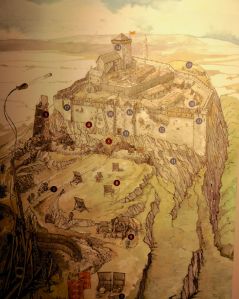
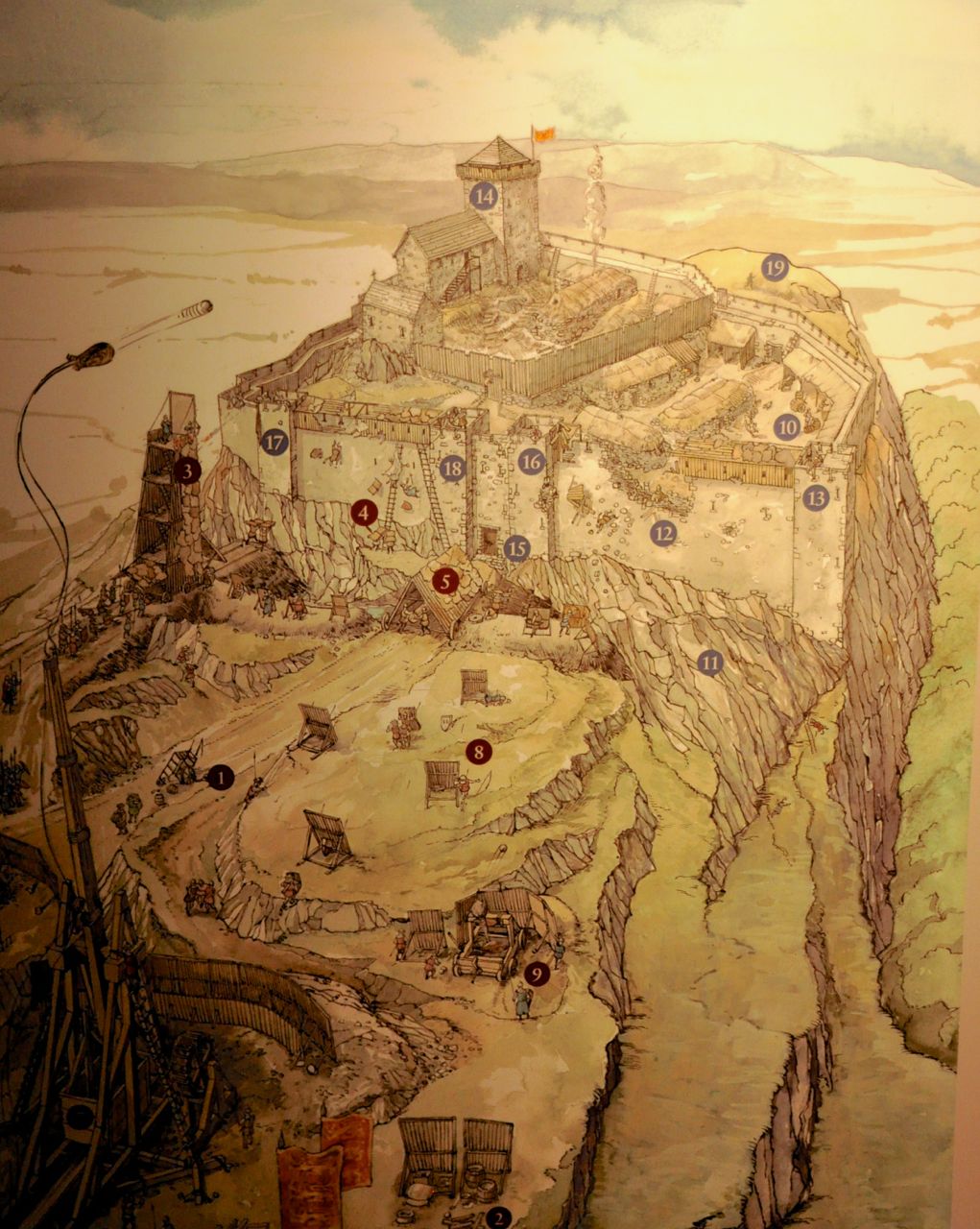
Drawing of the siege1304 – English King Edward I waged war on Scotland for years; Stirling Castle was the last stronghold; it was besieged and bombarded by 17 siege engines for 4 months.  When a massive trebuchet was built (“War Wolf”) capable of hurling missiles weighing 300 lbs, the Scots surrendered and the English controlled it for 10 years.
1314 – King of Scotland Robert the Bruce (Robert I) retook the castle by beating the 3X larger English army of Edward II at the Battle of Bannockburn just outside the Stirling Castle walls.
1336 – Stirling Castle was captured by the English
1337 – A siege of Stirling Castle by the Scots was unsuccessful
1342 – The future Scottish King Robert Stewart (Robert II) retook Stirling Castle in a successful siege.  The castle remained Scottish until the end of the war in 1357.

Two of those battles, the victories of the plucky Scots under William Wallace in 1297 and Robert the Bruce in 1314, both against huge odds, remain a source of fierce pride in a Scotland that still questions its English union.

Before visiting the castle, a little more history (but 400 years worth!) is worthwhile.  The Stewart kings Robert II and III made Stirling Castle their primary residence.  It’s from Robert II’s time that the earliest surviving parts of the castle were built – the foundations of the North Gate, built in the 1380’s.  King James I ascended the throne (then was caught and imprisoned by the English, saw a beautiful lady from his tower prison, wrote a poem about her [The King’s Quair] that we all read in high school, married her [cousin to English King Henry IV], and was released), but was assassinated in 1437, whereupon his queen smuggled son James II into Stirling Castle for safekeeping.  James III was born in Stirling Castle and favored it as his “most pleasant residence” (he was killed in a revolt led by his son James IV).  During the reign of James IV and V, 1490 – 1560 (and beyond), the city entered its golden age; Stirling became the principal royal center.  Almost all the present buildings in the castle were constructed, in grand style, turning the castle into the showpiece of Scotland (i.e., one-upmanship over England).  With James IV’s death, James V was crowned in the royal chapel of Stirling Castle (at age 17 months).  He married the French noblewoman Mary of Guise and had a daughter Mary Queen of Scots.  When James V died, Mary of Guise became Regent of Scotland; with nobles scrambling for power, she brought her daughter Mary to Stirling Castle for safekeeping behind strong walls (she came with 2,500 cavalry, 1,000 infantry, and a baggage train a mile long).  Mary Queen of Scots was crowned (as an infant) in Stirling Castle and spent her early years there, subsequently going to France.  In the face of threats from England, French troops were brought in and the outer defenses of Stirling Castle were built.  Mary Queen of Scots returned to Stirling Castle, wed, and had a son there, James VI (responsible for the King James version of the Bible) in 1567.  The Catholic Mary’s estranged husband was mysteriously murdered, she remarried, there was an uprising, and she was abducted to England and held captive by Queen Elizabeth I.  With various factions plotting for power, Mary was forced to abdicate to James VI, who was crowned king at age 9 months, raised in the safety of Stirling Castle as Protestant, and turned against his Catholic mother.  Stirling Castle became the base for James supporters, Edinburgh for Mary’s.  Attacks were made against Stirling Castle, but failed.  Mary was eventually executed by Queen Elizabeth I.  When Queen Elizabeth died without an heir in 1603, King James VI of Scotland became King James I of a united Scotland and England.  He left for London, returning to Scotland only once, briefly, after 14 years.  With his absence, Stirling’s role as a royal residence declined, and Stirling Castle became principally a military center and a prison.  When James VI died in 1625, the son Charles I inherited a kingdom divided by religion and throne pretenders.  His efforts to impose English liturgy on Scotland led to war – and his beheading, with Scotland choosing son Charles II as their king, who lived in Sterling Castle in 1640, while England got Oliver Cromwell, who turned England into a Republic.  Charles II marched against Cromwell and was defeated; Cromwell’s forces successfully besieged Stirling Castle in 1651, inflicting still-visible shot marks within the Castle.  Charles II fled, but returned as King of England and Scotland a decade later when Cromwell died and the English monarchy was restored.  Religious tension grew, and Charles’ attempted to introduce religious freedom for Catholics was unsuccessful.  When Charles II died and his Catholic brother James VII (English James II) not only ascended the throne but subsequently produced a Catholic heir, war broke out; James, the last Catholic King of England and Scotland, was forced to flee in 1688 and Protestants (William and Mary) assumed the throne.  James continued to claim the thrones of England and Scotland from exile in France and encouraged revolts in his name (Jacobite Rebellions). His grandson the Bonnie Prince Charlie led an ultimately unsuccessful uprising in 1745; the Bonnie Prince bypassed Stirling and captured Edinburgh, but returning to Stirling in 1746 he was unable to capture Stirling Castle.  This was the last time that Stirling Castle was besieged.  The Bonnie Prince’s subsequent defeat ended any chance of Catholicism becoming re-established in England.

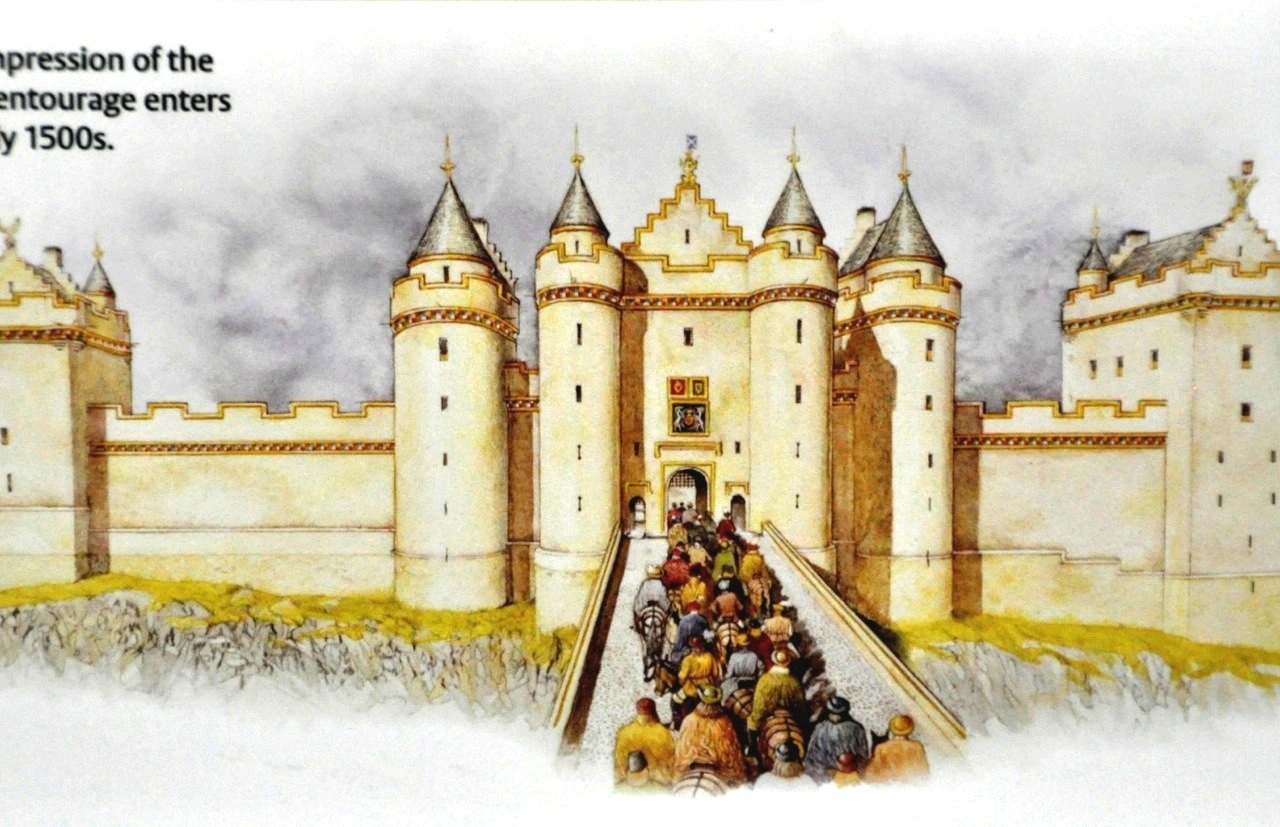
Wow!  A lot of history swirled around this castle.  Let’s take a look at it (finally, eh?).  This Depiction of Stirling Castle entrance, 1500picture is an artist’s impression of the grand entrance to James IV castle, based on a detail from a Scottish map done in the late 1500’s; the gate was among the most magnificent in the UK.  When it was constructed, it both strengthened the castle’s defenses and projected the greatness of James himself.  The gate was probably reached by wooden bridge over a moat.  This original gate was higher than the current one; it had 5-story towers capped with conical roofs, and was probably coated in gold limewash, with carved details painted and gilded.

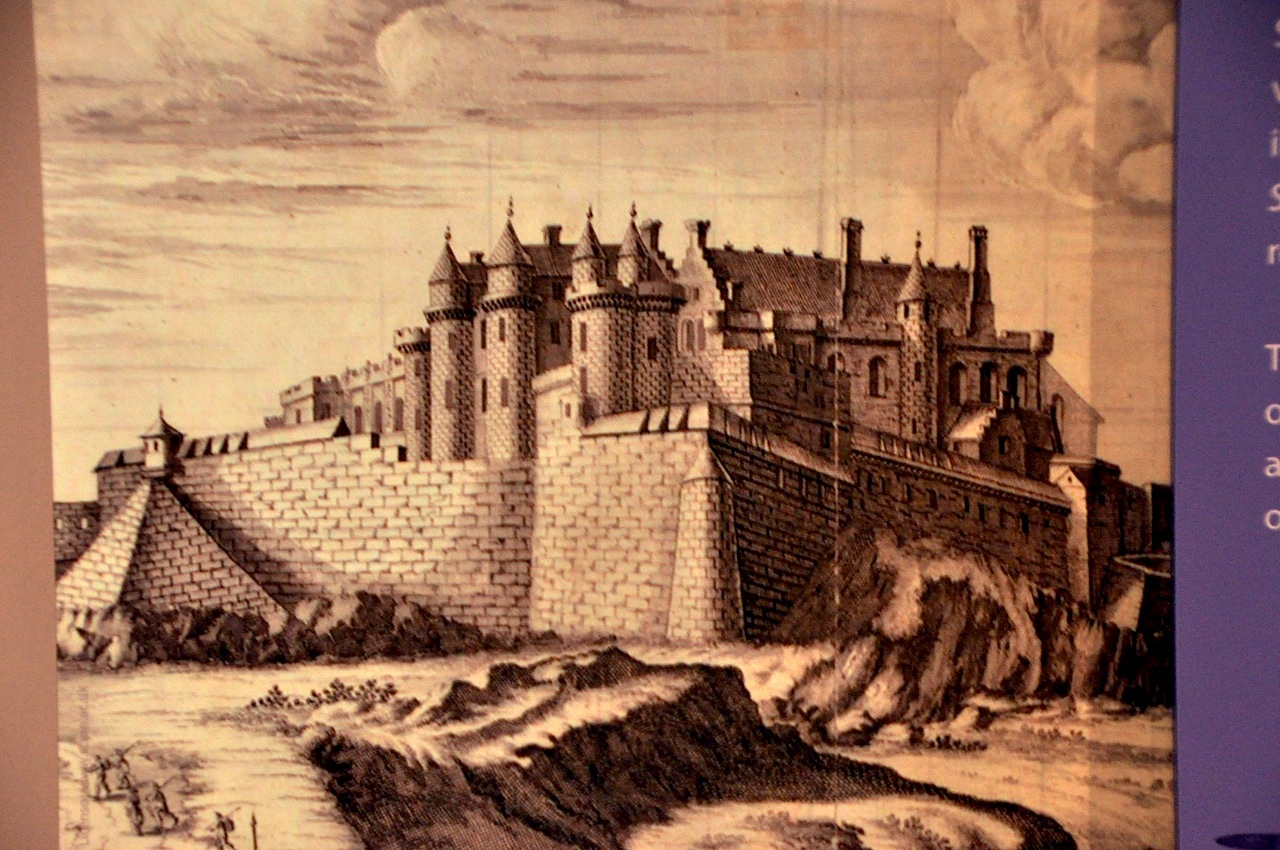
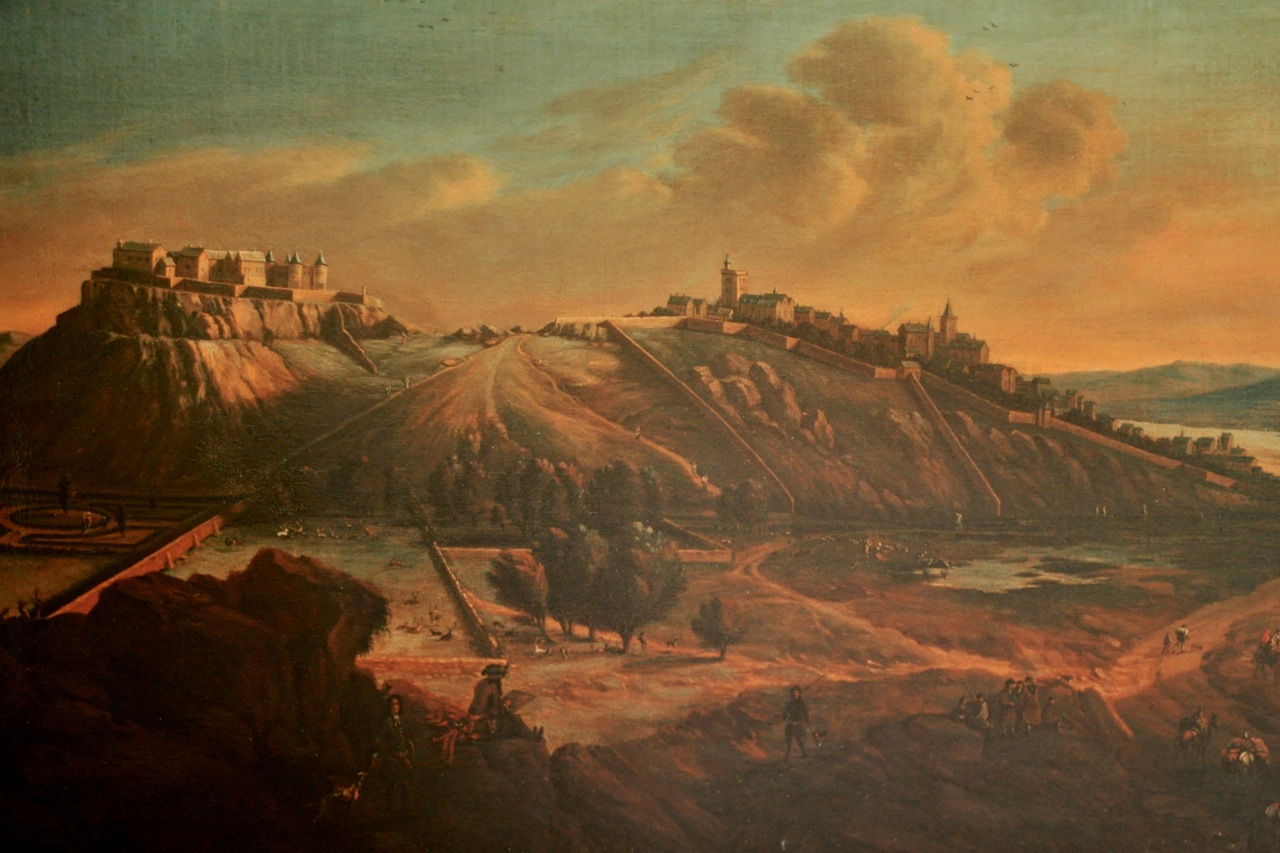
Drawing of Stirling Castle, 1671The first detailed drawing of Stirling Castle comes courtesy of a military engineer in 1671, although the view is not from the gate.

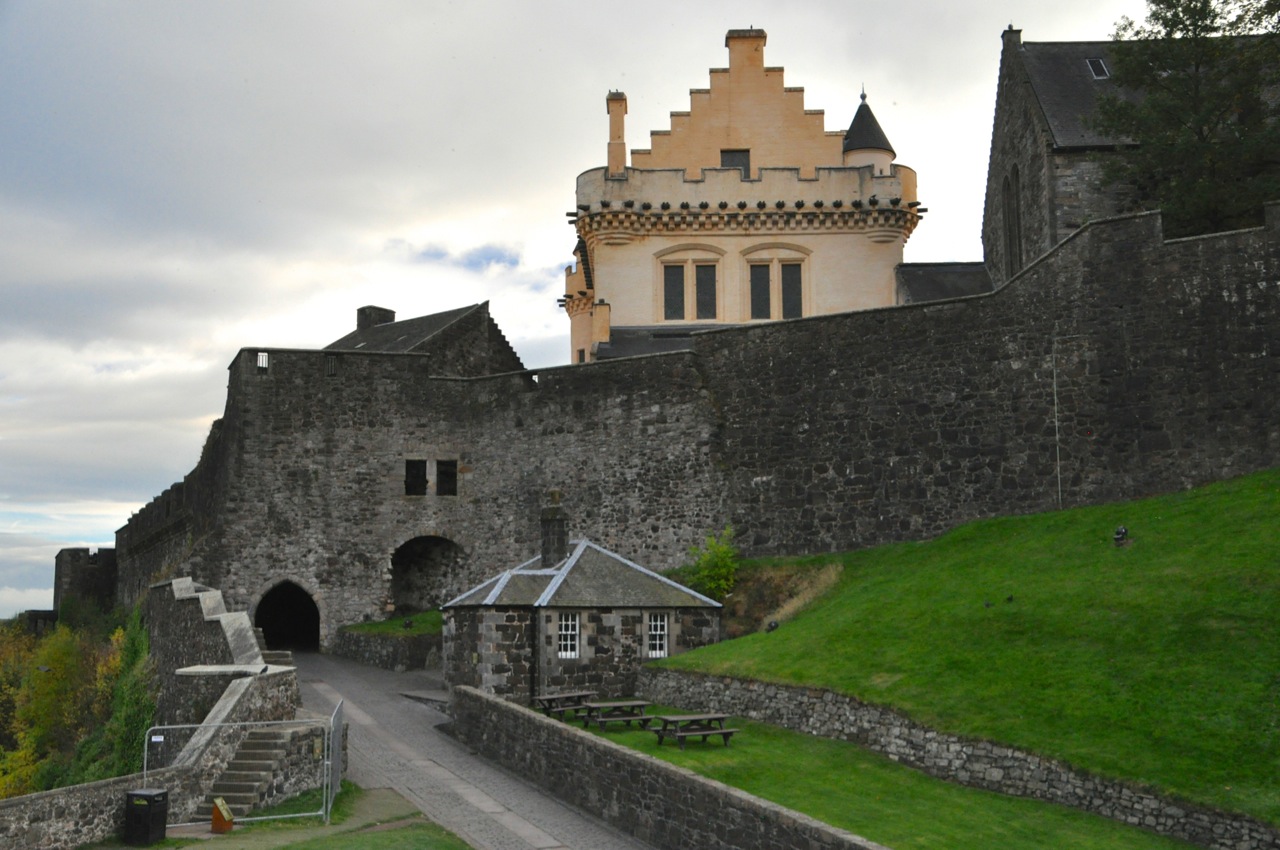
Today the entrance to the castle – the old castle interior – looks like the illustration shown just below, with the buildings built by James IV and Entrance to the Stirling Castle royal buildingsV peeking above the wall.  Comparing this picture with that from the 1500’s above, the current gate is clearly less grand and more military-looking, reflecting its changed role after the departure of James VI (and the impact of siege bombardments!).
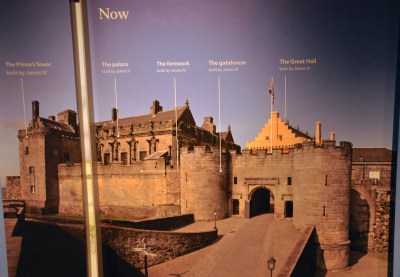
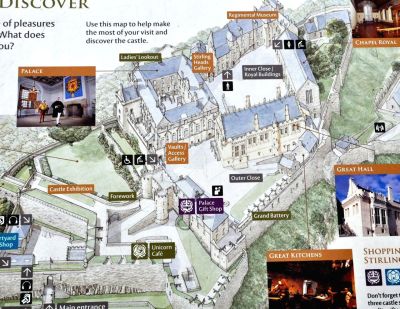
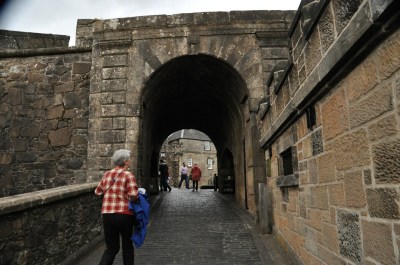
The main entrance to Stirling Castle now takes you into the Map of Stirling Castleextensive outer defenses, built by Protestant Queen Anne (daughter of deposed Catholic James VII) in 1708 after her half-brother contested the crown.  This map of the Stirling Castle fortress shown on the left is a good overview.  The original entrance to the castle, now called the “Forework”, is just below the center of the picture.  The current entrance to the outer defenses is at the bottom left.  That entrance is shown in the pictures below.  The entrance takes you to a
courtyard holding pen, with another gate that takes you to the front of the original castle, shown below.  Entrance to the original front of Stirling CastleTurning left after going through that second entrance (the map of Stirling Castle, above, provides a useful overview), one comes to a formal garden/green called the Queen Anne Garden, shown below, although it was already there in the 1400’s for the royal family to enjoy.  You can begin
to see the amazing vista that the castle provides, so let’s take a look around.  It’s

impressive, and many of the important battles of Scotland would have been visible from here.  You will also note, from the map of the Stirling Castle above, that there are a number of cannon that look out over this vista; those cannon were instrumental in blowing up siege towers in later years.
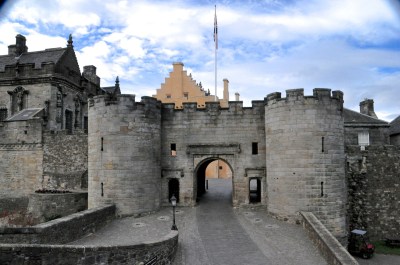
The original entrance to Stirling Castle, much changedOK, in we go through what used to be the grand entrance to the castle.  It definitely looks more military than grand!  The entrance takes us into the “Outer Close” – and mostly to a view of the back ends of the major buildings, the royal palace and the great hall, as well as going downhill to the “Great Kitchens” of the palace.

The Outer Close also had an interesting exhibit on the food of the late 1400’s – as you might imagine, it’s not too different from today.

The Inner Close was the core of Stirling Castle in the 1100’s and continued to be its center (the map of Stirling Castle is again useful).  In its golden age it was surrounded by the trappings of royalty, consisting of the King’s Old Building (private apartments of James IV, 1496), the Great Hall (used for banquets and business, 1503), Royal Palace (built by James V for greater luxury and privacy, 1540), and Chapel Royal (built by James VI for the baptism of his first son, 1594).  These buildings have been restored from their military conversions.

James V built the Royal Palace in grand style, on par with the finest French chateau, in order to impress and “proclaim the peace, prosperity and justice of his reign”.  Here’s what the outside looks like today, and what it would have looked like in 1540:

James V decorated the outside of the palace with over 250 sculptures, including classic gods and goddesses, designed to promote his authority and demonstrate his right to rule.  The statues have weathered (and suffered indignities) over the centuries, but they were clearly nicely done; examples below.  The last picture shows how they would have looked back in the day.

The Great Hall of 1503 was by far the largest banqueting hall ever built in medieval Scotland. Two high windows lit the dais on which the king and queen sat.  Five enormous fireplaces provided heating.  A hammerbeam roof soared above.  It was a grand setting for

the sumptuous banquets of the Renaissance kings, and in particular the two royal baptismal celebrations for the sons of Mary Queen of Scots and James VI.  In the latter, Depiction of the presentation of the fish dish in the Great Hallthe fish dish came on a model ship 15′ long and 36′ high, with a salvo of 36 brass guns.  As you can see from the picture of the Great Hall interior, above, to us the Great Hall really just looked like a big, empty building; it needed the pomp and glitter of tables and tapestry and roaring fires (and roaring cannon) to be impressive.

The Chapel Royal, one of the first Protestant churches built in Scotland, was built for that same baptism for the son of James VI (1594).  The painted frieze in the interior survives from Charles I’s coronation visit to Scotland in 1633.

The King’s Old Building, at the castle’s highest point, was built by James IV for his private residence; the turreted staircase went to his apartment, with spectacular views.  The building has endured 500 years of alterations; the right picture is an artist’s concept of what it might have looked like in the 1500’s.

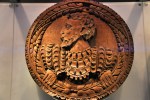
Attached to this building is the Stirling Heads Gallery housing the (fabulous) original carved portraits in oak that decorated the King’s Presence Chamber (a meeting room for honored visitors) in the Royal Palace.  The carvings were taken down following a ceiling collapse in 1777, and of a possible 100 original heads, 38 survive.  They’re beautiful – and they’re not small, about 3 feet across.  They’re divided into themes: heads of royalty (and the right to rule), “worthies” – heroes from history and myth, heads from Roman emperors, courtiers and costume, and Hercules.  We’ll share a bunch, starting off

with Royalty.  The heads below show courtiers wearing the (carefully depicted) fashionable

clothes of the 1540’s.  A few “worthies” are shown below, and Hercules below that.

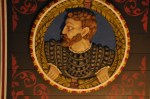
Finally, these heads were recovered with traces of paint on them.  It is thought the heads were vibrantly painted, as you’ll see in more detail when we show you their reproductions in the King’s Presence Chamber (shortly).  For now, let’s give you a flavor for what the heads really looked like!

To complete our visit to the Inner Close, we’ll tour the Royal Palace apartments.  To mark the arrival of his (2nd) French wife, Mary of Guise, James V built the Royal Palace to be as fine a residence as Mary would have known in the richer kingdom of France.  Both interior and the exterior were painted in bright colors with plenty of gilding to overwhelm with flamboyance.  The 6 rooms open to the public are the king’s and queen’s apartments.  Each had three spacious rooms – in ascending order of privacy: an Outer Hall‚ an Inner Hall and a Bedchamber.  Access to these rooms was restricted according to the importance of the visitor.  The rooms were on The King's Outer Hallthe same floor, arranged around a courtyard known as the Lion’s Den, and were used for a variety of purposes – taking meals, greeting important visitors, meetings on affairs of state, and dancing and entertainment.  The bedchambers were rarely used for sleeping; the king and queen slept in small private chambers known as closets.
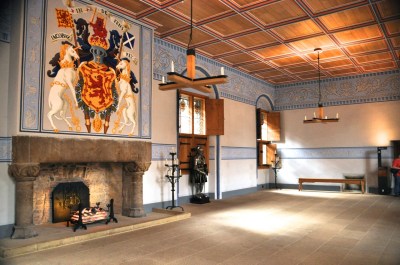
We’ll start with the King’s Outer Hall, shown above.  With sufficient social standing, you would be admitted to this hall to wait for a possible audience with the king.  It was a great honor to be admitted to the King’s Inner Hall, or “Presence Chamber”, shown below.
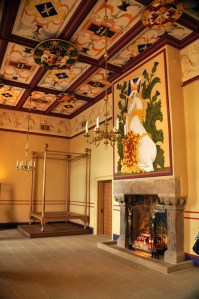
The King's Outer HallYou only made it to the King’s Bedchamber (left picture) if you were really important, or a personal friend.  The king probably dressed, washed and prayed here.

The Queen’s Outer Hall (below) was also a waiting room, Queen's Outer Hall
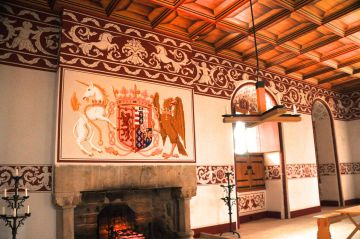


and it was a similar honor to be invited to her Inner Hall, shown below.

The low stools in the first picture were for the Queen’s ladies in waiting.  The ceiling may also have been covered in carved heads.  Finally there is the Queen’s bedchamber, reserved The Queen's Bedchamberfor the queen and her most important visitors.  The bed was symbolic; she slept in a small room nearby.

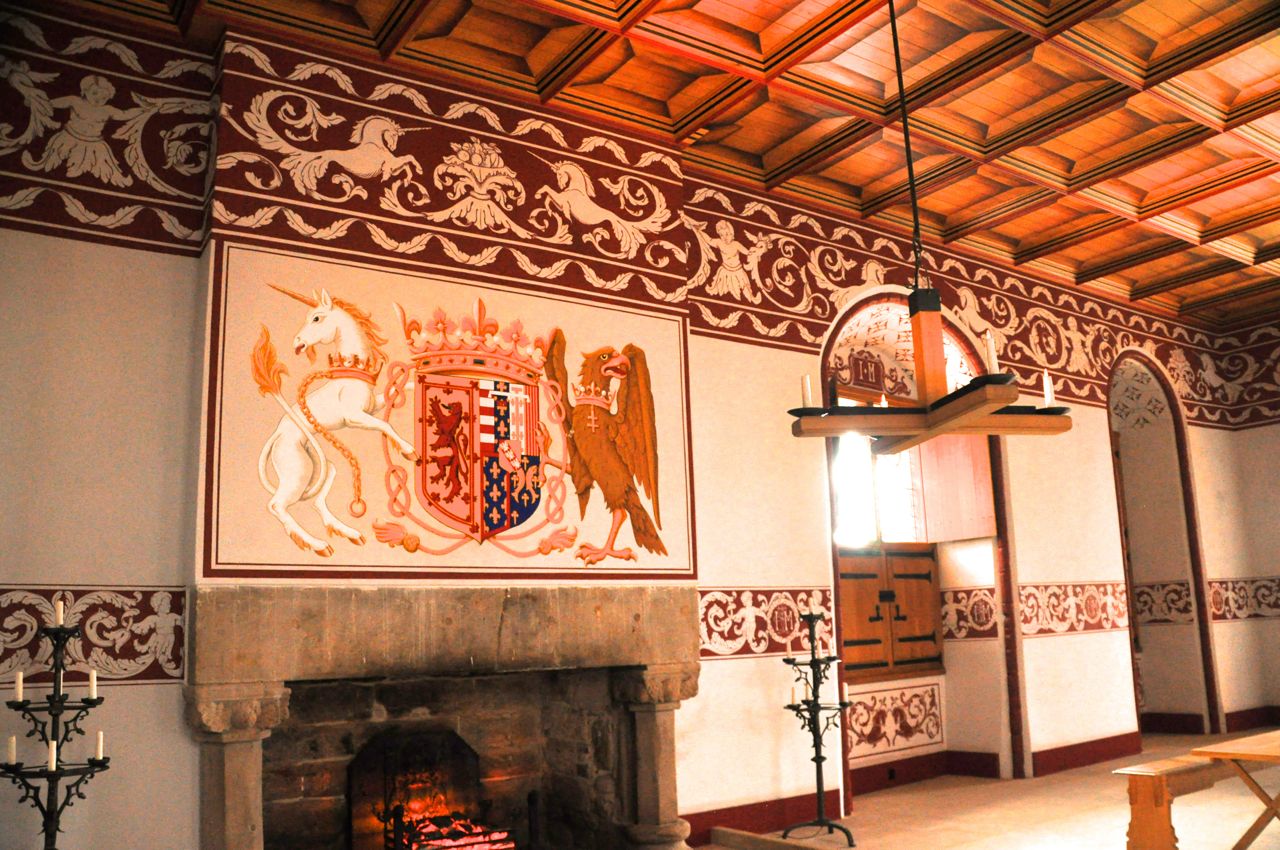
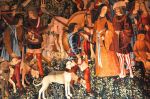
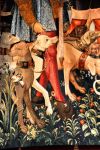
Perhaps you noticed the tapestries in the Queen’s Inner Hall?  Like the one over the fireplace, above?  They’re gorgeous and vivid!  Tapestries were extremely expensive and were prized by the wealthy elites of the European Renaissance.  It is known that James V had two sets of tapestries featuring unicorns, and historians of James IV believe the royal collection included tapestries similar to the famous The Hunt of the Unicorn series from 1500.  Accordingly, to furnish the Queen’s Inner Hall as it would have looked in the 1500’s, Stirling Castle is re-creating the 7 tapestries that constitute The Hunt of the Unicorn using traditional hand-weaving techniques, the weaving being done at the castle.  Six of them are on the walls now, but before we show some of them to you, we need to show you how the 7th one is being (painstakingly!) made.

Getting to where the tapestry is being weaved takes us to the North Gate, the oldest part of the castle.  The road there provides a nice overview of the surrounding land as well as the

ancillary buildings of the castle (site of the weaving).  The gate itself does indeed look old;

it was part of a gatehouse built in 1381.  Looking back at the North Gate, below, it is not known how the upper Looking back at the North Gatepart originally looked; the upper regions were leveled in 1511 to provide kitchens for the Great Hall.

Walking into the tapestry weaving room, we were unprepared for the scale of the enterprise.  The tapestries are fabulous on the wall, but we didn’t think about the intricacies of their creation.  It was fascinating, and we hope you’re impressed by the pictures below.  There was only one weaver when we were there, but several are involved.  They wear noise-cancelling headphones, and you are not allowed to distract them.  A separate person is available to answer questions (and enforce the rules).

Now that you’ve seen the scale, back to the Queen’s Inner Hall and the finished tapestries!  The tapestry below is one of our all-time favorites that we’ve seen in books, and it was a delight to see it in real life – a copy for sure, but a copy that probably can not be surpassed.

Another one; we love the detail – look, for instance, at the waves in the water.

We’ll do one more.

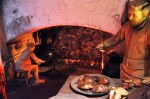
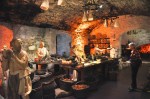
Layout of the Great KitchensFinally we’ll tour the castle kitchen.  As shown in this schematic, it was divided into a cooking area, a prep area, and a baking area.  Almost all the kitchen staff were male, while women worked as “hen wives” or “alewives”.  Brewing ale (from barley) was usually the work of women, done within the castle, and ale was consumed with every meal – even by children, as it was safer to drink than water or milk.  It was also highly nutritious and an important part of the medieval diet.  Much of it had a low alcohol level.  A servant working for the royal family was given a daily allowance of about 2 quarts.

The pictures below show the kitchen in order, moving from the cooking area to the bread

ovens.  Those of the upper crust of Stirling Castle – and their servants – enjoyed fine white bread from wheat flour, sieved through woolen and linen cloth to remove the bran.  Most people had coarser flour from rye or barley, with darker and heavier loaves.

There was a decided (social) food train.  The king and queen were served all of the food first, the extra then passed on, in order, to the courtiers, various officials, their personal servants, and finally those who served the food to the tables.  The same system applied among the other servants.

Yep.  I know.  This was a loooong post, but Stirling Castle had a lot of meat on its bones!  The next posts will be (gorgeous) scenery, not history, so you get a break!  We’re off to the Highlands, to Oban on Scotland’s west coast.


The City of Stirling, home of Stirling Castle

Stirling Castle and the city of StirlingStirling Stirling – and Stirling Castle in particular – practically IS Scottish history.  Located at the farthest downstream crossing of the River Forth, Stirling was the gateway between the Highlands and the Lowlands.  Guarded by the impregnable Stirling Castle, its strategic importance brought it traffic, wealth, … and invaders.  It became the Scottish capital and the royal stronghold of kings, and the city prospered.
Although Stirling the city has always been secondary to its Castle, it’s a quaint city with a fair amount of its own attractions.  To show you both the city and its Castle in one post would be too much; we’ll do the city first.

Let’s start with our hotel, which is impressive enough!  We’re within walking distance of

the castle, which puts us on a long, narrow, steep hill.  Which is a good description for all of Stirling.  There are not many Tudor-style buildings here; houses are mostly stone or

brick, and many look old.  Some really are, but let’s start with some ruins – Mar’s Wark.  Stirling has quite a history going back to the 1100’s, but it’s glory days were the 1500’s – 1600’s with the royal Stewart court (we’ll cover history in the next post on Stirling Castle).  James Erskine, Earl of Mar, became keeper of Stirling Castle and regent to King James VI.  To proclaim his status, in 1567 he built a grand, richly decorated mansion on the processional route up to the castle, including the display of the royal arms above the door.

150 years later the mansion was damaged by cannon fire during the (unsuccessful) Jacobite Rising led by the Bonnie Prince Charles, and the building was abandoned.

A very interesting non-ruin is the Argyll’s Lodging, Scotland’s finest example of a Renaissance town house.  Originally built in the 1500’s, this was a small and modest house but had the virtue of being near Stirling Castle.  Location, location, location.  Noblemen wanted to live near power, and in the 1630’s the 1st Earl of Stirling bought and rebuilt it into a fortified mansion grand enough to entertain royalty.  After our Earl died in 1640,

plans were made to convert the mansion into a poor house, but in 1666 it was bought by the 9th Earl of Argyll, who remodeled the house in the 1670’s.  Unfortunately our new Earl was beheaded for treason in 1685 (didn’t choose sides well), but the house remained in the family ownership for more than a century.  It subsequently became a military hospital and a youth hostel, but was renovated by Historic Scotland back to its time in the 1680’s.  As shown below, it’s impressive.

From the (protected) courtyard, the building still has its grand facade, complete with

original covered entrance bearing its date of 1632.  Every window or door is adorned with

fancy stonework.  The entrance leads to a large room where business would have been conducted.  Also on this first floor were two kitchens; one dates from the mid 1500’s and

was converted to a bake house after the new kitchen was built in the late 1500’s – the new kitchen complete with slop basin to the outside and a recess where salt was stored to keep it from becoming damp (this is drizzly Scotland, remember).

Upstairs was the most important public room of the house, the High Dining Room, where the Earl and Countess entertained their guests.  The entrance door is pretty cool, and we

thought the room itself was beautiful, simple and functional.  The painted decoration on

the entrance wall is original, from 1675 (!), and is recreated on the other walls.  The storage space in the room we thought was amazing.  The entire entrance wall is storage (first picture above), and extra (folding) tables are unobtrusively stored in alcoves along

the walls.  Very clever!  The room’s fireplace is from 1630 and was once richly painted.

The High Dining Room opened to one of three rooms that made up the state apartment from the 1630’s.  The first was the Drawing Room, which was the private living room.  The

fireplace still shows traces of the painted arms of the 1st Earl of Stirling.

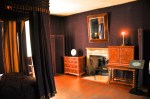
The High Dining Room opens to the Bed Chamber, which also could be accessed via a spiral staircase.  This is a sumptuous room!  The fabric that you see would have been

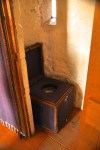
extremely expensive in these times; the great canopied bed was likely the most expensive item of furniture in the house.  Notice the en suite bathroom with boxed chamber pot and lid.  Pretty fancy, huh!

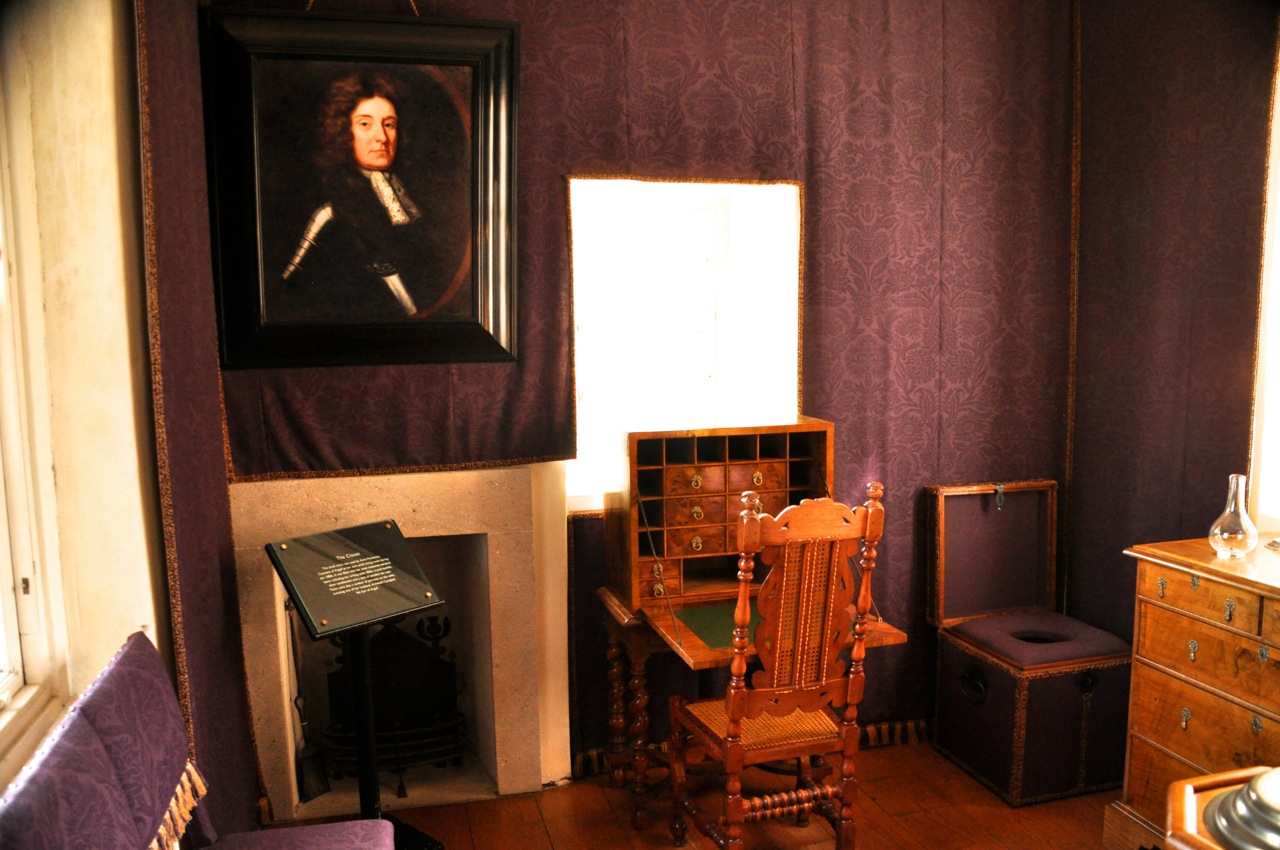
The Countess' Closet (sitting room)The so-called Closet is a small room used by the Countess as her own small sitting room.  It was filled with her most treasured personal items, including her writing table, Bible, crystal bottles, silver candlesticks, a case of wooden tea cups, and (of course) a portrait of her ill-fated husband, the 9th Earl of Argyll.

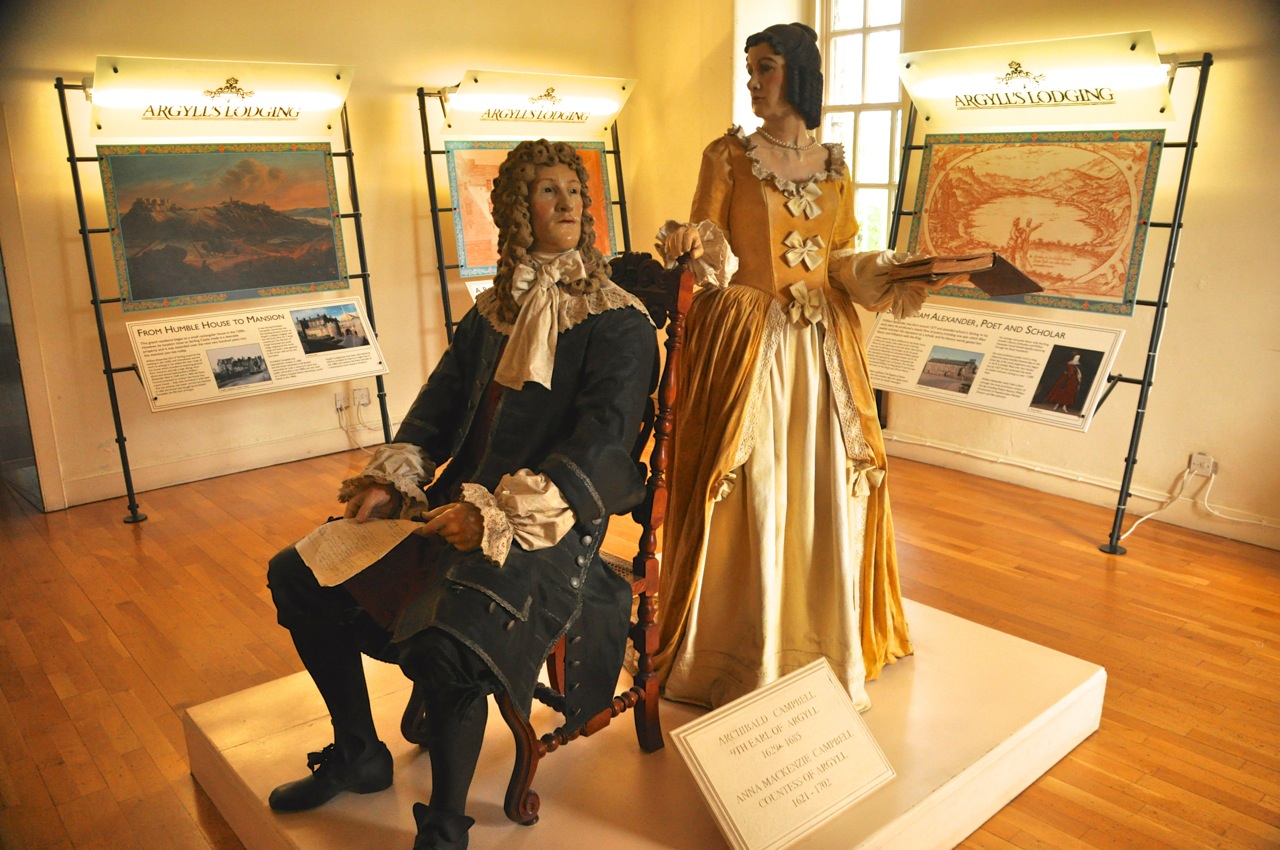
Archibald Campbell, 9th Earl of Argyll, and Anna Mackenzie Campbell, Countess of ArgyllWe’ll leave Argyll’s Lodging with a picture of the 9th Earl and his Countess, in the dress of their times.

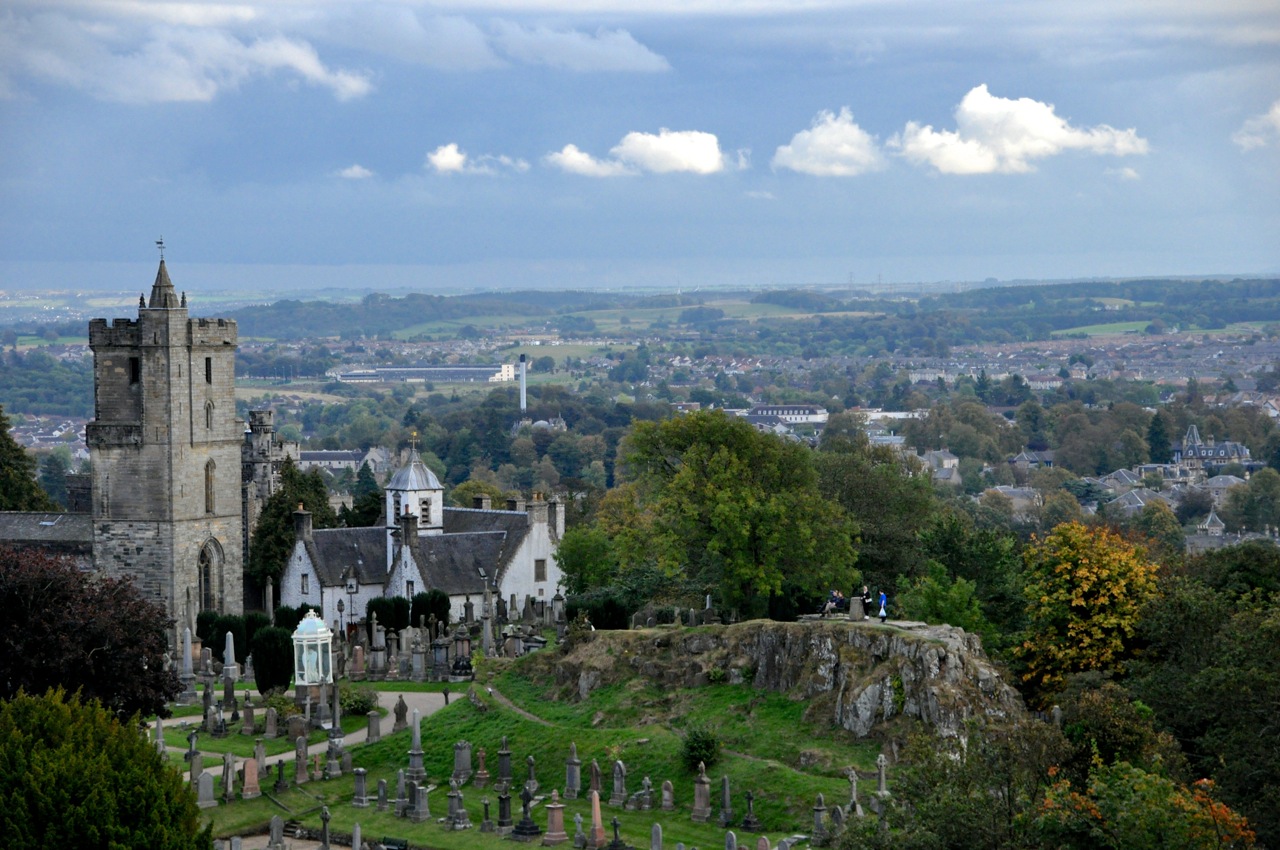
The last area we’ll visit is the Church of the Holy Rude (and adjacent hospital).  This is the medieval parish church of Stirling; “rude” is a medieval word for the cross of the Crucifixion.

The Church of the Holy Rude is the oldest building in Stirling, after the Castle.  Mary Queen of Scots worshiped here, the famous preacher John Knox preached here (we’ll visit him in a future post), royal baptisms occurred here, and the infant King James VI (later James I of England) was crowned here, making this church and Westminster Abbey (London) the only still-in-use churches to witness a coronation.

The first church on this site was built in 1129 but destroyed by fire in 1406.  The nave,

south aisle and tower of a new church were completed about 1414, and they’re still here, with rounded Scots pillars, Gothic arches and original timbered roof.  A choir was added in the early 1500’s, and the transepts were extended in the early 1900’s.  The interior is

wonderful – massive and graceful at the same time.  The medieval roof is convincingly medieval.

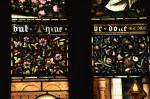
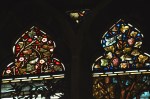
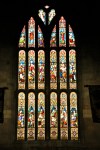
The church contains some fabulous stained glass windows, mainly from the late 1800’s.  We’ll show you a window with some close-ups.

Impressive, yes?  How about these:

In that 2nd picture above, Christ’s body (returning from the grave) is transparent!  Cool touch, eh?  We’ll share a few more snippets.

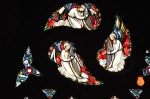
OK, one last window – a small one, leaf-shaped, above the tall arch.  It’s easy to miss.  This window was inserted in 1868, designed to be an encouragement to see the angel in every

person and situation.  Amen to that!!  A last tidbit of history about this old church.  As you might imagine, it had a number of interesting pastors over the centuries; in 1800 it had the Rev. John Russell, 60 years of age and a “hell-fire preacher”.  Scotland’s national poet Robert Burns, being a carouser and fathering many a child, was not a fan and made fun of him in poem, calling him “Black Russell” or “Rumble John”; which of course immortalized the Rev Russell.  Two quick cuts:

–  from The Holy Fair:

“Black Russell is na sparin:
His piercin words, like Highlan’ swords,
Divide the joints an’ marrow;
His talk o’ Hell, whare devils dwell,
Our vera sauls does harrow
Wi’ fright that day!”

–   from  The Kirk’s Alarm:

“Rumble John, Rumble John, mount the steps with a groan,
Cry ‘The Book is with heresy cramm’d;
Then lug out your ladle, deal brimstone like aidle, And roar every note o’ the Damn’d,
Rumble John, and roar every note o’ the Damn’d.”

The hospital adjacent to the Church of the Holy Rude is Cowane’s Hospital, built in the 1640’s as an almshouse for poor members of the merchant guild.  The building was

endowed by John Cowane, whose statue is there in the tower.  Today it’s a coffee shop/pub.

Wow!  Sorry about the long post!  Hope it was somewhat entertaining?

Next post – Stirling Castle: home of battles, refuge of kings and queens.

Melrose Abbey, Scotland (and Greenknowe Tower)

At last, we drive into Scotland!  There is nothing remarkable about the boundary.  The land, like much of England, is gently rolling and heavily farmed.  We stop at a town along our road just to explore a bit.  The houses of England are frequently gorgeous to an American’s eyes, often stone or Tudor and frequently delightfully charming, but this town

also has some kind of a mansion – which, I might add, is actually pretty common here in the UK.  For some reason no one rushes out from the manse to invite us in, so we travel on.

Greenknowe TowerWe encounter, unanticipated, this roofless ruin just off the road and decide to investigate.  There’s nobody here but us and an historical sign to tell us what we’re seeing.  It’s a “tower house”, apparently common in medieval Scotland, built by owners of small estates (a Scottish laird) as a defensible residence.  This tower, built in 1581 (the date and owner’s initials are inscribed over the door), is a later tower house, built more as a residence than for defense.  Many castles here have been modified and re-purposed over the ages, but this tower house has not seen much change!  We think it’s neat to see what a “real McCoy” was like.  So let’s go in!

The entrance is to a vaulted basement with a kitchen.  The fireplace is huge, with

amenities like a built-in slop drain to the outside.  Stairs lead to the hall level, with a large fireplace and 4 large windows (enlarged in the 1600’s when times were safer).  Originally

there would have been wood floors above separating the two upper stories.  A smaller stair accessed the bedrooms; there were two rooms on each floor, each room with a fireplace.

View from the windowPretty cool, isn’t it?  Life in the 1500’s, and you are there.  Large gardens used to be located nearby, as well as an “outbuilding”.  Throwing sewage out the window was apparently a city phenomenon.

The pastoral scenery continues as we travel further, along with occasional “mini-mountains”.  They’re just too big to be called hills.

Finally we arrive at the small town of Melrose, site of the ruins of the Melrose Abbey.  Like

many UK towns, it has a lot of charm.  And like many (all?) towns in the UK – Scotland in particular – there is a store here specializing in Scotch Whiskey.  One of my goals for our Scotland tour is to become knowledgeable of this local firewater.  In general, during our travels, we try to focus on learning , choosing our countries carefully.  The red wines of Spain, the beer of Belgium, the wines of New Zealand … so why do you think we’re now headed straight to Scotland?  Good planning, I say!  I do know a bit about Kentucky bourbon, but basically nothing about single malt Scotch whiskey – although I know it’s highly regarded (and can be very expensive).   So I’m off on my exploration!  Starting now!  One of the things I Taste profile map of single malt Scotch whiskeyquickly learned was the value of a “Scotch map”.  For some reason they’re hard to come by in hard copy, but right outside the Scotch store there’s a huge sign.  Laddies, I’m tellin’ ya, if you’re drinking Scotch, this graph is invaluable!  My gift to you.  And we will be visiting some of these distilleries, so stay tuned!  Sorry about all the glass reflections, couldn’t help it.

Presenting some history of the Melrose Abbey is in order, because it has a lot of history associated with it.  An earlier monastery was built nearby in the early 600’s, dedicated to St. Aidan of Lindisfarne (remember Aidan from the post “Bamburgh Castle“, Feb 23, 2015?).  St. Cuthbert grew up here and was Prior in 662 before he moved to Lindisfarne (remember him from the post “Durham and its Norman Cathedral“, Feb 6, 2015?).  That earlier monastery was sacked in 839.  Much later, King David I of Scotland decreed that a new abbey be built.  The east end was completed in 1146, in Gothic style, and the rest was finished over the next 50 years.  It had a hard life.  The abbey was destroyed by the English King Edward II in 1322 but rebuilt by King Robert the Bruce (national hero of Scotland who decisively defeated Edward II in the Battle of Bannockburn to create an independent Scotland; more on him in an upcoming Stirling Castle post!).  The rebuilt abbey was then destroyed by Richard II of England in 1385, but rebuilt again beginning at century’s end and continuing into the 1400’s.  It is the ruins of that last church that stand today.  The Melrose Abbey, internet pictureMelrose Abbey was one of Scotland’s richest and most powerful medieval abbeys, its late-14th-century architecture among the best in the UK.  Robert the Bruce asked that his heart be buried there, and a number of other Scottish kings lie there as well.  Alas, the abbey’s problems did not end; it was again damaged by English armies in 1544 and never fully repaired.  The last monk died in 1590.  Cannon fire further damaged its walls in 1650.

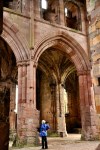
Even today the ruins are impressive.  They’re commandingly big, the massive construction

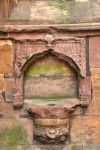
contrasting with the large but delicate, lacy windows.  There would have been a lot of statues decorating the building – the empty pedestals attest to that – but the Protestant

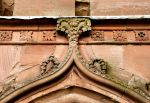
Reformation defaced even these ruins.  Nevertheless, intricate stonework is everywhere; the abbey must have been very impressive indeed.  Below are examples; badly weathered,

to be sure, but the detail can still be admired.  I also love all the little heads that show up

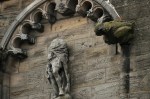
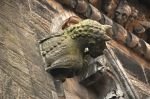
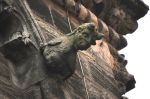
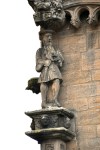
under pedestals and at arch ends.  Nicely done!  And of course the gargoyles.  The first one, in case you’re wondering, is a pig playing a bagpipe!

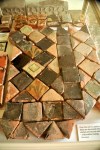
There’s a small museum associated with the abbey.  In addition to things like medieval

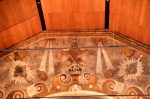
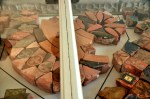
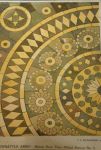
monk urinals and (sometimes) macabre arch bosses, there were some fabulous large mosaic floor tiles from the abbey, dating from the 13th century.  The floors would have been magnificent!

Communicating - or ex communicated?In spite of my most fervent prayer, I did not make the cut for Monkhood.  So back on the road again.  Next stop is the most important castle of Scotland, Stirling Castle.  There’s a lot of Scottish history associated with that castle, which I’ll touch on, but after that post the history lessons will pretty much go away.  That might make you sad, but the rest of Scotland is so amazingly spectacular that you will not care.  Promise!