Tour of the Bay of Islands

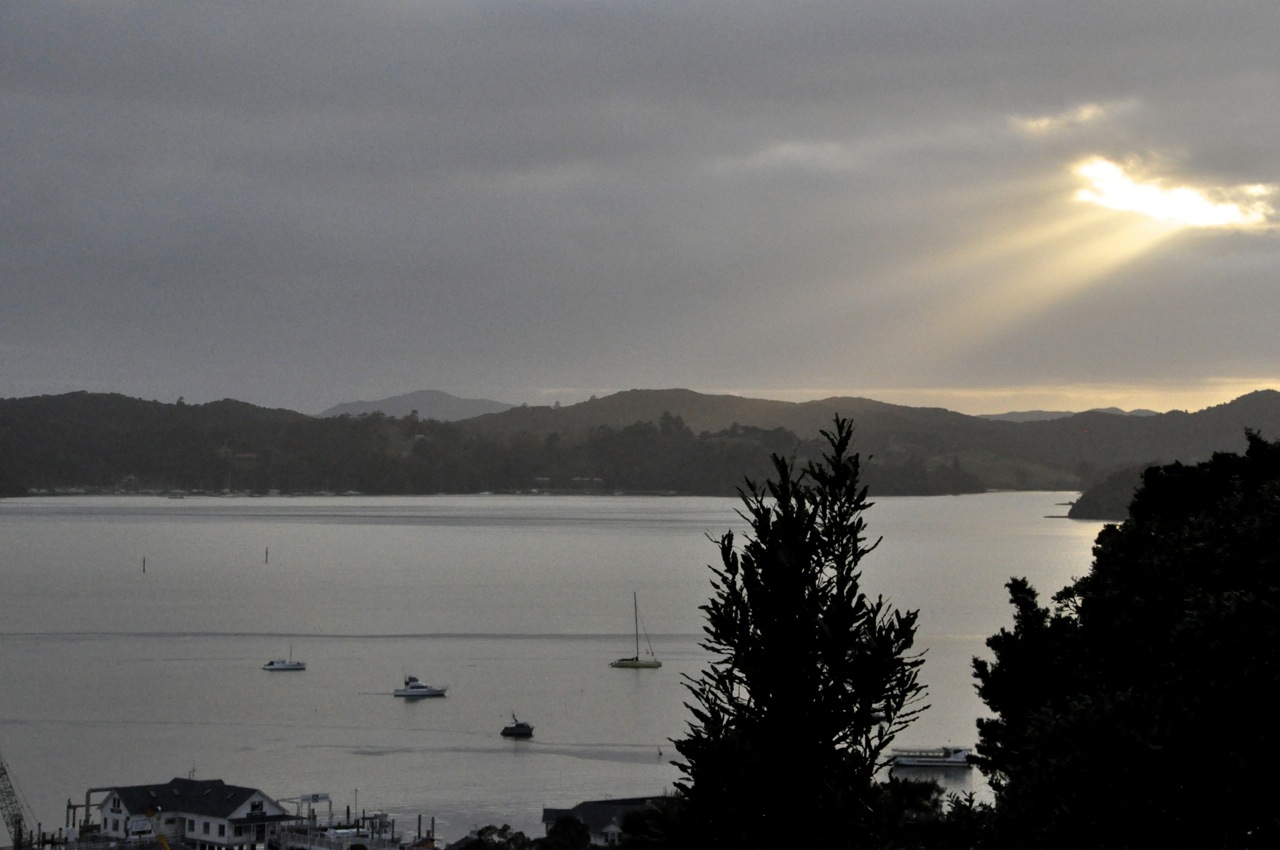
Well, ya can’t walk to the islands, you gotta take a boat.  At some expense, I might add.  We did the 4 hour morning trip, with a chance to swim with the dolphins, which I thought could be fun.  MorningUnfortunately NZ has a lot of rules about that, things like there can’t be a young dolphin in the pod, they have to be bottlenose, the number of people in the water can’t exceed the number of dolphins, and so on.  I had my suit on but was not optimistic.  Ginger was less enthusiastic – no way was she going into that cold water with fishy things bigger than her.  As you can see, the morning was really overcast, but at least not raining.
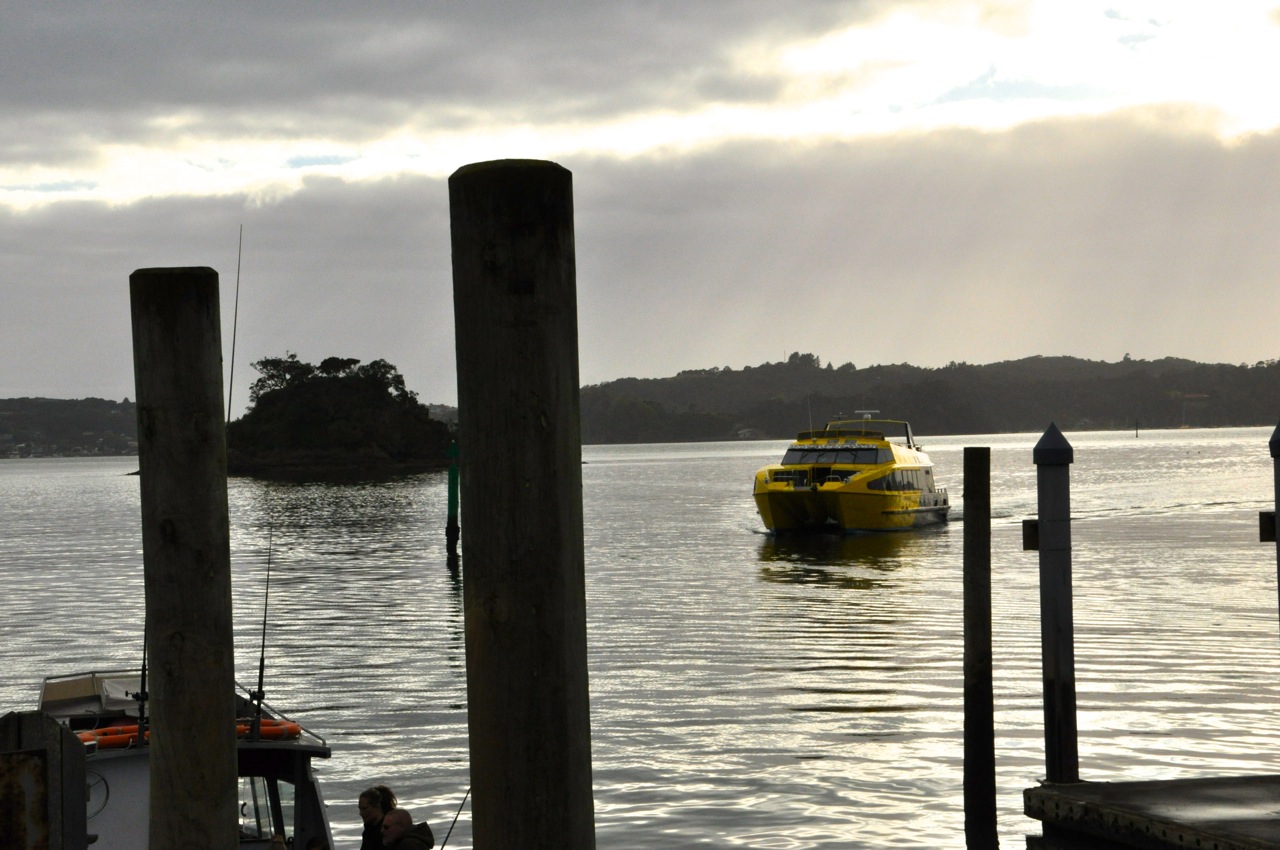
Well, that’s our boat.  This is a major thing to do in NZ, and the tourists fill these boats pretty well.  Our boatWe’re off-season, but there are two major boat companies, each doing more than 2 trips a day, and our smaller boat still had about 50 people on it.  There’s a bit of a jostle getting position to take a picture.  Not our thing, really, but we’re giving it a go.  There’s also a chance to see whales.  Interestingly, orcas were seen the previous day, which meant for that day there were no porpoises to be seen.
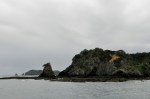
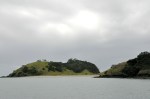
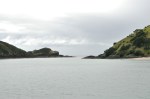
So we saw some islands.  Not too exciting, really.  There is some history involved.  For example, the first picture is the cove where Cook stopped as he was mapping and naming features of NZ.

And of course there are islands (or chunks of islands) owned by the rich of the world, such as that house above on the right.  Because many of these nice houses – with nice beaches, I might add! – are empty most of the time, as in the picture below,

nearby there is often a much much much more modest caretaker’s house – like the last picture – to keep the place clean and chase off the riff-raff.  There are indeed many very pretty beaches on this Bay, all empty when we came by but which are apparently occupied in the summer (it’s still pretty chilly here).  Here are a couple of interesting beaches.

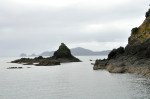
There’s actually a fair amount of interesting island scenery; jutting out crags, rock faces, shallow water of a different color, lonely lighthouses, etc.  Examples below.

Ah, the aquatic mammals we were supposed to see!  Well, we did see them, but pretty shy ones.  Photographing a dolphin or whale is not as easy as it sounds.  They’re up, you point the camera and push the button to focus and snap, and you have captured the bubbles of their departure.  And the rocking boat and jostling crowd do not help your success rate.  Yes, we found a small pod of 4 dolphins, yes they were bottlenose, but yes, they had a younger one (we were told; I think there just would have been a small riot to allow only 3 people into the water).

And whales?  Well, a whale, but this whale was harder to photograph than dolphins.  It briefly came up here and was gone, and you waited for forever, and it came up there and was gone.  And like the dolphins, the whale was not in a joyous mood; no leaping out of the water frolicking, no tail flick, just a small gray hump appearing, rolling and gone.  So here are my pictures of a whale, hard to get excited.

There were other animals as well.  Seals and our friend Charlie the red-billed gull,

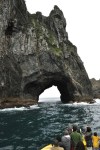
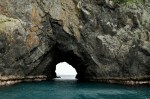
who flew with us on most of the journey, hoping for a handout.  Finally, the trip ends Hole in Rock, aproachwith a zip through “The Hole in the Rock”, that big chunk in the background.  A tourist thing, I had an initial negative reaction, but in fact it was kinda neat.  Here are the images of the funnel through the tunnel.  The last image shows a much smaller boat coming through (yet another tour group).

Well, that’s it for excitement.  Really, we’re more into hiking than boating, and it’s cheaper!

Hike and the Pied Shag Tree Nursery

We did a relatively short hike in the Waitangi area, and were thrilled with the Pied Shag Hotel and Nursery.  You’ll see.

This hike actually started with a waterfall at the beginning rather than being the reward at the end.  Falls, Waitangi WalkIt wasn’t a loop route, so we had a choice.  It had rained recently (I mean, it rained almost every day.  Have you noticed the skies in my photos?) and there was a bunch of brown silt in the water which you can see in the waterfall.  Unique for me, I could walk right up to the corner of that falls there in the foreground and put my hand in the water, my toes at the edge, the water going by at quite a clip as it executed its lemming thing.  Ginger opted out of the thrill.

Hikes here are interesting because the flora is like nothing we have seen.  The trees are amazing, and the tree ferns incredible.  Below are two shots of the trail.

Then, as we walked along a bank over the river, we encountered quite a few trees filled with birds called Pied Shag (they act like cormorants).  Many in nests.  With the cutest cuddly fuzzy babies.  Quite a nursery, with feeding going on, teenage Shag begging for more handouts, mommas diving, daddies building nests, birds fighting, real family time.  Because we’re on a bank and they’re in a tree, we’re eye-to-eye.  Amazing.  Here are some pictures.

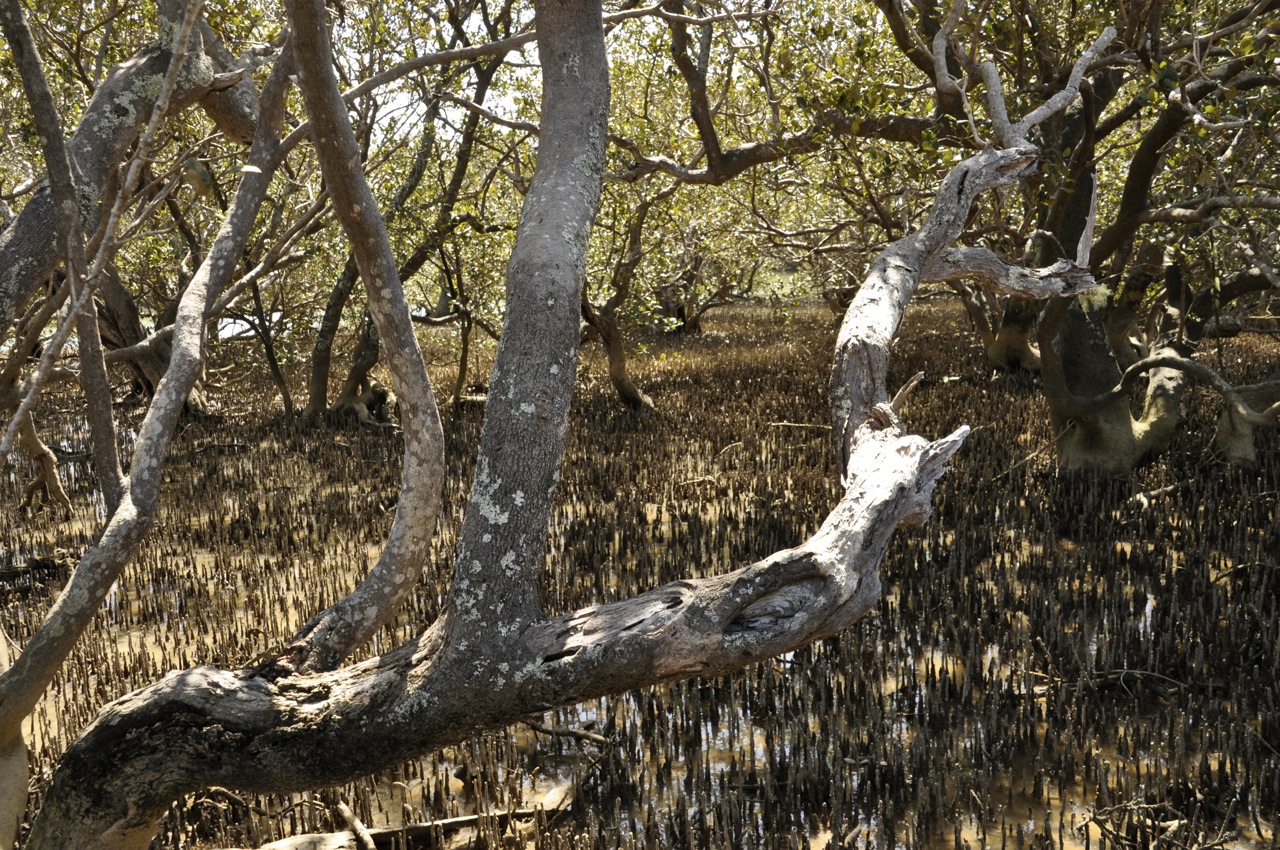
The hike also included a trip through a mangrove swamp.  Big mangrove swamp (they’re everywhere, really, but kinda hard to walk through without a boardwalk).  Mangrove SwampThere was a loud snapping sound occurring randomly in the swamp – turns out they’re “snapping” shrimp in burrows.  I hope you’ll forgive me if I don’t show you a photo of shrimp burrows (holes) in the mud.

Next post will be about a boat trip around the Bay of Islands.  How can you not take a boat trip if you’re visiting a place called “Bay of Islands”?

Historical Waitangi and Area

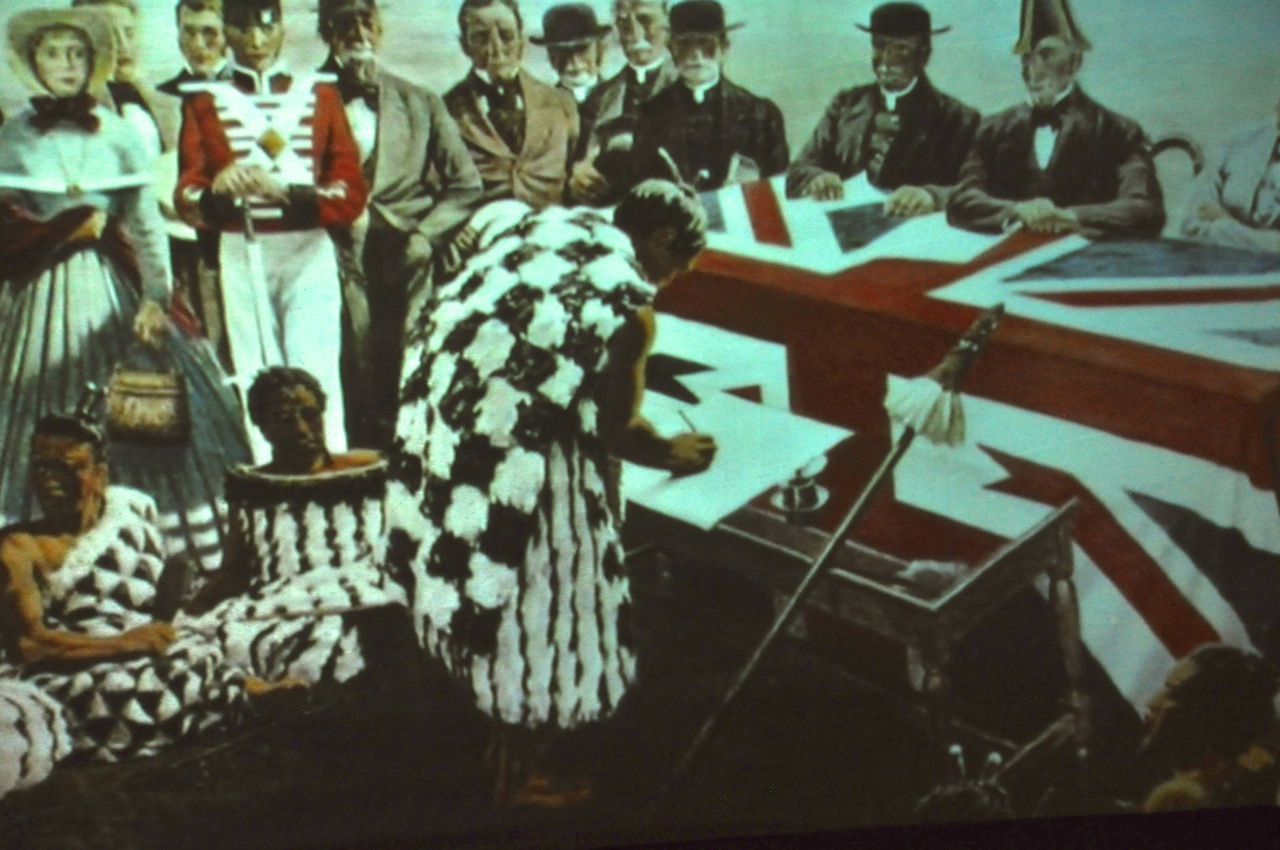
Kia Ora (that’s Maori for hello or welcome).  Waitangi is just north of us in Paihia and is historically the most important place in NZ due to the signing of the Waitangi Treaty there in 1840.  This treaty bestowed British citizenship on the Maori and subjugated them to British TreatySignlaw while supposedly protecting the Maori’s land and interests.  As I mentioned in an earlier post, this document is central to current day discussions over land issues.  Kiwis see this as the equivalent of the US Constitution.  Maori see this as a very different document than the one they signed in the Maori language; in the English version, Maori land and interests were anything but protected.  The Maori chief, Hone Heke, who was the major proponent for signing, was also the chief who, 5 years late,r precipitated the Northern WarsHeke expressed discontent over a period of a year by chopping down the British flagstaff flying over the nearby town (Kororareka) on 4 separate occasions.  The last time was too much, war broke out, and Heke and other chiefs took the town; in clashes it was burned to the ground (to be resurrected as Russell).  I mentioned before that the Maori were a warrior society, living in or near fortified hilltop pas.  Male children were trained to be warriors starting at age 5.  Maori were good at war, with constant practice (raids on other tribes).  They were a Stone Age culture; weapons were wood spears and sharp-edged jade clubs.  With European arrival, they also acquired muskets; these were quickly seen as a huge advantage in their wars, and an arms race was on.  Many Maori artifacts in museums are the result of trades for muskets with Europeans who treated the artifacts as art objects rather than tools.  We’re talking giving up a Maori tribe’s treasures, even war canoes!  Missionaries came under huge pressure because they were reluctant to engage in musket trade.  One of the Maori chiefs, Hongi Hika, went to London where he had a meeting with the King (!), who gave him a suit of armor, which on his return via Australia he traded for something like 400 muskets.  So when war broke out with the Europeans, the result was predictable but did not come easily.  Usually Maori were outnumbered at least 2 -1, but still managed to win half the battles!   It was not unusual for the British to lose a third of their assault force, with the Maori warriors  slipping away under cover of darkness.  Some of the major battles the Maori lost were due to other Maori tribes joining with the British forces (to settle previous scores).

These guys were on opposite sides, and I only show the pictures because I find the facial tattoos to be fascinating.  The Northern Wars lasted a year, the final fight showing Maori ingenuity.  Presaging WWI, in response to overwhelming British firepower, they built gun-fighting trenches and tunnels and withstood 10 days of cannon bombardment and attacks before finally being breached.

Let me show you some of the area around Waitangi before going to its cultural center.  The area below is one of the oldest European settlements with buildings still standing (eg, the whaling taverns and brothels in Kororareka were burned down).  An early missionary establishment next to the pa of Hongi Hika is shown in these pictures.

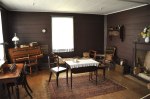
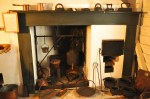
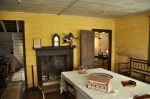
That’s the earliest wooden house in NZ, the missionary house (Kemp house) built in 1822.  The missionaries brought new technology and agricultural methods to the Maori, and hoped their religion would also be adopted.  The Stone Store is right next door and is the oldest stone house in NZ, built in 1836 to facilitate trade with the Maori; it’s a (tourist) store today, containing pretty much the same contents as would have been sold then – burlap bags, hand-made nails and so forth.  The interior of these houses is surprisingly modern to be there in the middle of nowhere, as shown in the images below:

And then it hit me – we think our country is young!  This place is a baby!  Walking through the missionary house I was struck by how much it reminded me of the time I lived in an old house just off Market St in downtown Charlestown SC (around 1955), in a house that was probably built before this one (although our furniture wasn’t that good, the kitchen was a little better …).  Connecticut has a stone house that is 200 years older than their stone house – a difference in years that exceeds Kiwi history in NZ!

OK, shifting gears back to the burnt town of Kororareka, rebuilt as Russell.  It’s a quaint little town across the bay, about 2 blocks by 2 blocks, with a single house (missionary) spared in the burning.  Pictures below:

One of the buildings there is the Duke of Marlborough Hotel, the oldest hotel in NZ, with liquor license #0001.  It’s pretty nice; we had lunch there on the veranda.

Finally, a view of the Waitangi treaty grounds.  They have a Maori meeting house, the signing house, and a war canoe.

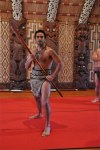
We took in a performance of Maori culture at the meeting house; we were met by Maori warriors emerging from the meeting house fully armed & doing choreographed movements, chants, vocalizing, all the while demonstrating their prowess with their traditional weapons; this was meant to be intimidating and a challenge, and was it ever!
Especially for me, having been chosen the “chief” of our of little group and being the object of their feints.  After doing their challenge, one of the warriors laid a “gift” – a palm-like branch – in front of me, to pick up if we came with peaceful intent (otherwise they probably eviscerate me on the spot).  We were then welcomed into the meeting house with song and dance.  Inside, a ritual song & speech of welcome followed, and I had to respond with my own speech, followed by the hongi, the simultaneous touching of foreheads and noses together & the symbolic exchange of breath with their chief.  Much song & dance with explanation followed, along with demonstrations of weapons use and games with sticks that improved limberness, hand/eye coordination etc.

One song started as a solo, finished as a duet, and even though it was in Maori, its beauty and emotion moved Ginger to tears.  A final group photo.We are Maori now

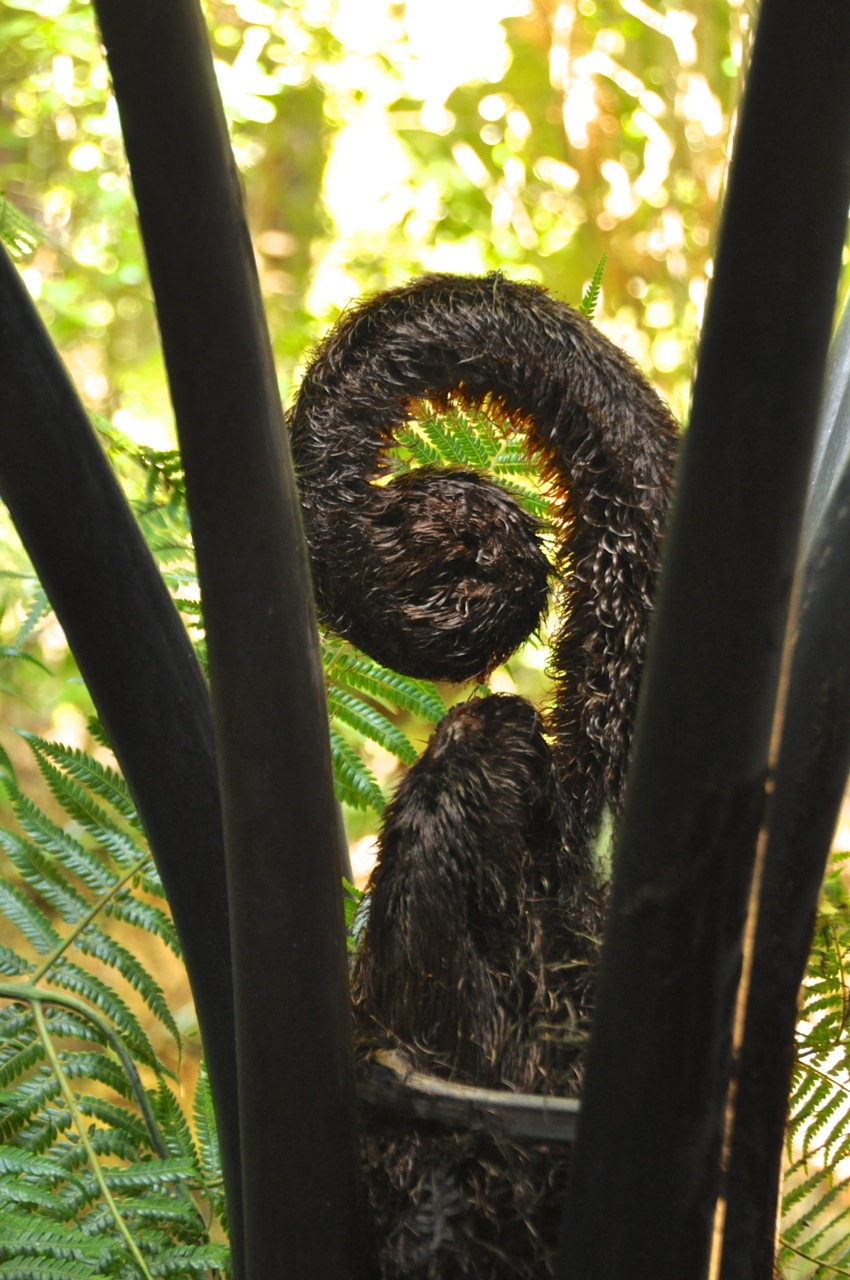
Well, I know, this has been a long post, but let me add a final “art” photo – an unfurling frond from a tree fern.

TreeFernFurl