It was the idea of Gaudí’s patron Eusebi Güell to build a gated garden-centered luxury housing development at Barcelona’s edge, an Eden beyond the Eixample. It was, however, 100 years ahead of its time and a failure; designed for 60 estates, it sold only 3 and its construction was halted unfinished. Güell’s heirs sold the site to the city, which decided to preserve it as a public park. Good decision! Today the more completed region (the terrace area, or Monumental Zone) is so popular that, to control the crowds, the city had to charge an admission fee ($9!) with timed entry.
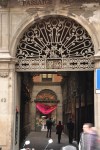
The pictures below show the main entrance to the Monumental Zone, protected by fabulous palm-frond wrought-iron gates in front of two gingerbread-like (Hansel and Gretel) houses that were the guard’s lodges. Behind them is the grand stairway leading to


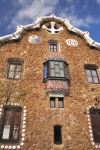
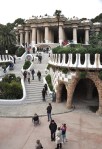
the “Hall of 100 Columns”, originally designed to house a produce market for the sites’ mansions while supporting a terrace on top. This “finished” area is the focal point of the park; we’ll come back to it; our timed entry is hours away, so we’ll first explore the public areas – which means we’ll be seeing things in reverse.
Mountains surround Barcelona to the northwest, and Park Güell is in the foothills; from the entrance, the land goes rather steeply uphill over undulating terrain. To overcome the


topography and connect the intended houses with various parts of the park, Gaudí planned three snaking pathways for carriages, including three bridges. But this is Gaudí, and these are not your normal roads and bridges! To minimize the intrusion of the roads, Gaudí designed them as structures jutting out from the hillsides, with separate footpaths in the arcades formed underneath. Designed with local stone that integrates them into the landscape, his structures echo natural forms, with columns resembling tree trunks. As we come up the hill, the first bridge is visible above us (first picture) and is supported by sloping grotto-like columns and vaults made from unhewn stones. Different!


The top of the bridge is crowned by balustrades with Mediterranean vegetation, shown below. The hillsides, by the way, are a happy home to many cute parrots.


Walking further takes us to the other bridges which have a similar creative motif.

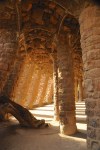
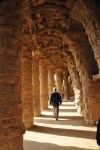
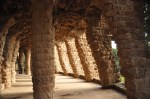
The last bridge is also intriguing and leads us to the terrace at the top of the Monumental


Zone, the region that was largely finished by Gaudí. In the last picture above, you’ll notice that the stones on the columns imitate the trunks of the palm trees planted above them. The short support columns in the middle of the image have a linear array of holes about half-way up, which Gaudí built so birds could nest there. Interesting details!
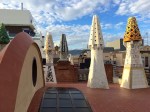
We’re standing on top of a huge terrace centered within the Monumental Zone; in the original plans it was called the Greek Theater, envisioned as a large staging area for


open-air shows that could be watched from the terraces of the planned – but unbuilt – villas. Note in that last picture that people are sitting on what appears to be a very long white bench that encircles most of the terrace. The bench is actually in the form of a sinuous sea serpent; the areas of small off-white tiles give it a positively scaly appearance. The deep curves of the bench form small seating enclaves, cleverly creating a more intimate social atmosphere. The bench is designed to ergonomically fit the body, and the back is anything but white! It’s inlaid with ceramic tiles and tile-shard mosaics, in a


symphony of colors and shapes that incorporate motifs of Catalan nationalism, religious mysticism and ancient poetry. It’s bold and abstract, before there was such a thing as abstract art.
The front of the terrace overlooks the main entrance to the Monumental Zone. If we had entered the main entrance, we would have seen a grand staircase leading up to the Hall of 100 Columns, as shown in the first picture below. Notice at the very top of that picture that there are people standing on the roof of the Hall of 100 Columns, which in fact is


the front of the terrace. The next picture shows the view from that front terrace, looking down at the main gate and some of the grand staircase. What I want to draw your attention to is the gingerbread-looking house in the background (you also saw it in the first set of pictures in this post) – the guard’s residence. It’s one of a pair of houses flanking the entrance gate; the other is  being renovated and is not currently photogenic, but the two are interestingly Gaudí, as shown in this picture from the internet. A Hansel and Gretel opera was popular in Barcelona at this time, and Gaudí designed these two guard houses to reflect that story. The guard’s residence, at the far left, represented the witch’s dwelling (with a poisonous-mushroom-shaped dome). The smaller house on the right, the working guard house with a visitor’s waiting room, represented the house of Hansel and Gretel. Closer views of these very interesting houses are shown below.


As we head back to the top of the terrace in order to take steps down to the Park Güell entrance, we notice that the colorful bench lining the left side of the terrace gradually


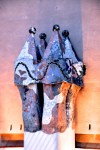
fades to mostly white colors, an interesting effect. On our way down the steps to the park entrance we pass through the “Pathway of Columns” that supports a road above projecting out from the hillside. The supporting columns themselves have interesting sculptures/formations attached to them, as shown below. The column-lined footpath


under the roadway becomes a long arcade, playfully suggesting a breaking wave forming


a surfer’s perfect tube. Pretty cool organic architecture! Which leads to this structure shown below, a fanciful spiral ramp.


The path down takes us to the park entrance, with a view of the stairs going to the Hall of


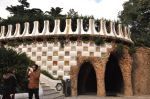
100 Columns. Off to the right is an intriguing structure that was designed to shelter carriages and horses on rainy days.
Before heading up to the Hall of 100 Columns, let’s just look at some of the Gaudí-designed details of the buildings. As usual, they’re playful and different.


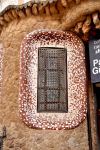

The grand stairway is actually a twin flight of steps (with two open landings). The stairs are divided by two small fountains, one of them a colorful ceramic dragon (looks like a
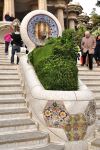


salamander to me!) that has become the most popular image of the park.
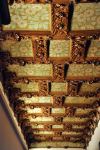
As noted at the start of this blog, the stairs lead to the Hall of 100 Columns, which was originally designed to house a produce market for the sites’ mansions (and to support the terrace on top). It’s pretty cool, with a mosaic ceiling having the shape of a series of upturned bowls, giving it an undulating feeling. It’s also studded with colorful medallions.


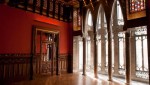
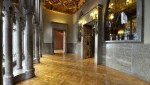
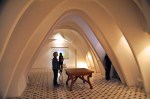
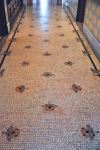
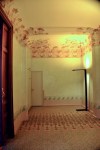
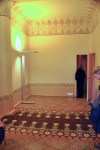
Our circuit has covered most of Park Güell. We’ll finish with a tour of the Guard’s House and a quick view of the Gaudí House Museum. First the guard’s – or witch’s – house. As expected, few things are “normal” in this house, including the deep blue walls (and blue ceilings!) of the ground floor. Below are shown some of those “abnormal” features: doors and arches that are parabolic, some walls that join ceilings in a continuous curve,
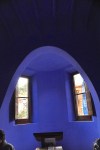


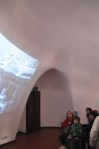

ceilings that are deeply ridged, stone columns positioned here and there, and some windows that are a collection of pentagons. It’s all really cool!
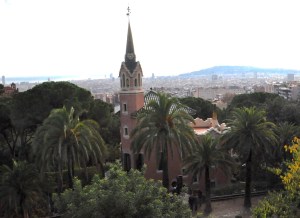
The Gaudí House Museum
Well, hope you enjoyed Gaudí’s fanciful Park Güell. Gaudí actually spent his last 20 years living in what is now the Gaudí House Museum, shown here, that’s within the Park. In a strange twist, it’s not a house he designed; it was a model home built to attract prospective buyers.
The next post will be on Barcelona’s Old City, the “Barri Gòtic” or Gothic Quarter.
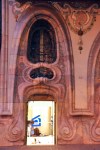
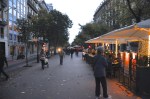
 humble origins, La Rambla’s sidewalk undulates like water in a stream – cute, but not so easy to walk on!

 temple dedicated to Emperor Augustus (Temple d’August), and even in the 1100’s the area was called “the Miraculum”, suggesting it was still intact. However, in the Middle Ages it was demolished, although parts were incorporated into new construction. A building project in the late 1800’s uncovered four of the temple’s columns, shown below (viewed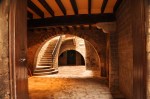
















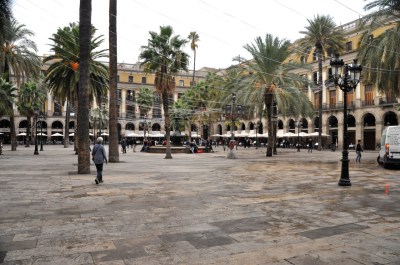 buildings and numerous palm trees. As with La Boqueria Market, big open spaces like this were once monasteries that were dissolved in the 1800’s. Today the square is a popular meeting place in the summer, a host for many festivals and markets (like the arts and crafts market we stumbled on, shown here), and home to a large number of restaurants, taverns, bars and some of the city’s most famous nightclubs. Getting to this square from La Rambla is via attractive passages, including the Bacardi Passatge, the first covered gallery of the city, built in 1865.
















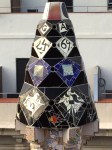
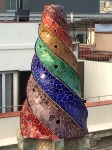





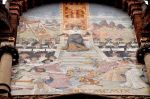
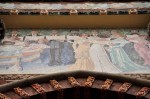
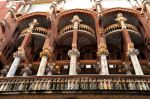
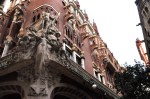














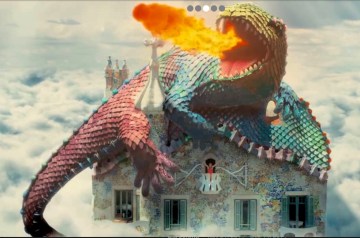 other main interpretation is that the whole facade is an allegory of Carnival; the roof is a harlequin’s hat, the balconies are ball masks, and the mosaics on the wall represent falling confetti. A mark of a great work of art is the controversy it creates, but hey, I know a dragon’s back when I see one!
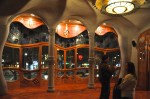
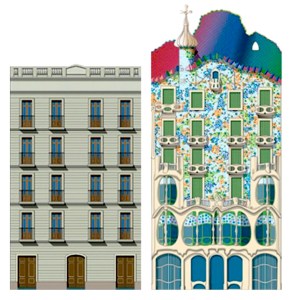 creative. So he hired Gaudí based on the architect’s incredible Park Guell (wait ’till you see that in a subsequent post!). He gave Gaudí free rein to do whatever he wanted. Although Batlló wanted to tear down his existing plain house, Gaudí convinced him that a renovation was sufficient. I think we can agree that the resulting renovated building is indeed “audacious and creative”. So let me show you the interior, where audacious and creative continues! Fasten seat belts. You should notice during the tour that there are few straight lines or square floors in Gaudí’s house. “Undulating” is probably the best description of every surface – including walls and ceilings!


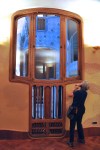


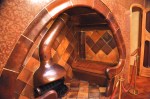
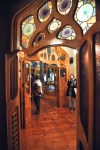












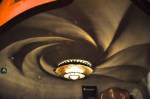
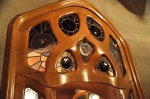
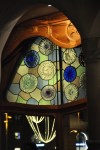


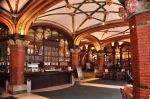
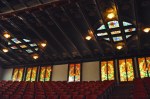
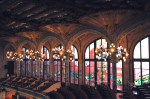
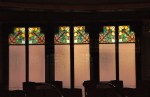
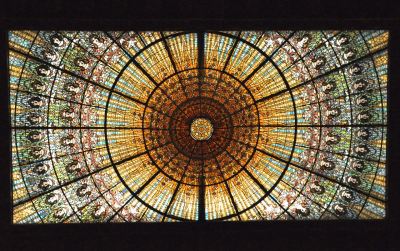 Concert Hall. We’ll call it Barcelona IV: Palau de la Musica Catalana. Here’s a preview. Don’t miss it!


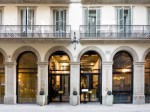
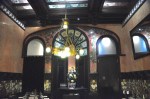
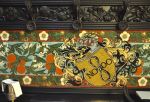
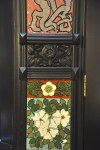
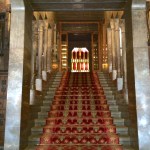
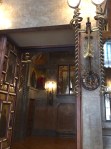
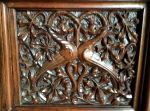
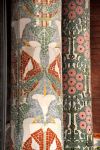
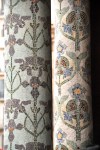
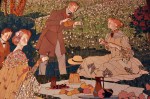
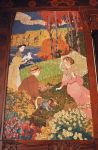
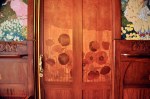
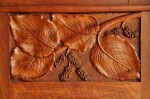
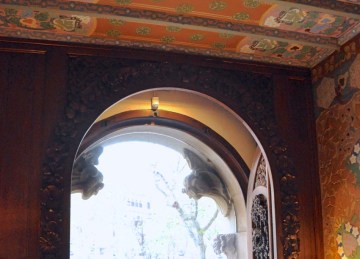 of the door (for a better view, right-click and “view image”). You will note from this picture that the vestibule interior looks pretty ornate! Yes, but it’s ornate with a purpose. The Morera family wanted the building interior to reference their family name, which means mulberry tree, and that reference is everywhere – exuberantly. From the entry, marble stairs lead up to an original elevator (the first in Barcelona) and then continue up to an entrance hall. I didn’t take a picture of those stairs, so I cribbed the first picture below from the Casa Morera website. Those flowers on the stair risers are mulberry tree flowers, and the mosaics and tiles


























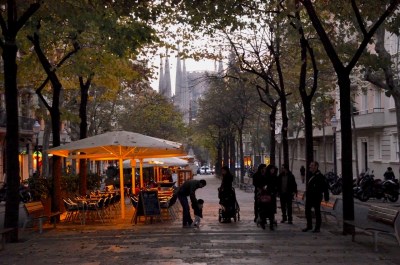 could you not? And did I say the food is fabulous? We’re here in December, and the weather is delightful (we suspect the summer might be tough). At night we can still dine in outside cafes wearing only light jackets, while street vendors sell roasted chestnuts that harken back to a colder climate. This city has charm. Are you sold yet?
 Familia Cathedral that was started in 1882 and is still under construction. Just to whet your appetite, here’s a picture of Sagrada from the internet. My! Doesn’t that look just like 1882! No? Although that list of what I’m going to cover in Barcelona might sound like ‘way too much, I think you’re going to be as captivated by this city as we were.
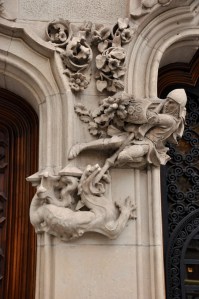 incorporated rich decoration and detail, frequent use of plant motifs, a predominance of the curve over the straight line, a taste for asymmetry, and … what to say … fantasy? Tomorrow’s future chic? You’ll see. It’s a hundred years later, but I think Modernisme is still ahead of its time. Oh, one other piece of information: the main symbol of Catalunya is the dragon, which was slain by St. George, the region’s patron saint. In Barcelona, “there be dragons”; they are everywhere.




























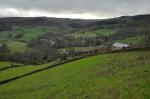
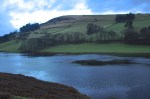
 Park multiple times, taking highways going to other places. Each time we expect to get a glimpse of the park, whetting our appetite for more. Wishful thinking! This is England in winter. The views on our previous trips through this northern region? A typical example is shown here. Every time. Nada. There may be peaks out there, but they’re shy.


 here since 1086 when the Normans built Peveril Castle, shown to the left. One can still see parts of the town ditch that surrounded the medieval village. In the 1700’s lead mining was the main industry; impressive caverns related to the mining are nearby, and several miner’s cottages can still be found in the village. A glimpse of the town is shown below, but we’re off to see better things, the scenery of the Peak District.





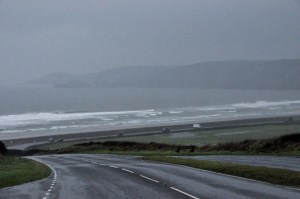 Alas, it’s raining. Ugh. Although we’re here in South Wales to hike some of the Pembrokeshire Coastal Path, today is definitely not the day! So we’re off to St. David’s Cathedral, which is located nearby on the most westerly point of Wales.
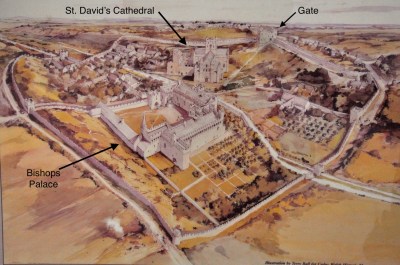 1171, leading to an increase in pilgrimage and necessitating a larger cathedral; the present cathedral was begun in 1181 and swiftly completed. King Edward I conquered Wales (post
 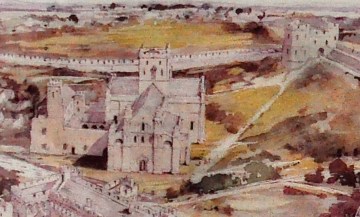 Enough history -let’s take a look at this very interesting cathedral! Its overall appearance is nicely captured in the picture to the left, which is a magnification from the illustration above. The entrance gate to the compound is in the upper right corner; the wall in the illustration no longer exists, but the massive gate, dating to the 1300’s, remains, as shown below. After passing through the gate, your way down to the cathedral takes you past a cemetery (conventional wisdom said the closer you were buried to a church, the better your chances for heaven; I suspect the church benefited from that notion). The picture to the right, below, shows a sprawling Cathedral; the

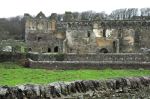
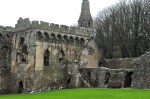
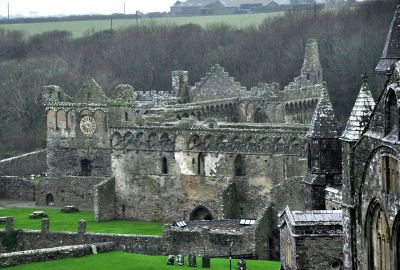 Cathedral is the ruined Bishop’s Palace. It would have been spectacularly beautiful back in its day. I’ll show you more a bit later.


 The layout of the Cathedral, shown here, is from a survey of the main part of the Cathedral in 1715; missing from the survey is the cloister and associated buildings. Beyond the nave the survey shows a number of rooms and chapels that were added later (as mentioned earlier).

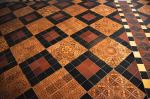







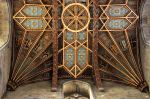

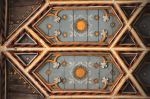







 There are two more chapels. The Chapel of St. Thomas Becket, shown here, was built in the early 1200’s but remodeled in the 1300’s (the ceiling is from the 1300’s). In the layout schematic of 1715 shown earlier, this room is called “The Chapter House”.





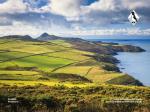
 This last picture is us leaving Wales across the very beautiful bridge that connects to England. It’s still raining.



 clear that farming is a big deal here. It’s also clear that the Welsh have a very dry sense of humor – that or they’re incredibly anal, as suggested by this sign at the edge of the road.








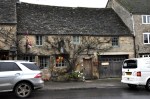
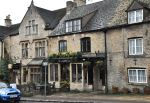
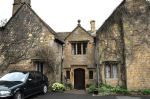
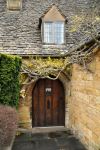
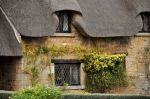
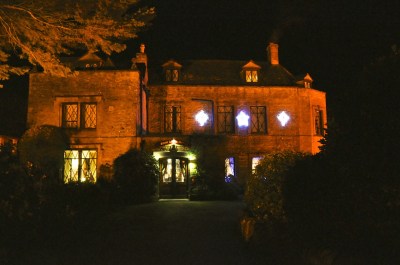 Like so much of the Cotswolds, the town buildings have a lot of character. We’re staying at this lovely hotel that’s loaded with old English charm. It faces the town square and was built in the 1700’s for a local family, but for most of the 1800’s it was the rectory of the nearby St. Edward’s church. We’re here at Christmas time, which adds to the charm of the place, but in the pictures of the buildings below you should imagine how beautiful they would be with the vines and greenery in bloom.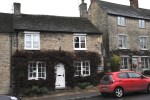

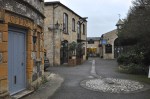


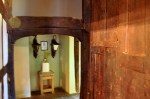


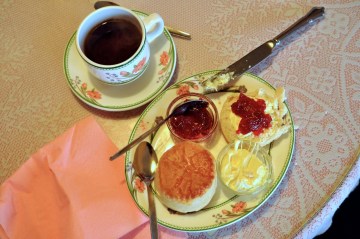 luckily Christmas is not that season. The buildings of the city are not the oldest in the Cotswolds, mostly dating from just the 1600’s. We’ll start with a tea room break – one of England’s wonderful customs, tea and crumpets with clotted cream. It is sooooooo good!

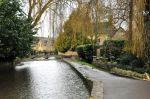
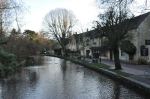
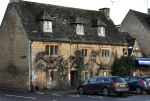


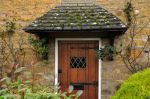
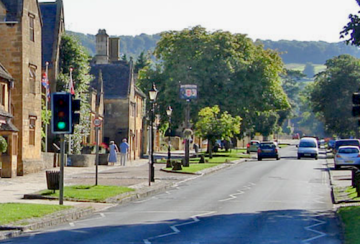 the original dirt road, and people built their houses behind the streams (now the streams run underground in pipes). The road is lined with red chestnut trees and honey-colored Cotswold limestone buildings and is referred to as the “Jewel of the Cotswolds”. We don’t take such hype seriously – remember “Venice of the Cotswolds”? In this case, however, the hype might be right. We think the city is gorgeous, primarily due to the incredible old
  vines that cling to the cute houses. This is Christmas time, with little blooming; we can only imagine how beautiful this city would be in spring!








 trekin' time