Queenstown, Arrowtown and the Routeburn

QUEENSTOWN

Ah, Queenstown.   It’s one of NZ’s best-known destinations, and it’s certainly Queenstownthe country’s premier commercialized resort town.  It’s also beautiful, nestled at the base of mountains and looking across gorgeous Lake Wakatipu to the craggy Remarkables range (see image from the internet to the left).  You might enjoy a pilot’s video of the area as he lands a small plane at Queenstown airport.  The link below will open the video in a new window – it’s about 4 minutes long.  http://www.chonday.com/Videos/pilotnewzdalnd1.
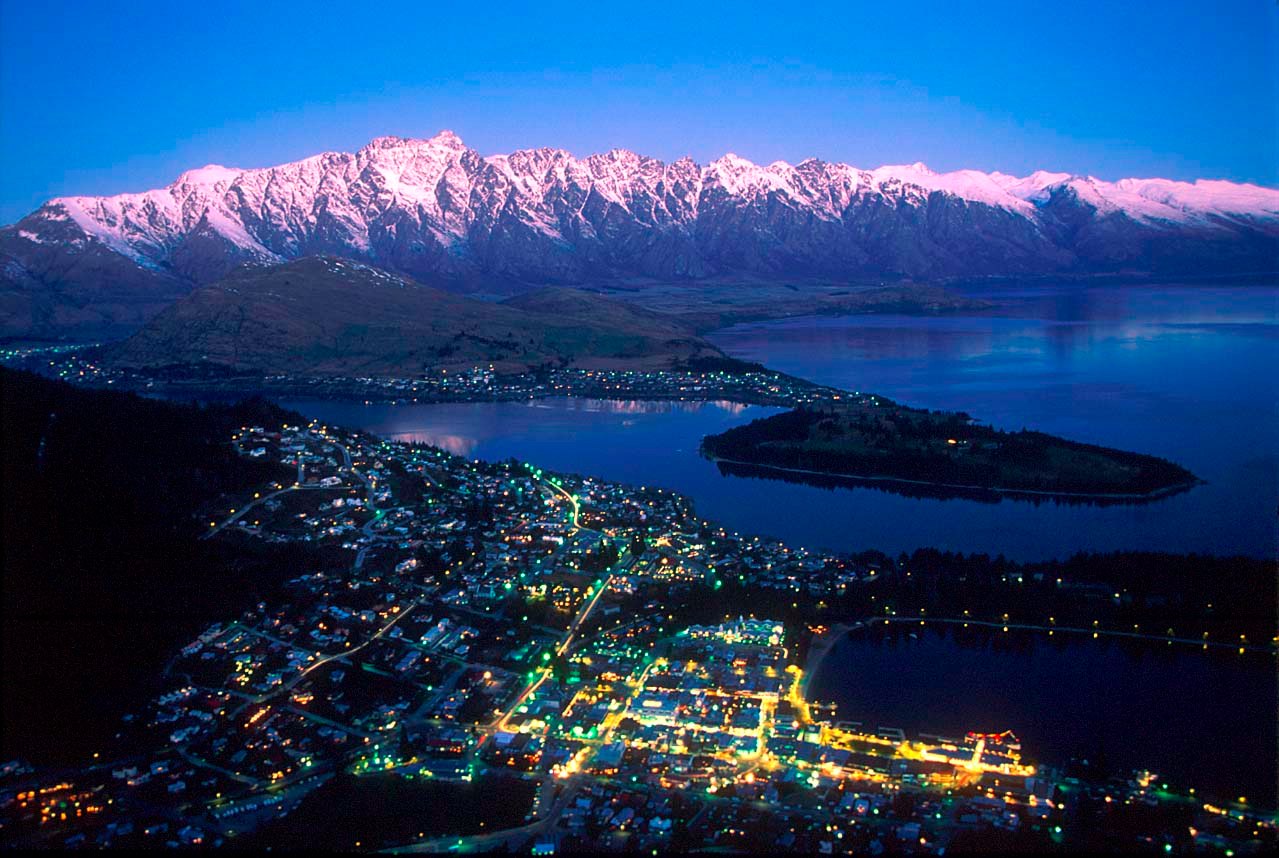
Quite a location, but we thought the city itself was a flawed jewel, at least for old fogies like us: it was crowded, touristy, and filled with stores heavily marketing every adrenaline-fueled activity known to man.  It’s a place for young people with a lot of  money to spend on flying, falling, floating, speeding events – and the price for each was hundreds of dollars.  Ginger wasn’t really keen on any of it.   So we took a pass on the adrenalin rush, and went instead for the surrounding beauty:  the Routeburn track and a visit to historic Arrowtown.  In this case “we” is three of us; my sister Linda, from Albuquerque, joined us in Queenstown and will travel with us for awhile.

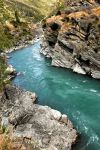
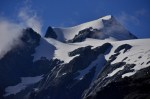
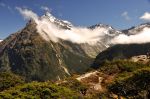
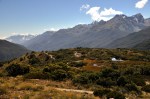
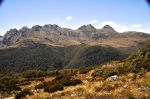
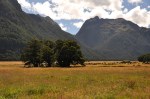
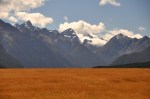
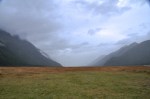
First, some pictures of the area coming into Queenstown.  It’s austerely beautiful.
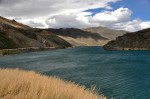
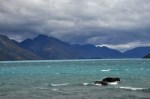
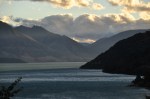
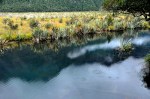
Next a few pictures from the Queenstown shore.  The last two pictures show the same scene under different light – always amazing how different the colors are on different days.  The light is somehow special in New Zealand – a painter’s light, often with a golden glow.
While we’re discussing Queenstown and light, let me show you some views from our apartment as the sun starts to set.  It was pretty nice.

ARROWTOWN

Miners' cottages, Avenue of Trees, ArrowtownArrowtown, only 10 miles from Queenstown, was born when gold was discovered in the Arrow River in 1862 – lots of gold.  One of the early prospectors was able to keep his lode secret while recovering 200 lbs. of the stuff.  The area became known as the richest for its size in the world, and at its height it was a town of 7000.  Today the population is 2400, surviving on the tourist trade and doing quite well.  It’s a nice-looking New Zealand town, with one of its highlights being the Avenue of Trees shown above.  Those trees were planted in 1867 along the line of tiny miners’ cottages that have been preserved.  More views of the town are shown below.

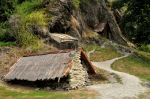
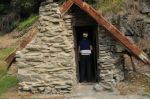
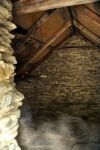
One of Arrowtown’s claims to fame is its Chinese history.  After a few years gold became harder to mine, miners left for newly discovered gold fields on the West Coast, and Arrowtown was left with businesses but few customers.  The solution was to import Chinese to the gold fields – as stated in the local newspaper, “An increase in population, even were it in the shape of chimpanzees, would be preferable to no population at all.”  By 1870 there were 5000 Chinese in Arrowtown, living in a segregated community, forced to work abandoned mining claims or the tailings of European miners, or working for half what a European earned.  Despite the racism, the Chinese were known for their “sober, upright and straightforward” conduct.  Arrowtown has the best preserved Chinese community in New Zealand.  Ah Lum's Store The best preserved building is Ah Lum’s store, built in 1883.  Ah Lum was literate in English and became a pillar of the Chinese community; his store sold both European and Chinese goods, operated as an opium den, and was a bank for the Chinese.  The loft also provided accommodation for travelers.  The compact floor plan, and an interior area, are shown below.

The (restored) Chinese miners’ huts are incredibly small, intended as temporary structures, with tin, sod, stone and timber the principal materials.  The huts became permanent as the miners aged and were unable to return home.  Pictures below.
ROUTEBURN TRACK

Linda and Ginger at the trailheadIf you remember, we “did” the Routeburn Track in a previous post  (April 20, “Leaving Milford Sound – the Routeburn Track to Key Summit” [clicking on the title will take you there in a new window]).  “Did” meaning we climbed part-way up one end of the trail.  Now we will go part-way up the other end of the trail – unfortunately leaving unseen the really, really pretty part in the middle.  Alas, such is the sad fate of those unwilling to carry heavy backpacks for days.  Still, the trip promises to be pretty.  The Routeburn is one of NZ’s Great Walks, and one of its finest.

Actually, just getting to the trailhead is pretty spectacular!  It’s at the other end of the long Lake Wakatipu, and the lake’s color changes along its length, and undergoes amazing

changes from day to day (that NZ light!).  The head of the lake is even more beautiful, as shown below.  In fact, it’s beautiful enough to have caught the attention of movie
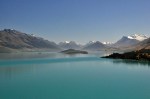
producers, and the area appears in films like The Chronicles of Narnia, X-Men Origins, Lord of the Rings and The Hobbit.

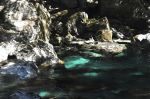
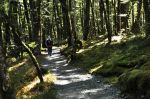
The Routeburn trail at this end goes steadily uphill following the beautiful Route Burn river, which is very clear with a somewhat turquoise cast.

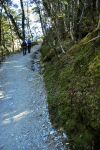
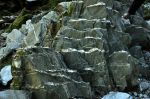
 I love being serenaded by a musical river, so this is a treat!  The trail itself is a regular highway, but a little rocky.  However. it’s sides are very green, covered by an enormous variety of ground covers and moss.  Very large mossy rocks are common, along with some rougher rocks that, typical of NZ, have veins of different materials, making them interesting.
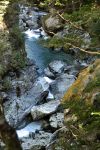
The water coming gallumphing down over rocks is beautiful.
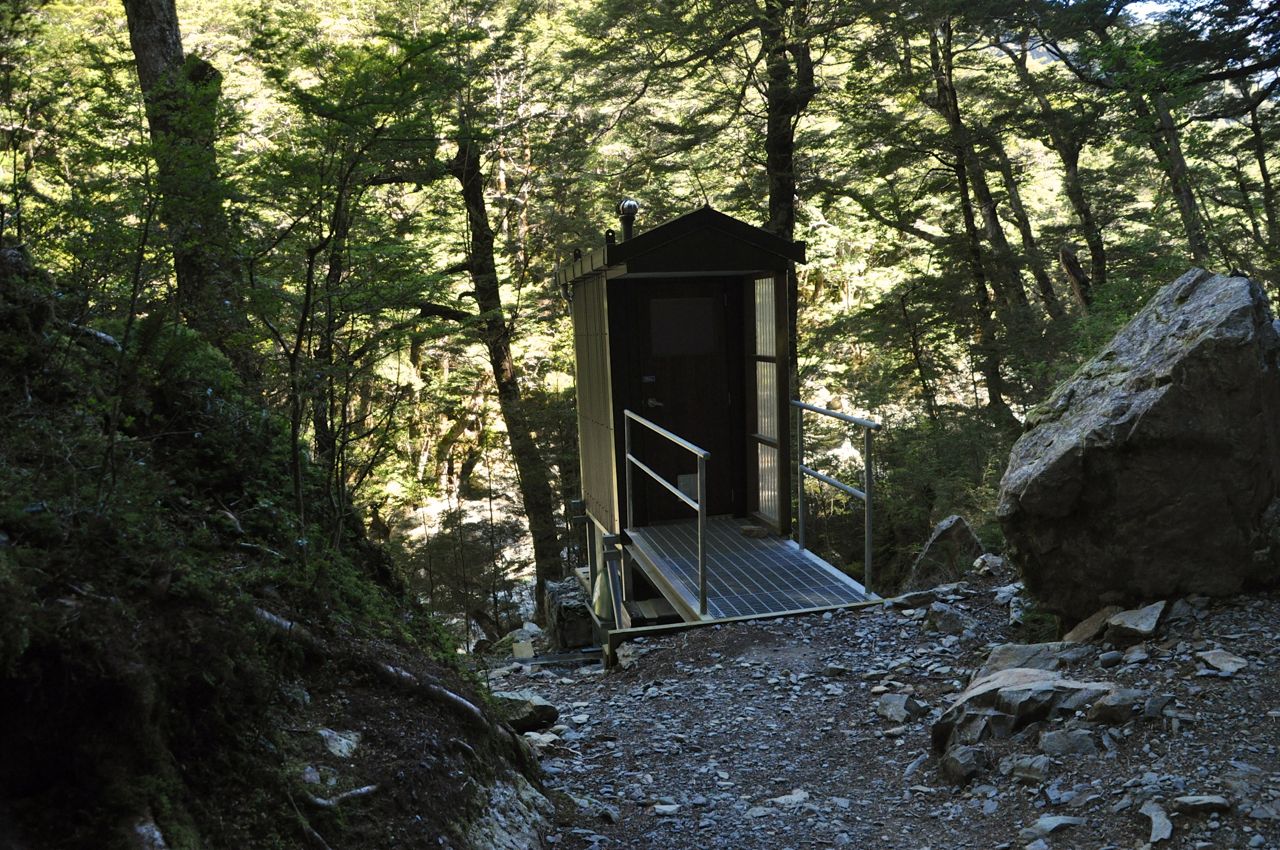
We’ve been walking for a couple hours now, and the ladies need a restroom break.  We’re not the only ones on the trail, so this is a bit tricky, but we find some house-sized boulders close to the trail that will provide the needed cover.  Okay!  Biology attended to!  Off we go, Luxury, just 25 steps too fara whole 25 steps around the boulders, and lo and behold what should we see before our eyes?  Yep, the luxury of a very nice outdoor toilet, the distance from the trailhead almost perfectly calibrated for the needs of a female walker.  Almost.  Maybe 25 steps too far, actually.  How funny was that?
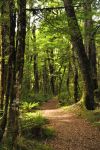
After a bit more we come to a pretty part of the river and the ladies decide they have had enough hiking.  I decide to hike up to the first hut, which should have a nice view.  The trail continues to be pretty, with a forest of ferns under the trees, and a nice beech forest.

The trail opens out to a beautiful meadow, and then I’m there.  I didn’t take a picture of it,

but the hut itself was pretty spiffy.  I’m used to rustic lean-to structures.  This was a four star fancy building, doors and wood bunks and all!  The surrounding meadow is gorgeous, with clear stream, impressive mountains and a waterfall.
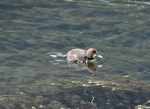
As I head back, the Route Burn River is illuminated by beautiful, slanting late afternoon light.  An added bonus, I see several diminutive Rifleman birds.

That’s it!  Pretty but not spectacular.  Alas, the truly gorgeous views are in the middle section that we did not hike, but I am content.

Next stop, the glaciers!
Granada’s Alhambra

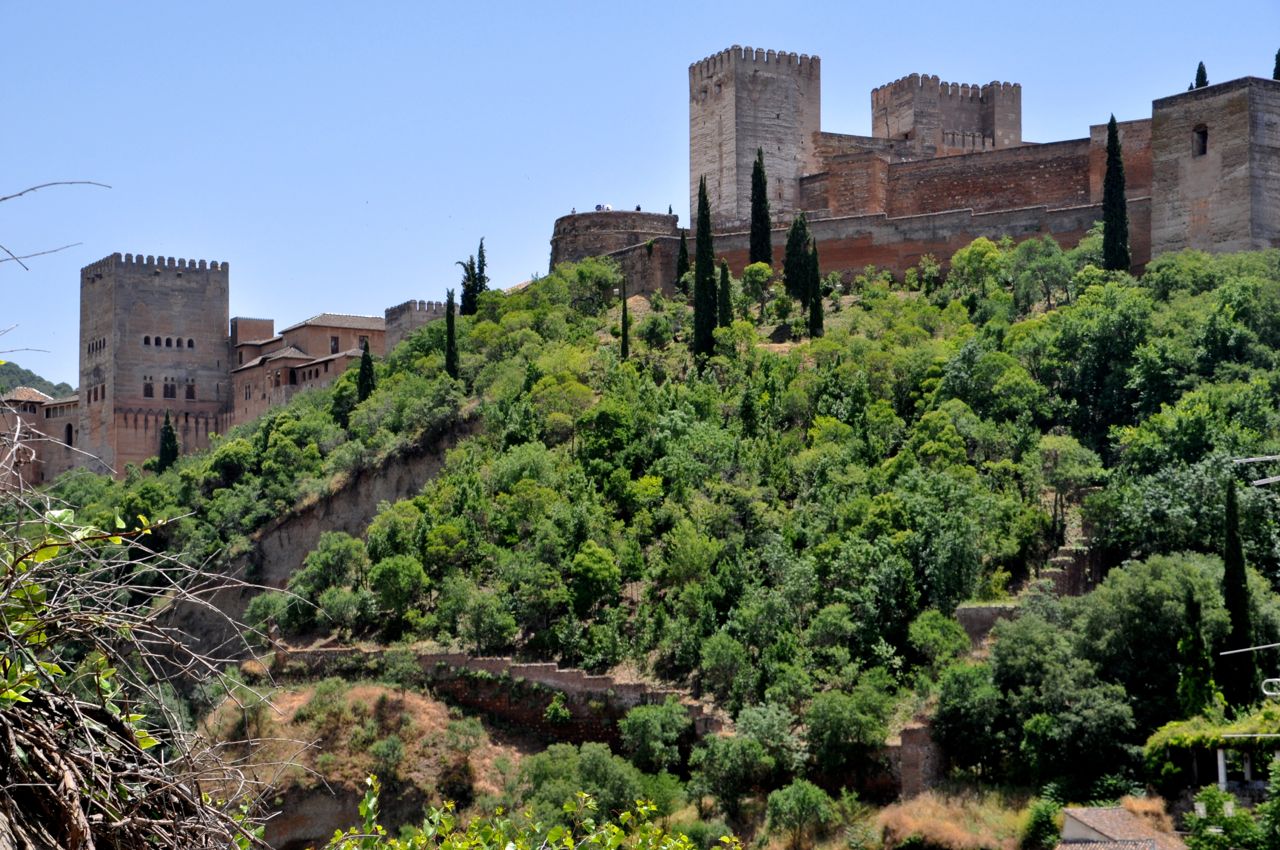
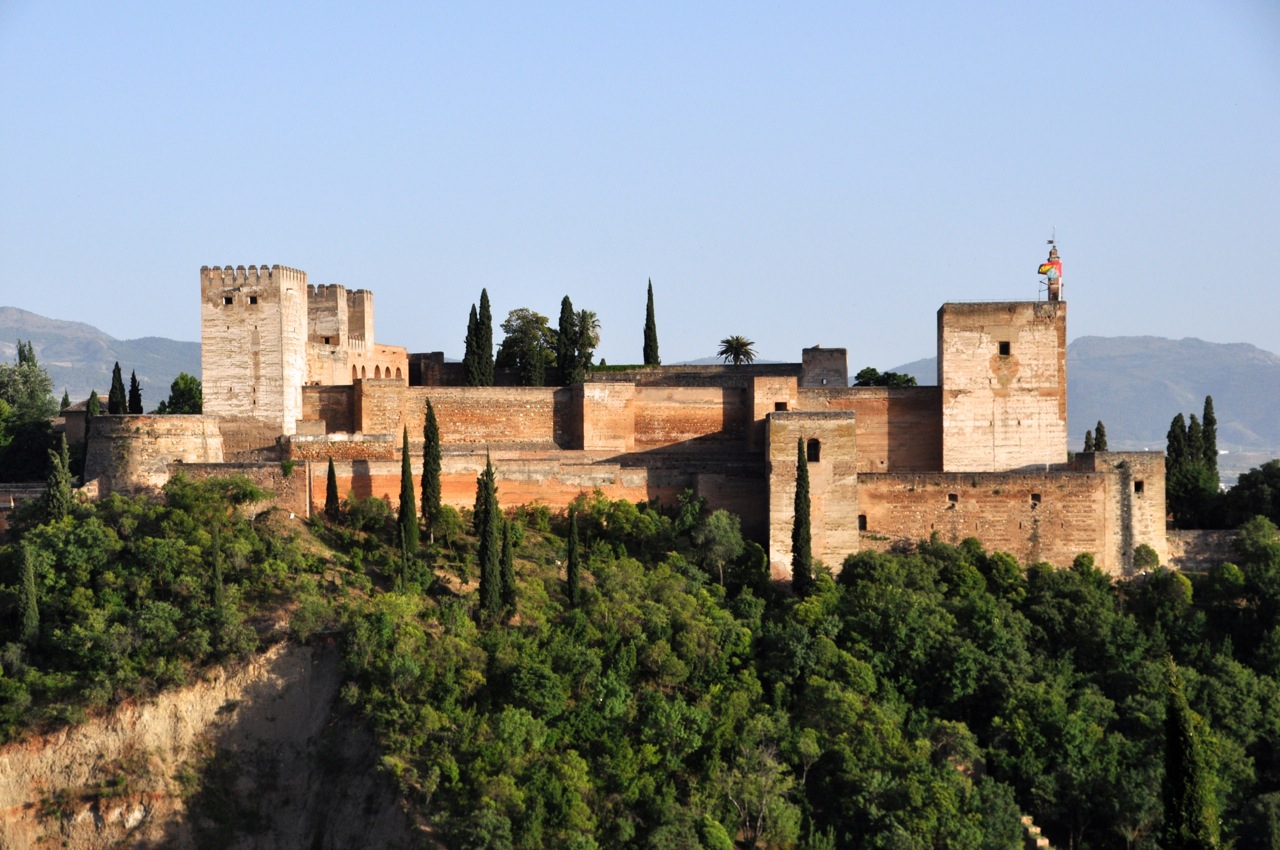
DSC_0126The magnificent Alhambra fortress was the last stronghold of the Moorish kingdom in Europe, with a palace that highlighted the decorative splendor of that civilization.   While the rest of Europe dragged through the Middle Ages, Granada blossomed from the 1200’s to nearly the 1500’s.  What you see today is merely a glimpse of what the magnificence must have been.  Time marched on, and in this case not for the better.  The Christians built their own version of beauty on top of some of the Alhambra, it fell into ruin and was populated by the homeless, Napoleon stationed his troops there in the 1800’s contributing substantially to its ruin (he blew up several of the gates), and of course time itself dulls or eliminates the paint and gilding that was once a source of its beauty.  Nevertheless, as you’ll see – it ain’t bad!

You need tickets to see the Alhambra, and they verge on scarce.  Only (!) 300 visitors are allowed A road up to the Alhambrato enter the palace every 30 minutes, and with up to 8,000 visitors a day, that’s a problem.  The good news is that some areas of the Alhambra are accessible and free, and we’ll visit those first.  We’ll walk up the hill, which is pretty steep, as you can see in the picture to the left (and as you want in a fortress).  Note that The Alhambra with surrounding old wallsthe walls of the Alhambra connected with the walls around Granada, the remnants of which you can see in the photo above.  There’s a reason this place was the lone hold-out for 200 years.

Granada goes back in time a millennium or much more, so it is no surprise that there are walls on top of walls on top of repaired walls, and ruins here and there.  When one encounters the fortress walls/towers, they are impressively vertical and remarkably well-preserved.  At one point there were 30 of these towers.

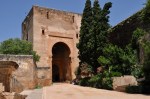
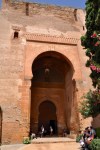
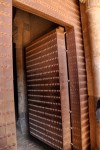
Pictures below show the Justice gate into the fortress (there were only 4 gates).  As you can see, it was built for defense!  Big motha’.  In addition to the gate’s four 90º turns for better defense, it has a metal door that looks pretty sturdy.  And it’s not just a functional gate – there are remnants of decoration.

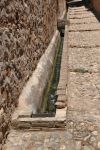
The sultan's summer palace - and water channel                                                                                                                                                                                                                       The Moors had a thing for water.  To the Moors, coming from the desert, water was precious; they reveled in it and surrounded themselves with ponds, fountains and gardens.  There is a river at the base of the Alhambra’s hill; the Moors diverted water from that river at a point upstream and uphill, running it down through the sultan’s summer home and garden, the Generalife, and then via aqueduct into the Alhambra city complex and palace (summer home and water path shown to the left; details later in the post).  Much of that infrastructure still remains and some is still functional, as shown below.

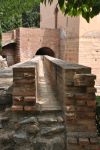
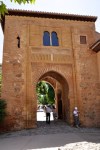
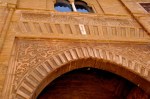
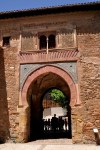
Once through the Justice Gate, the Wine Gate greets you.  One of the oldest constructions of the Alhambra, it separated the fortress (Alcazaba) from the town (medina) and palace within the Alhambra walls.

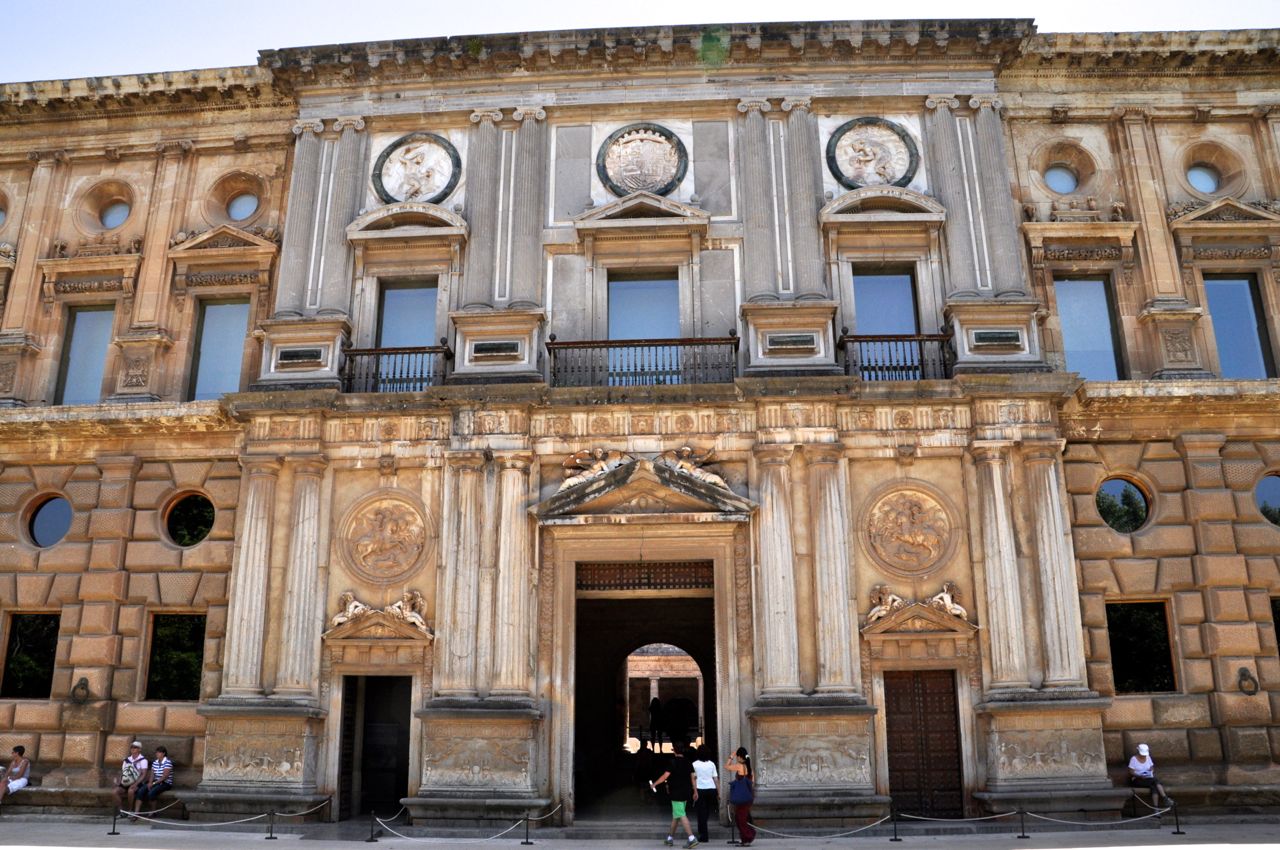
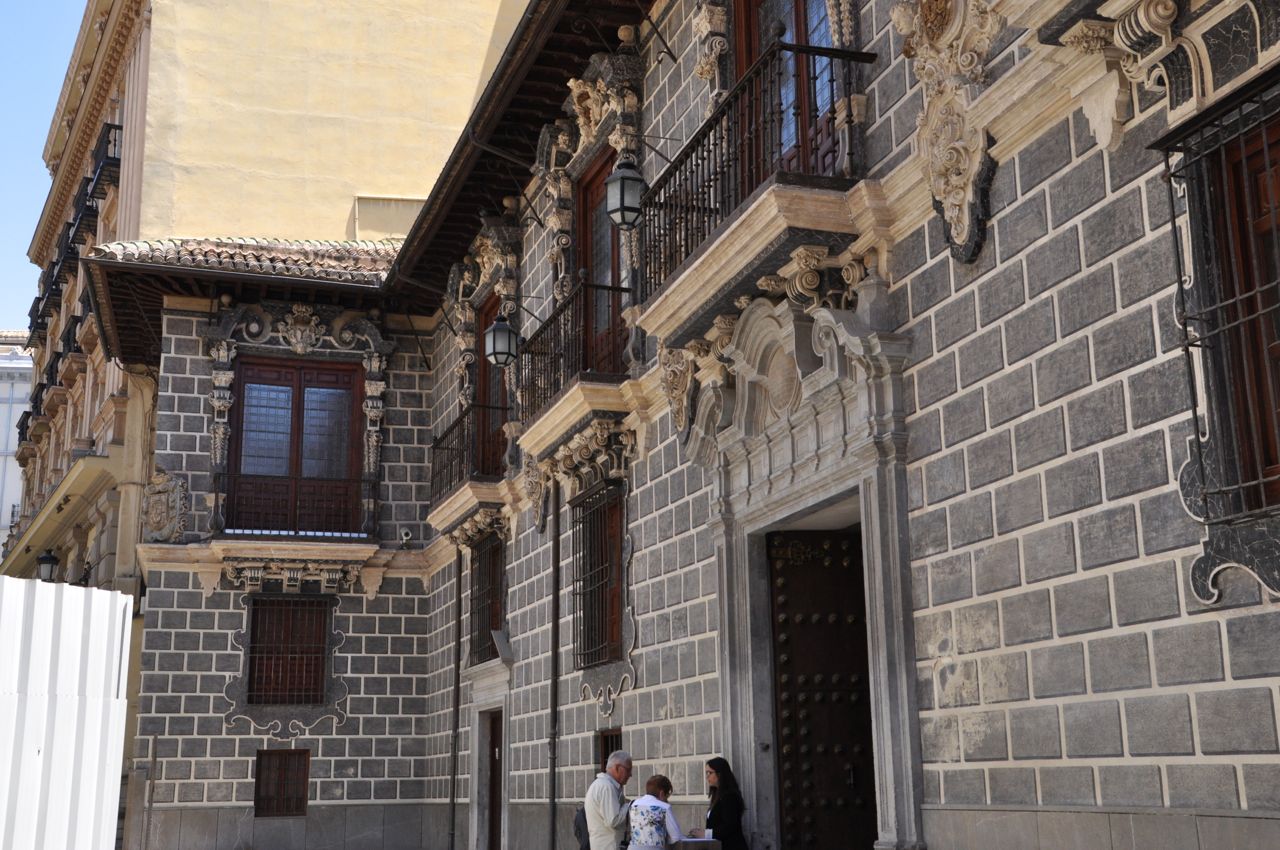
Nearby is Charles V’s palace; the conquerors should have their own palace, right?  Not that old one, the Moors’ Palacios Nazaries that we’ll visit shortly.  So in 1533 good ol’ Charles V Charles V's Palace(you remember him, right?  He OK’d construction of the Catholic cathedral in the middle of Córdoba’s Mesquita [post of May 13, 2014; “Córdoba”]) started construction of a new palace, financed by a poke-in-the-eye tax on Granada’s Muslim population.  However, a few years later Charlie lost interest and the project was abandoned without its planned roof.  Like the cathedral within the Mesquita, the architectural style of the palace (Renaissance) looks VERY much out of place in the Alhambra, but it is interesting in its own right.   On the exterior, the building is square, with pilasters framing the entrance.  The blocks beneath the bases of the pilasters have some fine carved battle scenes showing who won and who lost and why this building sits here, just in case you forgot (below, left).  Going into the building, a big

 surprise is that most of it is an open, completely circular courtyard, a circle within a square.  The large courtyard is surrounded by marble columns that create a covered balcony and a gallery (above, right).

THE ALCAZABA

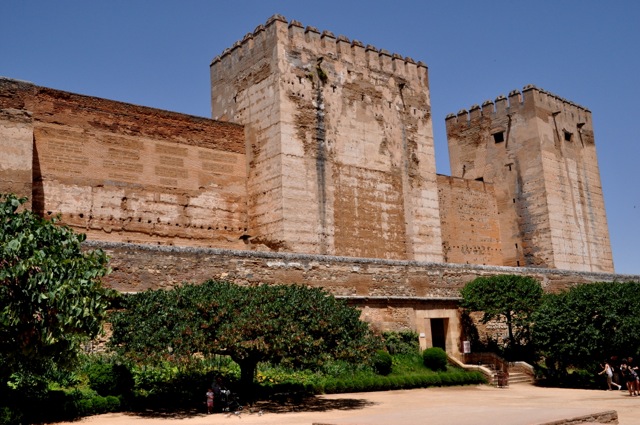
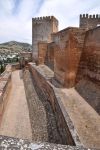
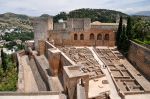
The AlcazabaWith tickets in hand, we now pass through the Wine Gate and face the Alcazaba, which certainly looks imposing even from inside the walls.  The courtyard in the front was originally a moat, which would have made it even more impressive!  The fortress is old, from the 1200’s, but is mostly in ruins, much of the destruction caused by Napoleon’s troops.  Pictures are shown below.  Note that the entrance into the fort, shown from different levels, is a back-and-forth path protected by several gates, the approach incredibly exposed from above.  I would NOT want to be part of the attacking party!

We’re now going to walk to the Generalife, the summer palace and gardens of the sultan.  It’s at the other end of the Alhambra complex, past what used to be an urban town (medina) of 2,000 people who lived up here.  The medina was also destroyed by the invading French, and ruins are only sporadically visible.  It is, however, a pleasant walk (see below).

One of the interesting buildings we walk past is the Parador de Granada San Francisco.  A Parador is an historical building that the Spanish government runs as a fancy hotel.  Within the Alhambra the building was a Moorish palace but was subsequently converted to a Franciscan monastery.  As you can see below it’s quite attractive.  How cool would it be to sleep here within the Alhambra!  But, alas, it’s far too expensive for our budget.

THE GENERALIFE

Path to the Generalife

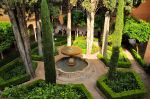
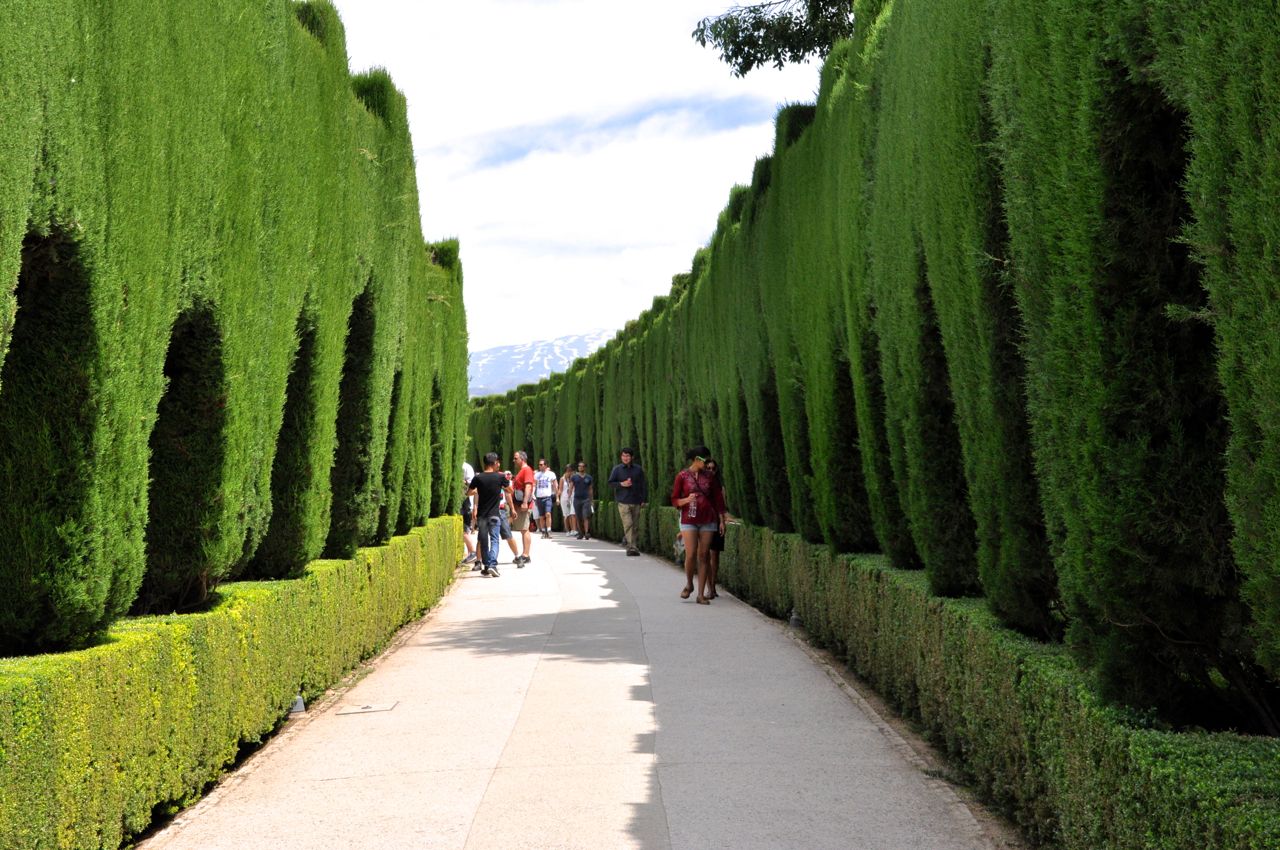
We continue to walk to the Generalife.  Tall evergreens line a charming path to the extensive gardens, where more evergreens in many shapes form shady, secluded, hidden areas around fountains and pools.  Everything seems to be in bloom.  It’s hard to capture the beauty of such an expanse in the small area of a photo, but I do take some side shots of flower areas with a view of the Alhambra.

At the end of the gardens is the sultan’s summer home, a cool and quiet escape.  You saw the overview of the summer home earlier (above) when we discussed the aqueduct.  Now we’ll go inside this house.  Even after all these centuries, it’s still pretty spectacular for a “get-away” place.  Pictures below.

THE PALACIOS NAZARIES

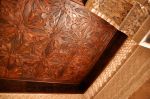
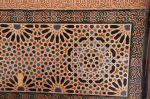
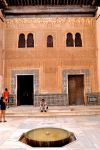
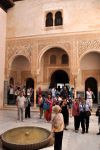
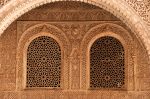
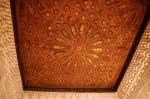
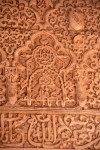
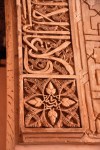
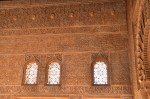
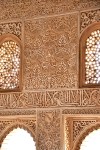
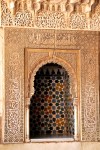
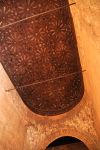
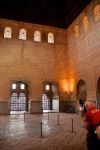
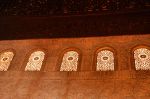
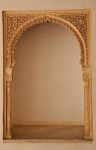
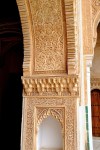
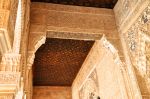
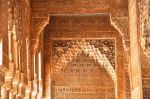
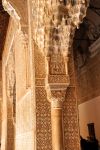
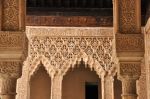
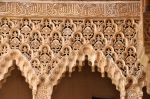
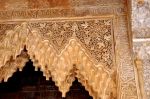
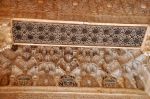
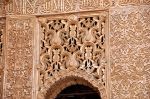
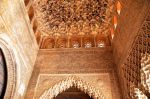
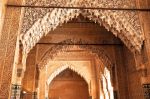
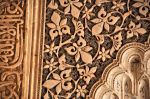
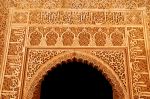
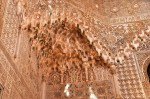
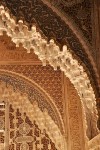
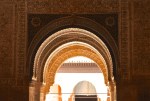
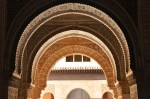
Finally, it is our time to enter the Palacios Nazaries (miss that entry time by 30 minutes and you don’t get in).  This is the jewel of the Alhambra, the reason most people come to Granada.  The royal palace was built mostly in the 1300’s and is the best example of the elegant Moorish civilization of that time.  Remember that gorgeous palace in Sevilla’s Alcazar (post of May 1, 2014, “Sevilla’s Alcazar”)?  It was copying the real McCoy here.  We are going to deluge you with photos!  There is much to admire – rooms decorated with molded plaster from top to bottom, beautiful and intricate carved wood ceilings, stucco “stalactites”, intricate ceramic tiles, and beautiful filigree windows.  Notice our repeating “beautiful” and “intricate” words.  What you will see is a lot of repetition in a decoration.  It just keeps going, yet it is not too much – well, maybe some of the tile patterns are optically active, but usually not.  The overall effect is what I call a “visual mantra”.  Something beautiful repeated and repeated and repeated, and you stare at it and your heart rate goes down, your blood pressure drops, and tranquility descends.  And your mind says “Jeez, is this ever beautiful”!  And you turn your head and see a new and different wonderful pattern and the feeling repeats along with the patterns.  We’ll just be showing you picture snippets, but we think you’ll see.  Enough talk!  I’ll divide the tour by rooms.  We’ll start by walking through a few “administrative” rooms, including an oratorio (a Mecca-oriented prayer room).

Administrative Rooms

No words – just walk with us.

The Oratorio

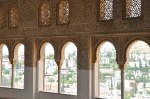
OK, mea culpa, we’re showing this room a bit out of order within the administrative rooms, but we just wanted to highlight it.  Not only is this room beautiful, it has a beautiful view of Granada’s Albayzín.

The Court of Myrtles

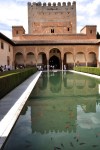
It’s named for the two fragrant myrtle hedges.  It’s pretty.  Some chambers were demolished to make room for Charles V’s palace, but happily only a few.  The lateral sections were living quarters for the women (harem).

The Boat Room

It’s so named due to a corrupted Spanish translation of the Arabic; it should read something more akin to “Room of divine blessing and luck”.  It’s a waiting room before entry to the Grand Hall of the Ambassadors, the sultan’s throne room.  My guess is that it was a bit more ornate back then.

The Grand Hall of the Ambassadors

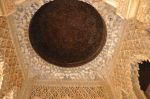
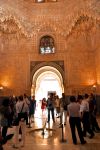
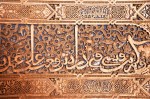
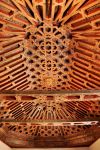
This is the palace’s largest room, the Sultan’s throne room.  It’s a perfect cube – would you expect anything less from these lovers of geometric design?  That domed wooden ceiling is a masterpiece of craftsmanship, with over 8,000 inlaid pieces.  The cornice consists of wooden “stalactites”; the stucco walls are still glorious even without their original paint and gilding.  The filigree windows once held stained glass (and had heavy drapes to block out the heat).  The calligraphic inscriptions are of poems, prayers or praises.  An example:

Oh, God, fighter of the devil, please help me.  In name of God, who is merciful and has mercy.  Oh, God, please be company and salvation for our Master Mohammed and his generation.  And say: May the anger of God and of every devil that allows the disturbance of hell help me; and deliver me from the evil of the envious ones when they are going to be envious.  And no deity but God is alive, whom we must praise eternally.  Praise to the God of centuries“.

The floor was originally marble, but is now tiles from the 1500’s – not a bad update!

When in use, the room would have been in semi-darkness, with the lighting concentrated on a throne opposite the entrance.  A visitor would have stepped from the glaring Court of Myrtles into this dim, cool, incense-filled, intensely decorated world to meet the silhouetted sultan.  Of course you have to imagine the pillows and Persian carpets and throne and ivory-inlaid chairs and vases and hookah pipes and probably gorgeous ladies and scribes and bustling aides.  We would have been impressed, and struggling to make eye-contact with the all-powerful sultan!

Connecting Rooms

There are connecting passageways to private rooms of the royal family (and servants, of course).  We’ll just show pictures.

The Courtyard of the Lions

This is the private quarters of the royal family, and probably the most famous area of the Alhambra.  We’re just going to show you the pictures (a lot of pictures), and then we’ll talk.

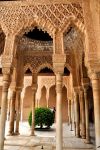
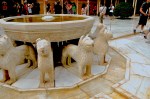
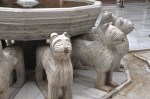
The design of the courtyard refers to Persian gardens of old.  It’s divided in quadrants symbolizing the four corners of the world, and irrigated by water channels (that went to the apartments of the royal family) symbolizing the four rivers of the Quran’s Paradise ; the theme is thus an architectural manifestation of Paradise.  The slender column forest has been said to represent the palm trees of an oasis in the desert.  Originally there was a below-level garden in each of the 4 quadrants, the top of the plants cut to be level with the courtyard.  Today the courtyard floor is white marble, in the center of which is a white marble fountain from the 1000’s, a dodecagon-shaped basin resting on top of 12 lions – one of the more important examples of Moorish sculpture (which ordinarily prohibits images of animals or humans).   There is a (long) poem in calligraphy on the basin rim, part of which is:

…Such a translucent basin, sculpted pearl!
Argentic ripples are added on it by the quiet dew
And its liquid silver goes over the daisies, melted, and even purer.
Water and marble seem to be one,
without letting us know which of them is flowing.
Don’t you see how water overflows the borders
and the warned drains are here against it?
They are like the lover who in vain
tries to hide his tears from his beloved…”

Another poem decorating a wall goes:

“How beautiful is this garden
where the flowers of Earth rival the stars of Heaven.
What can compare with this fountain, gushing crystal-clear water?
Nothing except the fullest moon, pouring light from an unclouded sky.”

The Courtyard is beautiful indeed, then and now.

Hall of the Abencerrajes

This was the Sultan’s living room, with an exquisite ceiling in the shape of an eight-sided star.  It has a history – a sultan took a new wife and wanted to disinherit the children of the first marriage, so he invited them (the Abencerrajes) to dinner and killed all 36 – nearly the entire family – but he missed the son who would ultimately assume the throne (some of the blame for the decline of the Muslim world had to do with such constant infighting.  The Catholics weren’t your only enemy).  Why am I not showing you pictures of this incredible room?  It was closed.  Bummer!  Below is a picture of the outside of the building, and next to it an internet picture of the ceiling.

Hall of the Kings

This is just a connecting hall at the back of the Courtyard of the Lions.  It is, of course, gorgeous.

Hall of Two Sisters

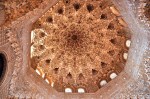
It’s named for the two slabs of white marble on the floor flanking the fountain carrying water to the Courtyard of the Lions.  It is the center of a series of chambers where the sultana and her family lived.  The ceiling is incredibly beautiful.

Well, that’s the shooting match.  There is still some beauty to be seen on the way out of the Palace, such as the Patio of Lindaraja, but it’s not on the same scale.

The sultan and his favorite wifeThat’s it!  It is a beautiful palace, putting the monstrosity of Charles V’s palace to shame.  He thought he could improve on the Palacios Nazaries???  We thought the art of the Moors was amazing.  Hope you enjoyed it.

Our next stop in Spain is Madrid.

Grenada

Hills of olive treesThroughout most of Spain, the trip to any city is past hill after hill planted in rows of olive trees.  Grenada, nestled at the foot of the Sierra Nevada mountains, is no exception.  Pretty, isn’t it?

As Cordoba declined, Granada grew, and for a time Granada was the grandest city in Spain – and ultimately the last city in Spain under The AlhambraMuslim rule.  The  Alhambra fortress, the last stronghold of the Moorish kingdom in Spain, finally fell to the Reconquista in 1492.  Until then it was the greatest Moorish palace, highlighting the splendor of a Moorish civilization that nowhere else shone as brightly.

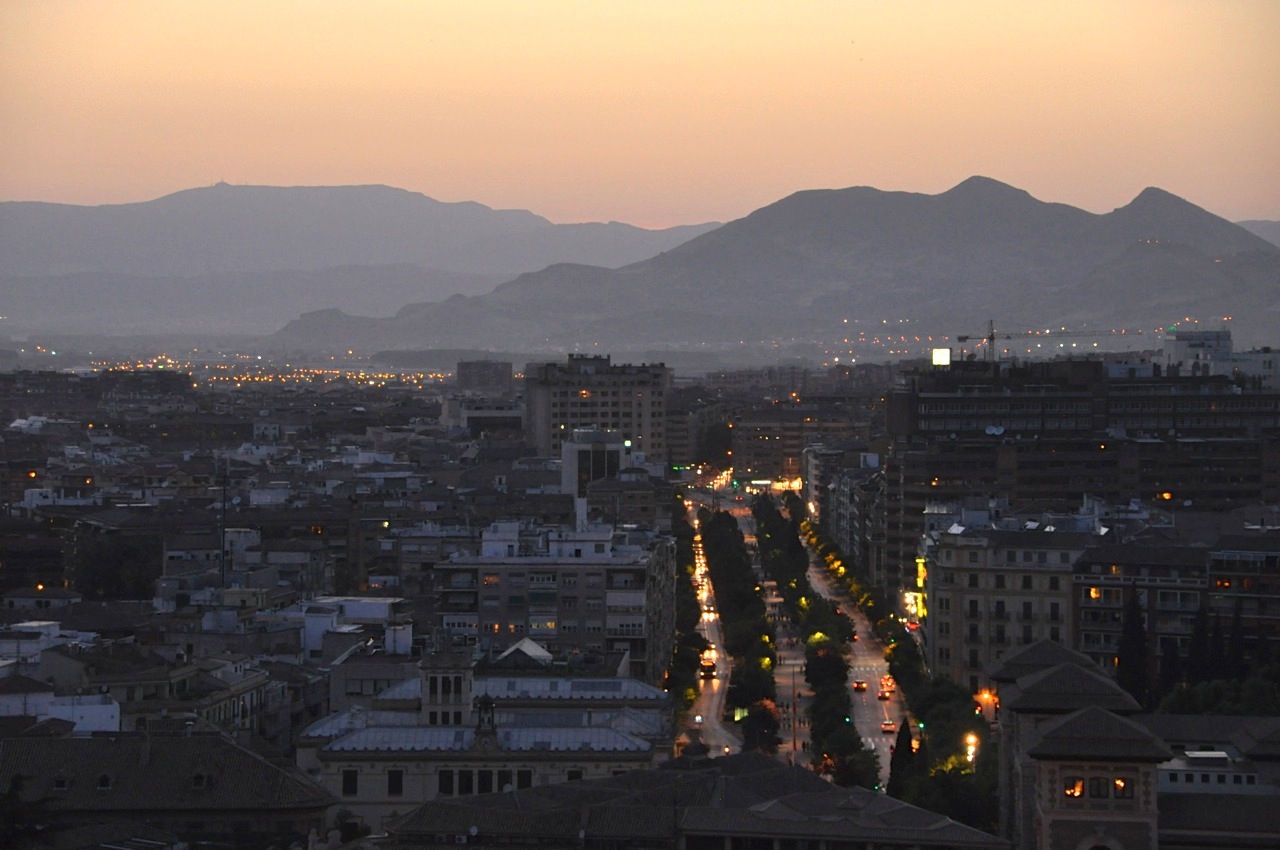
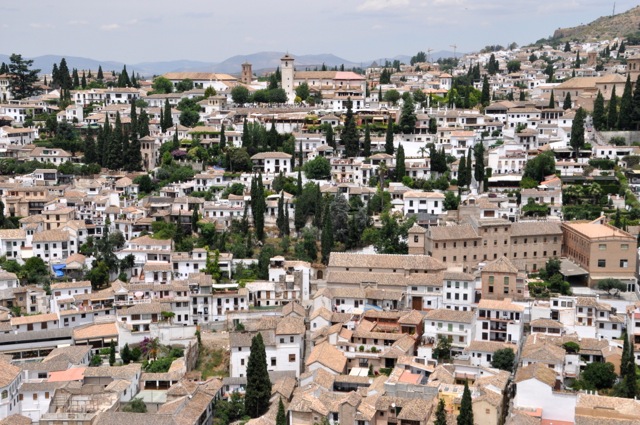
The modern city of GranadaToday Granada and suburbs have a population approaching half a million; it’s a modern city, as shown to the left, but the historical center is absolutely a world apart.  It dates back a thousand years, and as one of Europe’s top sights, draws up to 8,000 visitors a day (!), mostly to see the Alhambra.  However, Granada offers many more antiquities to see, among them a beautiful cathedral and the Albayzín, the best-preserved Moorish quarter in Spain.  The Albayzín The Albayzin, taken from the Alhambraflows down a steep hill across the river from the hill on which the Alhambra was built.  It’s a picturesque place, and strikingly different from the rest of Grenada!  That picture of  modern Grenada shown above was taken from the Albayzín; you stand in a Moorish world from the 1400’s, and look through a time warp into a modern, bustling city.

THE HISTORIC CITY CENTER

Let me start by showing you this historic center, home of a grand cathedral, the burial chapel of kings, the old silk market, Moorish baths, and a surviving caravanserai (a roadside inn for merchant travelers and their camels).  Although the modern city has infiltrated and surrounded these landmarks, the shops and plentiful restaurants absorb both the locals and hordes of tourists remarkably well.  Also doing well are the street performers, who are quite good, as shown below.

Some of the city’s North African heritage can still be seen in the open-air market for spices and herbs, and the many open-storefront grocery shops that abound.

THE HISTORIC CITY CENTER – THE CATHEDRAL AND THE ROYAL CHAPEL

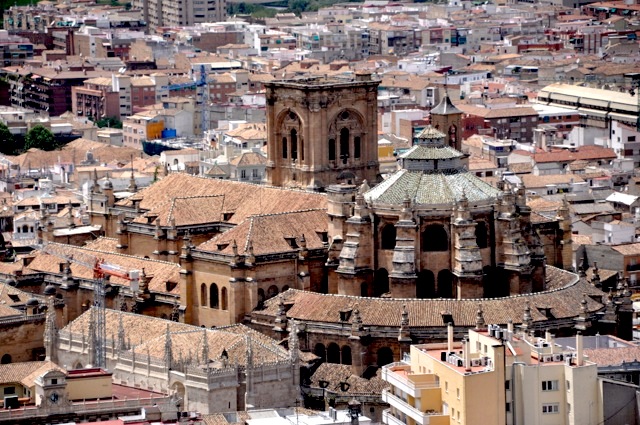
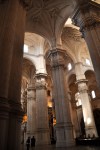
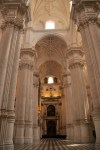
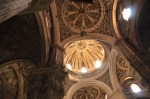
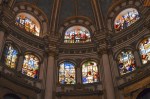
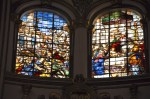
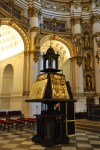
Granada was under Muslim rule for 700 years, the last 200 seeing it grow as the Reconquista slowly drove refugees here.  By 1400 Granada held 120,000 people, very large for Europe at that time.  The plazas here were bustling with the city’s main (and rich) markets.  Later, under Catholic rule, this area became the Moorish ghetto.  Then, with the Inquisition (1500), thousands of Arabic books were burned, the mosques razed, Muslims evicted or forced to The Granada Cathedral (and adjacent Royal Chapel)convert, and the Cathedral built on top of the old mosque.  And oh my, a statement was made with the Cathedral!  It’s the 2nd largest in Spain after Sevilla’s (post of July 11, “Sevilla and its Cathedral”).  It was built in Spanish Renaissance style, and finished 181 years later with Baroque decoration.  It’s hard to get a picture of the Cathedral from the outside, since it’s surrounded by other buildings, but it practically screams “Triumph!”.  A picture of the impressive exterior, and pictures of the equally impressive interior, are shown below.

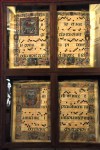
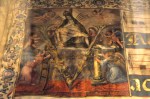
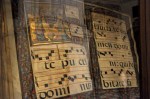
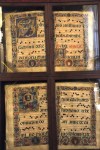
The Cathedral houses a collection of illustrated music sheets, mostly Gregorian chants from the 1500’s.  The artwork in these miniatures is amazingly beautiful!!

At about the same time as the Cathedral was being built, King Ferdinand and Queen Isabel decreed they wanted to be buried in the city of their final Reconquista triumph and ordered a Royal Chapel be built for Royal Chapelthat purpose.  500 years ago, this was the finest that money could buy – they spent 1/4th of their wealth on it.  It was completed in just 15 years.  The style is Plateresque Gothic – Gothic simplicity combined with Mudejar decoration.  Externally there is not much to see, since 3 sides are connected to other buildings (including the Cathedral).  Pictures were not permitted inside; the marble figures of the king and queen in repose are impressive – carved in Italy.

THE HISTORIC CITY CENTER – THE ALCAICERÍA

Originally this was an important Moorish silk market with 200 shops (sufficiently important that all of it’s 10 gates had armed guards ).  Destroyed by fire in 1850, it was rebuilt later that century for the tourist trade.  Today it has (unmanned) gates, a series of interconnecting narrow walkways, and marble columns defining the many very touristy shops.

THE HISTORIC CITY CENTER – CORRAL DEL CARBÓN

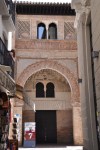
The name “carbon” comes from the earlier use of this building as a coal storage facility(!).  This is the only survivor  of Granda’s original 14 “caravanserai”.  Here, just a block away from the Alcaicería, merchants could rest their camels, get a bite to eat, and get a good night’s sleep.  It was built in the 1300’s and has a pretty fancy Moorish door for your roadside inn, as shown below.  Inside it’s plain but elegant, with surviving architecture and

brickwork .  The 1300’s!  Doesn’t the inside look an awful lot like today’s motels?  You park your camel instead of your car.  It’s always amazing how the basic things we need really don’t change that much through time.  Even 2000-year-old houses that we saw in Pompei, Italy looked very livable and inviting!

THE HISTORIC CITY CENTER – MOORISH PUBLIC BATHS

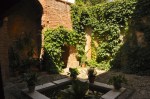
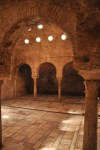
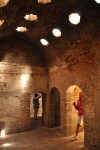
Public baths were a big part of Muslim community life, not only for cleansing but as a place to socialize or do business.  After the Reconquista, the Christians assumed that conspiracies might also be hatched there, so few survived.  Below is a survivor from the 1000’s, with the traditional cold room, warm room and hot room, and the heating below the floor.  It’s all very Roman, except the Romans had pools; the Muslims just doused.

THE HISTORIC CITY CENTER – THE OLD MADRASSA

The Christian City Hall Just across from the Royal Chapel is the Muslim madrassa or school, which became Christian Granada’s City Hall.  Today the outside has a strange paint job – those mortar joints are not real (picture, left)!   But inside, there is a lot of true 1400’s Muslim decoration (not Mudejar), and it is outstandingly beautiful.

THE ALBAYZÍN

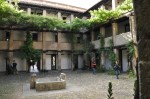
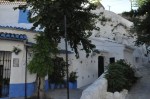
We’re staying in the Albayzín; on arriving we discover that it has a dearth of streets allowing car access; most “streets” are much too narrow, steep, and often have stairs; foot-traffic only.  Read: we had to struggle up cobblestone streets  with our backpacks quite some distance to reach our apartment!  The streets are narrow for a purpose, so that the surrounding buildings will provide shade from the hot sun.  For unknown reasons the streets are also maze-like, and even with a map you will get lost, guaranteed.  Finding the apartment we’d rented was not easy!  The instructions were to go to the cafe –

The 4 Gatos (you can see the patio umbrellas and awning in the first picture above) – and turn left.  Well, that takes us into a closed courtyard surrounded by building walls!  Eventually we discovered an alley at the very end of that courtyard that goes off to the right but was invisible from the street, (red arrow in left picture above – you’ll need to click on the picture to see it) – and eventually found the right building. Welcome to the maze!  Our small apartment is on the 2nd floor of the house shown by the blue arrow in the left picture above.  On the inside, picture to the right, it’s definitely Moorish; old wood timbers and columns and an interior courtyard that was the style then.  The apartment isn’t much, but that courtyard is pretty cool.

The “streets” are also interesting.  Down near the base of the Albayzín, just off one of the cities’ main avenues, there are small food stores, pubs, cafes, and a bit further up, a lot of

tourist shops, many of the latter sprawling into the street itself.  As you climb (and climb) higher, all that falls away and its just you hemmed in by close-set buildings on narrow twisting streets/alleys, until you turn a corner and are surprised by a small stone water fountain, or colorful tiles, or a cafe with umbrellas, a view of a residential patio garden, or a delightful small shady park.  Stopping at a cafe for a sangria or mojito on the hot climb is pure heaven!  Let me show you examples of the streets.  Notice that many of the streets are actually steps.

Examples of nice surprises.

There are 20 or so small churches here in the Albayzín, all sitting on spots that were once mosques.  They are often simple, to make it easier for the (you-better-convert-or-else) ex-Muslims who were not used to worshiping among images.  Below are two pictures of such a church (the alter was not so simple!), along with a picture of a picture of a convent from the 1500’s – it looked like it would be impressive, but it was closed when we came by.

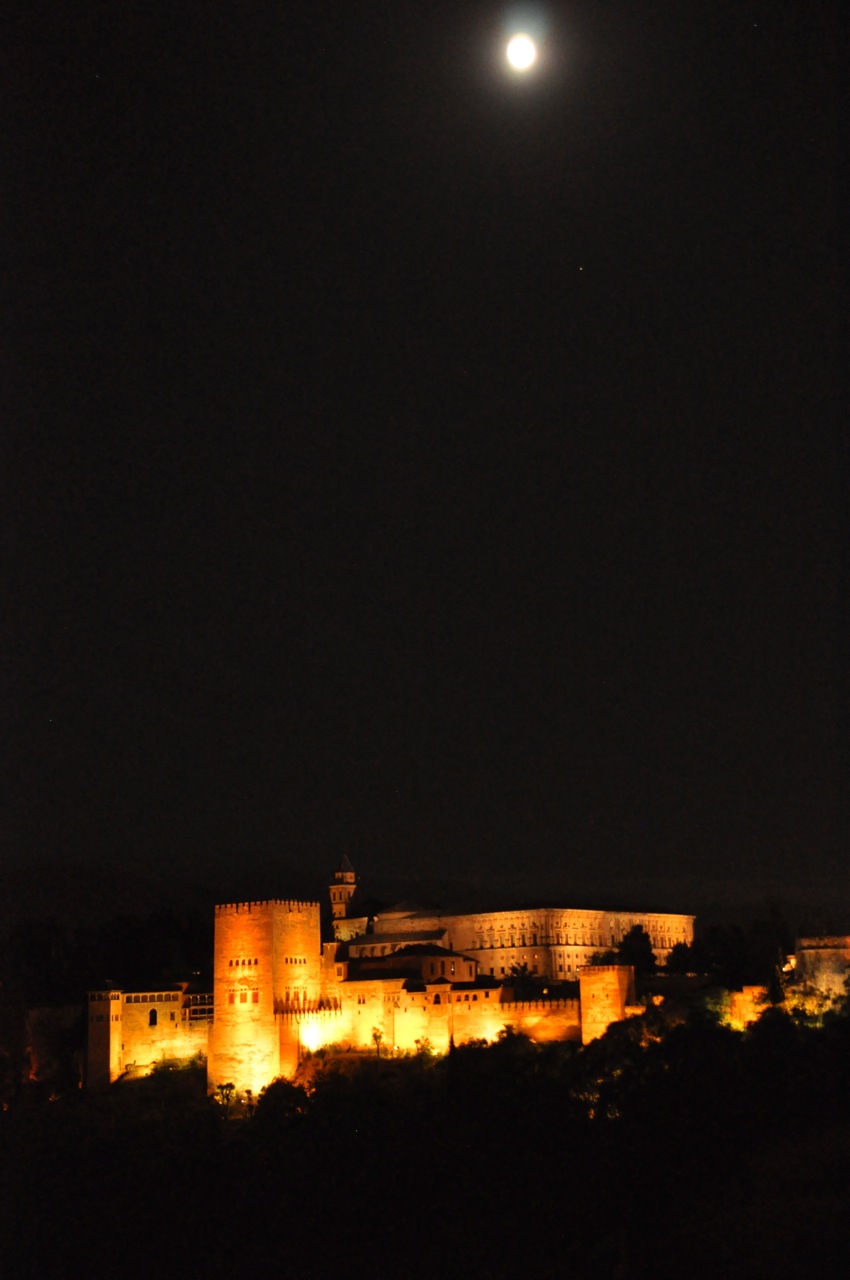
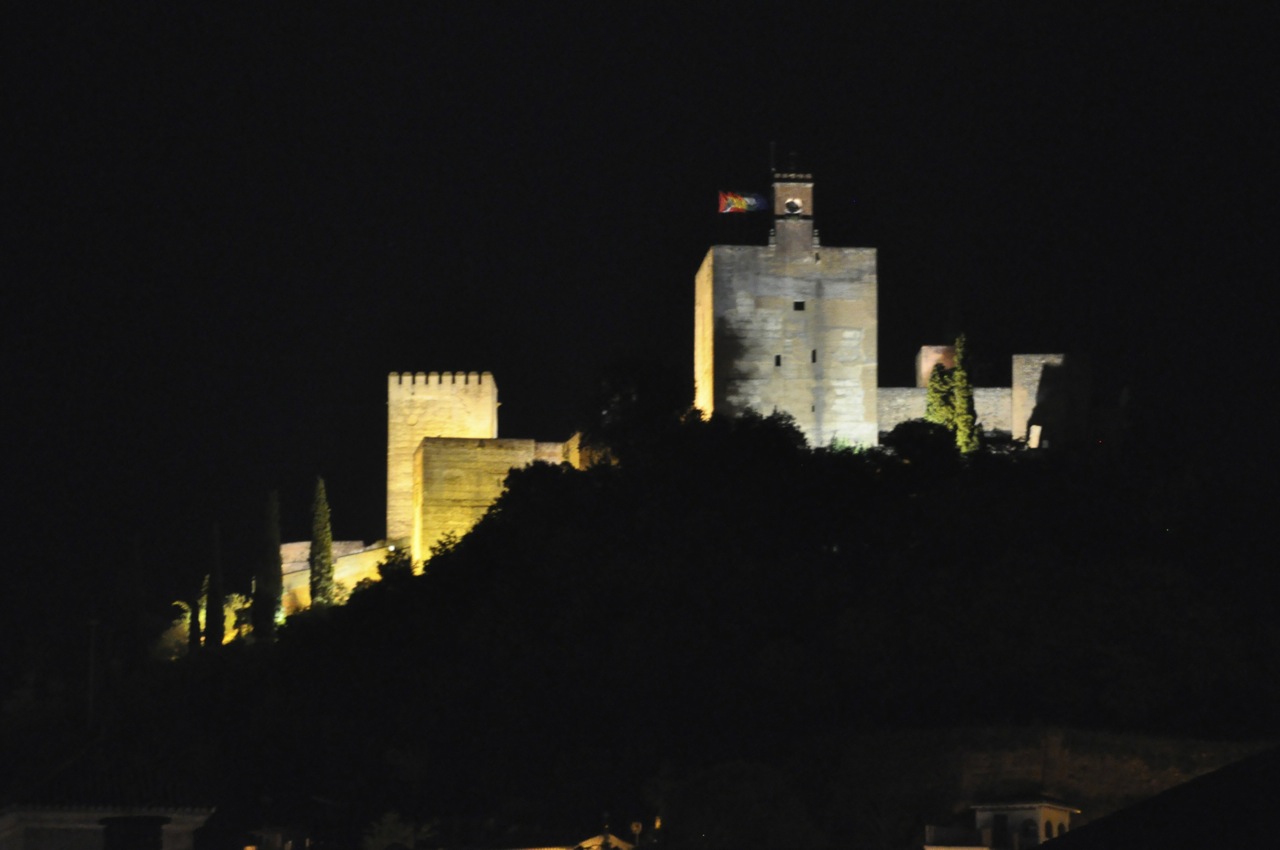
There is another interesting aspect to Granada – it has a distinct gypsy population of about 50,000, and although they’ve been in Granada since the 1400’s, they remain unassimilated.  Many of these gypsies live in a district directly connecting with the Albayzín, the Sacromonte.  This very colorful low-rent district (cave-dwelling is common, for example) also attracts “hippies” and some of Spain’s youthful unemployed (50% The Alhambra at night, from the Albayzínunemployment for the under-25!).  Many gypsies work the tourist crowds, and in general, deserved or not, they have a less-than-sterling reputation.  Put it all together, and guide books voice strong concerns about being in the Albayzín after dark.  Certainly Ginger had some reservations – after all, the place is nothing but dark alleys – but this is Spain, the land of the mid-day siesta producing a time-offset; restaurants don’t open for dinner until 8 or 9pm, it’s cooler then, and the Alhambra seen from the Albayzín is gorgeous at night, as you can see from the picture on the left.  So with a little prodding from me, off we went into the nights, and happily we had zero problems.

I really wanted to see the Sacromonte; there are tours that take tourists to bars and the gypsy Zambra dance (a flamenco variation), but we’re wary of (non-authentic) tourist shows.  I decide to walk there (in daylight), but Ginger is not enthusiastic; I’m on my own.  So I scale the Albayzín, and then down, and then up the Sacromonte, and it is sunny and I am hot, but it’s interesting.  From where I am the Sacromonte looks normal and well kept, until I realize that it’s not quite normal; most of the buildings and houses I’m seeing are just fronts with no depth; the houses are built into the hill (or into a cave, who knows?).

It’s similar to an Italian hill town, except the town is mostly hill!  Also I notice that I seem to be the only person in the world.  It is siesta time, and other than an occasional car coming by, nothing but nothing is stirring.  I see a sign announcing there is a  restaurant/bar up this driveway, and I’m hot and thirsty, and maybe I can find me a gypsy!   So up I go, up quite a steep, curving driveway, which continues up for much longer than I anticipated.  And up!  It’s a bloomin’ mountain!  I get there, and it is closed.  Drat!  Learning: Gypsies take their siestas very seriously.  Time to go home.  On the way out, I come across a guide with a family on tour, on Segways.  We’re at the top of a quite steep and long hill, looking down, and the guide is talking to a young lady on her Segway “You just release the brake and lean forward ….”   Think Olympic ski jump ….  After I reached the bottom, walking, the Segways were still up there.

Let me finish with a view of Granada food.  It wasn’t too shabby!

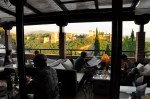
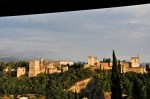
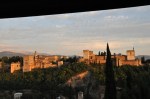
San Nicolas Viewpoint from the AlhambraNot only is the food quite good, but it often comes with a great view, particularly in the Albayzín.  One of our favorite restaurants has an impressive view of the Alhambra.  It’s at a popular spot, the San Nicolás viewpoint, and as you can see in the picture a lot of people hang out in the small park there to catch the sunset.  Just below that gray wall (and across the street) is the restaurant – those dark bays above the white wall are the restaurant windows.  In the pictures below we’re inside that restaurant looking out, and we’ll share the view of the sunset with you – oh, and maybe you’ll notice the Alhambra is part of the view ….

Romance?Is that romantic or what???

Next post – inside the Alhambra!

Córdoba

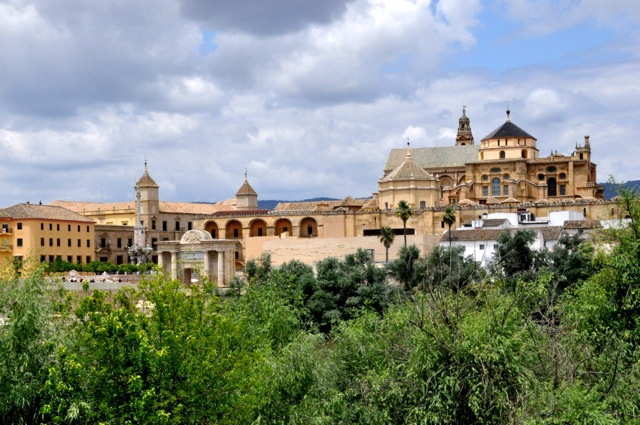
Córdoba is a fascinating city, and the highlight of our Spanish trip.  We loved it.  It’s dripping with history; the intersection of Christianity and Islam is most vivid here.  It was an outpost of the Roman Empire, but by the time of Julius Ceasar it had become Rome’s regional capital.  The Visigoths took over in the late 500’s, but in the early 700’s it was captured by the Moors.  Then it flourished!  In the 900’s it became the regional capital of the Muslim world, and surprising to me, the world’s most populous city and it’s intellectual center (the rest of Europe was mired in the Dark Ages).  It was famed for its artistic expression, dedication to philosophy and science, and its religious tolerance (although Islam was preeminent, Judaism and Christianity co-existed [and it still has an historic Jewish Quarter]).  The “Ornament of the World”,  it reportedly had 3000 mosques, splendid palaces, 300 public baths, and the largest library in the world, housing as much as a million volumes.  All of that changed quickly with a new hard-line ruler in the late 900’s.  Gone was religious tolerance, books on philosophy were burned to please the Muslim clergy, and the other volumes were sold or lost in the ensuing power struggles/battles (some things don’t change in the Muslim world).  The city declined steadily, and in the early 1200’s it was captured in the Christian Reconquista.  Today, Córdoba’s big draw is the mosque-turned cathedral called the Mezquita.  Remarkably well-preserved, the Mezquita gives a fabulous glimpse into the Muslim world of the 900’s, and stands in stark contrast to the Catholic religion that replaced it.  It’s visually and emotionally breath-taking.  It blew us away.  You’ll see.

Modern Córdoba is an attractive city (see below) but we’re staying in the medieval town,

Córdoba, medieval regionquite striking in it’s own right (picture on the left).  Sevilla has taught us well (June 24, ’13, “Sevilla – Getting there”); we’re  getting used to driving and parking in impossible places; as you can see in the picture below, medieval streets are narrow and make right-angle turns with little room for error, and Narrow medieval streets still permit car trafficwe’re driving these streets and not even breathing hard!  Well … maybe a little.  Maybe an occasional “Eeek …. Eeek!” from Ginger.  Much better than the screaming and beating I was getting before.

The barrio is quite attractive, although many of the stores have a decidedly tourist nature to them.  The jewelry in some of these stores is actually pretty amazing; artisans are at their benches.  Much of the area has white-washed walls, with flower pots hanging everywhere.  We haven’t been to Greece yet, but we think it must look something like this.


Residential areas are quite attractive, and courtyard gardens are a big deal here – which is also reflected in the greenery in some of the restaurants, as shown in the last two photos below.

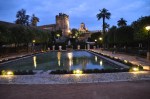
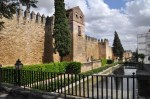
First we’re going to show you the Alcazar – Castle of the Christian Kings.  It’s an impressive fortress from the outside and the inside gardens are attractive.  We didn’t pony up the admission fee, but did buy tickets for an evening concert being held on the grounds, hence the evening pics of the gardens.  Alas, the concert was cancelled when it started to sprinkle just before starting time (musicians have expensive instruments).

Now for the Mezquita.   We are going to show you a lot of pictures, because it is such an amazing place.  It was built and expanded from the 700’s to the 900’s so it’s – what? – about 1300 years old.  Today it’s one of Europe’s most breathtaking examples of Spanish Muslim architecture; back then it was the heart of what was the grandest city of the

medieval world.  From the pictures above, you can see that the mosque is absolutely massive!  It goes on forever.  Also note that the walls are far from plain; even after 1200 or so years the (no longer used) entrances are impressively beautiful, shown below.

Now let’s go inside.  One enters first through a grand portal into the Patio de los Naranjos (Courtyard of the Oranges) where Muslims would perfom a ritual washing before entering to worship.  The massive bronze door at the entrance looks exactly like the one in the cathedral in Sevilla (July 11, 2013, “Sevilla and its Cathedral”).  It’s magnificent.

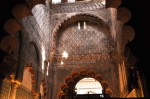
From the courtyard, with its orange trees arranged in spaced rows, one enters the mosque – into a forest of delicate columns that line up with the rows of orange trees in the courtyard, essentially joining outside to inside.  The 900 columns, some from as early as

AD  780, seem to recede to infinity, in all directions, as if reflecting the immensity and

complexity of Allah’s creation.  These are double arches, made from alternating red brick and white stone, sitting on top of marble, granite and alabaster columns (many of the materials are recycled from Roman ruins and Visigoth churches).  The arches are a neat engineering trick:  supporting the ceiling with such  thin columns required extra bracing using double arches.

At the start of this post we mentioned in passing that this mosque is now a Catholic cathedral.  During the Reconquista (which arrived in Córdoba in 1236), the normal process for dealing with a conquered populace was to destroy existing mosques and build Catholic churches on the ruins – making a subtle statement!  With a mosque so beautiful, the conquerors chose, instead, to simply reconsecrate the mosque as a Catholic church.  It acrued only minor changes over the next 300 years, but in the 1500’s King Carlos I was prevailed upon, over city council objections, to build a cathedral on the site.  The workman, however, respecting the beauty of the mosque, chose to build the cathedral smack dab in its center, thus leaving at least a portion of the mosque for future generations.  The juxtaposition of these two religious buildings is jarring (which we’ll revisit later).  For now, let’s note the ongoing Muslim/Catholic conflict at this site; the mosque was actually built on the ruins of a Visigoth church – there are stone carvings and mosaics from that period within the Mezquita, pictures below.  Muslims want more say

concerning the Mesquita, including its use for prayer again.  The Catholics argue that the Mezquita was always a Christian church, and the Muslims were just temporary residents (for 500 years!).  The battles continue ….

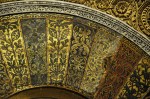
Below are pictures of some of the beautiful ceilings in the mosque.  There are many, many patterns in these decorated ceilings, some of them similar, but we couldn’t find an actual repeat.  They’re gorgeous.

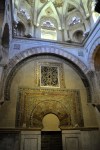
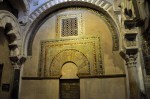
In the center of the pictures below, you’ll notice three highly decorated arches, distinct from the red and white striped arches seen in the rest of the Mesquita.  This is the

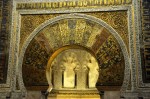
approach to the mihrab, the mosque equivalent of a church’s high alter.  The mihrab is a decorated niche/room where the imam would stand facing toward Mecca, with his back to the crowd, and read from scripture, give sermons and pray; the dome of mihrab was specifically designed to amplify the voice of the imam throughout the mosque.

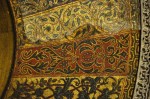
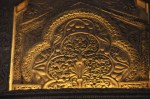
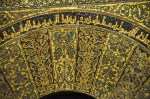
The  mihrab, in all its gloryThe mihrab is spectacular!!!  This artwork, done in the AD 900’s, still sparkles and bedazzles more than a millennium later!  Its beauty and its amazing intricacy are mind-boggling.  It is impressive from afar, but even more impressive the closer you get.  Decoration is on everything, everywhere you look, yet the effect is not excessive.  Reflecting the incredible wealth of Córdoba, the art was fashioned by Byzantine mosaicists using 3,000 lbs of glass-and-enamel cubes to depict stylized leaves, flowers and quotations from the Quran.  The pictures below do not do it justice, but they should give you a hint of its exquisite beauty (This artwork is also the wallpaper background of this blog).  The surrounding stone carvings are also amazingly beautiful.

The mihrab is mirrored on both sides by studded doors each topped with a similarly beautiful arch.  Even the grates above the arches are gorgeous.

I hope you’re suitably impressed.  Now return to the mihrab; with all that beauty in front of you, there is yet more to see by looking up!  The effect is the visual equivalent of surround-sound, a full-amp display of sparkling beauty.

Looking up at the dome, it’s fascinating!  Eight beautiful intersecting arches form bays for eight skylight windows and frame a scalloped octagonal dome.  Within that interior space the dome’s intricate ribs create a flower, the petals inscribed with beautiful flowers themselves.  It’s spectacular!  Curves within curves, octagons within octagons – the Muslim artisans were masters of geometric design.

The mosque is absolutely vast – it could hold 20,000 people on their prayer rugs – yet the low ceilings and nearby columns create an intimate, enclosed and worshipful atmosphere.  Well, when the mosque was turned into a church, what to do?  No way were the Catholics going to be able to get 20,000 attendees from a Muslim city already in steep decline.  So initially the conquerors did very little, replacing just 16 Mezquita columns with Gothic arches to make a small chapel.  In the late 1300’s a Royal Chapel was built for the tombs of the now Christian Kings; it was never open to the public, and isn’t now, but I was able to take pictures from afar; the well-preserved Mudejar walls and dome are beautiful, as shown below.

Peripheral regions of the mosque were re-purposed for Christianity, such as the incorporation of small chapels, tombs, baptismals, and the Treasury, examples shown below.

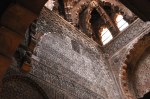
In the early 1500’s came the decision to build a grand Catholic cathedral in the Mezquita’s center.  It was done in late Gothic style, with towering Renaissance arches and a beautiful ceiling.  It’s an attractive church, really, but in my mind it’s a disaster!  The comparisons that it invites do it no favors.  One enters a mosque, and the Catholic church is nowhere to be seen; it’s lost in the forest of (beautiful) columns.  When you do find it, it

appears suddenly and awkwardly, hidden by the low ceiling of the mosque.  While the mosque is about 30 feet high, the cathedral is 130 – 4 times the height!  I did not take many pictures of the cathedral, due to my very negative emotional reaction.  Here are the pictures:

Yes, the cathedral is beautiful.  There is an extensive, if not bombastic, display of wealth and greatness and grand vastness.  Emotionally, however, we were shocked.  Within just a few feet we could immerse ourselves in the Muslim environment or the Christian environment.  The evoked emotions were radically different, and our Christian roots were challenged!  Surprisingly, going from mosque to cathedral was almost revolting!  The mosque with its low ceilings and close columns was all intimacy with Allah and awe at the world’s beauty and endless repetition.  The cathedral with its vast vertical space and elaborate, ornate displays of wealth evoked feelings of being small (and poor) before a distant, rich and very powerful God.  I may not be able to express the evoked feelings well, but the difference in aesthetics and psychology between the two religions that leaps from this juxtaposition was easily felt by both of us.

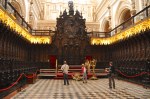
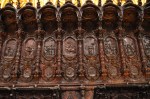
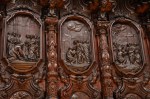
However, I would be remiss if I did not show you the truly amazing Baroque-era choir stalls in the cathedral, made in 1750 from New World mahogany, one of the masterpieces from this time.  Each stall features a scene from the Bible.

We’ll close this looong post with two final sections on the old city, interesting given that in the 900-1000’s it was the world’s greatest city (who knew?).  Below are a drawing and a model of a portion of the city from that time, showing some of the city wall, to the right the Mezquita, and to the left the Alcazar (fortress) of the Caliph, the top Muslim ruler of the region.  This was a city of maybe half a million people (!), and the Mezquita wasn’t big enough, so Córdoba had many more mosques (!), two of them (the twin mosques), located between the city walls as shown below.  Note in the model the large waterwheel bringing water from the river into the city.

Today there are still remnants of the old city, as shown below.

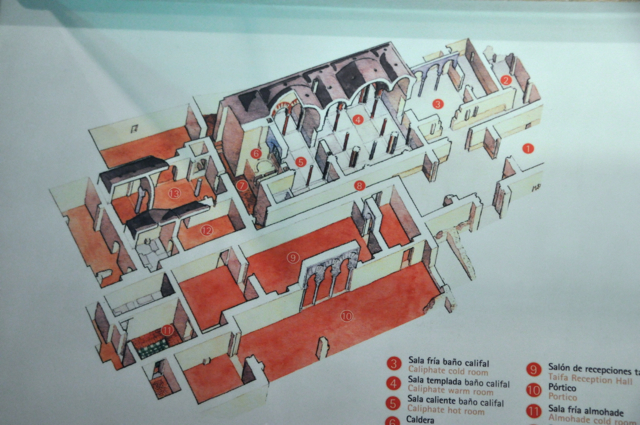
Diagram of the Caliphate's bathsFinally, we’ll quickly visit what remains of the baths of the Caliph, where apparently a lot of the Caliphate’s business was conducted.  The baths were pretty fancy, as shown in the sketch, and involved the normal cold, warm and hot rooms, heated from under the floor (wear wooden sandals).  The sketch shows it was an impressive facility, but today the ruins offer only a hint of that glory.

That’s enough!  What a fabulous city!  Hope you enjoyed it.

Next stop: Grenada and the famous Alhambra!

Sevilla’s Alcazar

NOTE: When I started this blog back in May of 2013, in Spain, I struggled to put pictures into a post, not knowing how to do it well.  The struggle was enough of a hassle that I quit until I could master this blogging art (old-dog problem).  Now, almost a year later, roosting in New Zealand with over 50 posts to my credit, I am returning to my Spain pictures to back-fill those adventures.  And indeed, as much as NZ is an amazing adventure in physical beauty, Spain is an amazing adventure in culture and history.  You’ll see.

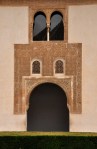
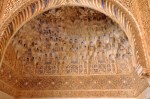
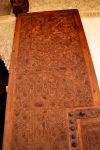
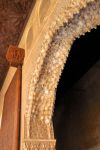
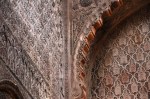
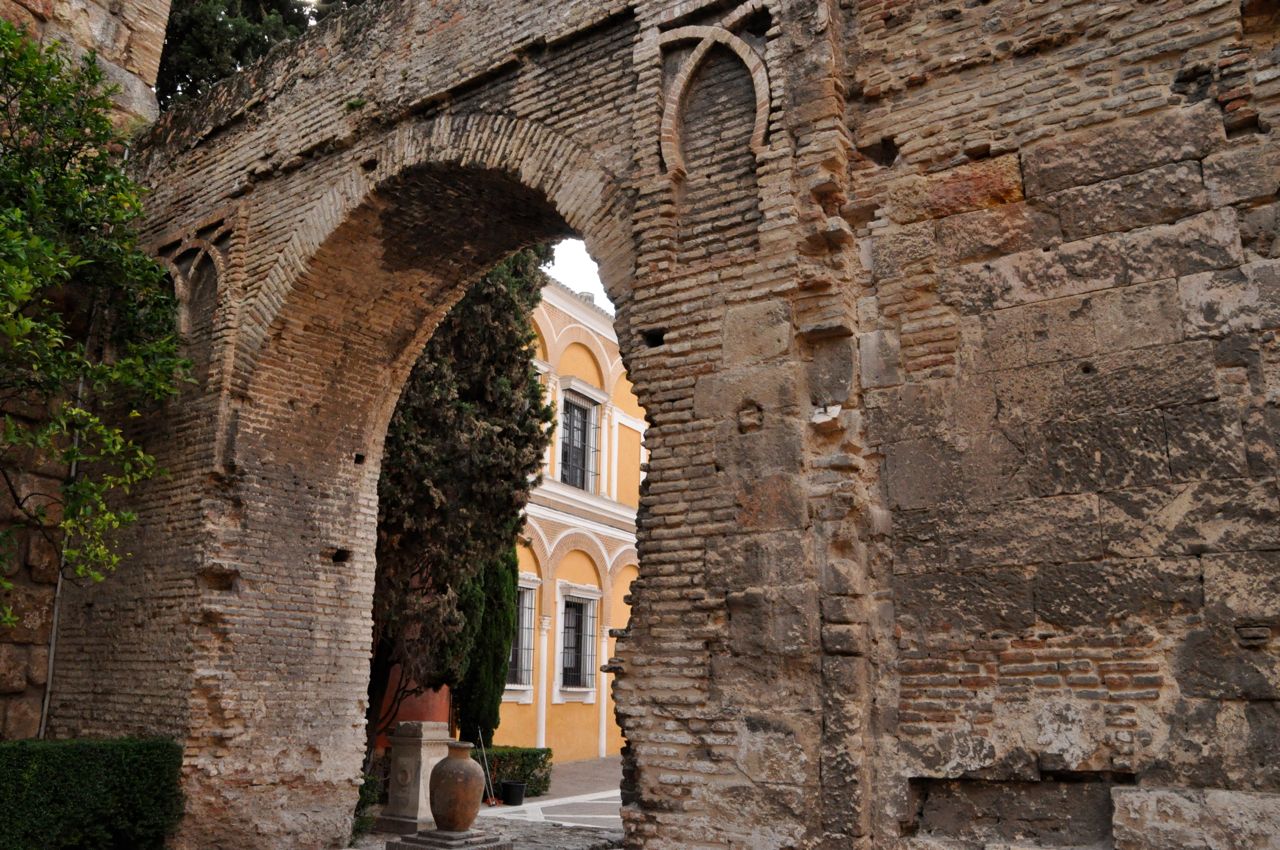
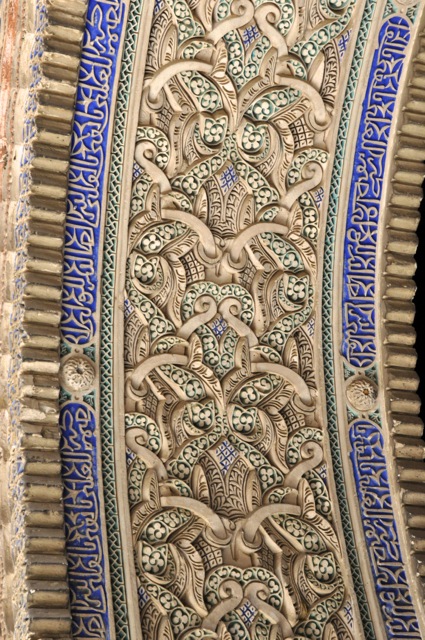
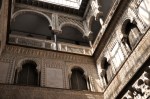
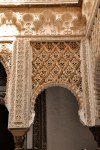
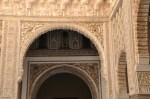
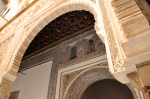
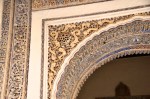
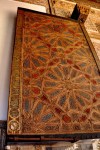
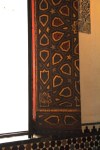
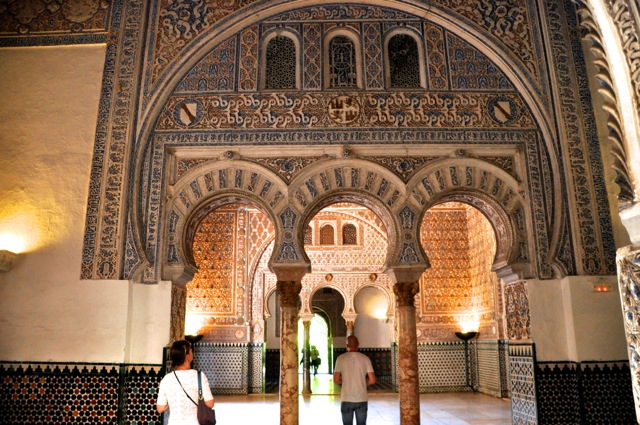
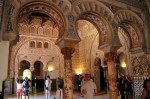
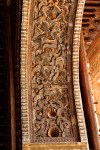
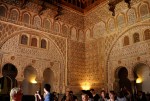
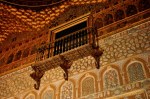
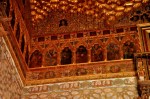
Original wall of the Moorish palace, AD 900'sAaaaaand, picking up where we left off, now we’re at Sevilla’s Alcazar.  Oh my.  Originally it was a palace built in the AD 900’s for the local governors of the local Moorish state (the picture shows an original palace wall).   After the fall of Sevilla in the 1300’s the palace was extensively expanded and rebuilt when the Christian King Pedro the Cruel left his wife and moved to the Alcazar with his mistress.  He hired Muslim workers from Grenada to recreate the romance of that city’s Alhambra (we’ll see Grenada in a coming post).  The style is called “Mudejar” – built by Moorish craftsmen for Christian rulers – and even with the subsequent hodgepodge that comes from more than 800 years of lived-in Plaster decoration on archway; note it is 3-D!renovation, the Alcazar is considered Spain’s best example of that style.  Mudejar is distinctly Islamic, using tile and plaster and wood that is highly decorated with a dominant geometrical character.  Its striking appearance is the result of the interconnection and superimposition of geometric design with different stylized elements such as stars, leaves, flowers, shells and calligraphy (quotations from the Quran) – anything but human or animal forms, depictions of which are forbidden by Islam.  The Mudejar’s complicated patterns have never been surpassed in sophisication; computer analysis has shown that many of the patterns followed complicated mathematical equations.  You might want to take a close look at the plaster decoration shown here (it’s the inside of an entrance arch).  That’s plaster, carved in 3-D, with stylized flowers and leaves arranged in a complicated pattern interweaving and repeating.   It’s truly amazing art, but it’s very hard to capture its intricacies with a camera – from afar the detail is not easily seen, and up close one can only view a tiny piece of the interconnecting, incredible and mesmerizingly beautiful work.  The walls, the arches, the ceilings, and even the floors are all amazing.  I’ll try to give you a feeling for it.  One could stand and gaze at this stuff for hours – which I guess we did.

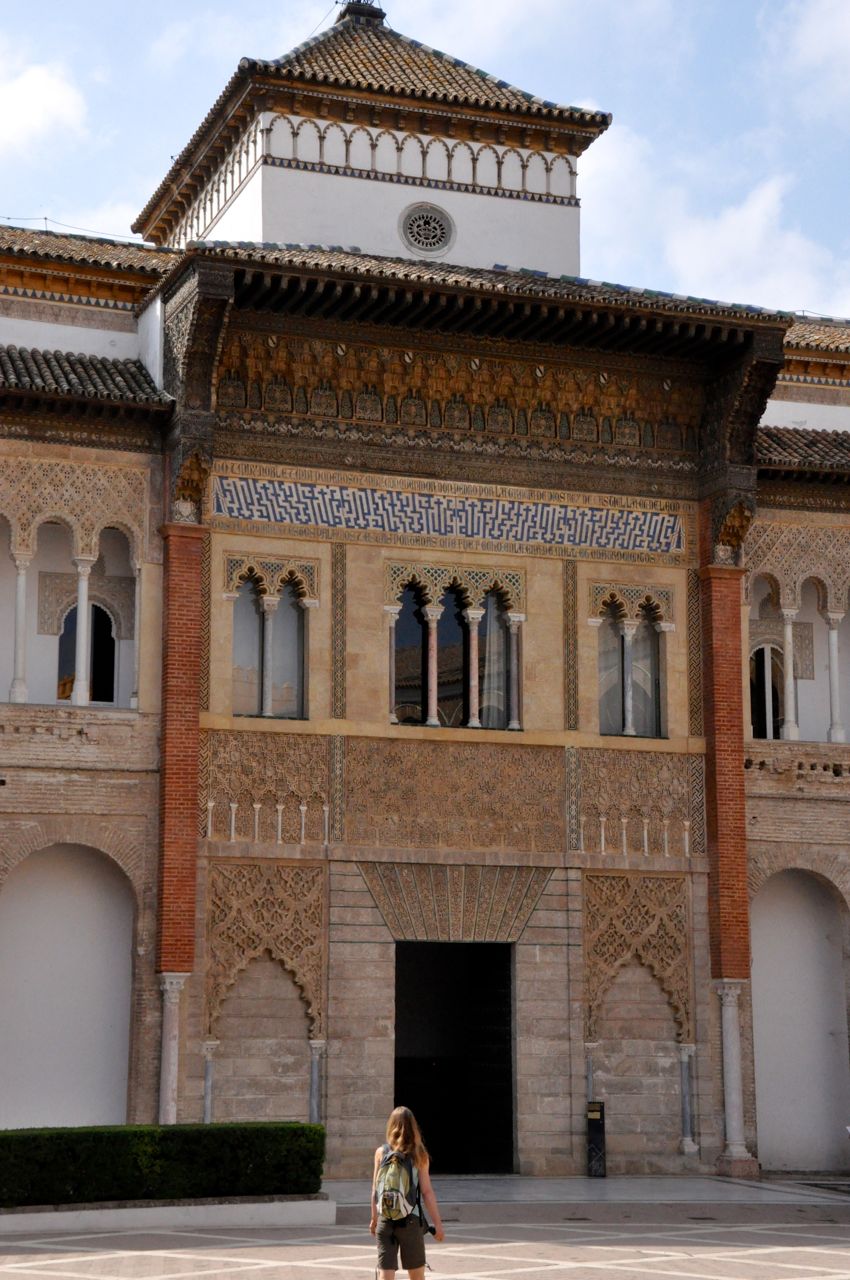
The floor plan of the palace is very confusing, perhaps as a protective device and likely as a means to impress with surprises.  It does that.  Every turn, every corner is a WOW.  The palace is still occupied today, but rarely, when the King and Queen of Spain visit (then the palace is closed to the public; hence tour guides are not big fans of royalty).  In this Patio de la Monteria, Admiral's Apts (1500's) and Pedro the Cruel Palace (1300's)picture, you’re standing in the Plaza de la Monteria; on the right is the Admiral’s Apartments from the early 1500’s.  When Columbus returned with news of the New World, Queen Isabel realized it could result in big business and created this wing to administer New World ventures.  To the left (out of view) is the Gothic Wing, built in the 1200’s; you can see a piece of it through the gate in the first picture.  We’re going straight King Pedro the Cruel's Palace entranceahead into King Pedro the Cruel’s Palace of the 1300’s.  Of course the palace has seen 8 centuries of living, and the colors are faded, and there are chinks here and there, so you’ll have to imagine how grand it must have been; nevertheless, although time has taken its toll, and colors are often gone, what’s left is still going to blow you away!

First let me show you some close-ups of the entrance and upper level.  Wow, we thought, clueless as to what was to follow.

Then comes the interior, and it starts out “isn’t that nice”.  Note the interesting ceilings!


As we wander through the maze of interconnecting rooms, the “isn’t that nice” slowly ratchets up to Holy S…!”  The intricate plasterwork begins to occupy the columns and walls, and the ceilings are incredibly beautiful, each with very different designs.

Court of the MaidensWe come to the Court of the Maidens, a central area surrounded by a number of other connected rooms, and likely an area where the king did business.  Not too shabby!  The upper level was actually added in the 1500’s (Renaissance style), but I think it works.  Other views are shown below.

The arched entrances to the other rooms have fabulous plaster decorations!

The ceilings in the walkways are varied and spectacular, as are all the patterns in plaster.

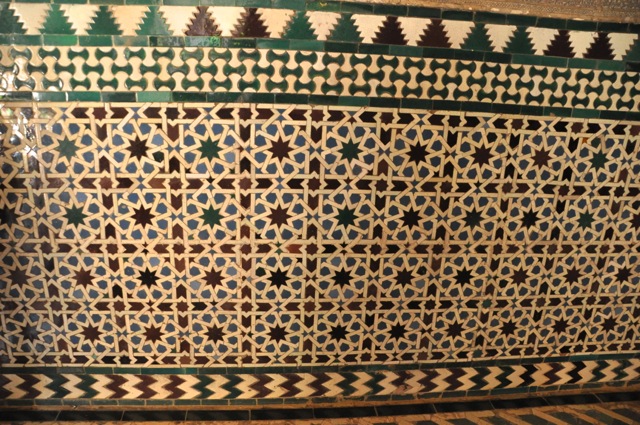
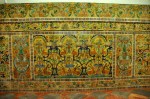
The lower part of the walls are solid tile in a Tile wall with intricate lines forming 8-sided starsgreat variety of intricate designs; in the one shown here, the geometric lines produce 8-sided stars and the appearance of squares, yet none of the lines makes even more than 1/8th of the side of a square!  I dare you to try and follow the path of one of the defining lines!

Below are pictures from some of the connecting rooms, beginning with a picture of one of the gorgeous wood shutters for the windows; each window has shutters with different patterns.

Next we come to the Dolls’ Court, which gets its name from two tiny faces decorating one of the arches.  This room is thought to be the harem in the original palace (rank has its privileges), but which became a private region for King Pedro and his family.  Originally the court center had a pool, reflecting the once brightly colored decorative patterns.

As we wander around, getting lost in the maze of rooms, I take more pictures, mostly ceilings and window shutters.

Entrance to the amazing roomThen we stumble upon this entrance.  It goes to the Hall of the Ambassadors.  The room is – can I find more superlatives? – the most fabulous amazing ornate spectacular palace room (see below).  Because of the startlingly unique ceiling, it is also called “The Room of the Half-Orange”.


Wow!  How do you  follow that?!  We wander on – it’s hard to top the Hall of Ambassadors, but we do find some very nice ceilings in connecting rooms, as shown below;

and suddenly we’re in the Gothic wing of the palace. It’s strikingly different (see first two pictures),  but it does contain some very interesting tapestries from Brussels dating to the 1500’s.

From the Gothic Wing there is an exit to the Gardens, which are more than extensive.

Leaving the Palace through what was the carriage entranceFinally, we exit through what was once the “parking lot” for the visitors’ carriages and horses.

Hope you enjoyed this visit to the Alcazar and its Mudejar art.

The next post will be about the fascinating city of Malaga on the Costa del Sol.

Dunedin – Chinese Scholar Garden, and Polynesia

CHINESE SCHOLAR GARDEN

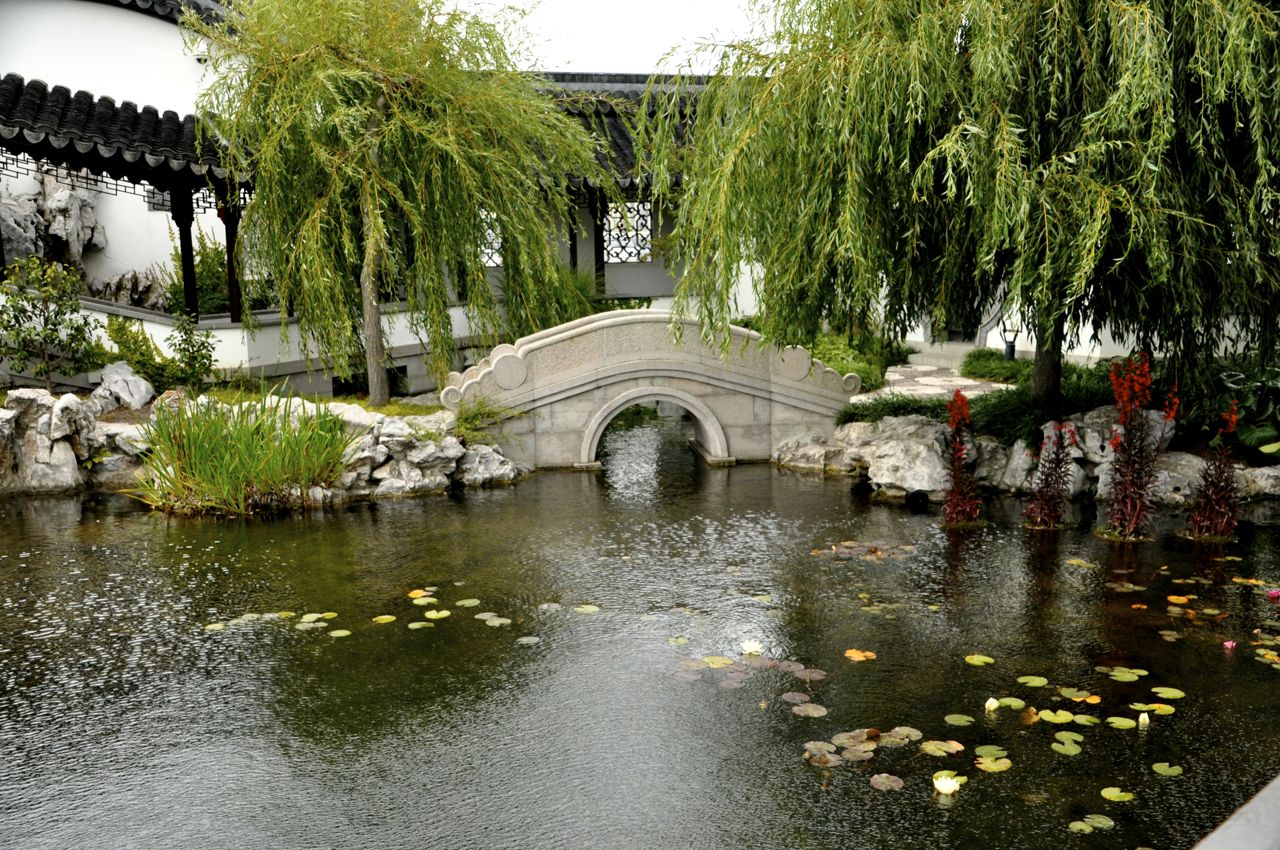
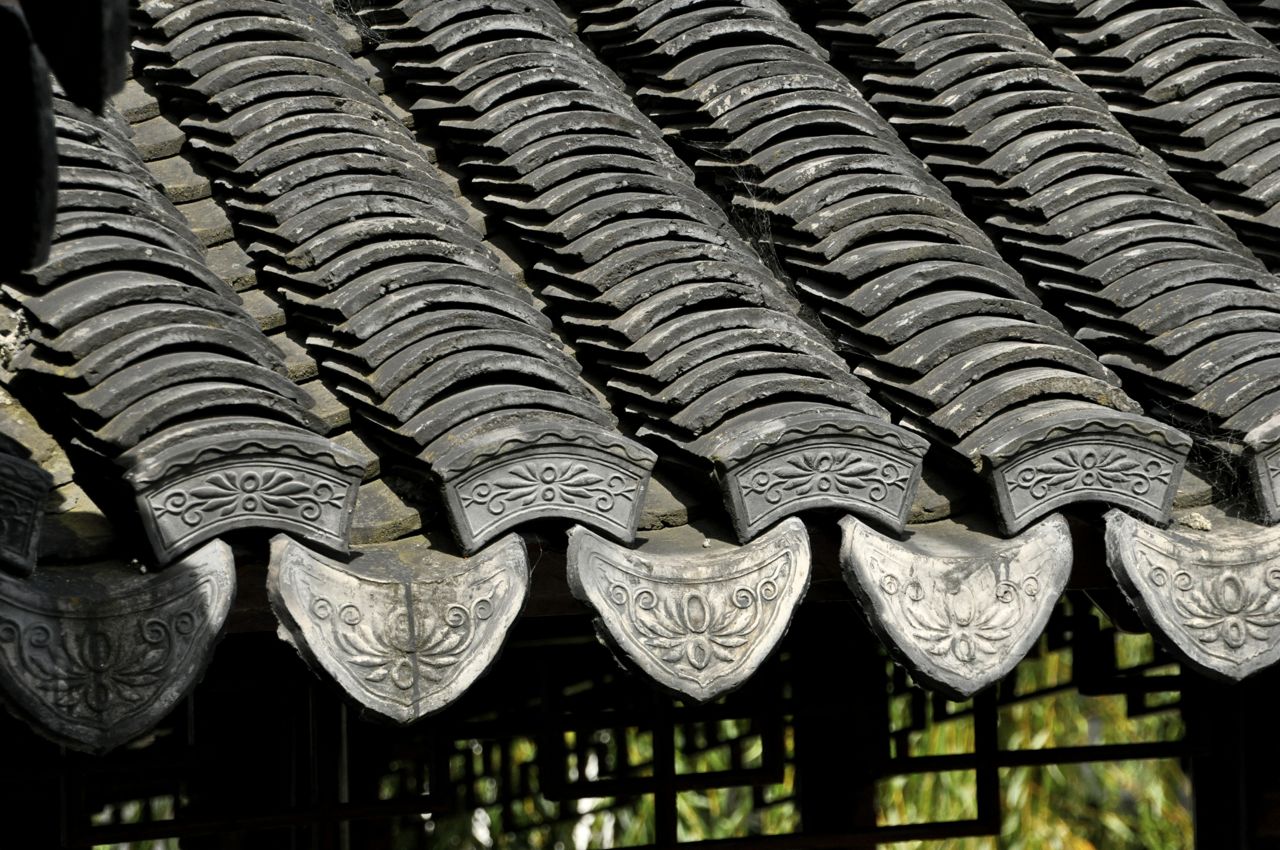
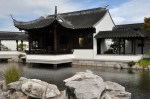
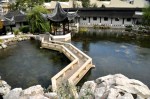
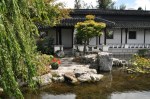
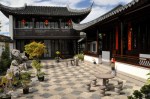
Chinese Garden bridgeThe Chinese Garden is a recent – and fabulous – addition to Dunedin.  It is one of only 3 Ming Dynasty scholars’ gardens outside China.  A scholar’s garden is the creation of a “spiritual utopia”, a contemplative space, an escape from daily concerns where one can re-connect with nature, the ancient way of life, one’s true self.  The gardens try to capture the look of traditional Chinese paintings and the imagery created in poetry.  To create this authentic garden, its wooden houses and structures were made in Shanghai using 4th century BC techniques – no nails, just mortise and tenon joints.  The granite plinths and facings were hand chipped, the columns free-standing and not pinned.  Terracotta roof tilesThe buildings needed 380,000 terracotta roof tiles, handmade in Suzhou, China.  After being assembled in Shanghai, the buildings were taken apart and shipped to Dunedin, along with 970 tons of rock and 130 tons of granite.  Forty Chinese artisans from Shanghai did the installation in Dunedin.

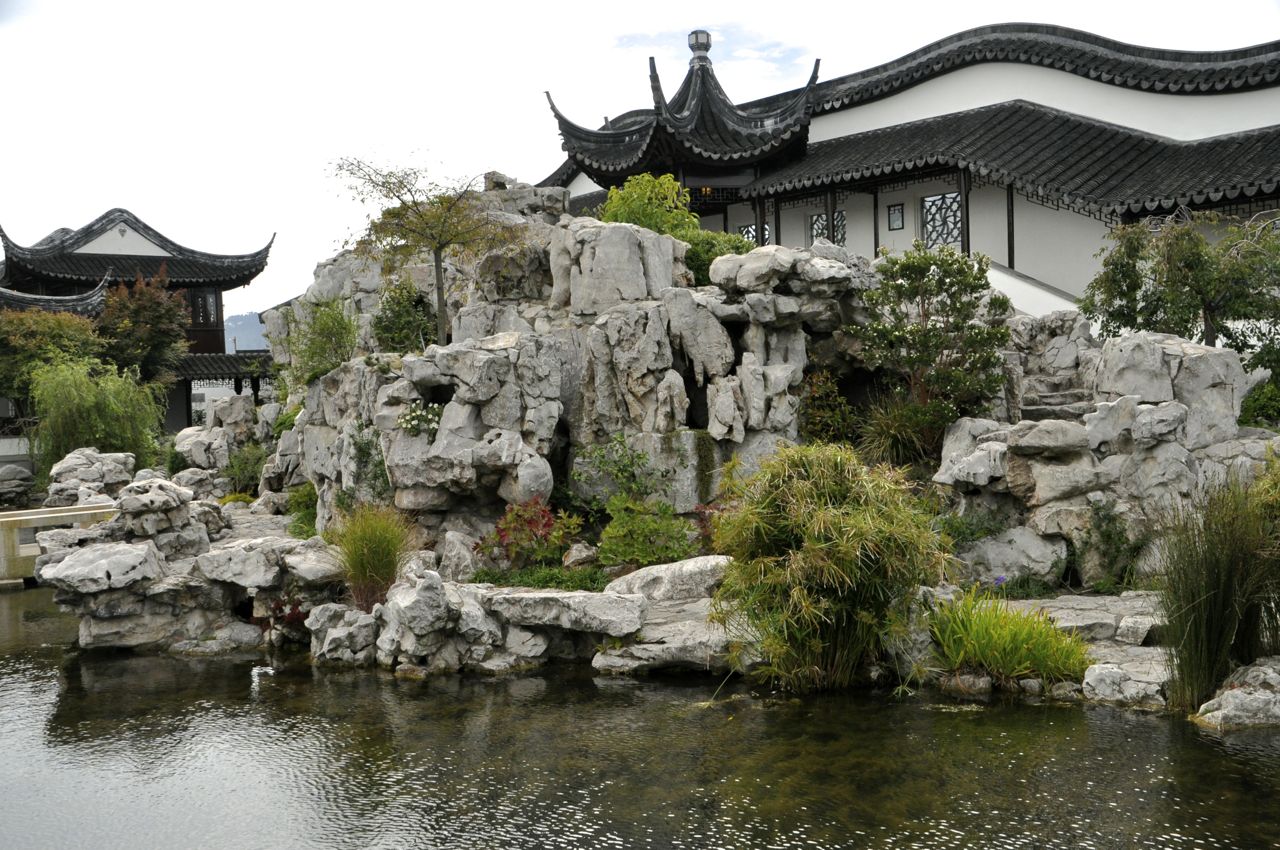
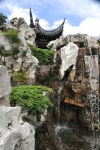
The Chinese word for “landscape” literally Chinese garden mountainmeans “mountains and waters”, and the mountain built here is from prized Lake Tai rock (from near Suzhou), a rock that represents wisdom and immortality; during the Song dynasty this sculpted rock was the most expensive object in the empire.

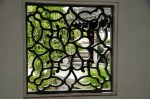
We felt this Scholar’s Garden was indeed a wonderful, soothing, contemplative, fabulous place.  By intent, there are visual surprises around every turn and corner (of which there are many!).  Beckoning niches, contrasting colors and textures, or repeating patterns are traps for your eye and give you pause.  Every window has a different intricate and marvelous grating.  Let us take you on a tour.  I’m just going to put a bunch of pictures below, as we walked around.

THE OTAGO MUSEUM – POLYNESIA and MELANESIA

This is a small but interesting museum that covers a number of subjects, but we were mostly Polynesia/Melanesiacaught by the Polynesia/Melanesia wing – we really didn’t know much about the island regions of our world, and since we’re living in one of them, NZ, with Maori inhabitants, we thought we’d take a closer look.  For orientation, here’s a map.  As you can see, Polynesia is ‘way out there, specks floating in a big ocean!

Before starting the Polynesia section, we took a quick look at some very nice Maori carvings that the museum had.  They were made for a meeting house near Napier (North Island), and were carved in the 1870’s.  We’re impressed!

For us, there are two very fascinating aspects of Polynesia.  One is that the islands were settled one-by-one by seafarers using basically a canoe with a sail; these islands are anything but close, so the utter audacity of sailing off into the unknown is amazing.  A sail and a prayer – if not a death wish – for a family or couple!  I can see it now – “Hey sweetie, how about we sail off into that sunset and get away from here?  We’ll find an island just for us.  I mean, how big can the Pacific ocean be?  You bring the water, I’ll paddle.”  Yeah, not sure that pick-up line would work with Ginger.

The other fascinating aspect is the subsequent developmental changes (or their lack!) that occurred from a common culture.  The islands were far enough apart that there was no chance for communication early on and,  like Darwin’s finches, the cultures evolved in isolation.  Alas, the museum does not directly address this topic, but it’s visible in the displays.

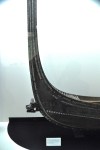
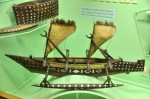
Boats of the PacificLet’s start with migration.  Polynesian culture goes back 3 or 4 thousand years in some areas, originating from Southeast Asia and Taiwan.  The far-flung areas we now call Polynesia were occupied by the late 1200’s AD.  The picture to the left shows typical boats from different regions, and mostly they are riffs on the same theme, with a couple of exceptions that I’ll show first.  China is the biggest exception – really not a Polynesian Typical Chinese shipplayer, but interesting nonetheless.  A very different boat!  China had a permanent navy in the 1100’s during the Song Dynasty, with 52,000 marines!  They were the leading maritime power in the early 1400’s, until subsequent emperors lost interest, eliminated their navy, and turned inward.  Their boats had a different purpose (not island hopping/fishing) and thus had nothing in common with Polynesian boats.  The other exception in this display is a Peruvian boatKon-Tiki-like boat/raft from Peru, but there is little evidence that South America contributed much to Polynesia (except possibly to Easter Island).  You may notice from the overall display at the start of this paragraph and in the pictures below that the New Zealand boat is different from most of its cohorts, having no sail and no outrigger.  Its evolution is likely due to the shore-hugging short-distance travel around these large two islands, though sails and outriggers would have been used for the initial ocean crossings.  You can also see that the war canoes of the Solomon Islands were very similar to that of the Maori, including the dramatically upraised prow.  The other boats all have  outriggers or a double hull, many have sails, and all are structurally similar.

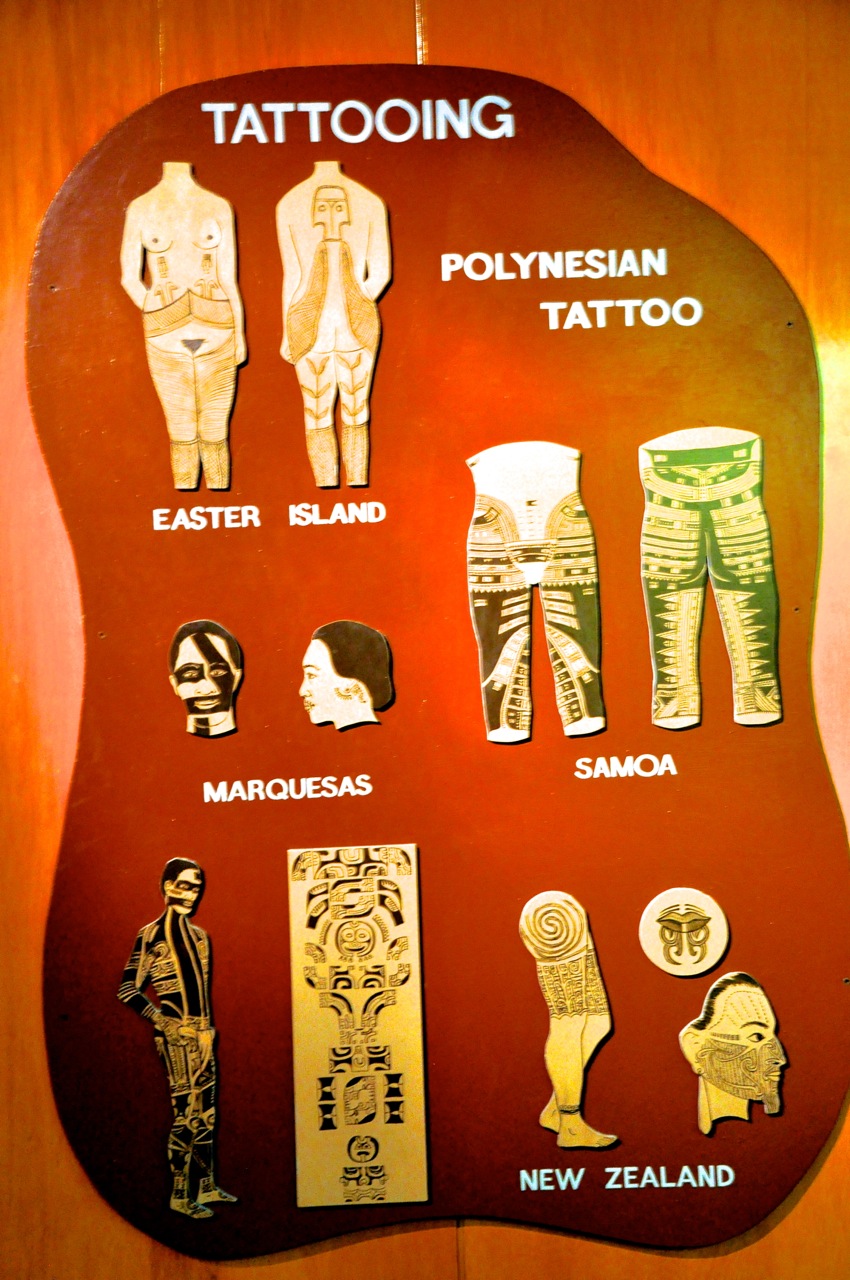
Differences in tattooingWe thought the NZ Maori tattooing was extensive!  This painful process was primarily done on Maori males, the females usually just doing their chins.  For the Maori, tattooing was a mark of puberty as well as conveying information on a person’s lineage, tribe, occupation, rank, and exploits.  Well, as you can see in this display, tattooing is obviously a Polynesian thing!  And the Maori were conservative!  Look at the Easter Island women, or the Samoa or Marquesas extensive tattoos (Ouch)!  In these other cultures tattooing was also a mark of puberty, courage, rank and status.

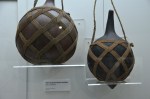
Decorative art such as combs and pendants, shown below, also show similarities across the island cultures, perhaps due to the similarity of available raw materials.  The particular designs used in ornamentation, who wore them and how they were worn, however, varied from island to island.  For instance, the pendants in the case below were decorated clam shells; it’s the same resource, but different cultures wore them on the chest, on the neck, or on the head.

Apparently house construction varied regionally across the islands, but there wasn’t much on display.  I have two for you below, one a picture (New Caledonia), one a display (Samoa).  Samoans were the “Architects of the Pacific”.  Their houses  were built without nails, screws or pegs.  The open sides of the house allowed free circulation of air, but blinds of woven palm leaves could be lowered.  Floors were of stone.

Breadfruit splitters, Marquesas vs Tahiti

Tools had a lot of similarity.  When a particular need would be the same – say, splitting breadfruit – the solution on different islands was usually quite similar, as shown with these breadfruit splitters to the left from Marquesas and Tahiti.


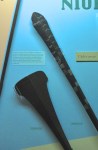
Often differences in tools among the islands were directly related to the availability of raw materials, such as the adzes below in coral, stone and jade.


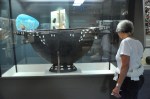
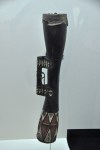
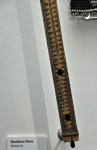
Not everything is easily compared between islands.  We’ll just show some bowls and interesting tools.

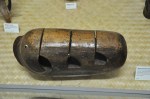
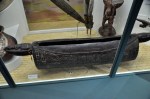
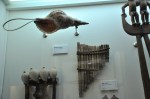
Music and celebrations are universal, as are drums and pipes.

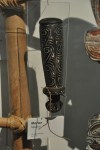
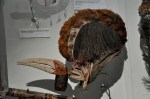
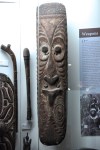
And where there is dance, there are masks.

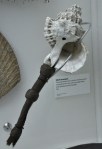
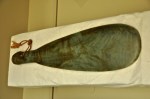
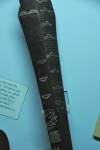
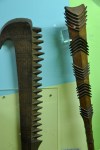
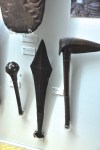
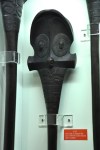
Finally, of course there is war.  Islands are not an escape; the Maori were a warrior culture, as we have seen in earlier posts.  When it came to war, the Polynesian islands diverged considerably, depending on the political culture.  Some islands became fully developed kingdoms with little warfare, others divided into constantly warring tribes, such as NZ’s Maori.  The primary force driving the culture one way or the other, in addition to population pressure, was geography.  On level islands, where communication was essentially unimpeded, warfare was not chosen.  On mountainous islands, with distinct boundaries like mountain ridges, warring groups were the norm.  How interesting is that!  Below are instruments of warfare, starting with the clubs.

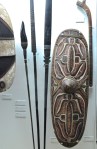
In addition to clubs, there were spears and shields.

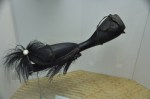
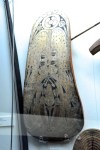
Warrior from Tuvalu, an atollAs a last picture, this is a Kiribati warrior from Tuvalu, an atoll.  Atolls, just a few feet above the sea, support very little life other than a few trees and coconut palms (water was obtained from holes dug in the coral).  With so few resources, humans struggled.  However, here is a well-dressed warrior, on an atoll where we have been told warfare is not likely to occur!  We don’t understand the need for armor, but the armor is in itself interesting; the cloth is coconut fiber decorated with shells.  The helmet and stomach guard are of fish skin.  Sharks teeth are used in the weapons. Quite a use of what you’ve got!

Well, I hope you enjoyed that long discourse on Polynesia and its insight into cultural evolution.  My take-away is that if the resources are pretty much the same, the evolution is pretty much the same.  If everyone lives on a flat area with few natural defenses, people make peace (conversely, it there are defensible borders, it becomes us-vs-them).  I also thought it was interesting to get an insight into stone-age cultures existing into the late 1800’s!

Next post – Christchurch!

Dunedin – Architecture and Art

Dunedin is the largest city in the southern half of the South Island, with a population of 120,000 (20% of which are students).  Called the “Edinburgh of the South”, it was founded by Scottish settlers around 1850, who named it after home – DunEDIN(BURGH).  Ten years later gold was discovered nearby, and this port city quickly became NZ’s most important, spurring a building boom that resulted in a legacy of harmonious Gothic Revival architecture fashioned from volcanic bluestone and creamy limestone.  This is a city post – Dunedin’s university, churches, architecture, and art museum.

THE UNIVERSITY OF OTAGO

Dunedin is home to NZ’s first university (1869).  We happen to be here during the University’s Orientation Week, a big mistake!  Classes are not yet in session, and students, newly liberated from parental control, have a lot of time for beer drinking and rowdy behavior. We have unwittingly booked a motel in a student area, our walls are thin, and loud top-of-your-voice street-side “conversations” go on until 3 or 4 in the morning.  Groan!

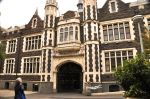
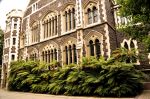
The University looks very much like an English university to us, although it’s on a considerably smaller scale.  In the pictures below, the darker stone is bluestone.

The details are fun – the carvings, the attractive windows, even downspouts are special.

THE CHURCHES

Every day we walk past this church that is not in our tour books – the Knox Church, it’s called, just a small Presbyterian church – but it is quite beautiful, reflecting the architecture of that time.

The most impressive church in Dunedin is St. Paul’s Cathedral, an Anglican church constructed in the early 1900’s entirely of Oamaru limestone (see post of Jan 20, Oamaru and Penguins).  It’s located on The Octagon, the central plaza of the city, laid out in 1846 and home to a number of well-preserved buildings.

Positively European, eh?  I’m a sucker for stained glass, and this church has a lot of it, all from the early 1900’s.

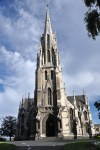
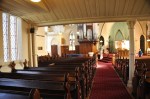
The final church is the First Church of Otago, touted as the most impressive of NZ’s earlier 19th century churches.  Praise is given to its wooden gabled ceiling and rose window, but we get there late and I am shooed out before I can even take a lo0k – just that quick picture from the door before I’m spotted.  I try to sweet-talk my way in, but it is not to be.  Still, the church is very impressive to look at, even from the outside.

THE ARCHITECTURE

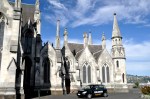
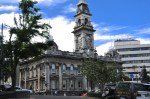
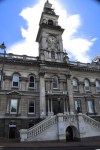
First, let’s look at a grand building there in the Octagon near St. Paul’s Cathedral: the Municipal Chambers, built in the Italian Renaissance style in 1880, also from Oamaru limestone.  The lamp bases aren’t bad either!

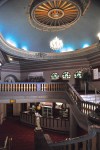
Also on the Octagon is the Regent Theatre, home to the Royal NZ Ballet and other shows.  Built in 1874, its interior is a combination of 19th century fashion and 1920’s art deco – a stunning combination, I think; classical and classy!

Another turn-of-the-20th-century building is the Dunedin Railway Station, again built of bluestone and Oamaru limestone.  I think it’s fabulous.  Ginger is not so sure.

C’mon, isn’t this the most resplendent train station you’ve ever seen?  The interior is also quite amazing, with a foyer of tile and a porcelain mosaic floor.

Other historical municipal buildings are the court house and jail – which are physically connected for the sake of efficiency.  Not all of the historical buildings are in great shape (for example, the warehouse buildings below, right).

Some of the residential homes downtown are reminiscent of New Orleans buildings of the same period – maybe it’s all that wrought iron (but definitely not the turret).

Below are samples of downtown business buildings.

Finally, I wanted to share our experience visiting a cafe downtown.  We saw people shooting up, with big syringes, right there at tables out front, in broad daylight!  So, of course, we had to try it too.  Or at least Ginger had to, that junky in need of a (sugar) high.  You order, select from a variety of fillings, take a seat, and soon appears a warm, sugar-coated doughnut (shell) and a large syringe filled with jelly, lemon, chocolate…, whatever your “fix”.  Just to keep it low calorie, it comes with a side of whipped cream, too.  Messy, yummy, the ultimate do-it-yourself rush.  It is an interesting take on the jelly doughnut.

DUNEDIN PUBLIC ART GALLERY

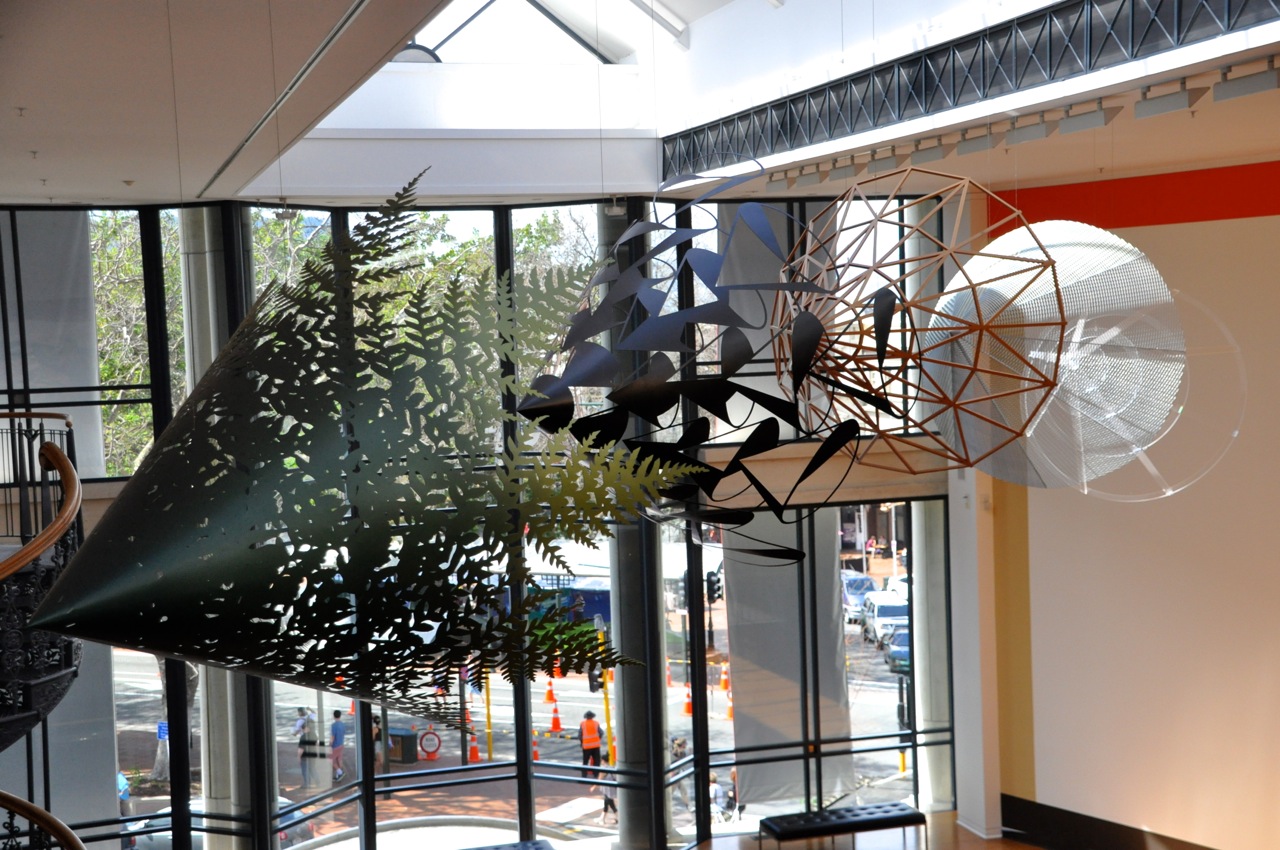
It’s the oldest gallery  in NZ, converted from 6 Victorian buildings into a very modern, gleaming museum, right on The Octagon.  The foyer has a work entitled “Cones” by NZ sculptor Cones by Neil DawsonNeil Dawson (his work also appears in our posts from Christchurch and Wellington, but unacknowledged).  Also note the cool spiral staircase barely visible on the left, from Victorian times. The museum has a traveling interactive exhibit of works by Seung Yul Oh that was fun; certainly Ginger got into it!  The pictures below show some of the art from this exhibition.

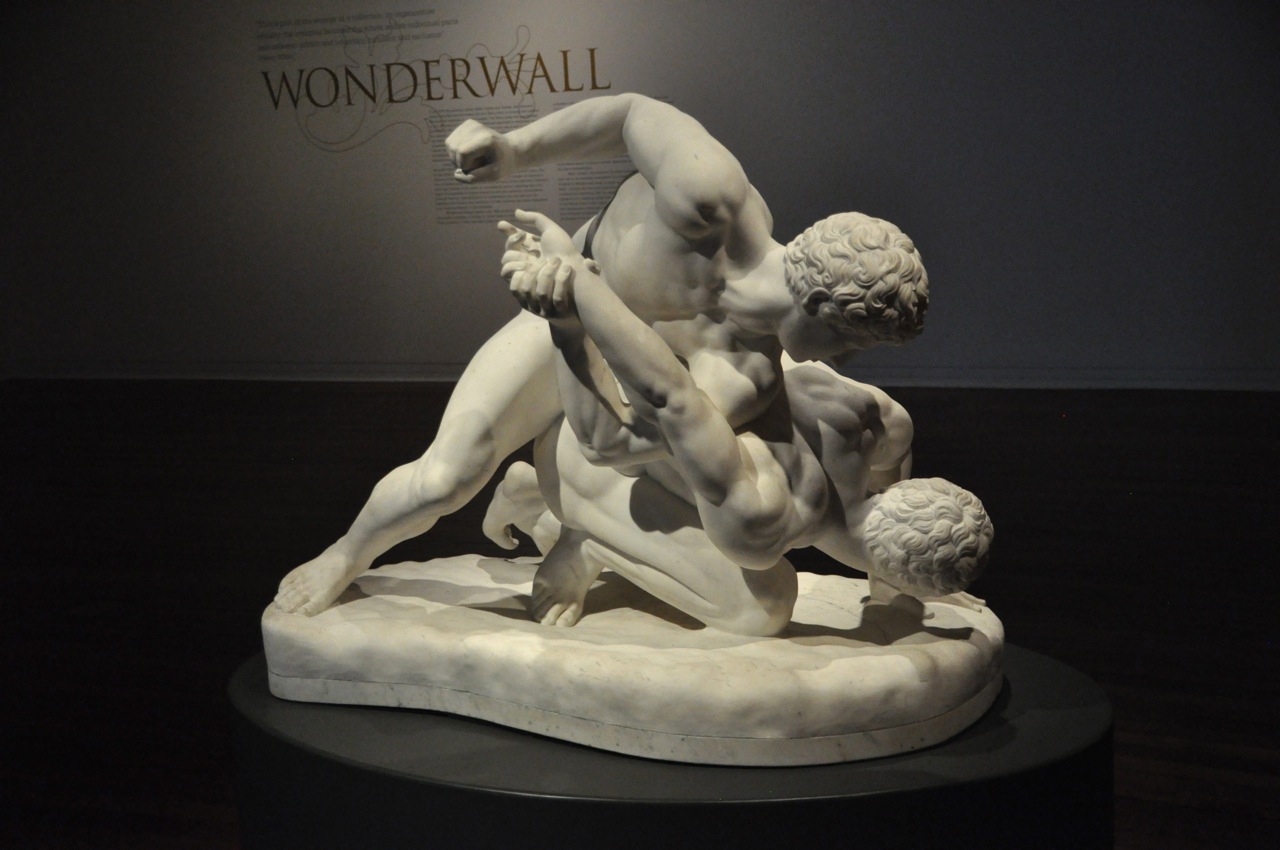
The Wonder Wall The core museum starts with an interesting introduction, “Wonderwall”, an entire wall of some great art!  This is the “salon style” of art display from the 1600’s.  The large room is otherwise empty, except for a full-size replica of the amazing “The Wrestlers” from 3rd century BC Greece.  The austere room and The Wrestlers, copy of 3rd Century Greek statuefabulous art is striking, and intriguing.  One of the ideas behind this type of presentation is to invite comparisons.  I note that many of these paintings show people looking out at me, looking in at them.  Ooooookay.  A little different.  In looking at art, I’m used to mentally putting myself in the picture.  Here I seem to be the picture, the gallery looking at me!  Turnabout!  Here are some pictures I like, up close.

The picture below is a fascinating “out there” piece of art created by Anne Ferran, an Australian artist, during a two-month artist-in-residence program at the museum.  From

Anne Ferran, Australian, 2001

Anne Ferran, Australian, 2001

across the room, it looked like a ghostly 3-D construction or a hologram.  Up close, it’s a ghostly picture of an infant’s christening gown.  It’s called a “photogram”; I suspect it’s done with x-rays using x-ray film.

OK,  on to some other art that impressed me.  Another “out there” fascinating collection by an American, Robert Rauschenberg, worked with unusual juxtapositions/allusions in color lithography, examples below.

I was blown away by the works of Frances Hodgkins.  Working in watercolor at the end of Impressionism/ beginning of Modernism, she captured the optical effects of light on water, along with movement and stillness, that I find incredibly beautiful.  Examples below.

Finally, let me show you some amazing linocuts (a woodblock-like process, but using linoleum) from the 1930’s.  Each color required one block , necessitating simple, abstract designs.  Yet this very simple, static process produced such a sense of speed and movement!  Printing was done by hand – a piece of paper was placed on the inked tile and rubbed – thus producing very affordable art for this industrial age.  The prints are grouped by artist.

That’s probably enough for one post!  The next and last post on Dunedin will showcase the fabulous Chinese Scholar’s Garden and the fascinating Polynesian exhibit at the Otago Museum.

Leaving Milford Sound – the Routeburn Track to Key Summit

On our way out of Milford Sound we plan to hike a piece of the Routeburn Track, one of the finest of NZ’s “Great Walks” (multi-day tramps).  It’s turning out to be a beautiful sunny day – we don’t know whether to cheer or curse our fate of yesterday (post of April 17, Milford Sound).  We decide to cheer – hard to stay grumpy on a sunny day!

The Routeburn track has an interesting twist.  Remember we took two – admittedly leisurely – days to drive to Milford Sound from just above Queenstown (post of April 13, Fiordland National Park and Milford Sound – Getting There) .  On the other extreme, tour buses from Queenstown drive to Milford Sound and back in one very long day.  The interesting story is that one can use the Routeburn Track to walk from Queenstown to (just above) Milford Sound over the Southern Alps in just 2 (long) days; it’s only 20 miles!  So why not build a short highway across the mountains to link the two tourist destinations?  The answer is twofold – one, Milford Sound already gets plenty of tourists in spite of the travel hurdles.  Two, if they built the highway, the city of Te Anau (Gateway to Milford Sound) would cease to exist.  So NZ wisely embraces the status quo.

The Routeburn track is very green and pretty, as one might expect from the rainfall.

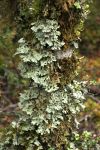
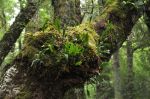
As you can see in that last picture above, the banks of the trail (horizontal and vertical!) are solid with moss and ferns.  Other areas have banks that are chock-a-block full of lichen.  Sometimes the ferns are a solid mass going up the hillsides, just a forest of ferns (picture not shown).  It’s all very colorful!

Occasionally we encounter small waterfalls.

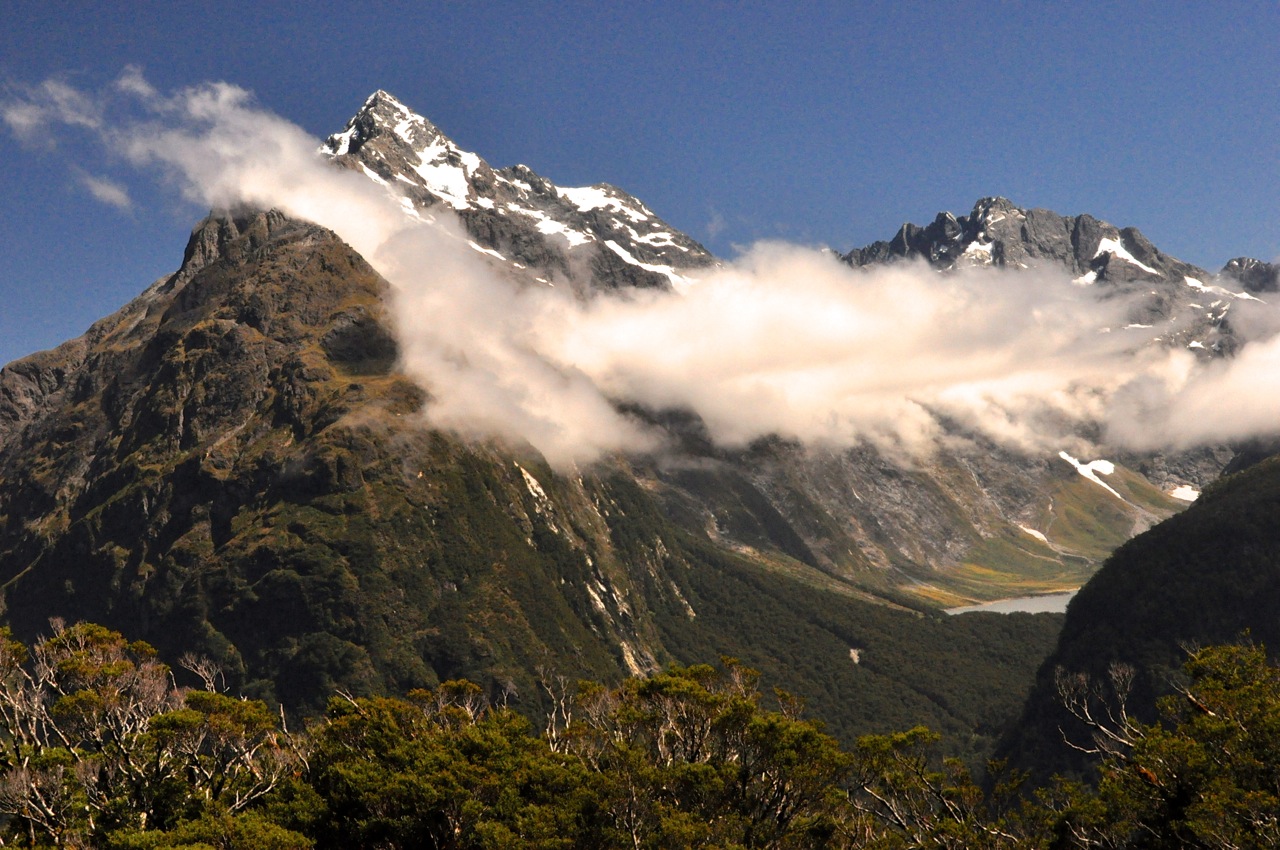
After an hour or so of steady upward climb, Ginger decides this is not her day to hike and turns back.  I’m 9DSC_0046feeling great and will push on.  Soon thereafter the trail to Key Summit splits from the Routeburn.  I take the Key Summit trail which heads up even more steeply.  Soon the forest ends abruptly, the view opens up, and I’m hiking past sub-alpine plants.  The picture to the left, below, looks back at the valley where we started, the other picture is the increasingly pretty view ahead.

The flora is interesting, with a fuzzy ground cover and a number of small wildflowers like the genetian.

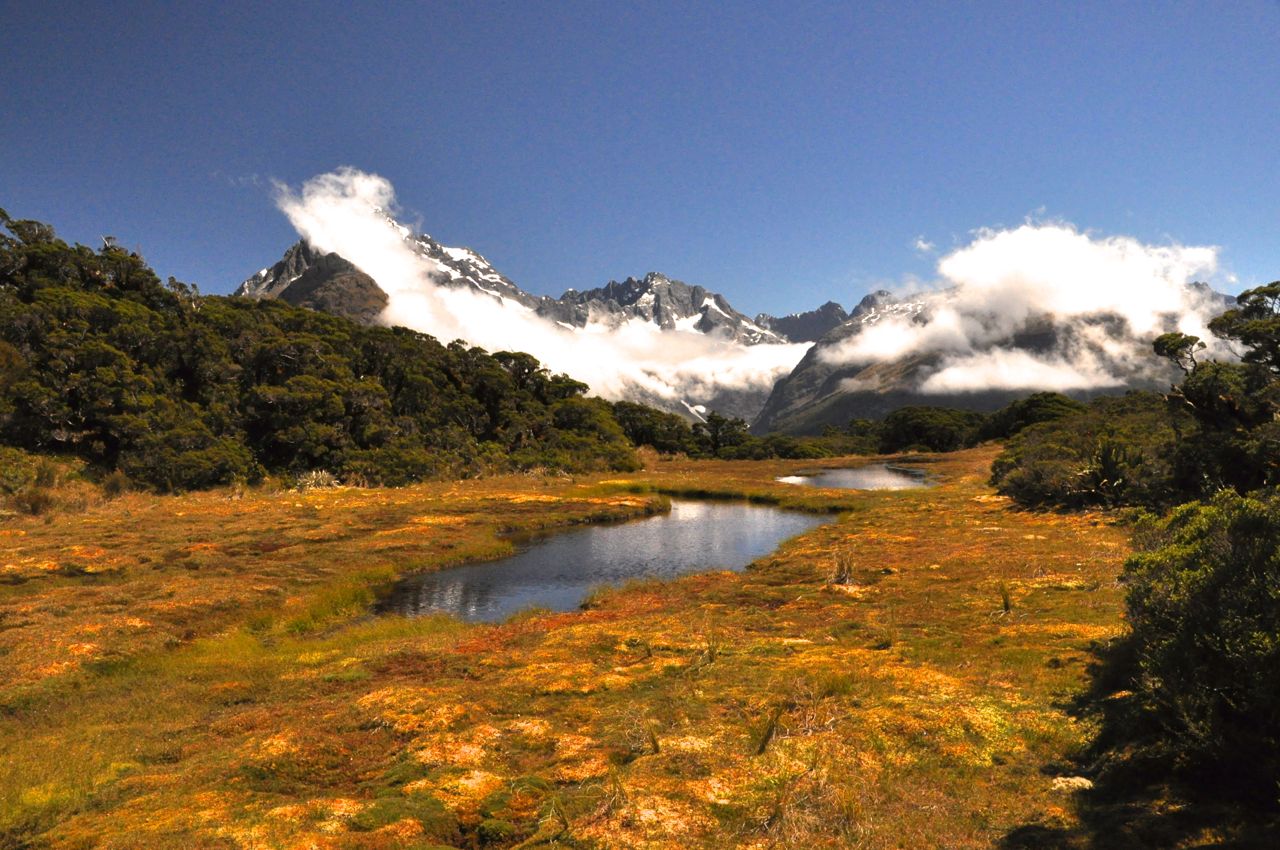
Finally I’m at the top, and it’s quite a pretty view from this small summit, with mountains absolutely surrounding it.  The small tarns and yellow ground cover/grass add to the beauty!

Looking more closely, I see that there is also a lot of red here, adding to the very pleasing palette of colors.  There’s red algae in some of the tarns, red lichen on the rocks, and a thick red moss on most of the tree trunks and limbs.  I’m loving the feast of colors!
The trail doesn’t really stop here; it seems to wander off in several directions, including a “nature walk”.  I decide to wander as well, going up, of course.  There’s a hill ahead.  One of the advertised “sights” from the Key Summit is the view of three valleys that intersect here, the great conjunction.  You can sense – if not see – them in the pictures below; the first picture shows a valley over the left side of the summit, the next showing that valley joining another and falling away, the third picture showing the joining valley over the right side of the summit, and the last picture hinting at the third valley that’s coming in, but the view is blocked by the hill ahead.

Lake Marian in the cirqueAs I’m walking up the hill, I come to an opening with a bench, and a sign saying there’s a view of Lake Marian.  Sure enough, there’s a glacial cirque with a lake – always a pretty sight!  Alas, there is just a snippet of the lake showing.  As I’m watching, a guide with a customer shows up and says the trail continues up the hill for a better view.  I’m on it!  However, there is no obvious trail anywhere, things seem to Pretty tarnsend here.  As I walk up the hill, a trail does emerge – a footpath, really, and not used much.  I do pass some more quite beautiful tarns.  After some climbing the steep footpath then leaves the open tundra to go into a forest of short trees with the red moss.  The trail becomes almost hidden in the plants, and then becomes nothing but mud and roots and hauling yourself up by grabbing tree trunks – you really have to want to go here!  It is also taking me longer than anticipated.

Finally I’m out of the woods, and there is a good view of Lake Marian!  It looks like a pretty fabulous place to pitch a tent, over there.

A further benefit is the view up the hill; down in the valley there’s a big lake – probably

Lake Gunn that we visited yesterday.  Key Summit is definitely a pretty place!

Alas, I have taken longer than planned, the long-suffering Ginger is patiently (?) waiting (lucky for me she keeps her Kindle in the car), so even though the path continues up, I’d better go back.  More’s the pity!  The problem with a day hike into NZ’s multi-day Great Walks is that you do the tough vertical climbing to get to the pretty areas,  then once there, with easier hiking and all the best views still ahead, you turn around and go back down.  Still, the half-loaf is worth it (and I didn’t have to carry a heavy backpack).

Below are two pictures taken on the way down of the pretty tarns and the red ground cover with berries.

On our way back out Milford Road, we stop at Lake Gunn to see it in the sun – it’s a pretty place, with very clear water.  For comparison I’ve included our picture of Lake Gunn from yesterday.

The valleys are also much prettier in sun.

That’s it for Milford Sound!  Hope you enjoyed the trip up Routeburn.  Next stop, the Scottish city of Dunedin.

Milford Sound

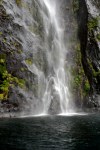
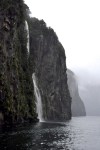
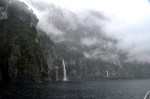
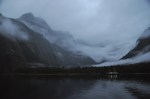
Milford Sound is a famous landmark of NZ.  People fly over by plane, or travel by bus or car, or even hike in over the Southern Alps.  It is said that one needs to see Milford Sound on repeat visits: in the sun, in the rain, and under a blanket of snow.  Why one should see it in the rain is not intuitive, but my travel book says that shortly after a big downpour every cliff sports a waterfall (and the place looks even more magical as ethereal mist descends).  I say this to lift our spirits, because it is raining steadily, and the “ethereal mist” is pretty damn depressing.  I know that the famous and massive Mitre Peak is staring me straight in the face in the left picture, but someone ate it.  Still, the view has a somewhat oriental charm to it, just not the OhMyGosh! view I was hoping for.

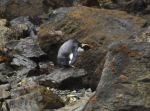
There are some nice views before departing – a white heron fishing, a near-by waterfall – but note my difficulty in keeping my lens dry.  The minimalism of traveling does not permit many photographic accessories.  A lens hood or underwear, that’s the choice.

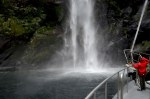
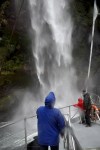
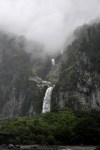
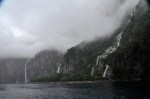
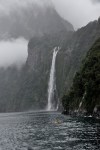
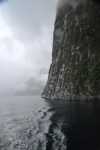
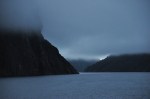
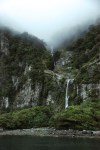
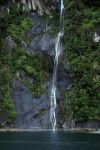
Finally we’re off, along with 58 other hardy souls looking a little long-in-the-face as well.  The boat is nice, although its large picture windows are not going to work for taking good photos from inside.  I’ll have to brave the elements outside, and dash inside to clean my lens – along with a lot of other photographers, but everyone plays nice.  The first views are certainly atmospheric; big mountains diving straight into the water, and tall waterfalls appearing out of the clouds.  In gray.  Sigh!  For perspective, look at the other cruise ship in the last picture.

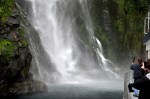
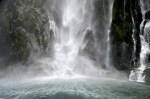
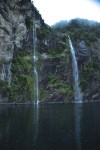
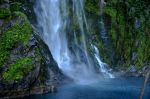
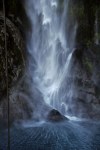
As we motor out, there certainly are waterfalls!  When we get closer to them, there is still some color through the rain and mist, thank goodness.  They’re pretty, take a look.

Part of what is happening here is the presence of many “hanging valleys”.  In the ice age, mile-thick glaciers rumbled cross-wise across mountains and valleys, churning a trough a mile deep.  When the glaciers left, leaving nearly vertical cliffs at the trench edges, the rivers traveling down those valleys now had no choice but to hurtle lemming-like off the cliffs into the waiting Sound (fiord).  In Milford Sound, only a half-mile wide, the effect is impressive; the peaks, we are told, go up 3000 feet (alas, in the fog we only see about 100 feet of that!), and the water of the Sound is over 1000 feet deep.  Where we float, the sides of the glacier-sheared mountains are near-vertical.  What that means for us is that the cruise ships can get within a few feet of the mountainside with no fear of hitting anything, and they do that at the waterfalls with some glee.  Which you’ll see below, as we approach a single waterfall.

I saw what was going to happen and quickly bailed into the cabin, as did ginger (in the blue raincoat).  The prow went into the waterfall; the kid and dad got soaked!  And I mean drowned-rat soaked!  They were dripping their own cascades as they sloshed into the cabin.

There are more waterfalls, which are just everywhere.  It’s like the world has sprung a leak.

I hope you’re enjoying the beauty of these waterfalls!  It’s raining, and I’m having to dash in and out of the cabin to dry my lens.  Soon my lens cloth and then handkerchief are as damp as the lens, and I’m just pushing the wet and smear around.  Reality is probably clearer than what you see in these pictures – but fear not, the mist and fog you see in the pictures may be augmented by my wet lens, but for sure it is really there!

We do another close-encounter with a waterfall, shown below.  The waterfall is truly beautiful, but this time everybody retreats at the last minute.  No takers to experience becoming one with the waterfall!  Which just goes to prove that if history is close enough in time, humanity can learn from its mistakes.

That waterfall was a pretty one!  Alas, you only get to see the static view; the moving view was so much better, with the changing patterns of falling water and those white trails on the water surface zinging out at us at high speed, almost scarily.

We’re heading for a small bay where we’ll moor for the night – what little light we had is beginning to fade.

Surprise, we get to go out and explore before dinner!  On the water.  A few choose to go out in kayaks by themselves.  A couple of young ladies decide to go swimming (!).  We, along with many others, choose to go out in small rubber boats with a guide.  A good choice!  The perspective is slightly  different this close to the water, and we get to see some wildlife here at the end of the day – a NZ pigeon (large, beautiful tree-dwelling birds!), a seal practicing his diving technique, and – lucky us! – a Fiordland crested penguin coming home to his nest!  He is very cute as he hops up the rocks to his burrow.  The last picture is of our bay as twilight deepens.

Well, the day was beautiful in spite of the rain, and the waterfalls were other-worldly, but we are disappointed; the mountains should be towering above us, cathedral-like, for thousands of feet, and we see only glimpses beyond 100 ft up.  Our captain says there is a good chance the clouds will lift by morning.  We cross our fingers and go to sleep.  The late-night passengers take pictures of seals that climb on board at the lower level and sleep on the deck!

The morningThe morning brings the same low cloud cover.  Today we will head first to the mouth of the Sound (the Tasman Sea), and then head for home.  There is a chance the clouds will lift for the trip home!  In fact, the rain has stopped and things are looking lighter, especially up ahead, and certainly the views are brighter and sharper!

As we approach the Tasman Sea, we have clear skies!  As in, practically no clouds overhead at all!  There is hope!

Looking back at the low-lying funkOf course, looking backward, there is still nothing but truncated mountains as far as the eye can see.  Can the funk go away in time?  As we move further out into the Tasman Sea and look back, the cloud situation is amazingly and frustratingly apparent.  In the pictures below, look at those beautiful, commanding mountains towering above the cloud cover!  Yes!  And look at how thin that layer of low-lying white cloud is!  And look at the sun trying to shine through!  This could work!!

Well, it’s hopeful!  As we enter the Sound, the low-lying cloud cover is dauntingly there, but there are also luminous areas where the sun struggles to break through, as shown in the first image below.  As we venture further into the Sound, everything gets clearer and brighter.  The last image, looking backward, shows real sun shinning on where we were.

As we retrace our path of yesterday, we revisit the waterfall close-encounter.  The waterfall is definitely a little smaller, but the view is now even more beautiful, the colors brighter, the rocks more clearly defined.  It is again a magical view in NZ.

As we travel on, it becomes clear that we will not escape our fate of a low cloud ceiling.  The funk is lifting behind us, but not in front, and time is running out.  It is a little frustrating, knowing how thin the obscuring cloud cover is!

Horizontal scar marks from the glacier that formed the SoundWe do pass an interesting part of the Sound, where a protruding wall shows the scour marks of the glacier from so many millions of years ago.  Showing its age with wrinkles, it is.

Well, the weather continues to toy with us as we near our harbor destination; the ever-present cloud cover is getting lighter, but persists, restricting our view to just a few hundred feet up.

Mitre Peak at Milford Sound HarborAnd then we’re at the Milford Sound Harbor and disembark.  We disembark to, of course, the lifting of the funk, at least here.  Well, better late than never, I guess.  Ladies and gentlemen, we present finally, Mitre Peak in all its glory.  OhMyGosh!

Just for comparison, let us show you the before (yesterday) and after (today) pictures of the harbor, and you can judge what we missed!  The before pictures are the first two pictures  from this post.

Well, OK, I groused all through this post about what we missed, didn’t I?  My apologies.  I, of course, wanted it all.  Even so, it was pretty spectacular, wasn’t it?

Next post – Fiordland and the Routeburn Track!

Fiordland National Park and Milford Sound – Getting there

In our March 26th post (Aoraki/Mt. Cook National Park), I remarked that the South Island reportedly has most of the superlative sights in NZ.  Many of those sights lie in Fiordland, New Zealand’s largest, most remote and wildest national park.  It is a region of stunning beauty, boasting some of the tallest waterfalls in the world; its glacier-scoured lakes are the deepest in the country, some nearly 15oo feet deep; its coastline sports 14 glacier-carved fiords, some nearly 25 miles long.  (Note:  the fiords were misnamed as “sounds” by early sailors; a fiord is formed when a glacier grinds its way to the sea [and then melts]; a sound is a sea-drowned river valley).  Fiordland is also an isolated, almost inaccessibly wild land, bordered by the Southern Alps on one side and by steep fiords on the other.  It endures enormous rainfall –  it rains more than 200 days a year.  Milford Sound, where we’re headed, gets 27 feet of that wet stuff annually.  Of its 14 fiords, only 2 (Milford and Doubtful) are relatively easy to visit.  The Maori visited Fiordland but did not live there.  In 2001 the total human population of this vast land was 48 souls.  If you include border towns like Te Anau, the population today is still under 2000.   Isolated, yes, but there’s probably a correlation between low human population and the large numbers of the infamous sand fly (called “black fly” in the US), a tiny, blood-sucking critter with an incredibly vicious bite – they’re more like flying piranhas than insects.  This inhospitable remoteness does have some benefits: some of the animals and plants of the ancient super-continent Gondwana still exist here (eg. living brachiopods, unchanged in 300 million years); and in 1950 the takahe, a flightless bird that had been believed to be extinct for 50 years, was rediscovered in Fiordland.

We can’t wait to see this area.  We spent a bunch of money for an overnight cruise on Milford Sound; now we have to get there.  The plan is to high-tail it to the gateway town of Te Anau, spend the night, and get an early start for a leisurely trip along the 70 miles of Milford Road, billed as one of the world’s finest drives, before boarding our 60-person cruise ship.

We pass near Queenstown, which looks gorgeous in the distance. From the Crown Range

Saddle I think we see vineyards nearby.  Oh yeah, we’ll be back soon to visit!

The trip to Te Anau goes past the very long, very deep and very pretty Lake Wakatipu, then

travels over picturesque fields and mountains.  Te Anau, on the edge of the Fiordland, is much more impressive.  After we wander the town, take in a “fly over Fiordland” documentary (soooooooo much cheaper than paying for the fly-over itself!), and have dinner at a fancy Italian restaurant, there is just time enough to capture a few pictures

of the area as the sun sets.  The impressive views suggest a fabulous tomorrow!  Equally Our restored B&B monasteryfabulous was our B&B; it’s a restored monastery, beautifully done inside.  We were there for too little time to really appreciate it; for example, the outdoor mega-size chess set, the free port and gay laughter we could hear in the upstairs lounge as we went to bed….. darn it, can’t do it all!

The next morning is disappointingly overcast, with rain clouds on the horizon; looks like we’re going to get one of those 200 days of rain.  Drat!  And sure enough, clouds and rain are our companions through some magnificent valleys.  I think the views would be spectacular in shimmering sunlight, but it is still beautiful in the mist.

A popular tour-bus stop (Milford Sound is such a tour-bus mecca!) is Mirror Lakes, right by the highway.  We stop too.  In good weather there are outstanding reflections of the Earl Mountains.  Even in the rain, the view and color is nice.  The cute duck is a NZ Scaup.

We go further to Lake Gunn and decide to do the 2 mile nature walk.  Glad we did – it’s a good insight into the effects of 27 feet of rain!  The walk is a riot of mosses of every kind growing on everything, and plants growing on top of the mosses!  Trees are a vertical extension of the forest floor!  It’s beautiful, as you can see in the many images below, but we were afraid to stand still for long.

We continue, up and up, to the Homer Tunnel, carved nearly a mile through the solid stone of a glacial cirque.  The tunnel was quite an engineering feat, started in 1935 and finished in 1953.  It took so long in part because the downward angle quickly ran into water and in part because of interruptions by several avalanches and WWII.  What is novel to us is that it’s a one-lane road!  While we wait for our turn to go through, we are entertained by the numerous waterfalls pouring down – and the inquisitive and highly intelligent kea, the world’s only alpine parrot.

While we watch a kea on a car roof, it grabs a hard plastic cover over the tailgate hinge and rips about a fourth of it off!  As it works on the remainder, we inform the inhabitants that their car is being eaten.  The man steps out holding a short piece of 2×4 (be prepared?) and swats at the parrot, which nimbly hops to the front of the roof, out of swinging distance, but still on the roof!  Catch me if you can!  I am impressed, and hurry back to my car to make sure the gremlins aren’t there.  The redeeming virtue of the parrots is that they’re so cute!  They walk like sailors newly on land, a rolling gait, and appear fearless.

Inside the Homer TunnelFinally, after a 15 minute wait, it’s our turn, and off we go into the tunnel.  It looks old!  The stop lights governing traffic into this tunnel are only used in summertime; in wintertime, it’s every man for himself, which could mean backing out a loooong way.  I’m betting there are spirited “rock scissors paper” games when 2 cars meet.  Of course in wintertime chains are required, avalanches are a problem, and then you have to wait while maintenance workers in helicopters drop dynamite on the snow overhangs.  Maybe the stoplight wasn’t so bad!

Homer Tunnel exit, with waterfallsWe exit the Homer Tunnel into a whole lot of waterfalls coming from a massive cirque.  Just for perspective, the tunnel exit is the roofed structure in the lower left of the picture.  Waterfalls are absolutely everywhere;  it would be crazy to show close-ups, so just enjoy the overviews as we drive down!


Finally, we visit another tour-bus stop, The Chasm, where the Cleddau River scours rocks into interesting shapes as it falls nearly vertically down a deep, narrow channel.

We’ve now arrived at Milford Sound.  Rainy and overcast!  There were many other hikes to take from the Milford Road, but they were longer and we ran out of time; we board the cruise ship shortly at 4pm and just have time to take a quick look around.  Next post – The famous Milford Sound!