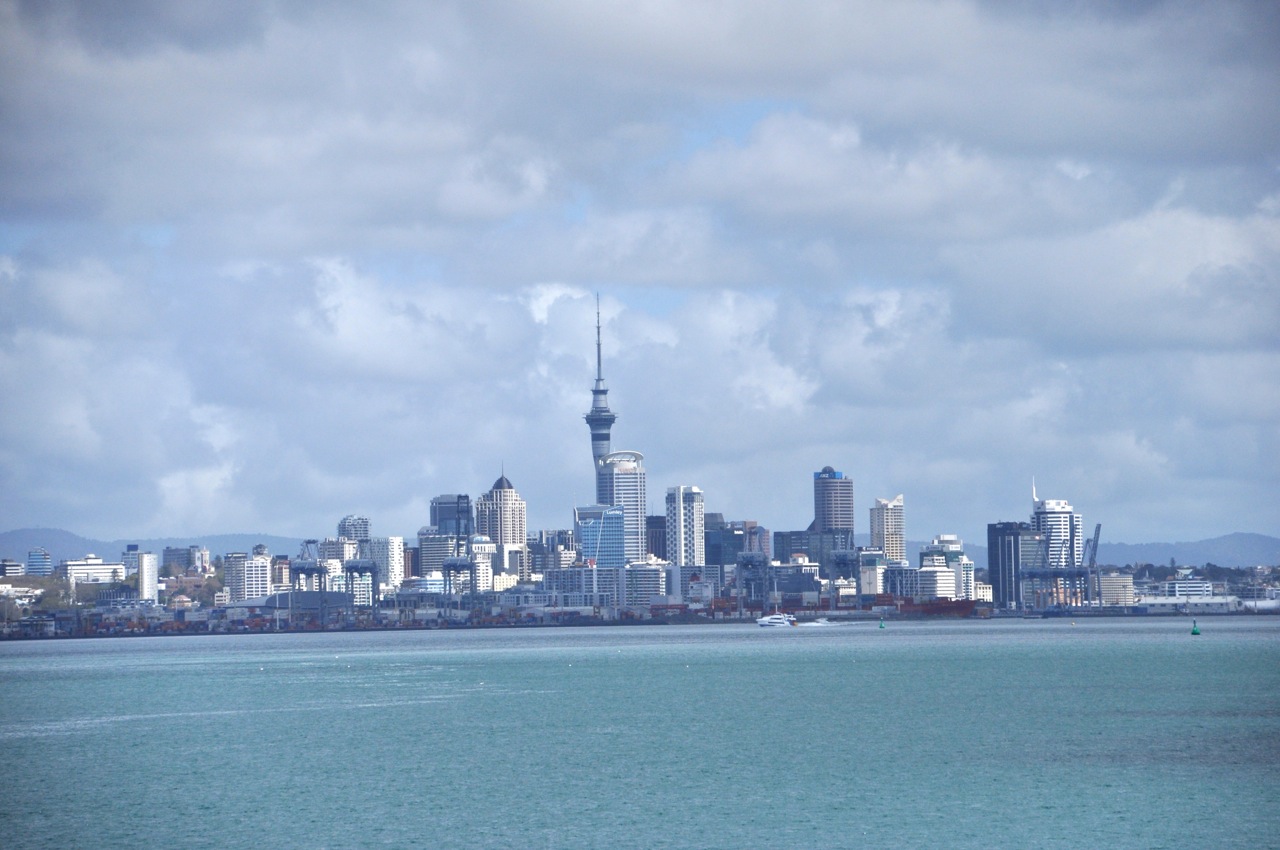
The Northlands – Bay of Islands to Waipoua Forest

We’re off to see some Kauri, the world’s 2nd largest trees.  With some regret we leave that gorgeous apartment in the Bay of Islands, home for 10 whole days.  Quite a luxury, that length of time in one spot, but it was some good R&R and allowed me to get this blog functional, finally.

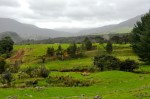
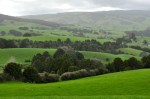
I’ve shown you a few pictures of the gorgeous Northland in earlier posts – green green green, impossible shades of green, rolling hills to mountains or ocean.  It’s really spectacular, and yet we know it is not the prettiest part of NZ.  Save the best for last, they say.  Let me show you the journey to the Waipoua Forest before I tell you about the Kauri.  Ladies and gentlemen, the land of sheep and cows.
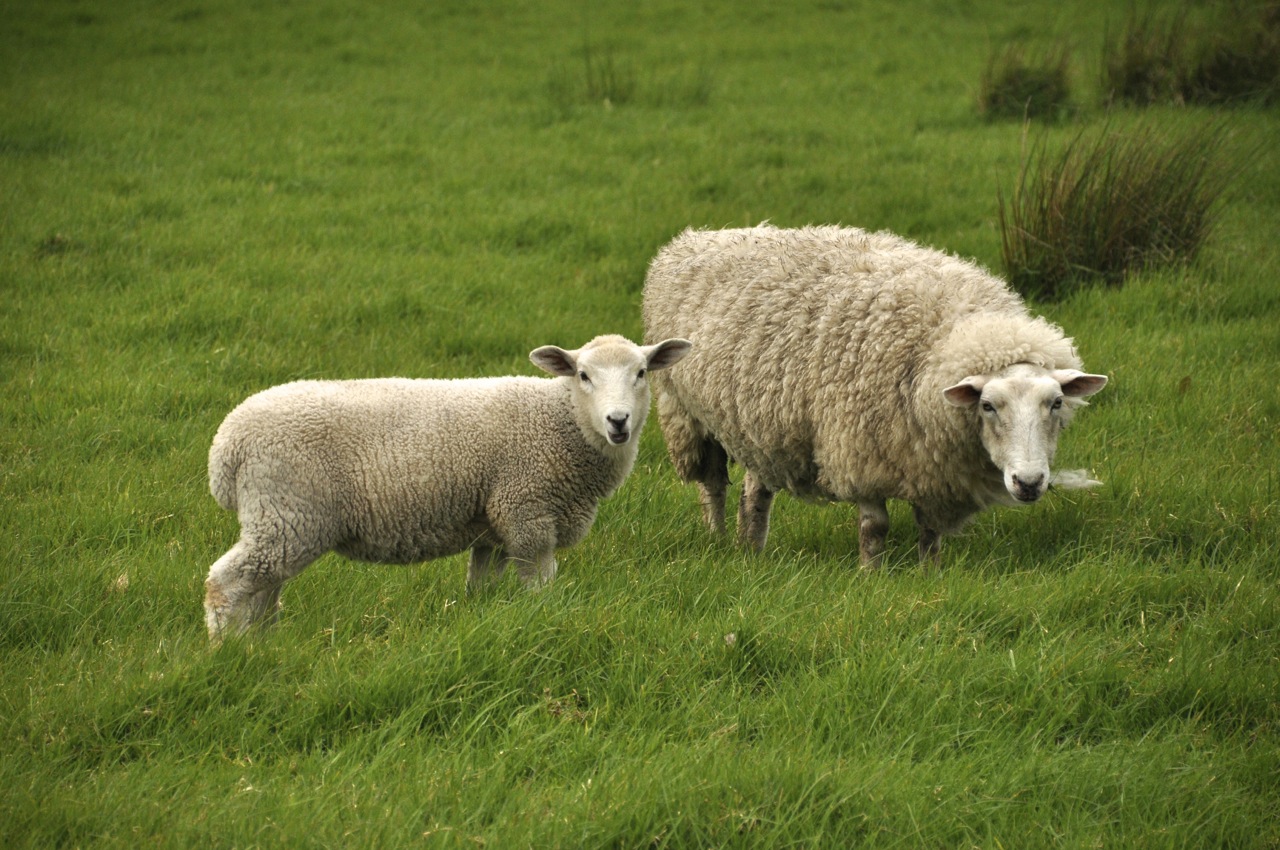
I can’t leave you without a picture of NZ’s most numerous resident, can I?  They’re Sheepeverywhere, dotting the landscape as beige blobs on a green background.  Cows too, in this neck of the woods, but they’re less photogenic.  Apparently many residents outside the cities use cows or sheep to cut the grass.  No need for a lawnmower.  This was the case for the B&B we’re headed to, but a part of me thinks of the ditty about the little ol’ lady who swallowed a spider.  I’m betting the lawnmower is less work.
Of course there is more to the Northland than gorgeous green hills.  One is never

far from water!  Here are a couple shots from Hokianga Harbor.  Looking out to the Tasman Sea, the incoming waves are ferocious, true for the entire west coast of NZ.  The smaller images look across the harbor to (big) sand dunes.

OK, on to the kauri.  Today they only survive in NZ.  The Northland and regions slightly lower were once covered by these magnificent pine trees.  They can live to be 2000 years old, reach 150 feet, and be 60 feet in diameter.  The Maori used smaller kauri for their war canoes that could hold 100 or 150 fighting men (and a village didn’t need too many of them!).  Then the Europeans sailed in.  The trees are straight as an arrow, and the Europeans saw the younger trees as perfect for tall ship masts.  Later, the straight-grained, durable, blemish-free, easy-to-work and beautiful wood dominated the NZ economy, supporting many cities.  Getting those monstrous logs down to sawmills was quite a challenge, and Northland still has remnants of small dams (some 60 feet tall) that were built and then demolished to send these trees crashing over waterfalls and down mountains.  By the early 1900’s, the trees were almost all gone (and with them, the economies of most of Northland’s cities).  Waipoua Forest75% of all surviving mature kauri trees exist in just two forests, together covering only 60 square miles.  The Waipoua is one of those and has the oldest kauri.  The biggest boy is about 2000 years old and has a name, Tane Mahuta (Maori for “God of the Forest”).  I’ll show him to you a bit later.
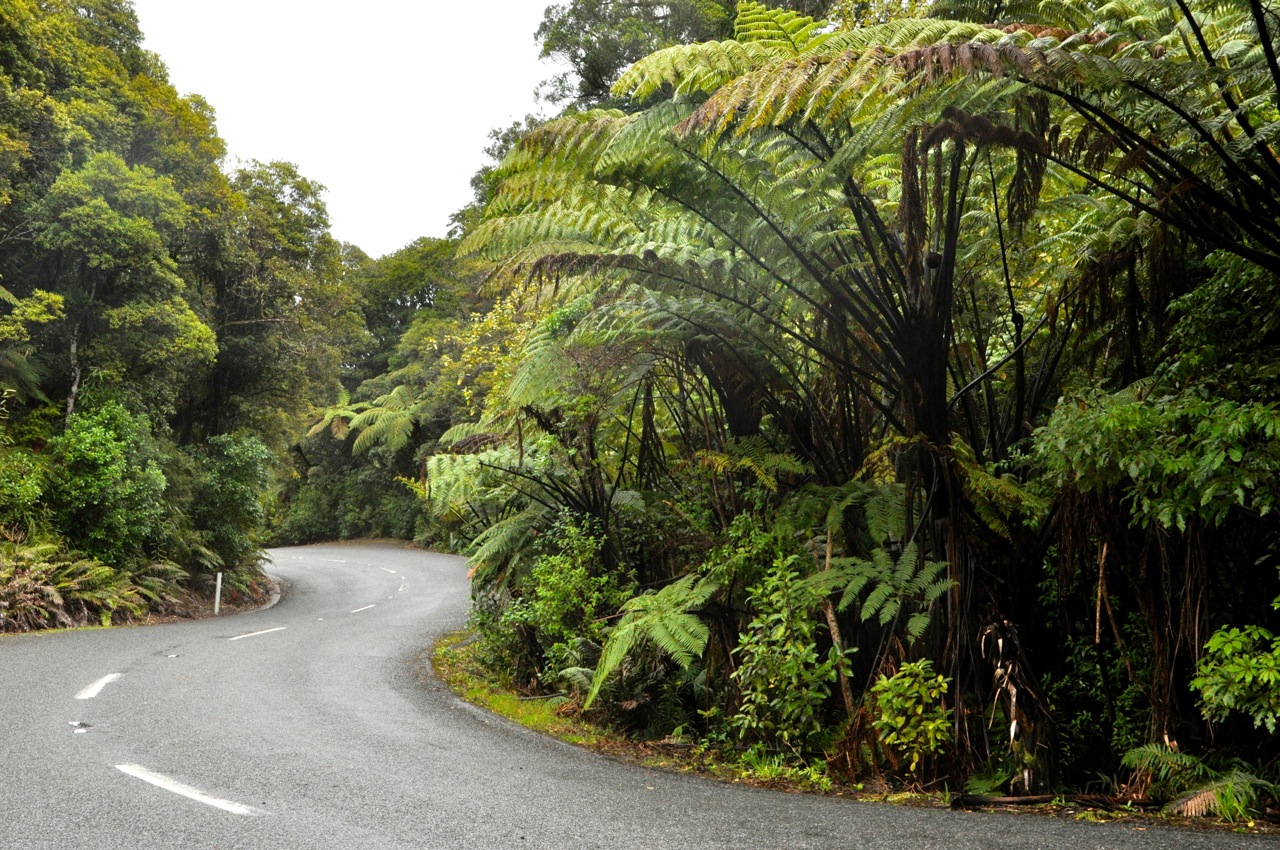
The forest is fascinating, with moss everywhere and epihytes Epiphyteseverywhere else (epiphytes grow on trees but get nutrients from air and rain).  I’ve seen epiphytes before, but not where they totally obscure the bark of a tree, all the way up!  They are varied and beautiful.  Something that resembles Staghorn fern, or maybe it is Staghorn fern, is frequently seen in the trees.

The walk through the forest to the big Kauri is magical!  It appears to us to be a tropical forest.  This is definitely not Kansas!  Today it is of course raining in a drenching kind of way (hmm; are we being taught why they call this a sub-tropical rainforest?), but we are undaunted (expecting the rain, we carry umbrellas).  A couple pictures of the hike below:

The kauris are magnificent.  They have a whitish bark, the younger ones look like growing Tane Mahutatelephone poles, and branches do not occur until you have craned your neck ‘way back.  The big guy (picture to side) is, of course, Tane Mahuta.  Others are also quite striking, as shown below.  I confess, I think the California Redwoods are more spectacular.  For me the redwoods have a cathedral-like quality to them, and I feel a quiet reverence in their presence.  They are also more numerous and taller, and pretty much all by themselves; you are surrounded by the pillars of that cathedral.  The kauri, on the other hand, are here and there and surrounded by a riot of almost-jungle.  Nevertheless, the kauri are so very old and so very massive, yet still so very beautiful, and the thought that they were almost eradicated from this world in order to make a buck is sobering. Respect your elders – isn’t that a Maori prinicple?  Pictures below.

Amen.
Bay of Islands Retrospective

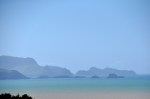
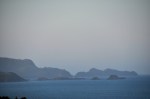
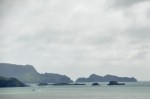
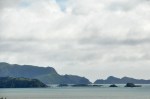
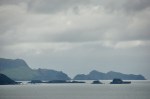
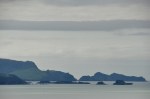
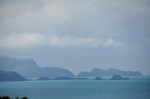
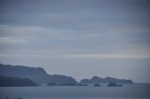
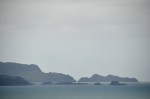
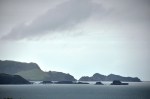
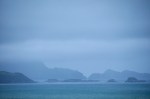
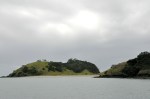
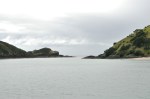
I thought I would share an experiment with you.  The pictures below are shot from our apartment at the Bay of Islands using a telephoto lens to look at a far-off headlands.  Far enough away to give everything a blue cast, typically, and general loss of color.  Then I just kept shooting the same spot over different days and different times, trying to capture the changing moods of the ocean and sky – because one of the joys of looking at a bay is that the same view is never ever ever the same.  The result isn’t great – I probably should have shot something closer to avoid the blue – but nevertheless, I think it is somewhat interesting.

Tour of the Bay of Islands

Well, ya can’t walk to the islands, you gotta take a boat.  At some expense, I might add.  We did the 4 hour morning trip, with a chance to swim with the dolphins, which I thought could be fun.  MorningUnfortunately NZ has a lot of rules about that, things like there can’t be a young dolphin in the pod, they have to be bottlenose, the number of people in the water can’t exceed the number of dolphins, and so on.  I had my suit on but was not optimistic.  Ginger was less enthusiastic – no way was she going into that cold water with fishy things bigger than her.  As you can see, the morning was really overcast, but at least not raining.

Well, that’s our boat.  This is a major thing to do in NZ, and the tourists fill these boats pretty well.  Our boatWe’re off-season, but there are two major boat companies, each doing more than 2 trips a day, and our smaller boat still had about 50 people on it.  There’s a bit of a jostle getting position to take a picture.  Not our thing, really, but we’re giving it a go.  There’s also a chance to see whales.  Interestingly, orcas were seen the previous day, which meant for that day there were no porpoises to be seen.

So we saw some islands.  Not too exciting, really.  There is some history involved.  For example, the first picture is the cove where Cook stopped as he was mapping and naming features of NZ.

And of course there are islands (or chunks of islands) owned by the rich of the world, such as that house above on the right.  Because many of these nice houses – with nice beaches, I might add! – are empty most of the time, as in the picture below,

nearby there is often a much much much more modest caretaker’s house – like the last picture – to keep the place clean and chase off the riff-raff.  There are indeed many very pretty beaches on this Bay, all empty when we came by but which are apparently occupied in the summer (it’s still pretty chilly here).  Here are a couple of interesting beaches.

There’s actually a fair amount of interesting island scenery; jutting out crags, rock faces, shallow water of a different color, lonely lighthouses, etc.  Examples below.

Ah, the aquatic mammals we were supposed to see!  Well, we did see them, but pretty shy ones.  Photographing a dolphin or whale is not as easy as it sounds.  They’re up, you point the camera and push the button to focus and snap, and you have captured the bubbles of their departure.  And the rocking boat and jostling crowd do not help your success rate.  Yes, we found a small pod of 4 dolphins, yes they were bottlenose, but yes, they had a younger one (we were told; I think there just would have been a small riot to allow only 3 people into the water).

And whales?  Well, a whale, but this whale was harder to photograph than dolphins.  It briefly came up here and was gone, and you waited for forever, and it came up there and was gone.  And like the dolphins, the whale was not in a joyous mood; no leaping out of the water frolicking, no tail flick, just a small gray hump appearing, rolling and gone.  So here are my pictures of a whale, hard to get excited.

There were other animals as well.  Seals and our friend Charlie the red-billed gull,

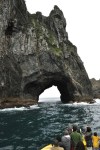
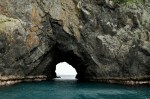
who flew with us on most of the journey, hoping for a handout.  Finally, the trip ends Hole in Rock, aproachwith a zip through “The Hole in the Rock”, that big chunk in the background.  A tourist thing, I had an initial negative reaction, but in fact it was kinda neat.  Here are the images of the funnel through the tunnel.  The last image shows a much smaller boat coming through (yet another tour group).

Well, that’s it for excitement.  Really, we’re more into hiking than boating, and it’s cheaper!

Hike and the Pied Shag Tree Nursery

We did a relatively short hike in the Waitangi area, and were thrilled with the Pied Shag Hotel and Nursery.  You’ll see.

This hike actually started with a waterfall at the beginning rather than being the reward at the end.  Falls, Waitangi WalkIt wasn’t a loop route, so we had a choice.  It had rained recently (I mean, it rained almost every day.  Have you noticed the skies in my photos?) and there was a bunch of brown silt in the water which you can see in the waterfall.  Unique for me, I could walk right up to the corner of that falls there in the foreground and put my hand in the water, my toes at the edge, the water going by at quite a clip as it executed its lemming thing.  Ginger opted out of the thrill.

Hikes here are interesting because the flora is like nothing we have seen.  The trees are amazing, and the tree ferns incredible.  Below are two shots of the trail.

Then, as we walked along a bank over the river, we encountered quite a few trees filled with birds called Pied Shag (they act like cormorants).  Many in nests.  With the cutest cuddly fuzzy babies.  Quite a nursery, with feeding going on, teenage Shag begging for more handouts, mommas diving, daddies building nests, birds fighting, real family time.  Because we’re on a bank and they’re in a tree, we’re eye-to-eye.  Amazing.  Here are some pictures.

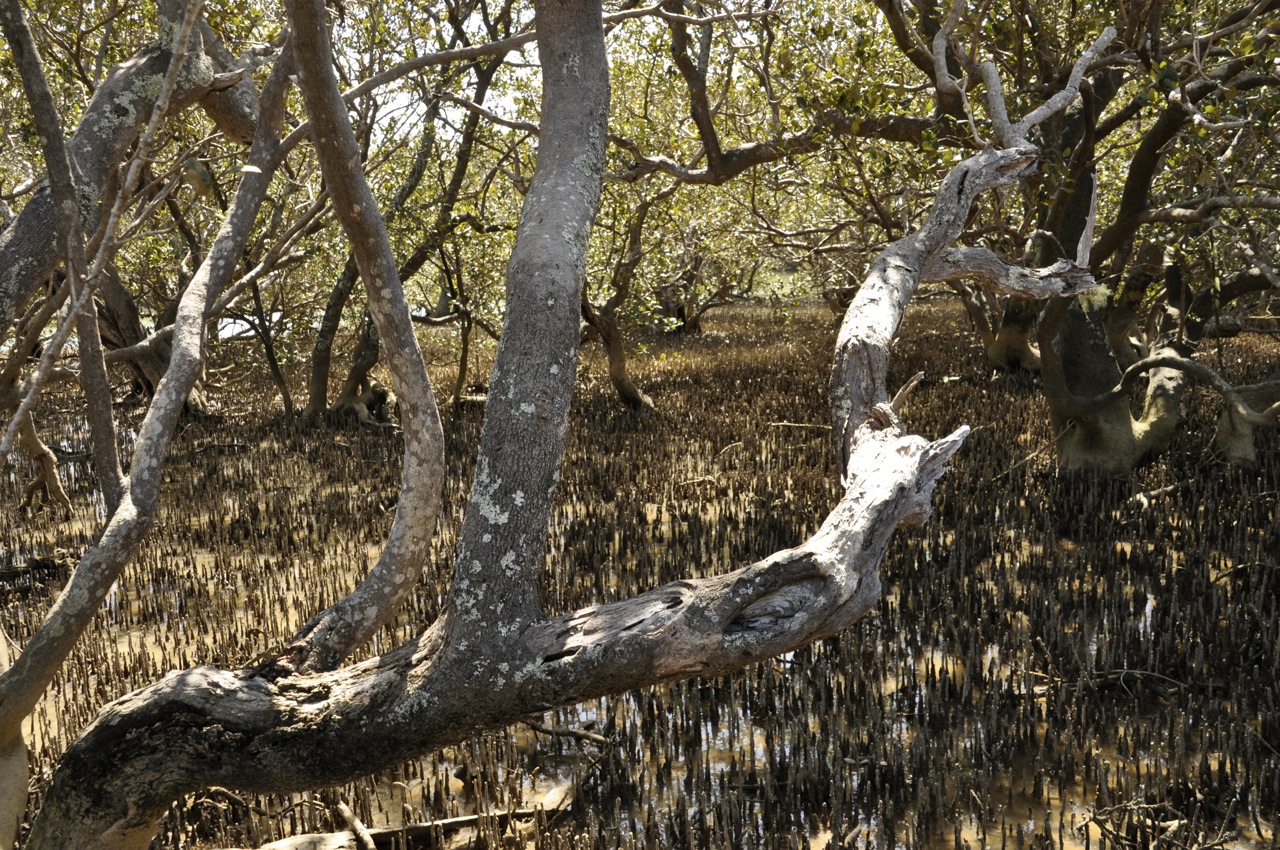
The hike also included a trip through a mangrove swamp.  Big mangrove swamp (they’re everywhere, really, but kinda hard to walk through without a boardwalk).  Mangrove SwampThere was a loud snapping sound occurring randomly in the swamp – turns out they’re “snapping” shrimp in burrows.  I hope you’ll forgive me if I don’t show you a photo of shrimp burrows (holes) in the mud.

Next post will be about a boat trip around the Bay of Islands.  How can you not take a boat trip if you’re visiting a place called “Bay of Islands”?

Historical Waitangi and Area

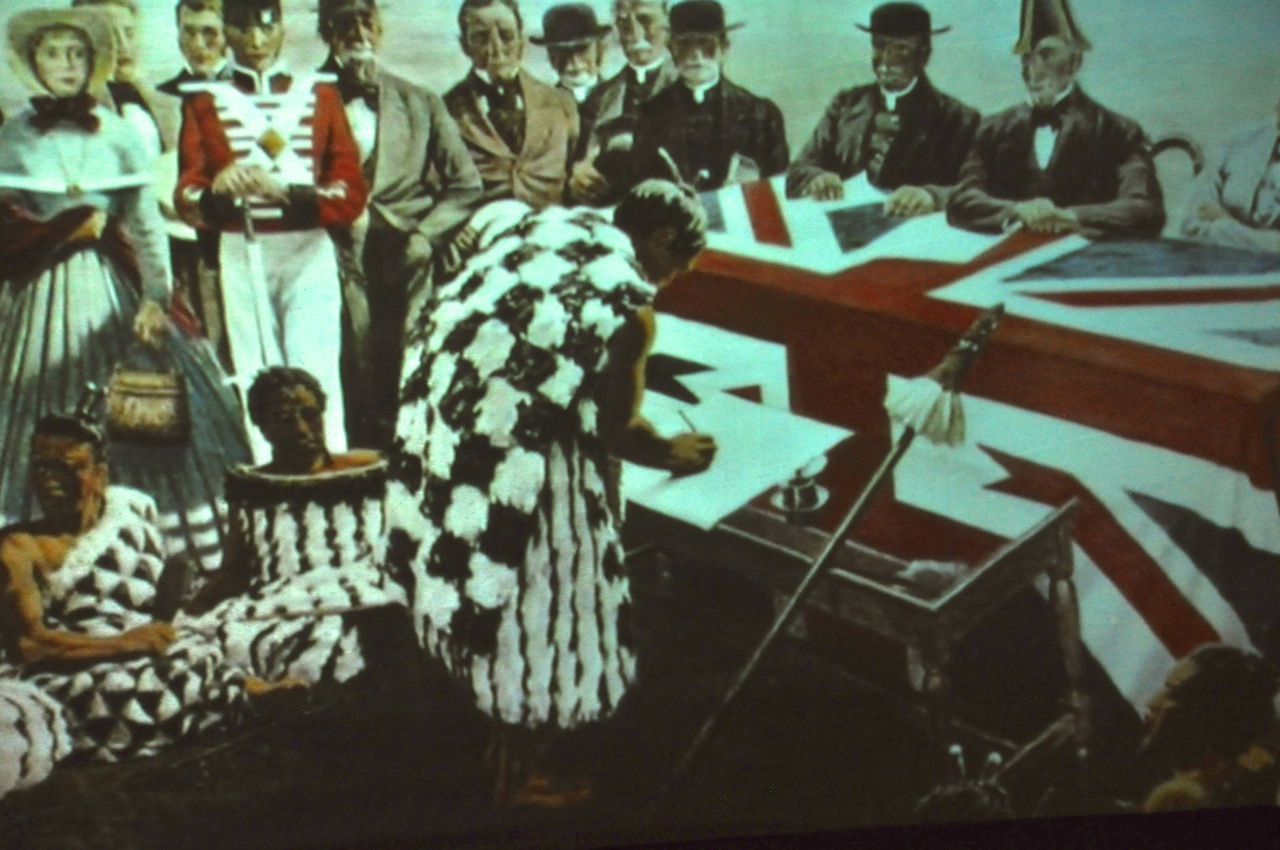
Kia Ora (that’s Maori for hello or welcome).  Waitangi is just north of us in Paihia and is historically the most important place in NZ due to the signing of the Waitangi Treaty there in 1840.  This treaty bestowed British citizenship on the Maori and subjugated them to British TreatySignlaw while supposedly protecting the Maori’s land and interests.  As I mentioned in an earlier post, this document is central to current day discussions over land issues.  Kiwis see this as the equivalent of the US Constitution.  Maori see this as a very different document than the one they signed in the Maori language; in the English version, Maori land and interests were anything but protected.  The Maori chief, Hone Heke, who was the major proponent for signing, was also the chief who, 5 years late,r precipitated the Northern WarsHeke expressed discontent over a period of a year by chopping down the British flagstaff flying over the nearby town (Kororareka) on 4 separate occasions.  The last time was too much, war broke out, and Heke and other chiefs took the town; in clashes it was burned to the ground (to be resurrected as Russell).  I mentioned before that the Maori were a warrior society, living in or near fortified hilltop pas.  Male children were trained to be warriors starting at age 5.  Maori were good at war, with constant practice (raids on other tribes).  They were a Stone Age culture; weapons were wood spears and sharp-edged jade clubs.  With European arrival, they also acquired muskets; these were quickly seen as a huge advantage in their wars, and an arms race was on.  Many Maori artifacts in museums are the result of trades for muskets with Europeans who treated the artifacts as art objects rather than tools.  We’re talking giving up a Maori tribe’s treasures, even war canoes!  Missionaries came under huge pressure because they were reluctant to engage in musket trade.  One of the Maori chiefs, Hongi Hika, went to London where he had a meeting with the King (!), who gave him a suit of armor, which on his return via Australia he traded for something like 400 muskets.  So when war broke out with the Europeans, the result was predictable but did not come easily.  Usually Maori were outnumbered at least 2 -1, but still managed to win half the battles!   It was not unusual for the British to lose a third of their assault force, with the Maori warriors  slipping away under cover of darkness.  Some of the major battles the Maori lost were due to other Maori tribes joining with the British forces (to settle previous scores).

These guys were on opposite sides, and I only show the pictures because I find the facial tattoos to be fascinating.  The Northern Wars lasted a year, the final fight showing Maori ingenuity.  Presaging WWI, in response to overwhelming British firepower, they built gun-fighting trenches and tunnels and withstood 10 days of cannon bombardment and attacks before finally being breached.

Let me show you some of the area around Waitangi before going to its cultural center.  The area below is one of the oldest European settlements with buildings still standing (eg, the whaling taverns and brothels in Kororareka were burned down).  An early missionary establishment next to the pa of Hongi Hika is shown in these pictures.

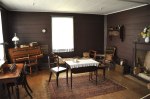
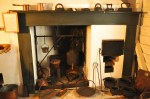
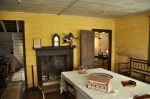
That’s the earliest wooden house in NZ, the missionary house (Kemp house) built in 1822.  The missionaries brought new technology and agricultural methods to the Maori, and hoped their religion would also be adopted.  The Stone Store is right next door and is the oldest stone house in NZ, built in 1836 to facilitate trade with the Maori; it’s a (tourist) store today, containing pretty much the same contents as would have been sold then – burlap bags, hand-made nails and so forth.  The interior of these houses is surprisingly modern to be there in the middle of nowhere, as shown in the images below:

And then it hit me – we think our country is young!  This place is a baby!  Walking through the missionary house I was struck by how much it reminded me of the time I lived in an old house just off Market St in downtown Charlestown SC (around 1955), in a house that was probably built before this one (although our furniture wasn’t that good, the kitchen was a little better …).  Connecticut has a stone house that is 200 years older than their stone house – a difference in years that exceeds Kiwi history in NZ!

OK, shifting gears back to the burnt town of Kororareka, rebuilt as Russell.  It’s a quaint little town across the bay, about 2 blocks by 2 blocks, with a single house (missionary) spared in the burning.  Pictures below:

One of the buildings there is the Duke of Marlborough Hotel, the oldest hotel in NZ, with liquor license #0001.  It’s pretty nice; we had lunch there on the veranda.

Finally, a view of the Waitangi treaty grounds.  They have a Maori meeting house, the signing house, and a war canoe.

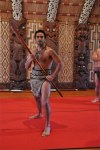
We took in a performance of Maori culture at the meeting house; we were met by Maori warriors emerging from the meeting house fully armed & doing choreographed movements, chants, vocalizing, all the while demonstrating their prowess with their traditional weapons; this was meant to be intimidating and a challenge, and was it ever!

Especially for me, having been chosen the “chief” of our of little group and being the object of their feints.  After doing their challenge, one of the warriors laid a “gift” – a palm-like branch – in front of me, to pick up if we came with peaceful intent (otherwise they probably eviscerate me on the spot).  We were then welcomed into the meeting house with song and dance.  Inside, a ritual song & speech of welcome followed, and I had to respond with my own speech, followed by the hongi, the simultaneous touching of foreheads and noses together & the symbolic exchange of breath with their chief.  Much song & dance with explanation followed, along with demonstrations of weapons use and games with sticks that improved limberness, hand/eye coordination etc.

One song started as a solo, finished as a duet, and even though it was in Maori, its beauty and emotion moved Ginger to tears.  A final group photo.We are Maori now

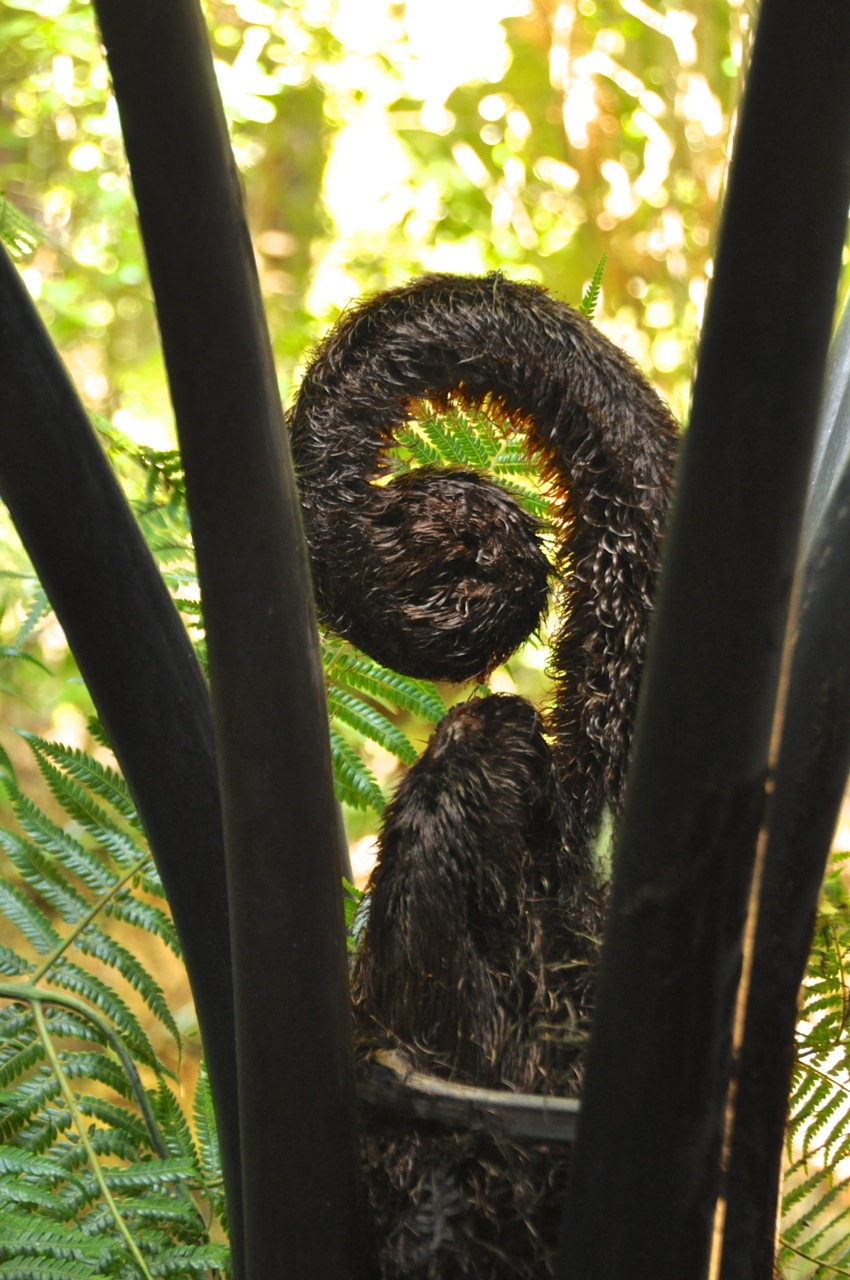
Well, I know, this has been a long post, but let me add a final “art” photo – an unfurling frond from a tree fern.

TreeFernFurl

Auckland to the Bay of Islands

I need a picture here before I bore you with a long story, so here is a pretty tree in Auckland.  Auckland TreeOK, we need a car. The cheapest I could find to rent for 9 months is $16,000.  That’s calling all agencies, even ones in NZ.  NZ’s version of “Rent a Wreck” still wanted $12000 for a 2002 Nissan getting poor mileage.   There’s a monetary advantage to renting; the credit card gets me free insurance, and I can leave the car in the North Island and rent another in the South Island, avoiding the $500 for car ferry.  But still, $16,000?  Really?  Leasing wasn’t much better, and was impossible to do for a new car.  Soooooooo – time to buy a car.  I discovered I could buy a used car with guaranteed buy back, thus capping my car expenses.  Not any car, mind you, but ones the dealers wanted to dump.  Not a new car, usually an older model (eg, 2005, sometimes a 2010, but all before the big push for better mileage).   We really wanted a newer, more comfortable car, since we’ll be doing a lot of driving.  We finally got a pretty good deal on an inherently expensive car, a 2012 Ford Mondeo, diesel, 15,000 kilometer mileage, with a lot of bells and whistles.  Computer for everything – but no navigation system (say what!?).  Good thing the boys got us a Garmin!  So we bit the bullet and bought the beast (but caveats; drive less than 15,000 km, no damage, etc; I can live with that).

So now we need auto insurance (US insurance will not carry over beyond Mexico and Canada).  The car dealer said they could get it for us, but this was Sunday and the insurance guys didn’t call back (and I’m thinking, what a way to pad a profit, I’ll find my own).  I didn’t mention that while test driving the cars we were considering (driving on the “wrong” side of the road) I kept edging left (curb side), with Ginger gently suggesting that I’m about to broadside the parked cars (in falsetto, no less), and at a red light when I made a left turn I pulled into the far (wrong) lane rather than the curb lane, freaking out Ginger, the salesperson, and all the oncoming drivers before I scooted into my correct lane.  Would I insure me?  Hmmmm.  I visit the big insurance guys in their store (AA), go on-line, get the yellow pages and call everybody with a picture advertisement – same story.  You’re a tourist, we won’t insure you; you need a home address here in NZ.  Wow, this was just like buying a phone in Spain – I have to buy a house first!  So I’m thinking, the auto dealer has some motivation here to find us insurance since we haven’t signed any papers yet.  I go from “I won’t buy your stinkin’ insurance” to “pray you can find me any insurance”.  And of course they did, and not too bad, really.   Auckland from WaihekeSo all is good.  Now to get out of here – say goodbye to Auckland!

We left Auckland and put quite a few Kiwi’s at risk of life and limb as I drove north to the Bay of Islands.  Ginger was a nervous wreck and kept up a steady (continuous?) stream of “edge of the road” comments.  Most roads here are just 2 lanes, rather narrow, and often twisty and up-and-down with no real break-down lanes and sharp drop-offs, and  it’s hard to get a feel for where the left side of the car is when your steering wheel is on the right (“wrong”) side of the car.  With oncoming traffic zooming by inches from my (right) side mirror I tend to NOT hug the center line and I drift a little (!) bit left.  So Ginger was the official left-side audio monitor, which meant she was in charge of nail-biting, leaning hard to the right, and periodically (continuously?) reminding me that I was going of the edge – again!  We went to bed last night at 10:30 PM, it’s 9:30 AM now and she’s still sleeping it off.

Northland countrysideAlso attached is a picture of the Northland above Auckland – very picturesque!  Lots of cows and sheep!  Greener than you can imagine!  Almost Switzerland-like.  Ginger didn’t want me to look at anything as we were driving (“It’s really pretty, but don’t look”).  And if I pulled over to take a picture, she’d scream because we were suddenly lurching off the road (maybe at faster than normal?)….  Somehow we made it unscathed, though.

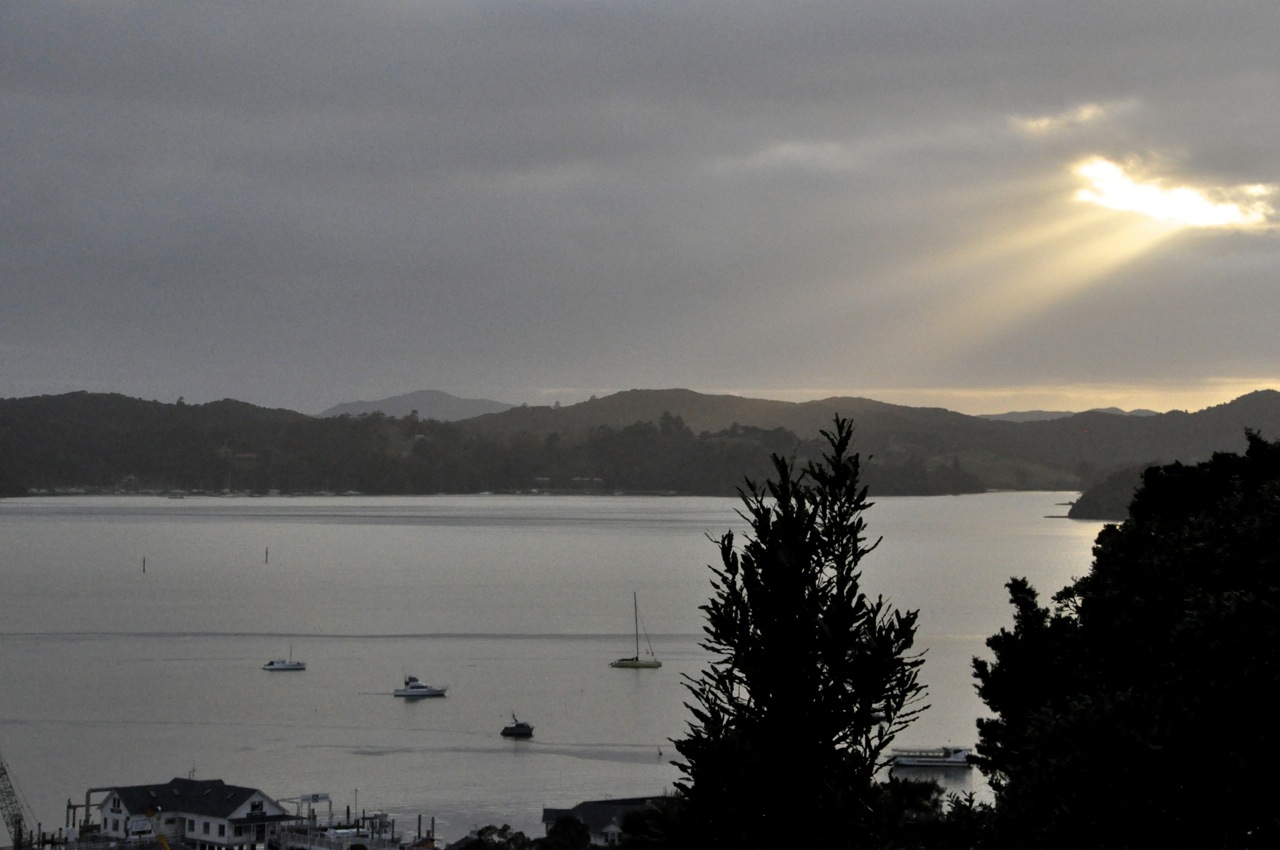
Our place at the Bay of Islands was carefully selected because we were going to spend 10 days there getting the blog up and using The Bay as a base to explore the Northland.  Our apartment (yellow)We chose well – an apartment in Paihia, a spectacular place.  The picture to the left shows our apartment from the bay – the yellowish one near the top, center.   And then there is the view out to the bay.  Mesmerizing, really.  This is a piece of paradise, ours for a short while.  The pictures below show a portion of the view from our deck ….

Not too bad.  But just to rub it in, here are views from the living room:

And from the kitchen:

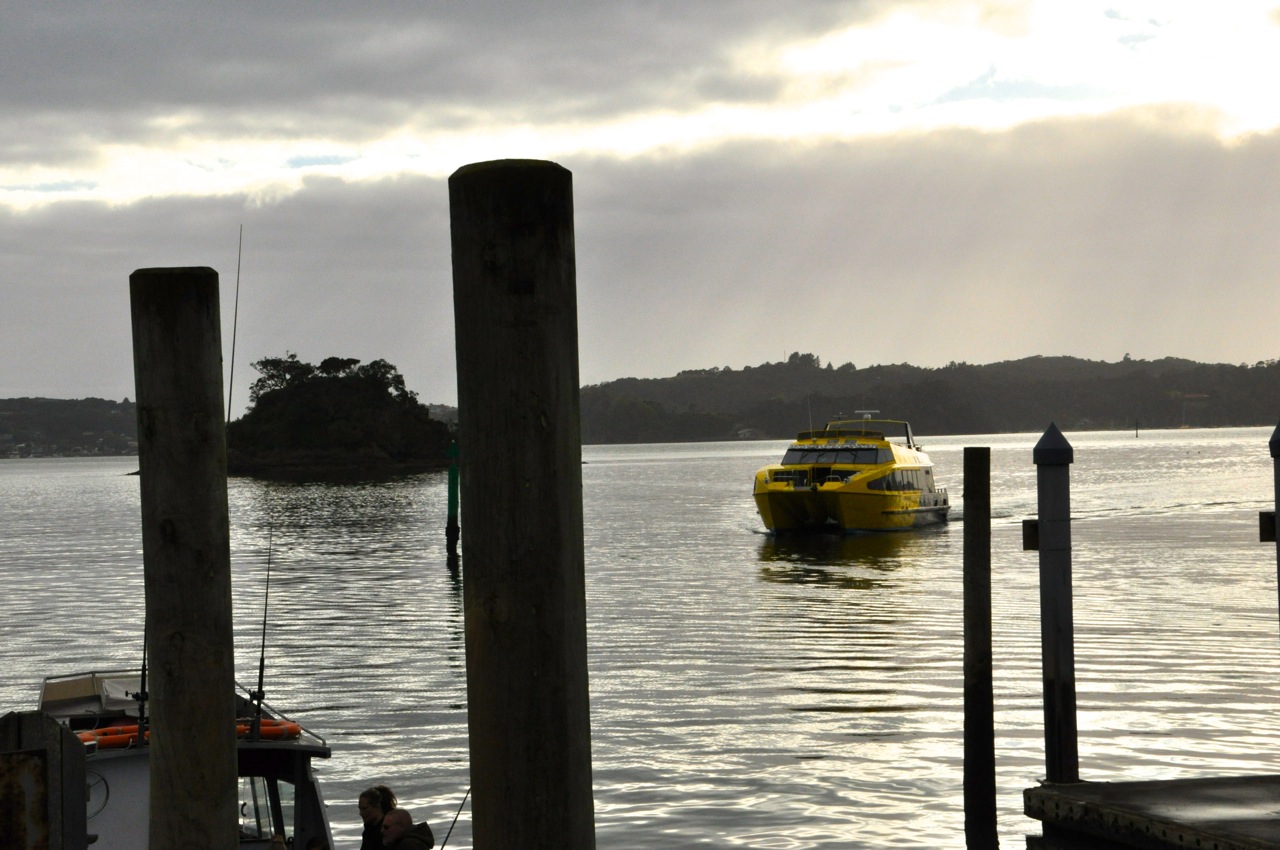
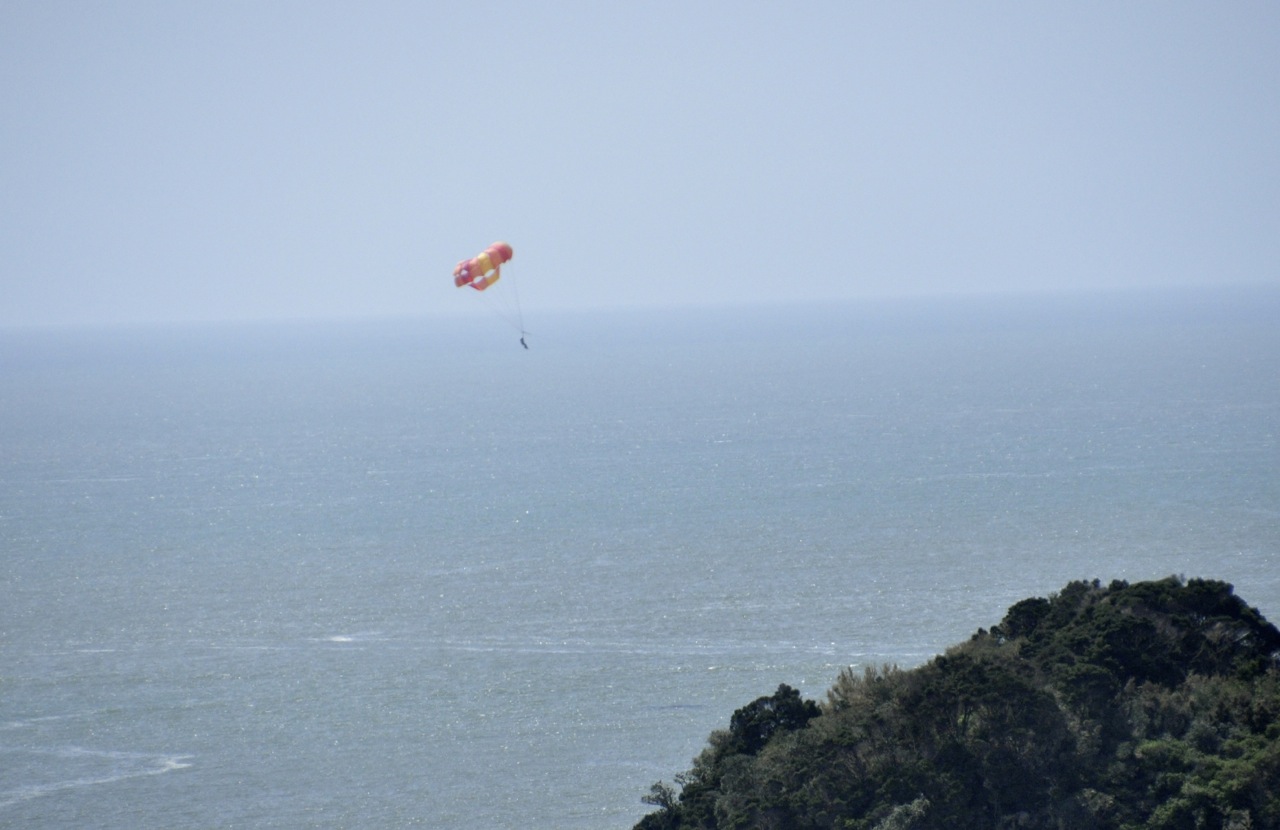
In other words, it was spectacular from anywhere.   And like the sea, never the same from one moment to the next.  Plus, this is New Zealand, so you get boats, and sailboats, and ferries and Sailing… parachutes? Are we surprised?  Not really.

I’m going to close with a picture of an unfurling frond from a tree fern here on property (tree ferns and flowers are everywhere), and then a picture of “live music on Sunday, 3pm -6pm)” from Al Fresco, a local bar/restaurant.

Paihia is a huge tourist destination – very busy in the summer.  Almost all tours come here to view the islands and swim with the dolphins.  Nevertheless, there’s less than a thousand people living here, and it’s a small town.   The music venue was cute.  The band wasn’t bad, a lot of the people knew them, and you had a lot of 3 generation tables.  Grandma and grandpa were tapping their feet.  The food wasn’t great but hey, can’t have everything.  I ordered a pot of mussels (I love mussels), and was surprised when the pot came out with like 8 mussels in it, protruding from the bowl.  Each mussel is about 8-9 inches long, which pretty much fills the pot.  The mussels are big!  Arnold Schwartzenegger mussels.  Unfortunately quite tough and chewy, kinda like unbeaten octopus.  Bummer!  Maybe they’re better elsewhere.  We’ll see!

Auckland Art Museum

Well, this was a cool building and decent museum, with mostly New Zealand paintings. Auckland Art Museum The picture there to the left is a large artwork hanging from the roof of the foyer.  The flowers are puffy fabric, big, and open and close individually by a (somewhat jerky) robotic mechanism.  Actually pretty cute.

Many of the painters in this museum – guys you never heard of – had gone to Europe to learn and hob-nob with the giants of the day, such as the Impressionists and Cubists, and returned to NZ with these new ideas, but my reaction to the NZ art, with two exceptions, was rather negative – the art was nice, but didn’t seem to add anything new.  I’ll present a few (very few!) of the old-style pictures I liked, and then show the two exceptions.  A short post!

OK, I lost the title and painter on this upper left one.  The subject is a (defeated) wounded soldier being treated in a sympathetic town.  I liked the setting – the beams/tree trunks of the barn, the Dutch-master-like treatment of the black dress and lace.  Very romantic, don’t you think?  The image on the right is by Edmund Leighton, “Un Gage d’Amour”, 1881.  An Englishman, not a Kiwi.  Nicely done, really.  Romantic theme.  Am I a sap, or what?

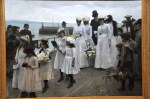
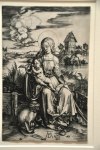
The bottom left is a very large painting of a child funeral by Frank Bramley, “For such is the kingdom of heaven”, 1891, an Englishman rather than a Kiwi.  Hmm.  Is there a pattern here?  The painting very much reminded me of John Singer Sargent from about the same time.  The last image (engraving) on the right is by Albrecht Dürer, “The virgin and child with a monkey”.  Yeah, not a NZ artist.  Definitely a pattern.  I love Dürer.  The work is fabulous.  The monkey?  I dunno, whatever sells, I guess.

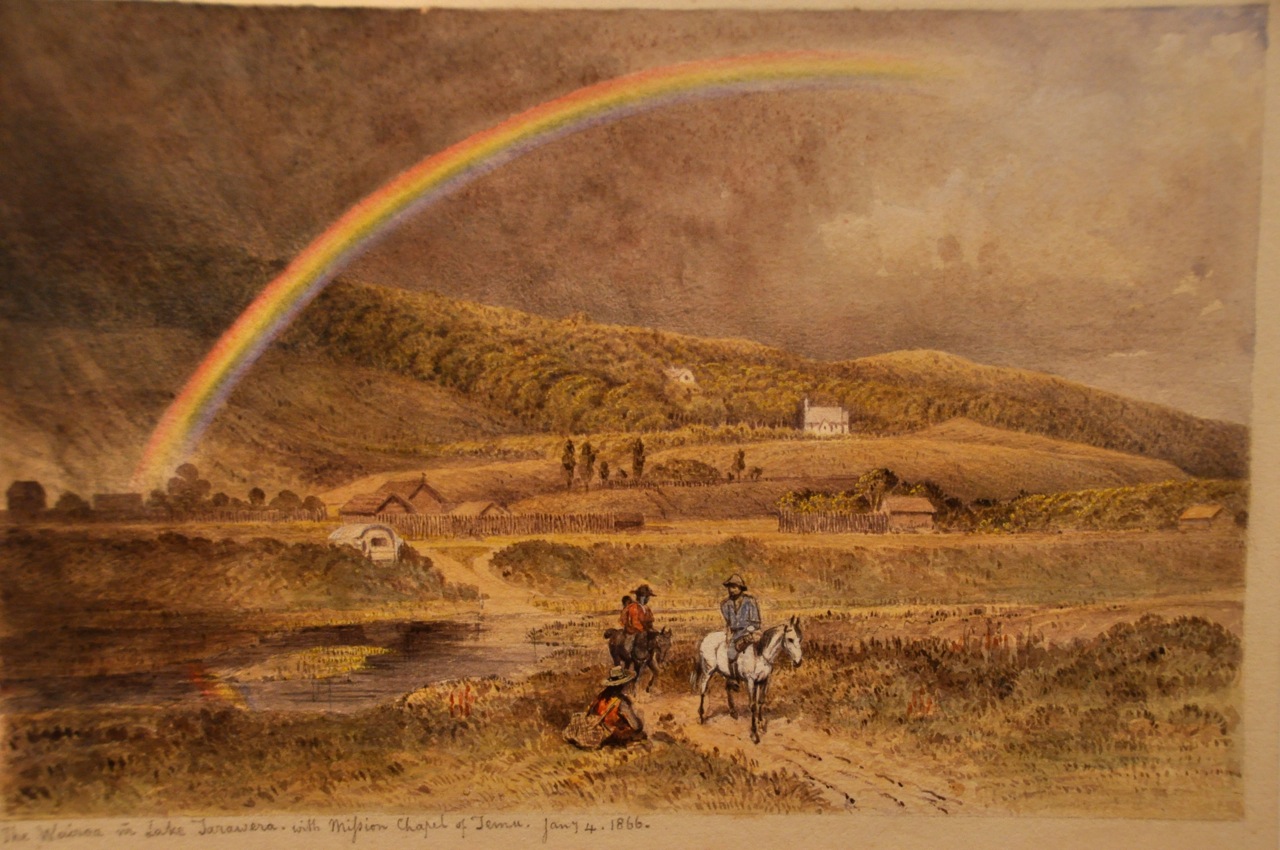
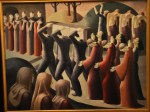
OK, let’s do 2 NZ artists.  der, Auckland Art MuseumThe first guy is not a professional painter; watercolor was just a hobby. This is John Kinder, “The Wairoa near Lake Tarawera with MissionChapel of Te Mu”, 1886.  There were a bunch of these paintings, and they were wonderful.   Kinder is important historically because he captured early times of European NZ settlement.  He’s an interesting guy – a top-notch mathematics student, he switched studies to become an Anglican ordained deacon.   After a decade of strict application of high church religious observances at his first position in England, the town asked for him to be removed.  Oops.  So that’s when you hop in your canoe and set off for the horizon, and he accepted a position as headmaster at the Church of England Grammar School in Auckland.  He did well, and he did a lot of paintings, thank you.  The other NZ painter I liked is a lady, A. Lois White, and the pictures were from the more modern 1930’s and ’40’s (Picasso time); and like many then, she was a Socialist.  The first line drawing is a subject common for that time protesting Nazism and Capitalism; I thought it well done, and might it apply today to capitalism?  My how some things don’t change.   The next three I loved because I found them different; such an interesting use of repetition!  And space-filling!  And hints of art noveau?

The line drawing is “Study for collapse”, 1944.  The upper right is “Funeral march”, 1936.  Lower left, “Pattern inspired by rain”, 1941 (and I like the subject matter).  Last, “Jonah and the great fish”, 1945.

That’s all for now.  Next post, we’re leaving Auckland for the great beyond.  WoooHoooo!!!

Auckland Museum (Mostly Maori)

Kia ora.  Humor me to continue briefly about Maori influence.  Captain Cook named a bunch of bays (eg, Doubtless Bay, from a ship log entry – “doubtless, a bay”).  Other than that, at least for the North Island, names are mostly Maori.  Impossible, multi-syllable, thousands of very similar names.  Names like Whanganui, Waingaro, Waitangi, Waitiki, Whangarei, Whangamumu, Whatuwhiwhi, Whangaroa.  Those cities being located just in the small arm of the North Island above Auckland – and there are more like that.  And there are lots lots lots more going south – Whakahoro, Whitianga, Waikaremoana …. my brain shuts off.  Oh, and to make it more interesting?  Whangarei is pronounced “Fahn-ga-ray”.  Confusion reigns, and no, it is not just the “W”‘s.  So when reading a guide book and you see a city name, you are guaranteed to have no bloomin’ idea where in the island they’re talking about.  My brain thinks all the cities have the same name.

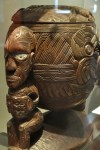
OK, onward to the Auckland Museum, which, among other things, contains the world’s finest collections of Maori and Pacific art and craft.  The carved wood art is amazing.  Intricate, often full of difficult fenestration, and full of Maori meaning, the art is incredible at any level.  It was applied to buildings, to gateways, to walking sticks, to canoes, to paddles, to boxes, to musical instruments, to bailing buckets for the canoes …. Let me share some examples; I’ll start with a storage shed for food and items of value to the tribe.AustraliaMuseumStorage1  Not too shabby – the sides and back are also carved the same way.  Some details:

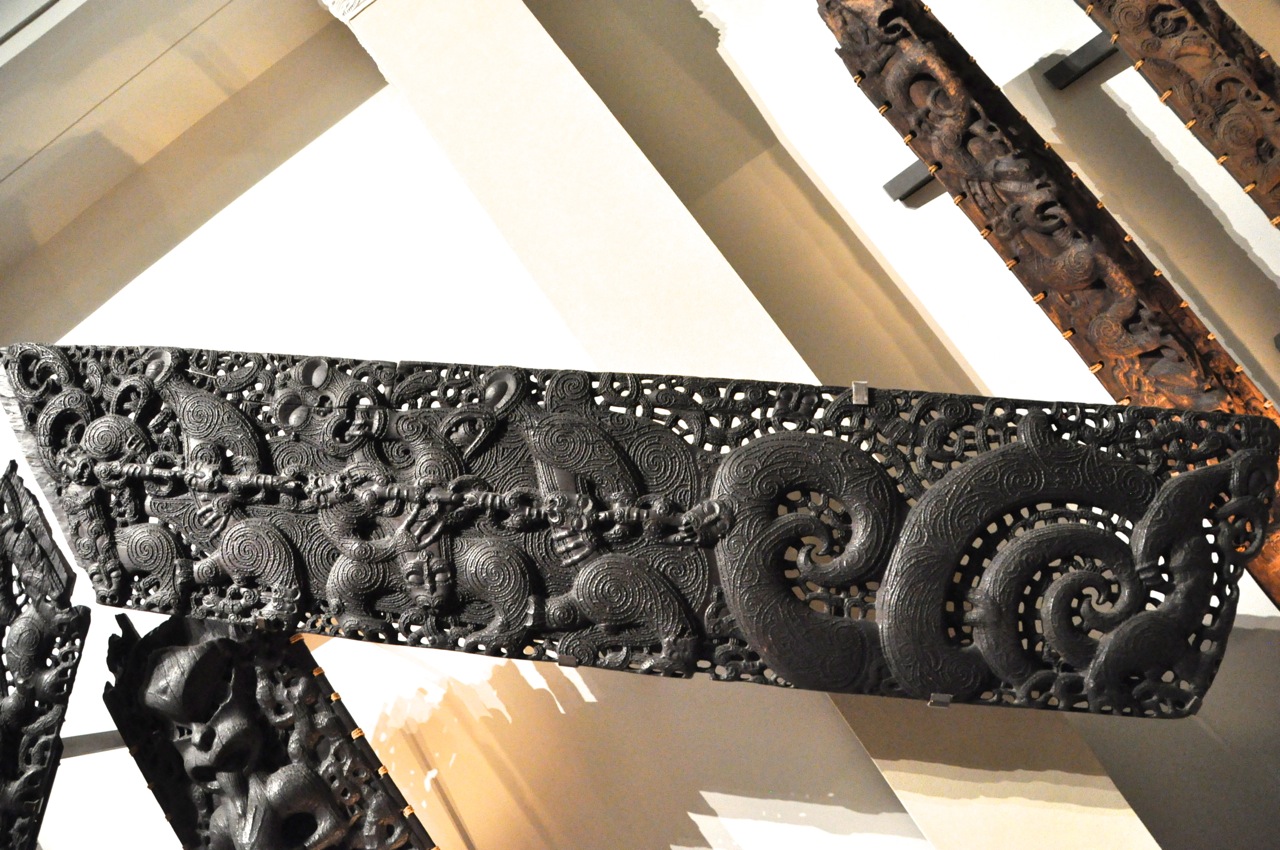
Carved panels were used for building decoration indoors and out, and as gateways.  A pretty example below:

Carved Panel

Of course, carved boxes to store valuables (like your favorite feathers):

OK, small things to big things, let me show you a war canoe.  It was built in 1836 from a single log; it is 25 meters long and can hold 100 warriors.  The vertical image is the very tall canoe’s tail.

Some examples of carved ship prows (and a canoe paddle):

Musical instruments were interesting.  There were no stringed instruments prior to European arrival, just drums and wind instruments; examples shown below:

As you might expect, bowls were carved (or shaped, the last one from a single piece of bark):

We’re getting near the end!  Stay with me just a while longer, the best is last.  Let me show you some of their fiber arts, done by the women.  Below is a kiwi feather cloak, each feather woven into the fabric.  A fiber mat and 2 skirts.  And fiber baskets.
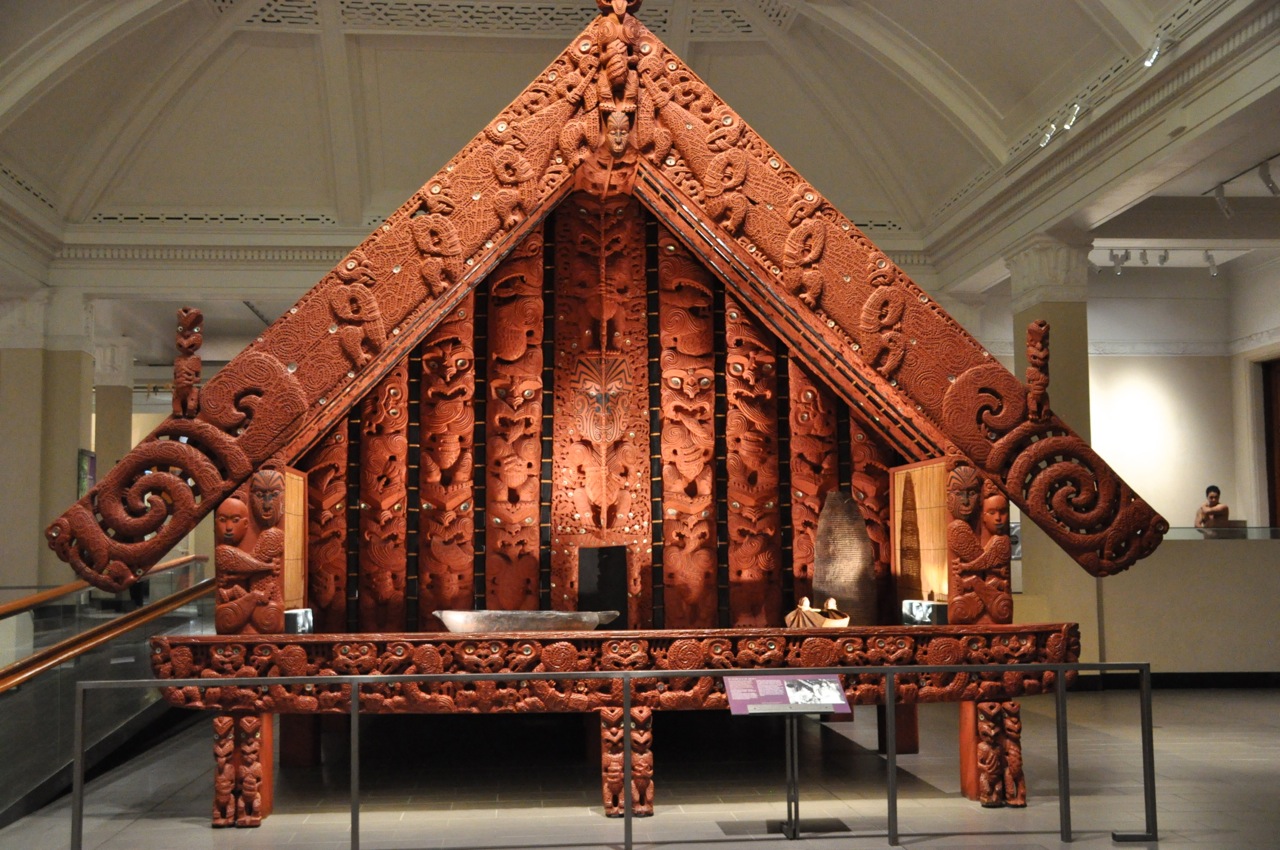
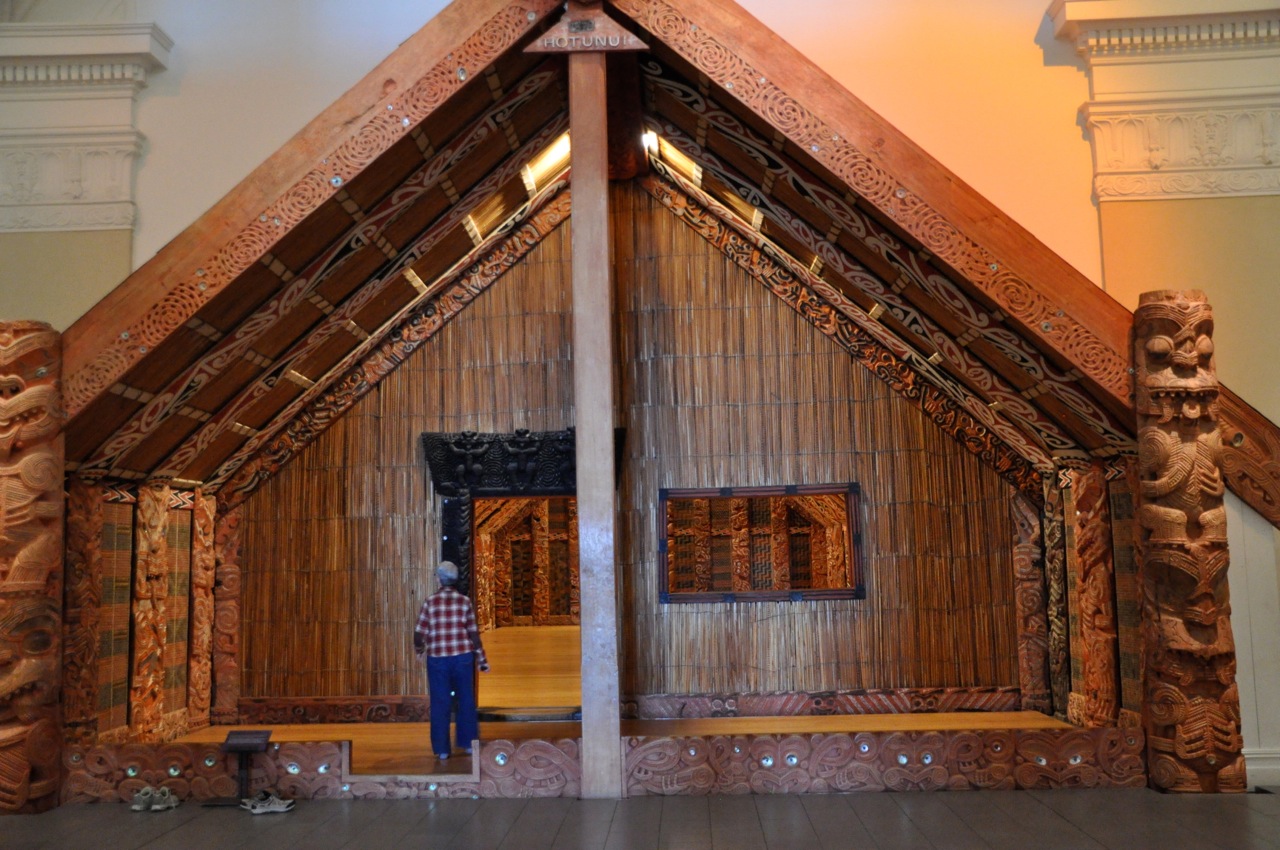
OK, for me the most spectacular was the meeting house, shown below:Meeting House

The meeting house is constructed of wood panels and woven fiber mats.  Each panel

typically represents a story from that tribe or sub-tribe, often regarding ancestors.  Support poles are typically images of ancestors.  The meeting house had many functions.  It was a place for the tribe to receive visitors, to do business, to entertain or have parties, or for weddings or funerals.

Truly spectacular, I thought.

Museums are tiring.  The receptionist told us the museum would take us 2-3 hours to see; we spent 5 hours and did not come close to seeing everything (a diverse museum, it had for instance an Edmund Hillary wing with his gear, pictures, and a large mock-up of Everest on which was projected in a time sequence his team’s daily progress up the mountain.   Cool!  And some pretty incredible fossils, like this one. Fossil But enough for now!


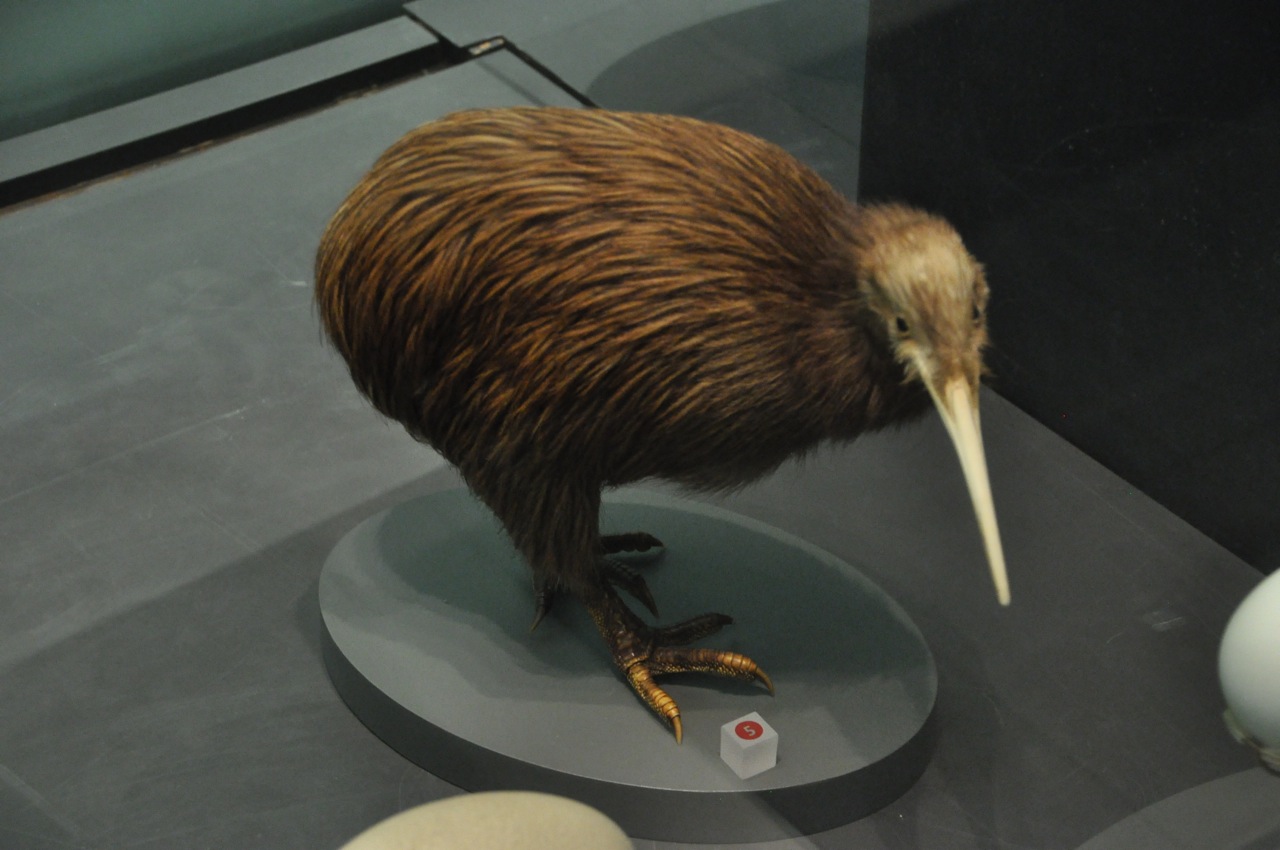
Except for this one last item from the museum, a stuffed Kiwi.  Aren’t they cute?  For those of you old enough to remember (are any of you old enough to remember?) Al Capp’s Shmoo, don’t they look like a Shmoo with feathers and beak?   We hope to see one while we’re here, but Shmoo – I mean kiwi – being in the forest and nocturnal, I dunno.Kiwi

The Maori

Kia Ora, welcome.  Hey, every now and then you gotta pay for looking at the beauty.  It’s not just about gorgeous, it’s also about context.  To be in NZ one has to know a little of its history, and that means the Maori, the original human inhabitants.  They arrived in canoes in the 1200’s.  I mean, how do you just hop in a canoe and paddle off to the horizon?  Your boss piss you off?   They found quite a bonanza here; in addition to sea-food and seals, there were Moa, Moaostrich-like birds that can weigh over 500 lbs (wiped out within 100 years).  Being isolated then (as now) they developed a unique culture with their own language (all spoken, no written).  Also distinctive crafts and performing arts (they were great wood carvers!).  Like the American Indians they were clannish, with a tribal organization and reverence for ancestors (whose images they would capture in wood carvings, displayed like heraldry).  And so, human nature being what it is, with time tribal societies engaged in endemic warfare and developed a prominent warrior culture.

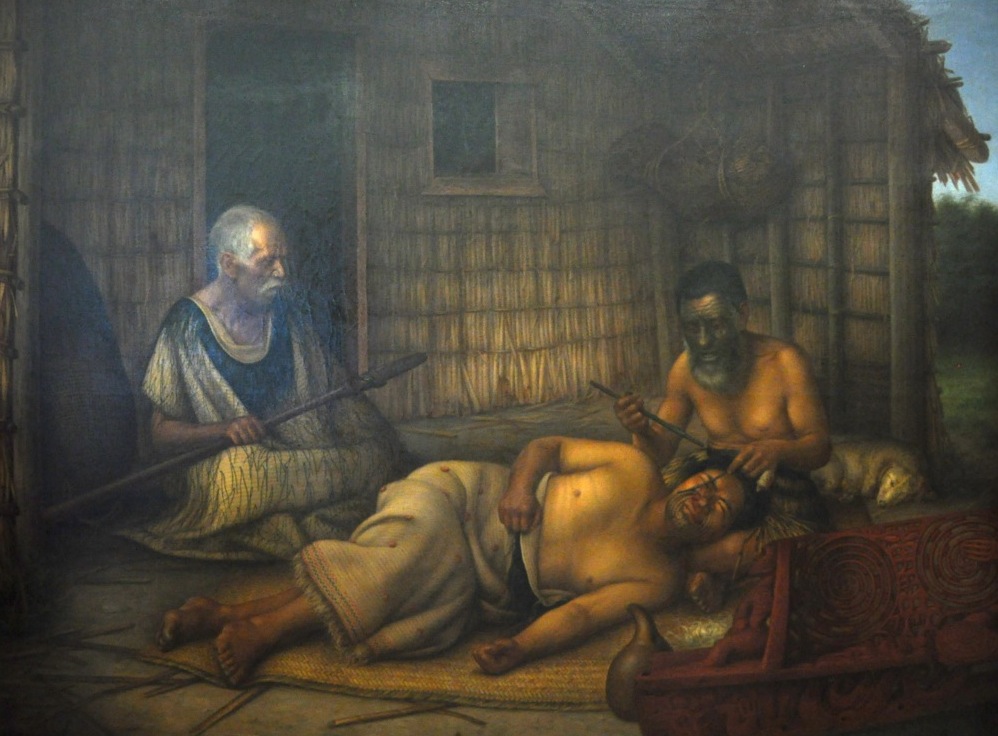
A remarkable part of Maori life was body decoration – tattoos.  This was done by a skilled and respected Tohunga-ta-moko, who would take a sharp tool and cut the skin in a design, then add ink to the wound, making the design permanent Mauri Painting(painting by Lindauer, late 1800’s).  Women would do this mostly to their chin and lips.  Men would do this to their entire face, as well as other parts of their body.  To some degree this practice (now as a conventional tatoo) continues with the Maori today.  So let’s take a look at a drawing of a Maori person in the 1800’s, and at some Maori carvings from before that.

In the middle image, our man holds a war club.  Of course, for capturing ancestors in wood, the tatoos Mauri Ancestorsprovided instant recognition (from the look of the ancestors portrayed in this image, they seem to have been caught in a rather compromising position).

Back to the warrior culture, the Maoris were fierce.  There are stories of Maori coming upon an inhabited island, being welcomed, handshakes all around, and then pouncing on the inhabitants and killing them all.  Genocide R us.  Before battle warriors would perform a dance, a haka, to declare their prowess and intimidate their enemies.  The haka uses fierce facial expressions, grimaces, weapon waving, showing the whites of eyes, grunts and cries, and – pointedly – sticking the tongue out and down.  The display of the tongue in the haka is an indication to the enemy that they will not only be defeated and killed, but eaten.  That message is seen in many of the Maori wood carvings.
Along with the warrior culture came fortified hill forts (pa) and some of the largest war canoes ever built (and carved).  Mauri PaThere are many, many many small hills in NZ, and terraced remains of pas are everywhere.  One of the interesting (to me) aspects of the model pa shown here is the gate in the middle of the picture.  The pa gate uses an uphill entrance and right angle turns, something we saw in Moorish forts a continent (and 5 centuries) away (and that I’ll show you as I backfill posts from Spain).

And then the Europeans (pakeha) came; Captain Cook mapped NZ from the sea in 1769.  Whalers came, and traders, and there were generally positive and amicable relations (the Maori language became written, for example), but things slowly deteriorated due to the usual problems of Old World diseases, alcohol, land grabs, a huge demand for firearms for inter-tribal conflicts, rough whalers, escaped convicts from Australia, prostitution, etc, all leading to a crumbling tribal structure.  Missionaries came, intent on converting Maori to Christianity.  Settlers came, with land issues and mistreatment of the Maori.  Finally in 1840 there was the seminal event in NZ history; partly to prevent French expansion, the British Crown sought to convince the Maori to become British subjects with all the protections of citizenship, including land ownership.  The Treaty of Waitangi was signed by the 5 major tribes of the North Island in 1840, purportedly guaranteeing Maori control of their lands, rights and possessions in return for their loss of sovereignty.  Small problem – the treaty was in English, with a Maori “translation”, but the two did not say the same thing, particularly regarding land and resource ownership.  Then the usual happened, with more settlers and land grabs, leading to the NZ wars of 1860.  After a year the Maori were subdued, and with it much of their lifestyle.  Unlike the American Indians, however, there are no barren deserts in NZ to send the natives to.  Maori were somewhat integrated, and over the years have had some of their grievances addressed.  Maori lag behind their countrymen in many categories, and currently there are as yet unsettled wrangles over cultural identity, land and resource rights.  A positive sign for the future is an increasing Kiwi pride and appreciation of the country’s Maori heritage.  I’ll share some of the amazing Maori art in the next post (with a LOT fewer words!  Sorry about the length of this post).

Auckland

Auckland2It’s an interesting city.  San Francisco on steroids, it sits on 50 or so extinct volcanoes that are 100-200 meters high; except for the wharf area, you are walking up or down, steeply.  One out of 3 Kiwis live here (but total NZ population is only 4.5 million – half the population of New York City).  Polyglot; it is the world’s largest Polynesian city.  Lots of skyscrapers, many quite interesting.  I did not take many pictures of Auckland buildings.  I was more interested in their parks and the wild stuff they do.  That central needle, the Skytower, is the height of the Eiffel tower.  There at the biggest bulge of the tower you can tether yourself to a ring and walk around the building on a narrow, flat, no hand-rail walkway, or even throw yourself off.  Or at the ground level downtown right there on a street corner you can get hurled upward in a cage tethered by rubber bands attached to two towers.  Pictures below.

Alas, all this is at some monetary cost and we were still reeling from the high cost of living.  Breakfast is $30, lunch is $50-$60, dinner is at least $80 with a glass of wine.  So I didn’t throw myself off a building.  Probably a mistake, I should do this on the way back through.

Also interesting are Auckland’s parks.  They’re plentiful and fabulous.  I mean, this is downtown Auckland!

Finally, NZ is so environmentally committed!  The picture below is a coffee cup.  It’s a pretty heavy cardboard, works great.  One can not find styrofoam anything here.  To use diesel fuel, there is a tax of $50/1000km for the carbon offset.  Hotels ask you to separate recyclables.  Pretty cool.Coffee cup