Northern Wales III: Beaumaris

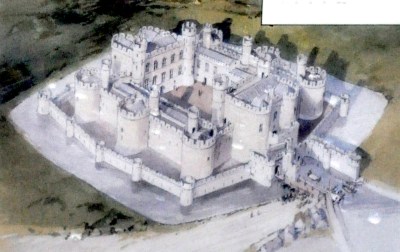
Beaumaris is on a big island, the Isle of Anglesey, and like Conwy it was a castle town, an English enclave surrounded by Welsh guerrillas.  Begun in 1295 in response to a revolt a year earlier, it was the last link in King Edward’s “Iron Chain” of castles enclosing Gwynedd, the former kingdom of North Wales.  Beaumaris Castle is a high point of medieval Beaumaris Castle (photo of a picture)castle design.  Built on flat marshy ground with no natural defenses, the castle incorporates concentric rings of fortifications – a double ring of walls surrounded by a moat.  The innermost wall is higher than the outer, providing greatly increased firepower.  A fortified dock was built to give sea access, allowing the castle to withstand sieges (as shown in the picture, the sea is more distant now).  However, problems in Scotland shifted the king’s priorities, and the castle was never finished.  An artist’s concept Artist concept of the completed Beaumaris Castleof what the castle would have looked like, had it been finished, is shown to the left.  The picture shows a much more imposing structure that would have been twice the height of the squat one we see today.  The inner walls look particularly impenetrable.  The south gate seen at the lower right faced the sea and was the main castle entrance as well as the dock.  A magnification of this artist’s rendition is shown below, along with a picture of the way it looks now.  The red arrows point to the dock’s

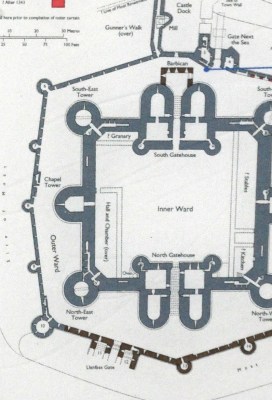
door to the castle.  Rather than using a harbor, this man-made dock used a wide shipping channel (now covered over) to deliver supplies.  Ships up to 40 tons could sail in at high tide and unload goods through the castle wall doorway.  The dock would be defended from the Gunner’s Walk, which can be seen to the right of the arrow in the left picture above, as well as at the top of the castle schematic Schematic of the Beaumaris Castleshown here.  Beneath the Gunner’s Walk was a corn mill for self-sufficiency, the mill turned by differences in water level between the moat and the sea.  Whereas the water in the dock was supplied by the sea, the water in the moat was supplied by a freshwater stream; the level between the two was regulated by a sluice gate in the Gunner’s Walk.  How clever!  The town wall started from here, but wasn’t finished until 1414.

The main entrance to the castle, shown in the paired pictures above, is to the left of the dock and was very well protected.  First there was the moat, then a drawbridge, then the outer gate.  If you got through that, there were the multiple defenses of the inner gate, with every stage having high- and low-level arrow loops.  The inner-wall gatehouse was defended by a barbican, then by three successive pairs of barred gates and portcullises.  Further, the outer wall south gate was off-set from the inner gatehouse, so attackers moving between gates would be exposed from more sides to archers waiting above.

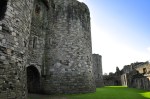
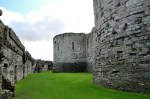
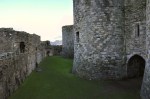
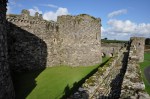
Pictures of the outer walls, which form a rough octagon, are shown below.  The walls had 15 towers, and with arrow loops at two or three levels there were over 300 shooting

positions for the archers inside.  And of course the taller inner walls provided yet more firepower.

From the schematic of the castle shown above, you can see there isn’t a lot of space between the inner and outer walls – it’s function was to be a killing space.  As shown in the pictures below, the inner walls look forbidding, but imagine them being twice that height

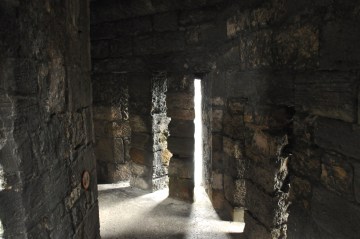
had the castle been finished.   The inner walls are 16 feet thick, with inner passageways – and plenty of latrines!  The inner walls sometimes have 3 levels of latrines, examples shown below.

OK, let’s enter the inner ward!  Beaumaris would have been the largest of King Edward’s

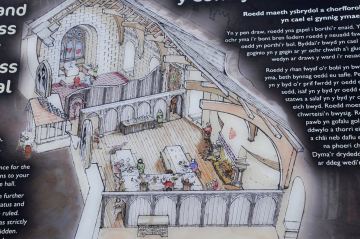
castles, and the intended accommodation within the inner ward, shown in the first picture below, was planned on a lavish scale.  It would have had first-floor stables, kitchens, great hall and private chambers.  Both gatehouses were planned to have grand arrangements of state rooms for the king and his family, an example shown in the second picture below.

The last picture above shows the unfinished north gate dominating the courtyard.

The castle also has a chapel; it’s in one of the inner wall middle towers (called the chapel tower, of course), and is accessible either from the inner ward or from the inner wall passageway.

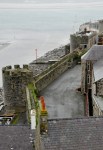
We’ll close with beautiful views from the castle across the Menai Straight to the

Snowdonia Mountains beyond.

Next post – Stow-on-the-Wold, and more, in the Cotswolds.


Northern Wales II: Caernarfon

Oh, there is history here!  The Romans built the first fort nearby, from which Caernarfon derives its name; in Welsh, the place was called “y gaer yn Arfon”, meaning “the stronghold in the land over against Môn”.  Following the Norman conquest of England, William the Conqueror turned his attention to Wales.  When the person nominally in charge of (northern) Wales was killed by the Welsh (1088), Norman control was re-established by building 3 castles, one of them here at Caernarfon.  It would have been a motte and bailey castle – the easy-to-build but militarily formidable fort of the time, with a protective ditch and a timber palisade enclosing a courtyard (bailey) and wooden keep on a raised earthwork (motte), similar to that shown at Lincoln Castle (post “The Lincoln Castle, Bishop’s Palace, and the Magna Carta“).  The Welsh recaptured the area in 1115, and this original Caernarfon castle became the property of the Welsh princes – until war broke out between Wales and England in 1282.  England’s King Edward I invaded and marched through northern Wales, capturing Welsh castles and starting his own at Conwy.  Several months later in 1283 the last Welsh castle fell, and Edward began building a new castle at Caernarfon, replacing the pre-existing motte and bailey structure.  The castle was intended to be the definitive chapter in King Edward’s conquest of Wales, constructed not only as a military stronghold but also as a seat of government and royal palace.  The defenses were built on a grand scale with a deliberate link to Caernarfon’s Roman past, the striped and angular walls designed to echo those of Constantinople, the imperial power of Rome.  The pictures below are from the internet.

Part of the castle’s fame comes from its association with the English title, “Prince of Wales”.  According to legend, Edward got the angry Welsh to submit to the Crown by promising them he would name “a prince, born in Wales, who spoke not a word of English”.  To the surprise of the Welsh, his son Edward II was born at Caernarfon in 1284 (speaking not a word of English – or any other language), and was created Prince of Wales in 1301 with control over Wales and its incomes.  Since then the title has traditionally been held by the eldest son of the monarch.  Prince Charles was “invested” with the title in Caernarfon Castle in 1969.

A schematic of today's Caernarfon CastleA schematic of Caernarfon Castle is shown here.  As you can see, it’s all walls and towers; construction was stopped in 1330 before it was completed.  Although there were once interior buildings, none have survived.

The main entrance to the castle, shown in the left picture below, is the town-facing King’s Gate; the right picture is a drawing of the unfinished

rear of the King’s Gate.  Had this twin-towered gatehouse been finished, it would have been protected by two drawbridge, 5 sets of doors, 6 portcullises, many murder holes above, and arrow loops to the side.  You can see from that drawing above that there was a chapel above the gatehouse passage.  It had double sinks for holy water, and slots in the floor to allow raising of the portcullises.  The whole second floor was intended to be a large hall; the windows and remains of finely sculpted heads finishing off the roof supports show that it was designed for stylish living.

Closer views of the castle walls are shown below.

High-tech arrow loop with slanted slitsArrow loops are everywhere in the walls, creating a veritable medieval machine gun.  These arrow loops were high-tech for their time: not only were they angled to allow each archer to cover a wide area, they also had an angled central pillar in the center of each loop to provide extra protection.

The impressive walls of the town and castle survive largely intact, but all that remains of the buildings within the castle are the foundations.  In part that’s because the buildings within the castle were never completed; money for construction was diverted to repair town walls damaged in the Welsh revolt of 1294; more money was diverted for Edward’s invasion of Scotland (post, Stirling Castle); and Edward died in 1307.  Further, when the Tudor’s (of Welsh origin) ascended the English throne in 1485, the Welsh were treated better.  Hostilities eased, castles became less important, and consequently they were neglected.  By 1620 only the Eagle Tower (shown later) and King’s Gate had roofs, and the domestic buildings had been stripped for building material.  Still, the interior is impressive!  The two pictures below look toward the unfinished Queens Gate.  In the first

picture, the large bare rectangle on the right is where the Great Hall once stood.  In its heyday the Great Hall would have been impressive, featuring fine architecture.  On the other side of the courtyard, the three joined brown rectangles are the foundations of the kitchen.  During the castle building, these kitchens would have fed up to 600 people.  A

large part of the diet was boiled meat (doesn’t that sound English?); the kitchen had fitted cauldrons and running water supplied by pipes from the Well Tower, as indicated above by the illustration and the picture of the ruins. There was also a waste disposal chute that went through the castle wall.

Inside Caernarfon Castle, looking at the Queen's GateReturning to the Caernarfon Castle overview, re-shown here, the jutting structure behind the kitchen site is the unfinished rear of the King’s Gate, and across from that the Chamberlain Tower, with the North-East Tower, Watch Tower and Queen’s Gate in the background.  The pictures below look in the opposite direction toward the huge three-

turreted Eagle Tower.  In the first picture, the leftmost tower is the Watch Tower, then the Chamberlain Tower and the Eagle Tower.  Note at the left edge of the right picture above, and in this The Granary Tower on the right, the North-East Tower on the left; note the notched walls that were unfinishedpicture of the Granary and North-East Towers, that there are notched walls ready for an expansion that never came.

Although the castle was never finished and never really used, King Edward (and other officials and overseers) did visit and were housed in completed royal lodgings on the upper floors.  When Edward and wife Eleanor visited in 1284 to have their son, the Eagle Tower was likely completed (up to the 2nd floor) and had the grandest

apartments.  Had Caernarfon been completed as intended, it could have contained a royal household of several hundred people.

City and castle walls are shown below.

When we were there, Caernarfon had a street fair.  Nice!  Among the highlights were a really cool (and momentarily convincing!) velociraptor moving through the crowd, and a

very cute calf.  Awwww!  Can I take him home??  And how about dining on super-fresh street seafood at the harbor under the shadow of a castle?  Crab anyone?  This kind of

experience is why we tolerate some of the discomforts of traveling.  Are you jealous, stay-at-home readers?  I’ll finish with pictures of the Caernarfon harbor.


Next post – Northern Wales III: Beaumaris

Northern Wales I: Conwy

Wales is a crescent-shaped peninsula jutting out from the England’s west side; it is relatively small, 170 x 60 miles.  Like Scotland, it’s part of the U.K. but not part of England, thank-you-very-much.  Their distinctiveness is evident in the pervasive presence of the Welsh language, which many speak, proudly.  Welsh is definitely not a dialect of English; its words look like an unpronounceable random assembly of letters, and it sounds like Elvish from Lord of the Rings.  It’s one of Europe’s oldest languages, written down around 600 A.D. and spoken 300 years before the existence of French or German.  All commendable, but let me give you an example of its challenges, like the name of this town a mile away from where we were staying.  As shown in the left picture below, the town’s name is “Llanfairpwllgwyngyll”.  Go ahead, pronounce it.  You see what I mean.  And

actually, that’s a compromise for the road signage.  The town’s real name is shown on the railroad station terminal, shown on the right picture – “Llanfairpwllgwyngyllgogerychwyrndrobwllllantysiliogogogoch”.  In Welsh, it means “St. Mary’s Church by the white hazel pool near the fierce whirlpool with the church of St Tysilio by the red cave”.  You couldn’t pronounce the short version so don’t even try the full name!  The good news is that everyone in Wales speaks English.

A little history of Wales is needed to add context to what you’ll see.  Wales, like England, was conquered by the Romans.  When the Roman empire fell, the Germanic Saxon tribes conquered England but could not overcome the wild warriors of Wales.  The various medieval kingdoms of Wales were unified in 1216, but the country was independent for just over 60 years – in 1282 England’s King Edward I invaded and soon conquered the country.  To maintain control in the troublesome North Wales, he built 17 castles that were masterpieces of medieval engineering, with many having sea access to negate any siege.  Most castles were built simultaneously with a walled town that was then filled with English settlers – English islands in the midst of angry Wales.  Except for a rebellion that started in 1400 and lasted for several years (Conwy Castle was itself captured and held by the Welsh for 3 months), Wales has remained under English domination – a domination that at least in the first few hundred years was harsh and punitive.  Today Wales, like Scotland, enjoys some measure of self-rule within the UK; it was granted its own parliament in 1999.  The Brexit vote puts a new spin on Wales’ future, possibly giving it independence again after 700 years.

North Wales is more scenic than the south, with more mountains and less population, but

for us its allure is its high concentration of castles, some of the best in England.  We’ll do three of them, starting with Conwy.  Nearby is also Mt. Snowdon (not shown), taller than any mountain in England (it’s a whopping 3,560 feet; should be fun to climb!).

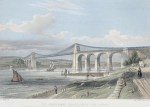
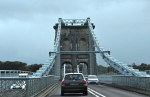
Before we go to Conwy, let me show you the Menai Suspension Bridge that we have to cross every day.  Built in 1826, it had to be a suspension bridge to allow passage of the tall-masted sailing ships of that time – particularly the Royal Navy.  It’s 100 feet above

sea level at high tide, and at 580 feet long it was the longest bridge of its day.  It was an engineering marvel, and is still used today for local traffic.  The hardware, particularly the huge Lego-like chain cables, are massive!  The view from the bridge isn’t bad either.

When King Edward I invaded and captured Northern Wales in early 1283, he built Conwy and its castle as a garrison town.  The area was a crossing point over the River Conwy between coastal and inland North Wales and was the site of a century-old Cistercian monastery (Aberconwy Abbey) favored by the Welsh princes.  As a powerful symbol of English power, he chose that site to build his English castle and walled town, uprooting the Welsh abbey.  It took only 4 years to build the castle and city walls.

Although the town itself is ordinary, it does have a good sense of humor, as shown in the store-front picture below.  It also has the best medieval walls in Britain, and a hulking,

still-awesome castle.  A representation of the (impressive!) city in 1287 is shown in the right picture.

So let’s see this castle!  The left picture below shows an entrance to Conwy through the city walls – the picture was taken from the left-most entrance to the city shown above in the representation of 1287.  The picture of the city street shows the problem of incorporating

a medieval city (with walls!) into the automobile age; you have to squeeze through that gate, and as you might surmise, yes, it’s a one-way road (actually, this is an exit from Conwy).  The right picture is a shot over the city wall showing the impressive castle in the background.  Doesn’t it look like an Eskimo art sculpture of a castle?  Solid; earthbound; compact.  And in this case, impenetrable.

Below are representations of the castle in 1287, and what it looks like today.  The entrance today is steep, but not like it was!  Then, as shown in the left picture below, you first

walked up a steep ramp that no horse could climb, then crossed a drawbridge, passed under a portcullis, stepped through 2 sets of doors (all protected with murder holes and arrow loops), and then entered the killing ground of the barbican.  The upper right picture isCastle walls from the side a good overview of the castle.  Notice that it’s divided into two sections, a front and a back.  The front was the working part of the castle; the back had the royal apartments.  The castle was at the cutting edge of military technology, with thick walls, rounded towers and turrets providing lethal fields of fire, a solid rock base, and royal apartments that could be defended separately.  Well supplied with fresh water from a spring-fed well, 91 feet down, and with its own dock, it could withstand sieges indefinitely.  Nothing on this scale had been seen before in Wales, which at that time had no real cities.  The last picture above and the picture to the left show how intimidating it still is.

The pictures below show the working part of the castle, viewed from the ground and from

the castle wall.  That doorway in the middle of the upper right picture went to the chapel Representation of the chapel and dining hall in the 1280'sand the Great Hall dining area, shown in the lower right picture.  A representation of how the chapel and dining hall looked in the 1280’s is shown here on the left.  People ate here regardless of rank; status was indicated by distance from the top table (and the further away, the plainer the food).

Below is a look at the living quarters, in this case the multiple apartments in the turrets and towers.  The floors are long gone, but you can see that each apartment had a window

and a big fireplace – and would have been quite cozy, if a bit compact.

Now to the royal apartments.  People of power protected their privacy, even in a castle.  As shown in the first representation below, entry to the royal apartments was barred by a

gatehouse, including a drawbridge!  Access from the castle walls was blocked by two doors, shown in the adjacent magnified image.  The royal apartments themselves are quite

spacious; in the 1280’s they would have been opulent and luxurious.  Today they’re one of the best unaltered medieval royal apartments in the UK.  Pictures of one of the apartments

are shown above.

I’ll finish this post by sharing a little Conwy history, and then some views of this pretty area.  The town buildings are not medieval, but the streets do have some history.  The street just outside the city walls is “Town Ditch Road”, named for the dry moat that was the first line of defense for the city.  The street running along the harbor by the castle is still “King’s Quay”.  Within the city walls there is a street that has a changed name; “Berry Street” was renamed from “Burial Street” – it had been a big ditch for mass burials during the plague in the 1600’s.  Shifting gears from that gruesome note, below are pretty views of the Conwy area from the castle walls.

Spiral fractures; be careful in castles!Not all went well on this trip to Conwy; descending a castle stairwell, perhaps foolishly in sandals, I slipped on a wet step and fell backward.  I protected my camera, but alas, not my hand, as shown in the x-ray.  I apparently sat on the hand, and the buns of steel did the rest; two fingers with spiral fractures.  Broken fingers are bad enough, but worse, that’s the end of the plan to climb Mt. Snowdon.  What a disaster!  So back we go to poor Britt in Lincoln.

I underestimated how delicate one’s fingers are; a year later I still need to do hand exercises.  Nevertheless, it’s only a wee blip in our adventures, and after a few months of healing we will return to this pretty area of Wales!

Next post – Caernarfon Castle!

The Lincoln Castle, Bishop’s Palace, and the Magna Carta

LINCOLN CASTLE

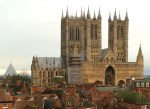
Lincoln Castle in the backgroundYou may remember from our first Lincoln post (The City of Lincoln) that in 1068 William The Conquerer built Lincoln Castle as a very visible symbol of power at the top of Steep Hill.  This picture, taken from the Lincoln Cathedral, shows the Cathedral’s Exchequer Gate in the foreground, and in the background, the walls of Lincoln Castle.  It may be a small town, but it is not a small castle!

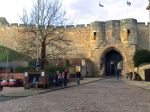
The main castle entrance is imposing, as shown in the pictures below.  The double-gated

barbican would have been deadly, but after artillery was developed in later centuries a barbican became irrelevant; today its interior court features incongruously elegant rooms.

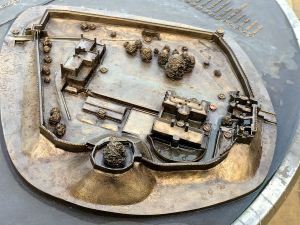
Model of Lincoln CastleThis model of the castle shows how roomy it is inside the walls.  The barbican entrance shown above is on the right side of the model. The castle has been re-purposed over the centuries, and nothing on the inside, other than the walls and towers themselves, looks anywhere close to its 1068 roots.  Below is the view of the courtyard from the castle wall above the main entrance.  That building straight ahead is the Courthouse, built in 1826.  Lincoln Castle was always a seat of justice,

and even today criminal cases are tried here.  In the 1800’s, trials for serious crimes (murder, arson) were a spectator sport, with fences built to control the crowds.  That last picture above shows Lincoln Castle’s beautifully preserved Victorian Prison; the ladies’ prison and associated exercise yard are in the foreground.  The prison was designed for the “separate system”, an isolating regime that kept inmates away from the corrupting influence of their fellow prisoners.  The Victorians believed that separation would encourage prisoners to reflect, repent, and more importantly, to reform.  Separation even

continued in the chapel, where prisoners sat in walled cubicles with a view only of the elevated pulpit (this chapel is the only original of its kind left in the world).  From 1848 to 1878, men, women and children as young as eight were held here for crimes ranging from

murder and highway robbery to stealing a waistcoat and Bible.  During this time seven murderers were hanged at the castle (again, a spectator sport) and their bodies buried in Lucy Tower (which we’ll see shortly).

One can walk the entire circumference of the medieval walls and enter the few towers.  The pictures below show the wall walk leading to the Lucy Tower, which was built in the late

1100’s.  Originally it was the castle keep, a fortified tower/residence and refuge of last resort (should the rest of the castle fall to an enemy).  It sits on a motte, an artificial mound that in this case is exceptionally high.  Keeps on a motte were a common building practice at the time of the Norman Conquest.

Finally, let me show you Cobb Hall, the small north-east tower dating from the 1200’s that housed the dungeon.  Entry is from ground level, with the dungeon underground.

Hey, as dungeons go, it’s small and would be dark, but I’ve seen worse!

THE BISHOP’S PALACE

The Bishop’s Palace, built in the late 1100’s, was the administrative center of the Lincoln Cathedral and was one of the most important buildings (and grandest residential structures) in England.  Both Henry VIII and James I were guests of bishops here.
Alas, the palace was sacked by royalist troops during the Civil War in 1648.  Today it’s just an evocative ruin (shown below).

THE MAGNA CARTA (and Charter of the Forest)

There are only 4 copies of this iconic document in existence, and Lincoln Castle is the only place in the world where an original 1215 Magna Carta and a 1217 Charter of the Forest can be seen side by side.  The story of the Magna Carta is fascinating.  One of the more celebrated documents in history, with enduring worldwide influence, it played a central role in England’s political life and greatly influenced our American Constitution.  Yet it is a complete political myth, ignored as soon as it was written, annulled by the Pope, and distorted 400 years later in order to oppose the divine right of kings.  So let me tell you the real story!  It’s a bit long, I’m afraid; my apologies: history is like that.

We start in the early 1200’s, when King John (following his predecessors) ruled England through a feudal system of laws and the principle of vis et voluntas, or “force and will” – the king’s executive and sometimes arbitrary decisions.  The king had waged war for many years trying to reclaim ancestral lands in Normandy, France, financing this effort with heavy taxes on the English barons.  Following a decisive defeat in 1214, King John was forced to sue France for peace and to pay compensation.  He was already personally unpopular with many of the barons in England, and his defeat galvanized “rebel” barons to organize resistance to his rule; they renounced their feudal ties and formed a militia that marched to London and Lincoln.  In order to avoid a civil war, John instructed the Archbishop of Canterbury (with other bishops, including Lincoln’s) to work out a peace agreement.  The resulting charter (let’s call it the Charter of 1215) promised protection for church rights and protection for the barons regarding illegal imprisonment, access to swift justice, and limitations on taxation and feudal payments to the Crown.  Importantly, it created a council of 25 barons to monitor and ensure John’s adherence to the charter, with the council empowered to seize John’s castles and lands until amends were made.  In return the barons agreed to dissolve their militias.  Although both sides agreed to the charter, neither stood behind their commitments.  King John appealed to the Pope for help, arguing that he signed it under duress and that the charter compromised the Pope’s rights as King John’s feudal lord.  The Pope declared the charter to be “shameful and demeaning … illegal and unjust” and the charter was “null, and void of all validity for ever”; further, under threat of excommunication, the King was not to observe the charter, nor the barons to try to enforce it.  Violence broke out, leading to the “First Barons’ War”, and the rebel barons offered the English throne to the French for their help.  That war, and its conclusion with the treaty of Lanbeth in 1217, was described in the earlier post (The City of Lincoln).  Following the war, a new council was called to re-assess the Charter of 1215 (actually now the Charter of 1216; King John died during the war and his son had issued a new and shorter charter eliminating some of its more radical content such as the council of barons).  The new council issued the Charter of 1217, which resembled that of 1216 with some additional clauses added to protect the rights of the barons over their feudal subjects and to water down restrictions on the Crown’s ability to levy taxation.  Because there were disagreements concerning the management of the royal forests, this issue was separated out as a complementary Charter of the Forest, and issued at the same time.  It pardoned existing forest offenses, imposed new controls over the forest courts, and established a review of the forest boundaries.  To distinguish between these two charters, the term magna carta libertatum, “the great charter of liberties”, was used to refer to the larger document, which in time became known simply as Magna Carta.  Both documents became part of English political life and for generations were renewed by each monarch in turn.  With time (and the advent of the English Parliament) they lost significance as their content was replaced with new laws.  However, 400 years later in the 1600’s, when the Stuart monarchs invoked the divine right of kings, the Magna Carta was revisited and (incorrectly) reinterpreted as a champion of individual rights that placed the king under the law, rather than above it (the “divine right of kings” argument went away with the English Civil War of the 1640’s and the execution of the Stuart King Charles I).

The Magna Carta that is commonly remembered today is the Magna Carta of King John, with the commemoration date of 1215.  That many clauses were omitted or redrafted, and new ones inserted, has made no difference in the collective memory of this venerable document.  The swindle is that the original 1215 charter (and the 1217 charter) concerned the medieval relationship between the monarch and the powerful barons; it did not mention the rights of ordinary people.  However, the political myth of the Magna Carta as a protection of everyone’s ancient personal liberties persists and forms an important symbol of liberty today – “the foundation of the freedom of the individual against the arbitrary authority of the despot” (Lord Denning).

The pictures below show the 1215 Magna Carta and the 1217 Charter of the Forest.  The

charters were written on parchment sheets using quill pins, in heavily abbreviated medieval Latin, which was the convention for legal documents at that time.

Next post – Wales, U.K.

The Lincoln Cathedral

Cathedral Model, 1300's - 1500's

Cathedral Model, 1300’s – 1500’s

In 1072, William the Conqueror ordered that a Cathedral be built at Lincoln.  Construction of the first Lincoln Cathedral was completed in 1092; it was rebuilt and expanded after a fire destroyed its timber roofing (1141).  Destroyed again by an earthquake (1185), it was rebuilt on a magnificent scale beginning in 1192 using local rock; only the lower part of the Cathedral’s front and its two attached towers survive from the original Norman structure.  The choir, eastern transepts and central nave were built in Early English Gothic style, but the rest followed architectural advances of pointed arches, flying buttresses and ribbed vaulting.  Its crossing tower, completed in 1311, was an amazing engineering feat for the time.  With a spire giving it a height of 525 ft, Lincoln Cathedral became the tallest building in the world, and the first to surpass the pyramid of Cheops in Egypt which had held that title for 4000 years.  That honor, however, was lost after 238 years when the heavy, lead-coated but rotting wooden spire collapsed in a storm (1549).  The spire was not replaced, a symbol of Lincoln’s economic and political decline at the time (see previous post, “The City of Lincoln”).  Still, the cathedral is the third largest in Britain (in floor space) after St Paul’s (London) and York Minster (post of Jan 22, 2015; The York Minster).

Sitting on top of a hill, Lincoln Cathedral is visible for miles around and absolutely

dominates the city in an awe-inspiring, gorgeous way, irresistibly drawing your eyes.  It’s a high point of medieval architecture, and also a navigation beacon; where are you in the city?  Look for the Cathedral.

Let’s take a walk around the Cathedral.  The overall plan is shown below; we’ll start with Lincoln Cathedral planthe west-facing entrance. The previous Norman churches were short and thick-walled, with small windows resulting in dark interiors.  The Gothic style made churches bright and spacious, but during the building of the Lincoln Cathedral the architects were writing the rule book, and it was literally trial and error (you’ll see some of this in the interior).  As shown in the picture to the left, the The Exchequer Gate blocking the viewExchequer Gate that was the main entrance to the Cathedral close (arrow) does a great job of blocking the view of the stunning front of the Cathedral – particularly the preserved Norman (lower) structure.  Further, as you can infer from the picture, once inside the gate you’re too close to get a good overview.  Ah well, here’s the best I can do for the Cathedral entrance.
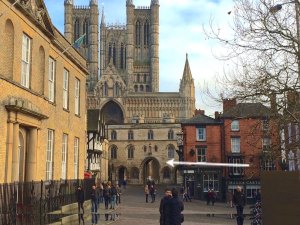
Let me show you that entrance in detail, top to bottom, Gothic to Norman.

Again, the lower part is from the early 1100’s, now set within the harmonious upper region from the early 1200’s.  The art that decorates the front entrance is impressive, from the Gothic repeating arch motifs in the first picture below to the many Norman carvings, two of which are shown below.  The next-to-last picture shows the faithful being rescued from the mouth of hell (far right), the detail in the last picture showing that hell is not a nice

place.  At the corners of this west-facing entrance are small towers that frame the front screen while continuing the arch motif – shown in the first 2 pictures below from the south side of the Cathedral.  And we can’t leave the entrance view of the Cathedral without showing the commanding towers that flank the nave just behind the entrance.

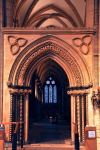
The south transept also has an entrance to the Cathedral, shown below.  In that last

picture, look at the base of the central column between the doors – it’s being hugged by

little devils, shown above.

The south side of the Cathedral is also highly decorated, with some interesting statues, many of them restored (Cathedral restoration costs $1.3 million/yr).

Then we come to the beautiful east side, and the chapter house.

The north side is more of the same, first picture below.  It’s a stunningly beautiful

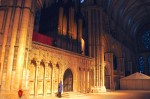
Cathedral, and inside it’s impressive as well.  The first picture below is from near the entrance showing the many stained glass windows; the next pictures are from the nave looking inward and then looking back to the entrance.  In that last picture, the blue overtones highlight the preponderance of blue in the stained glass!

Notice in the pictures below how the vaulting changes going down the side aisles.  The vaulting was experimental during the building; it varies between the nave, aisles, choir and chapels, particularly in how the vaulting interacts with (ignores or enhances) the

Cathedral’s bays.  The transept crossing that separated public access from the choir and alter is pretty spectacular.  In addition to the tranquility of repeating designs, as

shown in the first picture below, there are interesting (and playful) carvings everywhere.

The choir dates from 1360-80 and is amazing, with beautifully carved wood stalls and bench-ends.  I wasn’t happy with my capture of the choir, so I cribbed that last picture from the internet.  It shows the “pulpitum”, the wood choir screen that separates the choir

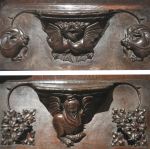
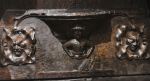
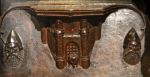
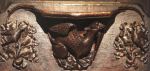
from the nave; it dates from even earlier, the 1330’s.  In addition to the intricately carved bench ends such as the one in the first picture below, the choir has 62 fascinating misericords or “mercy seats”.  In the early medieval church, prayers were said standing,

Detail of the misericord carving, a lion fighting a dragon

Detail of the misericord carving, a lion fighting a dragon

and seats were constructed so they could be turned up.  However, the seat underside could have a small shelf (the misericord), shown in the right picture above, which allowed the user to slightly reduce discomfort by leaning against it.  The seats and carvings are in oak, all different, and delightful.  Most of the seats were unfortunately in the down position (and the lighting was poor), so I bought their book and took some pictures of misericords from it, and I’ll share a bunch with you – they’re just that cool.  I was told that the folding parts of the seats were installed as single blocks of oak, and each misericord was carved in place.  No mistakes allowed!  I didn’t believe that story at the time, but when I looked closely at the carvings, I could see that the wood grain in the seat and the carving line up!  You can also see that in some of the figures below.

If you look back at the pictures of the choir shown earlier, the upper-right picture looks into the beautiful east end of the cathedral, completed in 1280.  Other views are below.

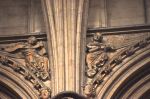
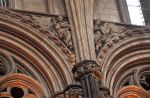
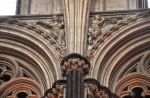
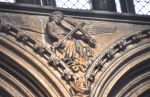
The central region behind the main choir is called the Angel’s Choir because the upper arches are framed by stone carvings of angels playing medieval musical instruments.  I’ve shown some of them below.  That first picture is an angel playing a guitar precursor

The Lincoln Imp in the Angel Choircalled a citole.  A famous stone carving in the Angel’s Choir is the Lincoln Imp.  According to legend, two mischievous imps were sent by Satan to do evil work; after causing mayhem elsewhere in England, the imps came to Lincoln Cathedral where they smashed furniture and tripped up the Bishop.  An angel appeared in the Angel Choir and ordered the imps to stop.  One imp sat on a stone pillar and threw rocks at the angel, whereupon the angel turned him to stone; there he now sits.

Before I show you the cloister, let me backtrack to the transept crossing to look up at the Cathedral’s massive central tower from underneath.  It’s gorgeous, but because I didn’t quite capture what I wanted to show, I’m including a

picture from the internet.  Isn’t the geometry beautiful?
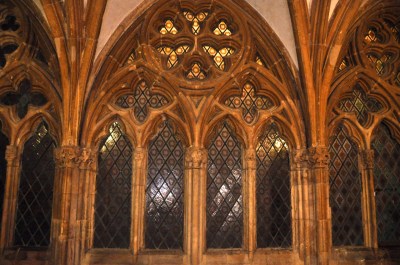
Corridor to the cloisterNow to the cloister.  Access is via this impressive windowed corridor that duplicates the cloister design.  The cloister itself (shown below) has a recent history – it was used for filming The Da Vinci Code, standing in for Westminster Abbey (which refused to permit filming).

What is impressive is the view of the cloister against the magnificent Cathedral (and its “Dean’s Eye” north transept window), shown below.  And there is an added bonus; part of the floor in a corner of the cloister is a mosaic from the Roman fort that occupied this hill!

At last, now the stained glass windows!  There are a lot of them, including some fabulous medieval glass.  We’ll start with the west entrance, pictures below.  Beautiful, yes?
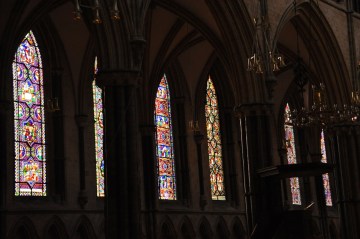
A few of the windows in the naveThere are many, many windows in the nave.  Like most churches, the stained glass is mostly from the mid 1800’s, following a rebirth in its popularity.  There’s too much to show, so I’ll just do a little (which will still be a lot).  Although the windows do not present the life of Jesus sequentially, it seems that all the stories of the New Testament are here, examples shown below.  The windows are gorgeous, aren’t they?

You didn’t think we were done with the nave windows, did you?  There’s also the Old Testament, and monk history, and ….

Now let me show you the gorgeous east end windows.  The first picture below shows most of that east wall, overwhelmingly in blue.  The next three pictures show the left and right side windows in normal light; then I’ve shown the right side window at night, lit by the outside lights of the cathedral.  The windows are beautiful in any light!

The large, central – and very blue! – window is simply spectacular, commanding attention.  It is one of England’s largest windows.

At last, the good stuff!  Although stained glass reached its height as an art form in the Middle Ages, there isn’t that much of it left; huge numbers of windows were destroyed in the French Revolution and Protestant Revolution (for instance, the English Parliament ordered all images of the Virgin Mary and the Trinity removed from churches; Protestant mobs were less selective).  Until its revival in the mid 1800’s (600 years later), stained glass was a lost art.  Colored glass became scarce, necessitating the painting of white glass.  The little decorative glass that was produced was mostly small heraldic panels for city halls.  Lincoln Cathedral has some examples of stained glass from this time in one of its side rooms, shown below.

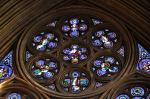
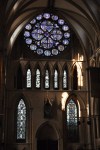
The medieval stained glass in the Lincoln Cathedral resides mostly at the ends of the transepts.  Each transept has a rose window, an uncommon feature in English medieval architecture.  The north transept has the “Dean’s Eye”, shown below, which depicts the Last Judgement.  It’s part of the original structure of the Cathedral, finished in 1220.

Underneath the rose window are a set of 5 windows with gorgeous geometrical designs,

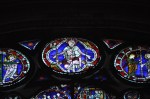
and below them these final two windows.


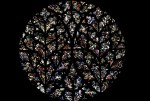
The south transept has the “Bishop’s Eye”; it too was built in 1220, but rebuilt around 1330.  It’s one of the largest examples of curvilinear tracery in medieval architecture, and was a challenge for the designers (and glass artists).  The window from outside the Cathedral and from inside the transept is shown below.

Most cathedral windows during this time displayed biblical images; that’s hard to do with such curvilinear shapes, so the window is instead a mosaic of color.  I was told that within the window there are images of the saints Paul, Andrew, and James; if so, it requires imagination!  The Bishop’s Eye is shown in more detail below.

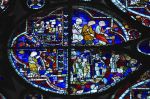
Details from two of the lower windows are shown below.

Goodness!  Could there be more to show of this majestic cathedral?  Of course!  But we never caught the chapter house when it was open.  There’s also lots of treasure, but I’ll only show two pictures.

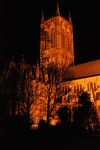
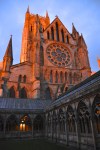
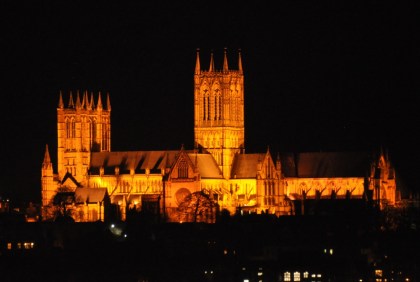
Enough is enough!  I will simply end with a view of the The Lincoln CathedralCathedral at night.  It is stunningly beautiful.
You masochists that have waded the whole way through this long, long post, I salute you!

The next (shorter!  Promise!) post will finish the fair city of Lincoln, and will include the Lincoln Castle, the Magna Carta, and the Bishop’s Palace.


The City of Lincoln

Why visit Lincoln, you ask?  This backwater city of 100,000?  It’s not on most tourist’s maps, but the city was important historically.  It has an amazing cathedral (English Gothic, 12th century), a castle (Norman, 11th century), a medieval Bishop’s Palace (12th century), one of only 4 original copies of the Magna Carta, a Christmas market and an annual Steampunk Festival, so it does get some tourists.  More pertinent to us, however, is that it is home to younger son Britt and family, and we can visit!  And visit.  And visit.  Little did poor Britt know that we would be there for an extended time.  After Ginger and I left to visit Barcelona (Spain), I separated my shoulder trying to tackle a would-be camera thief on marble stairs (a topic for a future Barcelona post), so back to Lincoln we went to recover.  There I fell and broke (badly) 2 ribs, and as I was recovering, Ginger needed major abdominal surgery.  So we basically moved into Britt’s house for quite a while.  Newly recovered and off to Wales, I slipped in a castle stairwell and broke two fingers (badly; spiral fractures); so back to Britt’s we went.  Soooooo – let me show you some of Lincoln!  It’s actually a very interesting town.

The Witham Shield, a 4th century decorative bronze covering for a wood backing

The Celtic Witham Shield

First some Lincoln history – and there’s lots of it.  We’ll ignore the early part, such as the arrival of Homo heidelbergensis (500,000 years ago) or the Neanderthals a bit later (Europe has HISTORY!).  Lincoln the city began as an Iron Age settlement of round wooden dwellings in the first century BC, established at a river (Witham) by a deep pool (Brayford Pool) at the foot of a large hill.  The origin of the name “Lincoln” likely comes from Celtic for pool, Lindon.  After the Romans conquered this part of Britain in AD 48 (using 40-50,000 soldiers), they built a fort on top of the (steep!) hill overlooking this settlement and at the northernmost end of the Roman road (Fosse Way) that went across England all the way to its southwest peninsula.

With two rivers accessible from the sea, the settlement flourished; when the Romans left, the city waned until the arrival of the Vikings, under whom it became an overseas trading center.  In the late 800’s, with an influx of Danes, Lincoln’s economy took off.  In 1068, after the Norman conquest, William I (The Conquerer) ordered Lincoln Castle to be built on the site of the Roman fort, for the same strategic reasons as the Romans.  Four years

later he ordered a cathedral to be built, completed in 1092.  Subsequently the diocese of Lincoln grew to became the largest in England, with more monasteries than the rest of the country put together.  By 1150 Lincoln was one of the wealthiest towns in England and soon became its 3rd largest city, with an economy based on cloth and wool (known especially for their scarlet and green cloth; Robin Hood wore woolens of Lincoln green).  In 2014, English barons rebelled over high taxes spent on King John’s failed wars in France and his arbitrary exercise of power.  The Archbishop of Canterbury (plus a Lincoln bishop) was appointed to organize peace talks, leading to the Magna Carta; when that document was repudiated, the rebel barons aligned with France and the First Barons’ War began, a dynastic war for the throne of England.  The turning point in this war was the Battle of Lincoln in 1217.  The French forces of Louis VIII breached Lincoln’s city walls and occupied the city, but English loyalists successfully held the castle.  The arrival of a loyalist relief force subsequently overwhelmed the French (and pillaged Lincoln on the pretense that the town was loyal to the French).  After the French tried to replenish their forces but were defeated at sea, Louis VIII signed the treaty of Lanbeth, relinquishing his claim to the English throne.  Lincoln’s fortune thereafter continually declined, particularly in the 1500’s after Henry VIII’s Dissolution of the Monasteries cut off a major source of income.  Buildings were destroyed in the 1600’s when Lincoln was caught between factions during the English Civil War.  In the late 1700’s, however, with the arrival of railroad links and the Industrial Revolution, Lincoln bloomed again.  During WWI Lincoln invented, designed and built the world’s first tanks.

So enough history!  Let me show you some of Lincoln, starting with it’s Roman heritage.  A cool thing about Lincoln is that a lot of its major roads still go through Roman or medieval gates.  Newport gate, shown below, was the walled city’s north gate in the 3rd century.

A few sections of the Roman wall and foundations of its towers are still present.

The Lincoln Cathedral had its own walled perimeter, or close, and some of those walls and a number of gates remain as well.

Lincoln’s allure lies less with its Roman ruins than with its medieval heritage, not just its castle and cathedral but also its medieval buildings (and a few streets).  For instance, of the 3 buildings in the first picture below, take a look at the timbered building on the far right.  Gravity has not been kind to this house – it’s called “The Crooked House” for good reason!

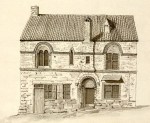
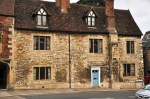
The oldest buildings in Lincoln date from the mid 1100’s and are associated with the Jewish community in Lincoln (before they were expelled en mass in 1290).  The Jew’s House shown in the first 2 pictures below is one of the earliest town houses in England, built from local limestone in the Norman (Romanesque) style and dating from about 1150.  Part of the façade survives; the elaborately carved doorway, the remains of two

double-arch windows, and much of the stonework on the upper story.  Next door is the Jew’s Court building, dating between 1150 and 1180, although the medieval stonework is mostly at basement level.  It was originally built as a duplex.

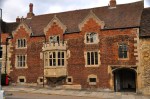
The Norman House, formerly known as “Aaron the Jew’s House”, dates between 1170 and 1180 and is another example of Norman domestic architecture.  I do love the way

the stone intercalates with the brick of the adjacent building.

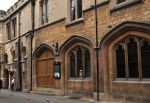
Another interesting building/gate is the Lincoln Guildhall and Stonebow.  The Stonebow arch is located where the southern gate to the old Roman city once stood.  The Tudor Guildhall, finished in 1520, was built on top; in the medieval period the Lincoln guilds met here to administer the city government.  The pictures below show the front and back.

Other interesting houses are a merchant’s house of 1543 – the Leigh-Pemberton House (now the tourist office), and timbered shops (including the fabulous Stokes High Bridge Cafe) built on the west side of the High Bridge in 1540.  The High Bridge was built over

the River Witham about 1160 and is the only medieval bridge in England with houses still on it.

There are many, many other interesting buildings in Lincoln, and I’m showing just a few in the pictures below.  In the first picture note the filled arch in the middle of the building (left of the blue door)!  Such reworked facades are common.

Alas, I neglected to take pictures of some of the really cute bars in old houses along the river (who takes a camera to a bar?).

I’ll finish this post on Lincoln with a description of Steep Hill.  The 4th picture at the beginning of this post is the city plan of Roman London, which shows an “uptown” (the Roman fort) and “downtown” (the associated city); and that plan is not too different from the structure of Lincoln over the ensuing 2ooo years.  Uptown, at the top of a steep hill, was the location of the castle, the cathedral, and the rich and powerful.  Downtown was everybody else.  Connecting them then and now is a main shopping street (High Street, downtown) that becomes a medieval street called Steep Hill, lined with cute shops and restaurants.  The Jew’s House, the Norman House, the Guildhall and Stokes are on those streets.  The pictures below show the upper part of Steep Hill heading downtown

(gentle slope).  The following pictures show a middle section of Steep Hill (and also the Harding House, from the 1400 and 1500’s).   It’s hard to capture steepness in a photo, but

the upper right picture showing pedestrians walking ahead of me gives you a good idea.  And that’s not the steep part!  The really steep part begins where the road veers to the right (and drops out of sight), shown in that last night picture.  Alas, I don’t have a picture of the steep part so I had to crib one from the internet, left picture below.  Again, its

steepness is hard to capture in the photo; it’s steep enough to merit a handrail, as well as park benches for the out-of-shape to avoid cardiac arrest. You can buy t-shirts that say “I survived Steep Hill”.  The last picture is from further down Steep Hill – why, it’s almost level!

Guess that’s enough introduction to the city of Lincoln.  An interesting place, yes?  And you haven’t seen anything yet.  Next post will be about the fabulous Lincoln Cathedral.


England’s Lake District

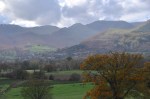
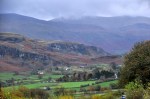
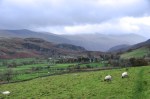
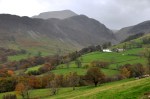
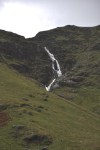
From Glasgow we’re driving to the small city of Lincoln in England, but we’ll take a short detour.  I once asked several English couples where they would choose to live in England if they had their choice.  The consensus was “The Lake District”, and we’re passing close to it.  For you poetry buffs, this is William Wordsworth’s stomping grounds (as well as Samuel Coleridge and Robert Southey).  It comprises an area of only 30 miles x 30 miles, and we visited just the less-touristy northern part around Keswick, avoiding Wordsworth and Beatrix Potter sights (although we’re Wordsworth fans).  As you’ll see, The Lake District, with a patch of brightthis pristine area juxtaposes a lush green countryside with treeless hills reminiscent of the Scottish highlands – quite a fascinating mix!  However, getting that lush green comes at a cost; rain, mixed with occasional “bright spots”.  Alas, the pictures below should show brilliant colors (it was fall when we were there), but “gloom” and “brilliant” don’t coexist easily.  Still, there were occasional bright spots like that shown above – which, by the way, was absolutely spectacular, in spite of the gloom!
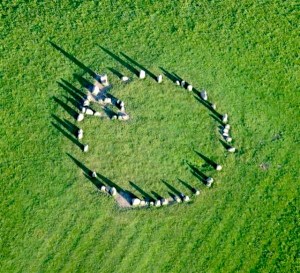
Near Keswick is the Castlerigg Stone Circle, built in the Neolithic period around 3200 BC.  A little quick math says this circle is 5,000 years old, which is going back aways.  It’s one ofAerial view of the Castlerigg Stone Circle, picture stolen from the internet the earliest stone circles in Britain and possibly in Europe.  From that aerial picture, it contains an unusual rectangular inclusion, called the “sanctuary”.  You may recall our previous encounters with similar stone circles in Scotland and Ireland (Isle of Harris and Southwest Ireland Tour and Traditional Irish Music I).  All these stone circles were built on a relatively high hill or ridges, with a view of the mountains in the distance – presumably in order to align the stones with mountain landmarks and the rising or setting sun at particular times of the year.  Since the heaviest stone is estimated to weigh 16 tons, hauling that sucker uphill must have been a chore, not to mention positioning it (Oops!  Nope.  Another foot to the right, please).  This Castlerigg circle is in a beautiful setting, as you can see below.

The Castlerigg circle lies on a line that would connect the two highest peaks on the horizon.  The 2 front stones face due north, toward a cut in the mountains.  Presumably

the stones served as a celestial calendar for ritual celebrations.  The sanctuary points to where the sun rises on May 1, the ancient (northern hemisphere) spring festival.  Some stones in the circle have been aligned with the midwinter sunrise and various lunar positions.  As in all these (thousands of!) stone circles, their true function is unknown.  Some archeologists link this circle with the nearby Neolithic stone axe industry (ah, early Capitalism!); the circle may have been a meeting place where stone axes were traded or exchanged.  Ritually deposited stone axes have been found all over Britain, suggesting that their use was more than functional (is that the original “bury the hatchet”?).

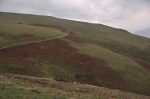
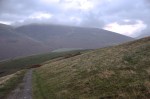
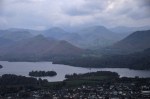
The day is getting short but we decide to do a quick hike up Latrigg Peak for an overview of Keswick and the nearby Derwentwater Lake.  The mountaintops are pretty much treeless, so there will be good views; but first you have to get there.  The ascent isn’t hard, but it’s

also not short.  The view, however, is worth it.

Now we just have to hike out of here in failing light!  Our reward as we stumble out is the view of cozy lights from the windows of the hillside farms.

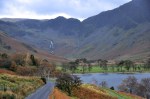
Our B&B is in the Newlands Valley just west of Derwentwater Lake, and the vista that greets us is a nice “G’morning, isn’t this gorgeous!”, even though that “bright spot” in theNewlands Valley, from our B&B picture isn’t shining on us.  Today we’re driving a loop that goes through a lot of Lake District scenery: Newlands Valley, Buttermere Village, the Honister Pass, Borrowdale, and Derwentwater Lake.  We’re heading west, and our two-lane road quickly becomes a single lane, as shown in the first picture below (although the road does have turnouts).  The subsequent pictures show picture-book idyllic scenery.

Then it’s up to Newlands Pass, going up treeless mountains as shown in the first picture below.  At the top is a nice waterfall!

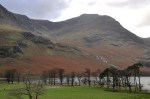
And then there’s a colorful descent down to the hamlet of Buttermere and its scenic lake.

As shown below it’s a pretty lake, but even better, it comes with a mountain-high cascading waterfall!  You can barely see it through the mist in the first picture (left side),

but it’s nicely shown in the next one.  The beauty of the long lake is offset by strange denizens – some of the ugliest, shaggiest sheep we’ve ever seen, a breed called Swaledale.  The poor things look like they’ve been assembled from a variety of leftover animal parts.

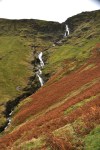
As we travel further we encounter another waterfall, even more beautiful than the last one!

It’s coming from the cirque above, probably from a small lake.  If that weren’t enough beauty, a little further along the road are a few more waterfalls coming down the

mountains!  That last picture looks back at the previous waterfall.  This is an awesome area!

Looking back on the way to Honister PassWe’re now heading up to glacier-carved Honister Pass.  This picture also looks back at our previous waterfall, far in the distance.  The river adds a new element to this pretty area.

The scenery going to the pass is treeless, stark and otherworldly empty; for perspective, the tiny white dots in the top right

picture below are grazing Swaledale sheep.  Near the top of the pass is England’s last still-functioning slate mine, which one can tour, but we decide to press on.  Going down is steep, but pretty; we have trees again.

Back at the valley floor there are scattered hamlets, and the scenery is again bucolic.

You remember Derwentwater Lake, seen from above during our hike yesterday (shown earlier), right?   When we climbed Latrigg Peak?  Well, now we’ve circled around to the lake’s southern end, at lake level.   The forest is gorgeous in its fall colors, the lake is choppy and gray but still interesting, and we decide to take a short hike along its shore.

Back on the road, the valley is enchantingly beautiful.  In the pictures below, the green of that grass seems impossible, but it’s real.

A few more stops to enjoy the view, shown below, and then we are back at our B&B with

not much of the day left.  Beautiful isn’t it?  The 2nd picture below is our

greeting the next day – another stunning “G’morning”.  Alas, we must leave this magnificent Lake District.  The next post will be from Lincoln; it’s not really on the tourist trail, but it does have a magnificent cathedral.  You’ll see.


Glasgow III – Glasgow Cathedral, Provand’s Lordship, and the Antonine Wall

We’ll finish with Glasgow by showcasing the really old.  The Glasgow Cathedral and nearby Provand’s Lordship are among the very few surviving buildings from Glasgow’s medieval period.  The Cathedral is the oldest building; Provand’s Lordship is the oldest house.  And the Antonine Wall?  Never heard of it?  We hadn’t either; it was the real northernmost wall (at least for awhile) that separated Roman Britain from those pesky Scots.

GLASGOW CATHEDRAL

The Glasgow Cathedral is a superb example of Scottish Gothic architecture, and the most complete medieval cathedral on the Scottish mainland.  The first picture below shows the Cathedral as it looked in 1820 (from a watercolor, “The Saving of the Cathedral”); the following picture shows how it looks today (the front towers seen in the watercolor were

demolished in 1840 as part of a grand restoration scheme that was never completed).

The history of the Cathedral begins with the construction of a small wooden church around 550 AD when St. Mungo started a religious community.  That structure was replaced by a stone church which was subsequently badly damaged by fire in 1136.  The walls of the nave in today’s church, up to the windows, are from the rebuilding that took place in the early 1200’s; the rest of the Cathedral was built in the mid 1200’s.  The Cathedral survived the Protestant Reformation relatively unscathed (as depicted in the first picture) not because the reforming mobs of 1560 were less zealous in Glasgow but because the organized trades of the city took up arms to protect it, the defenders outnumbering the attackers.  The title “cathedral” is now historic, dating from the period before the Scottish Reformation.

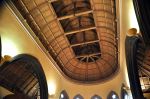
The cathedral interior is impressive, with a roof made mostly of wood.

Below are more views of the interior.

The many ceiling bosses of carved wood are all different, beautifully done, and colorful (and difficult to get in focus), as shown below.

There are lots of interesting carvings in nooks and crannies throughout the cathedral (see below).

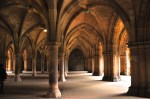
Another fascinating feature is the lower church beneath the Cathedral.  The land on which the Cathedral was built slopes, which allowed a lower church containing a crypt to be built beneath the choir; the crypt contains the tomb of St. Mungo.  It’s a large area, and

beautiful in a very different way than the soaring upper Cathedral.  The stone bosses are also pretty cool, each one different.

Finally, there’s the beautiful Blackadder Aisle, built around 1500 on the site of  St Mungo’s original church and designed to be part of a transept that was never completed (it’s hard to tell from the introductory pictures, but the cathedral has no true transepts).  The beautiful,

stately, arching white ceiling is highlighted at intersections with very interesting and brightly painted carved stone bosses.

PROVAND’S LORDSHIP

Provand's Lordship, near the Glasgow CathedralThis house, the oldest in Glasgow, was built by (and near) the Glasgow Cathedral in 1471.  It likely reflects “the lifestyles of the rich and famous” for that time.  It was originally the home of one of the 32 canons who managed a part of the Cathedral’s vast diocese – in this case the land at Provan (the other 31 canons were similarly housed).  By the 1600’s it had become a private home; by the 1700’s, and for the next 200 years, it was used as an inn, with rooms on the upper floors and a wide range of shops on the ground floor.  A small extension housed the city’s hangman.  It’s a pretty cool place, all stone with massive, rough-hewn, low-hanging beams and fireplaces everywhere.  The entrance opens into the
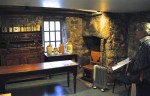
kitchen – where it’s very obvious that cooking was not a big production!  And of course a

dining room.  The rooms upstairs are old-time, rustic gorgeous.  The room shown below belonged to a canon from 1501 – 1513; he was both a priest and a lawyer.  The room would have served as a living room, bedroom and office.

Other rooms are shown below.

Provand’s Lordship houses one of Scotland’s best collections of furniture from the 1600’s. The chairs below are examples.

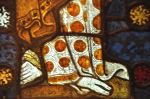
Provand’s Lordship also had medieval stained glass windows (now obtained from elsewhere).  The windows below were from England in the 1600’s and commemorate marriages between notable families.

The window below shows 3 saints: St. Nicholas, St. Paul and St. Peter.  It was made in the Netherlands in the 1500’s; the trefoil and 2 quarterfoil panels at the top are from England, made in the 1300’s.

The windows below are from the 1300’s.  The left window has panels depicting an angel, St. John the Baptist (from France) and an unidentified female saint (from England).  The second window depicts an unidentified male saint (from England).  Strangely, there were no stained glass windows from Scotland.


THE  ANTONINE WALL

What?  Never heard of it?  Interesting how history does that to us.  Yet you’ve heard of Hadrian’s Wall, right?  That northern-most demarcation of Rome keeping those pesky Scots at bay?  Actually, that northern-most border was the Antonine Wall.

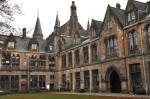
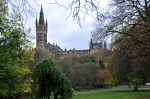
We discovered the little-publicized Antonine Wall when we visited a museum at the University of Glasgow; it’s a gorgeous university, as shown below.

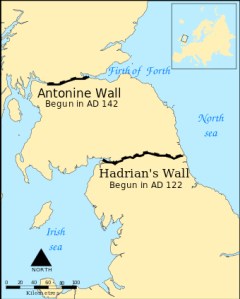
Just for review, as noted in our Hadrian’s Wall post (Hadrian’s Wall), that wall was built in 122 AD; it was 73 miles long, went from coast to coast, and was built 15 – 20 feet tall from quarried stone (in the middle of nowhere), with 80 stone forts along its length.  Probably as a result of continued attacks from Location of Antonine Wallthe unconquered north, in AD 142 Hadrian’s successor Emperor Antoninus Pius ordered a new wall built about 70 miles further north of the existing wall.  Again these clever Romans somehow knew where the shortest distance would be, and the wall was built from the river Clyde just above present-day Glasgow to the Firth of Forth just west of present-day Edinburgh.  The wall was 39 miles long, about 13 feet high, and 16 feet wide; it took 12 years to complete.  It was built of turf and earth on a stone foundation.  Like Hadrian’s Wall it had a deep ditch on the north side and a military road on the south.  A wooden palisade is thought to have been on top.  It was protected by 17 forts with about 10The Antonine Wall and forts “fortlets”, very likely on (Roman) mile spacings.  In spite of the effort it took to build the wall, it was abandoned only 8 years after completion (162 AD), the garrisons being relocated back to Hadrian’s Wall.  Following a series of attacks in 197 AD, the emperor Septimius Severus arrived in Scotland in 208 to secure the frontier.  He ordered repairs and re-established legions at Antonine’s Wall (after which the wall also became known as the Severan Wall).  Only a few years later the wall was  abandoned for the second time and never fortified again.
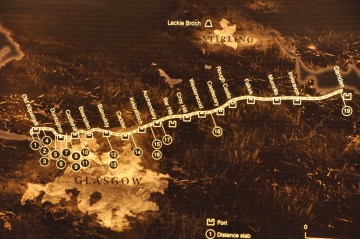
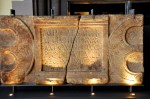
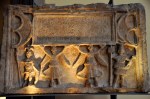
Apparently the ruins are not much to see; the turf and wood wall have largely weathered away.  Still, the various legions that built the wall commemorated their finished construction and their victorious struggles with the natives (called the Caledonians) in decorative local limestone slabs, called “Distance Slabs”.  The slabs were set into stone frames along the length of the wall.  Dedicated to the Emperor Antoninus Pius, they identify the legion, the length of the wall they built, and with symbolic imagery they depict the might of the Roman army and the native population in defeat.  In the largest known slab (shown below), the inscription reads: “For the Emperor Caesar Titus Aelius Hadrianus Antoninus Augustus Pius, Father of his Country, the Second Augustan Legion built this over a distance of 4652 paces.”

Other examples are shown below.

A number of stone statuary items from the bath houses and fort buildings attest to the Romans’ love of art even at their furthest outposts.

Other artifacts like coins and leather shoes were of course also plentiful.

That’s enough on Glasgow!  Next post is a change of pace, on England’s Lake District.


Glasgow II – Art Museums

Glasgow has 2 fabulous art museums, the Kelvingrove Art Gallery (and Museum) and the Burrell Collection from a wealthy shipping baron.

THE KELVINGROVE ART GALLERY

As you can see from the pictures below, the Kelvingrove is big!  To the point of overwhelming.  We spent a couple of days there.

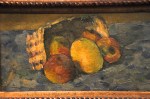
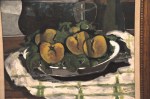
The grand 100-yr-old Spanish Baroque building is sort of a condensed version of our Smithsonian.  It has a Spitfire fighter plane hanging from the ceiling, stuffed animals (elephants, giraffe, kangaroo, moose), the Mackintosh exhibits we showed in the last post, exhibits from ancient Egypt, “Scotland’s First Peoples”,  etc.  I’m going to show some of its amazing artwork, starting with Impressionists.  Below are different treatments of still life – it’s always fun to compare!  The first picture (alas, slightly out-of-focus – all of the lighting was really dim!) is by Francois Bonvin, a mostly self-taught French painter with whom I was unfamiliar.  The rest are by artists we all know.

Discovering a “new” (to us) artist whose work we enjoy is always a special treat, and the Kelvingrove held several nice surprises hidden among the “masters”; maybe we should know these artists, but don’t?  Henri Le Sidaner, Othon Friesz, Armand Guillaumin?    Pictures of some of the paintings are shown below, pretty much arranged chronologically.

Another day and a change of pace – Flemish and Dutch Masters.  What a treat!  Below is a collaboration between Rubens and Brueghel (Rubens, of course, did the nudes).

Although we really like this period of art, we haven’t been very good students; there are a lot of painters here that we aren’t familiar with – like Pickenoy, below.

Another unfamiliar artist was the landscape painter Jan van Goyen; he was very poor, but became very influential.  In order to sell his paintings cheaply, he painted thinly and quickly with a limited palette of inexpensive pigments, sometimes churning out a painting a day.  His limited tonal range ended up being widely copied.  Impressive!

Yet another artist new to us was Jacob van Es.  Not much is known about this guy, but his paintings were in many collections of the times – Rubens owned two of his paintings.

OK, time for somebody we do know!  Rembrandt’s painting of his wife, pregnant with their first child, is shown below.  She’s dressed as Flora, Roman Goddess of flowers.  It’s fabulous.

Two other artists we weren’t familiar with are Egbert van der Poel and Willem Kalf; their paintings are shown below.  That last picture is by David Teniers the Younger; we didn’t know him either, but apparently he was considered one of the greatest painters in Europe

in his day, and hundreds of his pictures are in the museums of major cities.  Live and learn!

We discovered Rachel Ruysch earlier in our travels, and we consistently find her work in major cities.  She’s the daughter of a botanist (who had an insect collection and was, himself, an amateur painter); the rest, as they say, is history.  She was selling her still-life

paintings at the age of 18, and enjoyed great fame and reputation in her lifetime.

The last picture we’ll show from the Kelvingrove is one they’re very proud of.  Spoiler alert, it’s a bit more modern than the ones I’ve been showing you!  I’m sure you’re familiar with

it.  It’s a big painting, and very impressive.

THE BURRELL COLLECTION

Sir William Burrell was a Glaswegian shipping magnate who collected every conceivable form of art – including fireplaces and doorways.  The collection is incredible; the stunning amount of beauty would put most museums to shame, and it was hard to decide what to photograph.  The collection includes medieval The Warwick Vase, 100-200 AD, found in Hadrian's Villa at Tivoli; reconstructedart (stained glass, tapestries), Egyptian, Islamic and Chinese art, French Impressionist paintings, sculpture, armor, architecture, furniture….  Be prepared for ecclectic!  So where to start, eh?  How about this vase, found in Hadrian’s Villa at Tivoli, from 100-200 AD (restoration in the 1700’s).  Fill it with wine and take a bath?

Next let’s visit one of my addictions, stained glass.  The Burrell Collection has over 700

medieval stained glass panels from across Europe, one of the greatest collections in the 3 panels from a French cathedral, ~1280world.  The 3 panels shown on the left came from a French cathedral from about 1280 (!), showing a wedding party in the center, with kitchen scenes above and below that referenced the trade guild that paid for the window.  The only paint on the glass is a brown metal oxide that defines the faces, hair and folds of the clothes.  The individual pieces of colored glass are small, and therefore the many lead canes holding them together made the panels strong.  There are few restorations, and the window looks almost exactly like it did 750 years ago.

Below are a few more really old panels.

The panels that follow are still from the 1400’s, although the late 1400’s.  In the first picture below, the floor pattern and the L-shaped table create good perspective.  Details of

the faces, clothes and food were added using metal oxide paint.  The yellow hair and musical instruments were painted on the glass using silver stain.  Below are a few more glass panels, from the early 1500’s.

We’ll end this medieval glass section with 3 (composite) windows.

We’re switching now to tapestries, and then embroidered clothes.  The pictures below are just two of many very impressive tapestries.   Both are wool and silk.  Gorgeous, aren’t they?

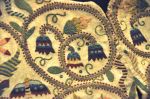
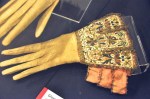
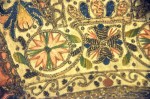
The early 1600’s were a period of peace and prosperity in Britain, and a time when aristocrats used clothing to flaunt their wealth.  Linen and silk garments were richly decorated with silk, silver, and gold threads – as you can see below.

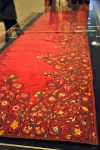
The last set of pictures shows a “petticoat”.  It’s a lot of cloth, as you’ll notice below!  Then

again, dress fashion in the 1600’s was designed to display a lot of cloth.  The museum states that the prominent placing of thistles (Scottish emblem) at the top of the embroidered border suggests it was created for the wife of King James VI (of Scotland; alias James I of Great Britain – see previous post “Stirling Castle” for James’ history).

As mentioned earlier, there are fireplaces and doorways in the collection ….

There’s Burrell’s dining room, where the walls are carved wood.

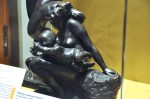
Statues of course – here are some bronzes from Rodin –

And the pottery!  It was fabulous stuff.  I’ll just show a bit of old Chinese pottery (and some carved jade), shown below.

The pottery below is porcelain from China’s Qing Dynasty, Kangxi period (1662 – 1722) – with the exception of the last item that’s carved ivory.

There were of course the high-tech weapons of the middle ages ….

And now the paintings!  Oh my!  What a collection!  There are over 600 paintings in the Burrell collection.  Considering the length of this post, you’ll be relieved to know I won’t show them all.  The paintings from earlier centuries are sometimes from a famous painter’s workshop rather than from the artist himself, as illustrated by the first painting below.  Many others are from the masters themselves; the Bellini (!) is exquisite, as is the painting by Giovanni Battista Moroni, one of the great portrait painters (Italian) in the

Late Renaissance period.  I’ve separated out paintings from my favorite period, the masters of the 1600’s, shown below.
One of the strengths of this collection is French Impression painters, one of our favorite periods.  Some examples below.


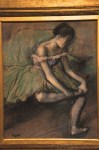
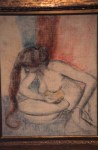
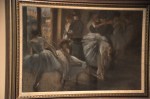
We’ll finish this oh-so-long post with paintings by Degas.  The Burrell has one of the finest Degas collections in Europe, with 22 paintings, pastels and drawings.  The pictures below are of his dancers, all but the first being pastels – and that picture is one of Degas’ first paintings of the ballet.

Well, we generally exhaust the patience of anyone who accompanies us to a museum.  If any of you have made it aaall the way through this post, our congratulations!

The next post (and last on Glasgow) is on Glasgow’s churches.

Glasgow I, The City

Glasgow lives in the shadow of its royal, history-ladened neighbor, Edinburgh (post Edinburgh II).  However, we liked Glasgow better, for several reasons:

  • Glasgow is a “real”city –  it’s not a big tourist destination, so you won’t find costumed sales folk hawking tours, and souvenir shops on every corner.
  • the architecture is fascinating – Victorian, playful facades, visionary Art Nouveau, and modern riffs off the latter.
  • There’s a lot of the incredible art and architecture of Charles Rennie Mackintosh and his  less-well-known wife, Margaret MacDonald.
  • And the museums aren’t bad either!

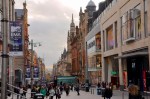
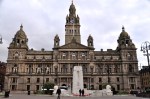
Let’s begin with some pictures of the streets and buildings of this interesting city.  Glasgow is a port city;  in its heyday (1800’s) it was a wealthy industrial powerhouse and Europe’s 6th biggest city.  Going into the 1900’s, while the rest of the UK was enthralled with Victorianism, working-class Glasgow veered into the modern, incorporating aspects of Minimalism, Art Nouveau, and even some Asian influence.  Today it’s an intriguing city that doesn’t take itself too seriously.  For example, look at the neoclassical Glasgow Gallery of Modern Art in the first picture below, with its Grecian columns; notice that the

equestrian statue (far left) sports a guy wearing an orange road hazard cone, and that the building’s mirrored mosaic is anything but neoclassical!  Or how about this building with the funky ironwork, from Glasgow’s days of iron forges?  Here, Glaswegians call sanded and polished concrete “Glasgow marble”.  There’s a lot of quirk and fun here.  More of the city is shown below.  OK, “more” is a lot of pictures, but then again the city is fascinating!

Even better, most of these buildings are covered with very artsy detail.  It pays to look up as you walk – a bit hazardous, but worth it; as shown below, the building facades are full of sculptures and friezes.

The people have fun too – one often encounters parties, sometimes bizarre, going on.

Not to mention, of course, the pervasive and wonderful Scotch bars!

It’s time for a little (a very little) art history.  In the late 1800’s a backlash against industrialization led to the “Arts and Crafts” movement, featuring hand-made objects with simple designs from nature.  With the new century approaching there was a creative energy for new styles for the new age.  In painting, one expression of new style was Impressionism.  In the design world the new style was “Art Nouveau”, which extended the Arts and Crafts emphasis on nature, incorporating  female figures and embracing modern manufacturing technologies to create flowing, linear, and abstract forms.

In Glasgow during this time, the Glasgow School of Art became one of the most successful art schools in the UK, with one of its students, Charles Rennie Mackintosh, winning many awards.  Staff and students developed their own approach to Art Nouveau, known as the “Glasgow Style”, that incorporated stylized, linear motifs based on nature.  A decade after Mackintosh graduated he was given a commission to build a new home for the Glasgow School of Art, with the freedom to design every detail.  It’s a pinnacle of artistic and architectural achievement.  A model is shown in the first picture below; well, I was

underwhelmed at first look, but this is a 1909 building, remember, and much here is actually new for the times.  The over-riding theme is ‘letting in the light’.  As you can see in the picture on the right, there are protruding iron arms at the base of the multi-paned windows with stylized roses at their ends (a Mackintosh trademark).  The arms were a new invention that reinforced those very large, fragile glass windows and allowed natural light to pour into the studios.  Throughout the building the lines are Modernist, with Asian

influences and Art Nouveau flourishes; examples shown above.  Alas, it’s a working school, without free access; the pictures above are pictures of pictures.  I can, however, show you tea rooms that Mackintosh designed.

When in 1875 a tea dealer placed table and chair in his shop and sold cups of freshly brewed tea, the tea room was born.  The idea quickly caught on.  Many city-center buildings were converted to tea rooms for meeting, relaxing and doing business – and they were a much better option than a bar for unescorted women.  The face of Glasgow tea rooms was Miss Cranston, who owned 4 of the largest; she favored modern design and unique decoration.  In 1896 Mackintosh was asked to design murals for one of her tea rooms, and his daring designs became a public talking point.  From 1900 on he was the sole designer of every aspect of her tea rooms.  1900 also marked Charles Mackintosh’s marriage to Margaret Macdonald, another graduate of the Glasgow School of Art, and together they collaborated on interior designs and artwork.  The pictures below are from

the “Ladies’ Luncheon Room” that Charles designed in 1900 (now in a museum); pay particular attention to the decorative panel that he did with Margaret (mostly Margaret’s style).  I think it’s fascinating – made with oil-painted gesso plaster on burlap and scrim, twine, glass beads, thread, mother-of-pearl & tin leaf.  There is more art that came from the tea room, of course; the related panel shown below, and beaten tin panels shown


just above.  In “The Dew”, the first picture above, Margaret drew the women’s hair, clothes and plant forms as one continuous looped line, broken only by small cascading circles and droplets – the title’s “Dew”.  Nice.

Mackintosh's Willow Tea Rooms, todayOur final look at a Mackintosh tea room is “The Willow TeaRooms and Gift Shop”.  These rooms are not in a museum – they constitute a 1903 Mackintosh building that is still serving food and tea to the public.  Below are pictures of these rooms as they looked in 1905;
and here is how those first two rooms above – the Front (ladies’) and Back (men’s) rooms – look today.

That last archival picture from 1905 (3rd picture, above) shows the “Room de Luxe” that overlooked the street below; it was the more extravagant and exclusive ladies’ room – a “fantasy for afternoon tea”.  Below is how it looks today; the chairs are reproductions, but

the decoration is original.  It really is exquisite – I don’t think I captured it so well – but it is missing at least one of its artistic highlights, one of Margaret Mackintosh’s more famous works, a gesso panel inspired by a sonnet (Rossetti’s O Ye, all ye that walk in Willow Wood).  It’s currently in the Kelvingrove Art Gallery that we’ll visit in the next post, but I’ll include it here where it belongs.  I think it’s gorgeous.  The story of Willowwood

is as follows:  A man sits by a well in Willowwood.  As he looks into the green waters, his reflection changes into that of his dead beloved.  As his beloved’s gray image fades, he scoops at the water with his hand to drink and grieves over his loss.

One last topic – the Tenement House.  Urban working-class Glaswegians lived in tenements, multi-storied flats often consisting of just 2 rooms and a shared outhouse. It wasn’t until the mid-1800’s that landlords were finally required by law to supply water to the houses.  The Tenement House was built in 1892 and was designed for the slightly better-off, with 4 rooms and the added luxury of its own toilet.  In 1911 a Miss Townsend

and her mother moved in, and for 64 years she changed nothing.  When Miss Townsend died, a relative came to collect a set of chairs from the will, and “felt like Pip on witnessing the room of Miss Havisham in Dickens’ Great Expectations“.  Ultimately the National Trust of Scotland bought this otherwise ordinary row home as a time-warp display of life back then.  Alas, photos were not allowed; these pictures come from their booklet.

Heating and cooking were done with coal, and the all-purpose kitchen shared laundry duties – notice the wringer on the sink in the first picture below.   Clothes were

dried overhead in this, the warmest room.  Ironing was done on the kitchen table using the flatirons heated on the range, as shown above.  Larger laundry loads were washed in the communal wash house outside.

That’s enough for now, don’t you think?  Next post: Glasgow II, Kelvingrove Art Gallery.