Oban, and the Highlands I

We’re  off to tiny Oban for several reasons:

  • it’s in the Scottish Highlands
  • it’s a resort town on the ocean
  • it has a ceilidh house (pronounced KAY-lee, for you non-Scottish speakers) where they perform Highland music, song and dance (and they also teach visitors a basic ceilidh dance)
  • and, most important, it has a Scotch whiskey distillery to tour

If you remember from a previous post (Melrose Abbey, Scotland (and Greenknowe Tower), February 25, 2015), one of my goals on this tour of Scotland is to become knowledgeable of one of mankind’s more famous drinks, the single malt Scotch (Ginger gamely joins in, but is not a big fan).  Oban was on the whiskey map in that previous post (“Oban 14 yr old”); good enough reason to visit.  So off we go!

The southern end of Loch LomondThere are a number of different roads that go through the southern/central Highlands, heading northwest.  We choose the route that goes past Loch Lomond, the largest inland stretch of water in Great Britain and the centerpiece of Scotland’s Trossachs National Park.  You’ll recall that traditional Scottish song “Loch Lomond”:

By yon bonnie banks, and by yon bonnie braes,
Where the sun shines bright on Loch Lomond,
Me and my true love were ever wont to gae,
On the bonny, bonny banks of Loch Lomond.

Chorus
Ye’ll tak’ the high road and I’ll tak the low road,
And I’ll be in Scotland afore ye,
But me and my true love will never meet again,
On the bonny, bonny banks of Loch Lomond.

It’s a familiar old song, but I never knew it’s history or meaning.  There are several slightly different interpretations, but most are connected to the Jacobite Uprising of 1745 in support of Bonnie Prince Charlie [discussed in the last post (Stirling Castle, August 4, 2015)].  Two Jacobite soldiers, captured by the English, have different fates: one is condemned to death while the other, his friend, will be set free.  The song by the condemned man is based on the old Celtic myth that the soul of a Scot who dies outside his homeland will find it’s way home by the spiritual, or “low” road.  Doesn’t that make the song so much sadder?

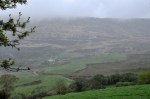
It’s a long lake, 24 miles, and there are many opportunities to take a picture.  It’s a cloudy

day (of course; this is Scotland) and the lake itself seems sad.  Soon we climb into more

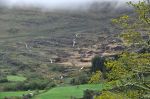
rugged and wildly beautiful territory.  And it just gets better, as shown below.

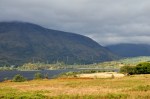
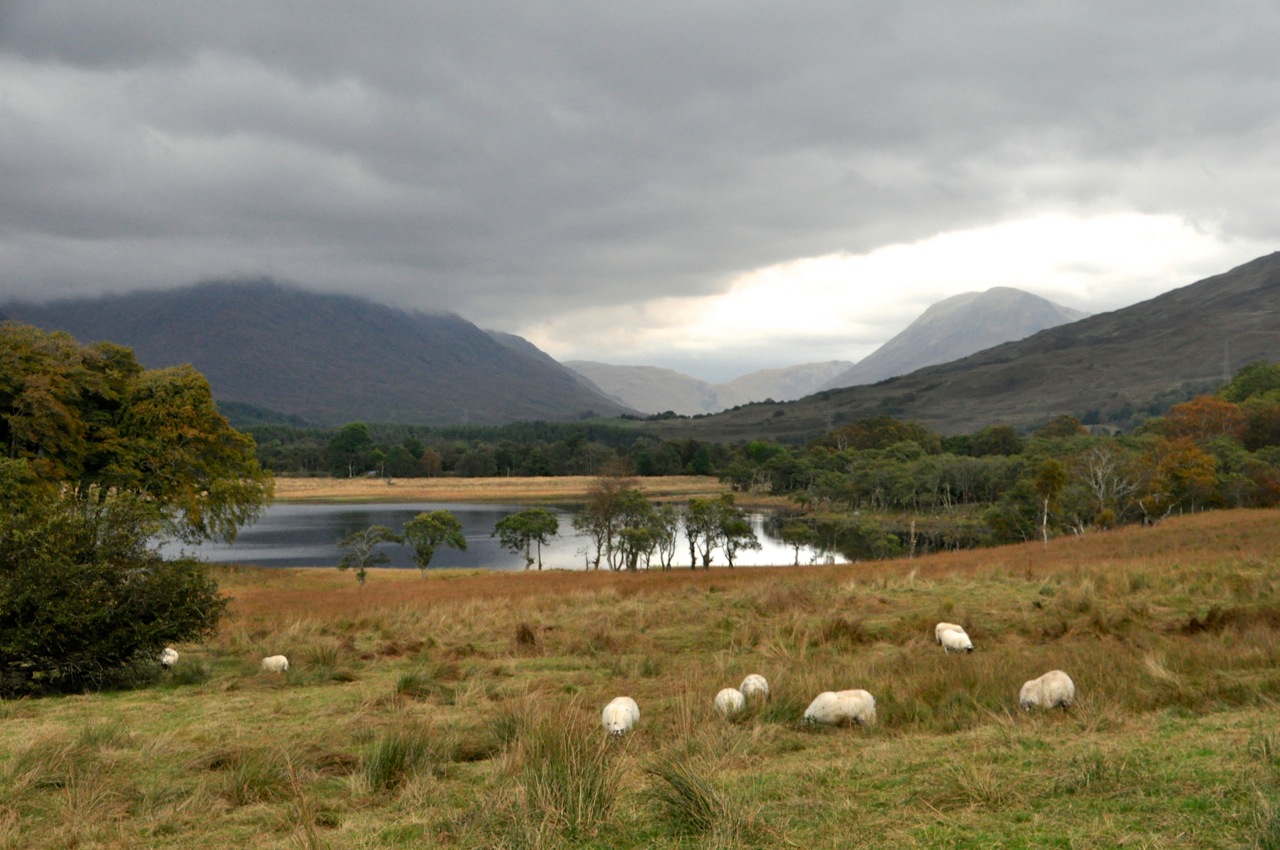
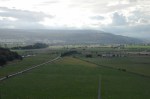
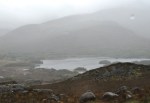
The Highland country sceneMy favorite view of this part of the Highlands is the bucolic scene to the left, with looming mountains, a picturesque small lake, and busy, contented sheep.  Lucky sheep, with such a view!
Aren’t the Highlands beautiful?  Wait ’til you see more of them, in subsequent posts!
After all that stark beauty, the ocean town of Oban was disappointing.  It’s a small (and low key) resort with gravel beaches and a winding promenade lined by small hotels.  Here

Scotland’s train system meets the ferry system to the Hebrides Islands; Oban’s center is a harbor, with huge boats.  Still, it’s pleasant enough, and it does have some great seafood restaurants!  Oh my gosh, if I’d been able to get a picture of one of the restaurant’s seafood platters, you’d be booking a plane ticket now.  Below are some views of the harbor.

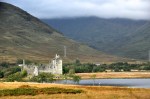
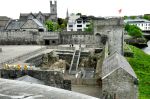
Oban really has no important sights (other than a distillery!), but a short walk away it does have the ruins of a small castle (Dunollie) on a commanding spot overlooking the harbor.

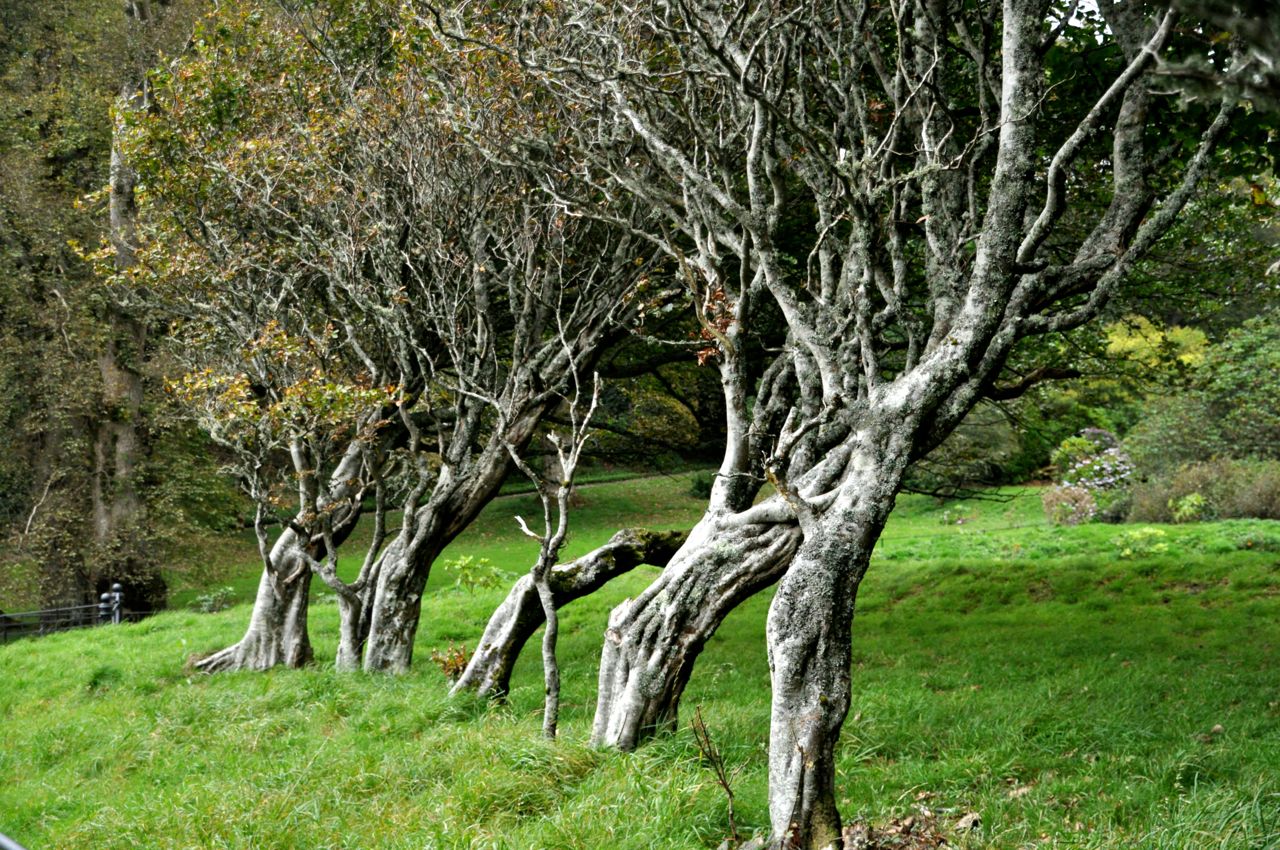
It was the home of kings (Clan Chiefs, really) in the kingdom of Lorn for a thousand years, and the seat of Clan MacDougall from the 12th century (the clan held 7 other castles and a fleet of galleys).  Dunollie Castle was captured by Cromwell, who garrisoned troops there; during the first Jacobite wars, it was besieged; and it was finally abandoned for good in 1746.  Today it just adds historic atmosphere – Wind-swept trees near Dunollie Castle something that Scotland (and England!) are very good at. And, speaking of atmosphere, there is an area near the castle called “The Witches” because it is forested with twisted old trees, some as old as 400 years, that show the effects of the high winds here.

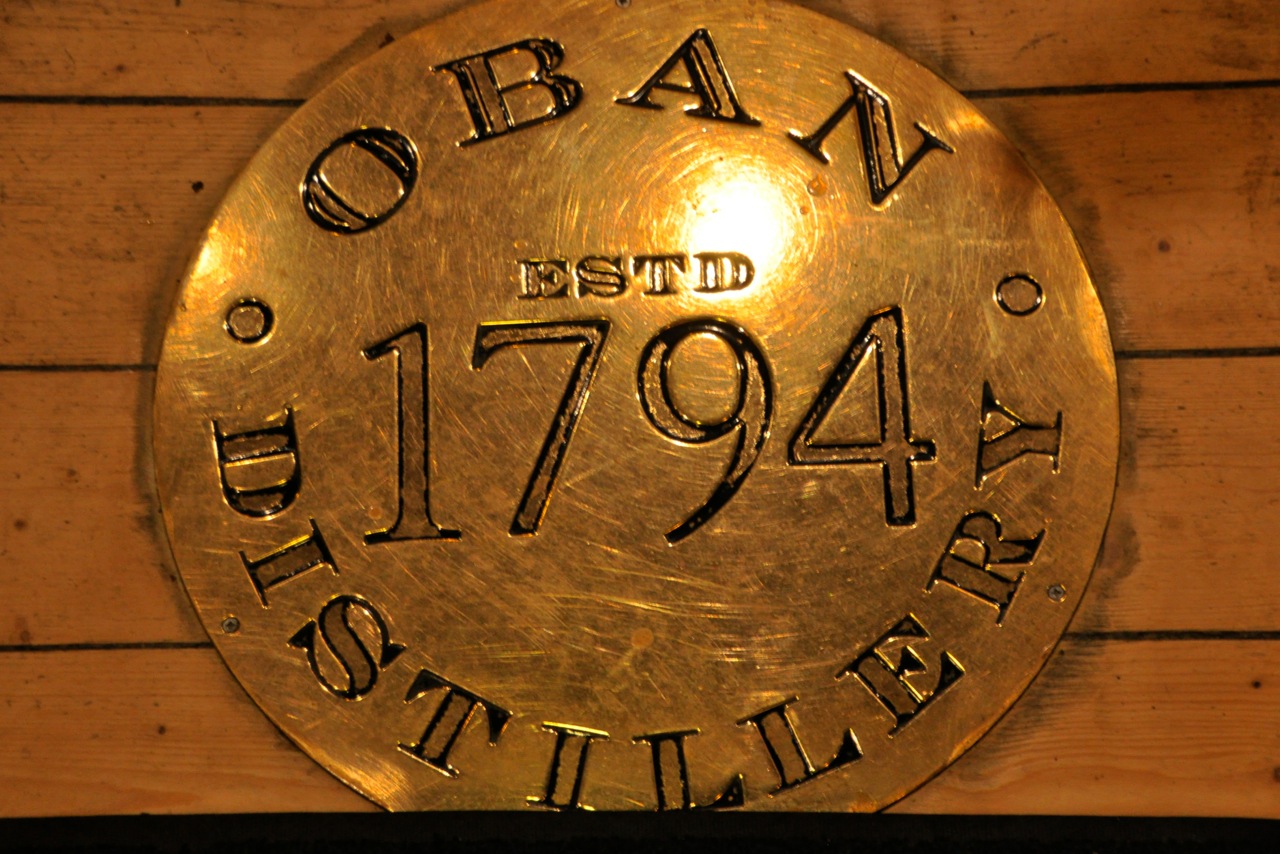
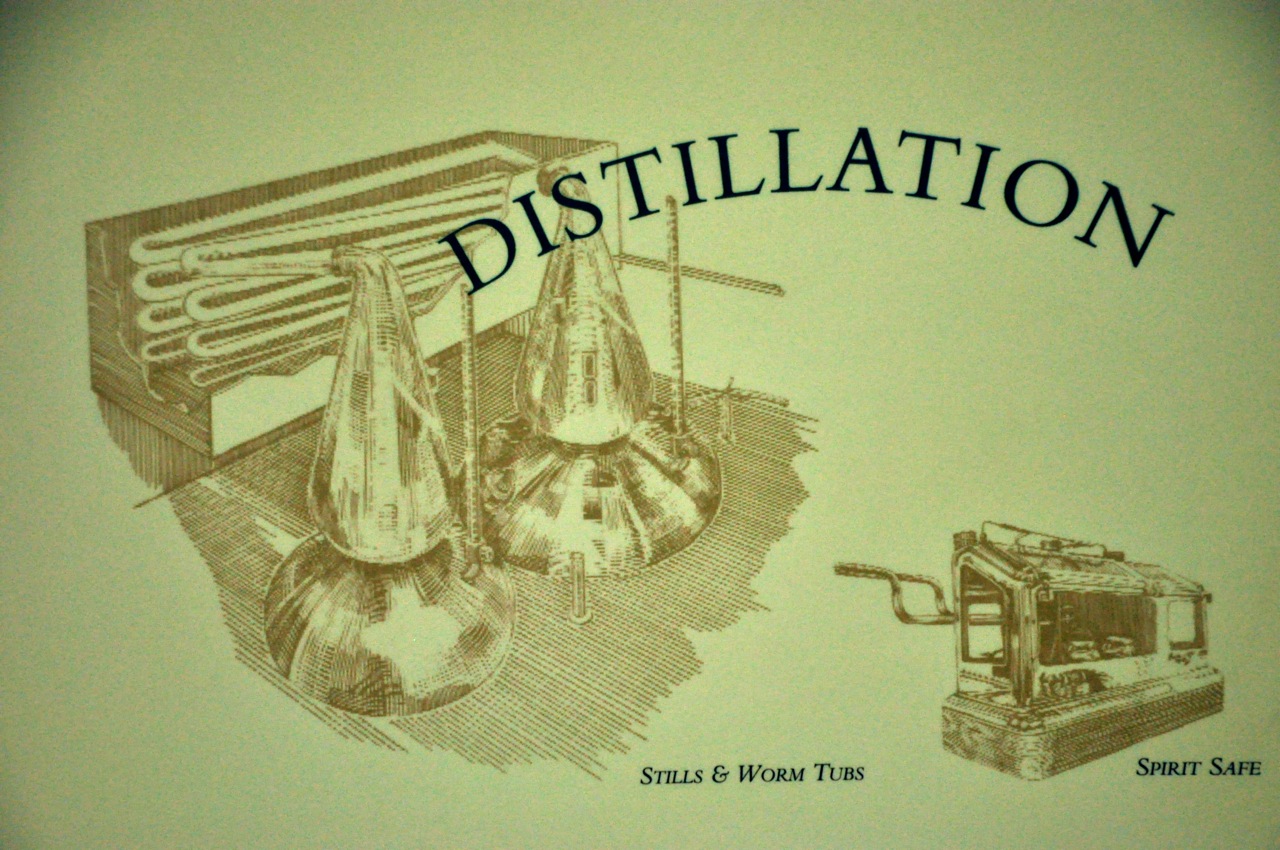
OK!  Time for the whiskey tour!  The Oban distillery is a Yep, it's old!block off the harbor in the middle of town, which is very unusual; most distilleries are off in the country.  In this case, Oban itself grew up around the 200-year old distillery.  That’s a small problem for the distillery – it can’t easily expand!  The Oban Whiskey Distillery produces a West Highland malt scotch.  In the map of Scotland below, different colors denote regions of Scotland making distinctive flavors of Scotch – there Regions of distinctive Scotch single malt whiskeysare about 5 of them.  Oban is near the middle of the various flavor profiles, with a touch of peat, a touch of salt, and a touch of honey in taste.  They make 4,000 gallons of Scotch a week (a lot of which goes to the US).  The process for making a single malt Scotch is pretty much the same throughout Scotland, and quite interesting!  Single malt Scotch is made from barley, water and yeast.  Sometimes peat smoke.  That’s it.  The diversity of flavors comes from the locally sourced ingredients, the skill of the master distiller, and subtleties in the production process.  All true, but the real revelation to me was that the real flavor of Scotch whiskey comes from America!  Fascinating!  Don’t tell a Scotsman that, but you’ll see.  Alas, most distilleries seem to think they have secrets, and photos are not allowed!  So I’ll just give an overview of the process.  Water is added to the barley to start germination (starch release), and then the barley is dried by heating in a kiln (in some distilleries, with smoking peat).  This is “malting”.  The malted grain is milled to a defined mix of powder-to-piece, hot water is added in a big stainless steel (or wood) vat, and the starch is converted to sugar (the wort), a process called “mashing”.  The wort is cooled, yeast is added, and fermentation occurs for 2-4 days (the time has a big effect on flavor), producing the “wash” – approximating a strong beer.  The "Candy Kiss" shape of the copper stillsThe wash is then distilled in two sequential copper stills that look like those on the left side of this picture – they look something like Hershey Kisses, only about 15 or 20 feet high.  The size and shape of the stills have a big effect on taste due to the liquid interacting with copper – the more the interaction, the lighter the Scotch (the liquid extracts copper).  The final distillation “cut” is about 68% alcohol, and goes to oak barrels to age – a minimum of 3 years to call it “Scotch”, but usually for a decade or more.  And this is where America comes in!  Those oak barrels remove harsher tastes and add flavors; and where do those oak barrels and flavors come from?  Why, 1-year-old used American bourbon barrels!  By (American) law our bourbon has to go into new oak barrels, so what to do with those used bourbon barrels?  The Scots buy them, knock them down, ship ’em to Scotland, rebuild the barrels, and add their Scotch to take on those yummy tastes!

Finally, our visit to a ceilidh.  This is the tail end of the tourist season, and we’re at the last show of the year, with just one other small group in attendance.  It’s probably a tailored-down show, but fun nonetheless!  After the band (2 people) plays Highland tunes, a singer sings Highland songs, and a young lady does very graceful, ballet-like

Highland dances, the audience gets to participate – both in song and in something like a line dance.  Some in the audience seem to know the steps; we do not.  The brief instruction was a little helpful, and the ensuing chaos was a lot of fun.  Although it seemed touristy, apparently people in Scotland grow up doing the ceilidh, and locals enjoy going.

Next stop – the Highlands II, Glencoe Valley.


Bunratty Castle and Limerick

Our SW Ireland Tour with Small Potatoes is over (Southwest Ireland Tour and Traditional Roy Stein and Nancy TomeiIrish Music I”, June 20, 2015), but for the next 1½ days we get to hang out with our good friends Nancy Tomei and Roy Stein, who were also on the tour (and who introduced us to Small Potatoes in the first place).  We can’t go too far afield due to incipient plane flights, so we’ll visit the nearby Bunratty Castle and the city of Limerick.

BUNRATTY CASTLE

Bunratty Castle was built in 1452, and like all places in Ireland it has a lot of history.  The Castle is operated as a tourist attraction, along with its adjacent “folk park”, an open-air museum of period buildings.

The castle itself is pretty darn imposing!  It sits on a strategically important site near the mouth of the Ralty River where it empties into the River Shannon (“Bunratty” is from the

Irish words for “end of the Ratty River”).  In the 1300’s the city Limerick, on the Shannon, was an important port for the English Crown, and the castle at Bunratty blocked river attacks by the pesky Irish.  Bunratty Castle is actually the 3rd stone castle built near this site (the 2nd stone castle was captured by the Irish soon after it was built).  Fifty years after it was built, the present Bunratty Castle ended up in the hands of the powerful O’Briens (and later Earls of Thomond) whom we met before (“Southwest Ireland Tour IV – Slea Head and Cliffs of Moher“, July 18, 2015).  The O’Briens expanded the site and eventually made it their chief seat, moving their base here from Ennis (“Start of our Ireland Tour“, June 16, 2015).  In 1646 the castle was in the hands of the British under the command of Rear Admiral Penn when it was put under siege by the Irish.  His infant son William Penn, founder of Pennsylvania, was in the castle; both were freed after the castle surrendered.  The present castle represents what it looked like around 1619.

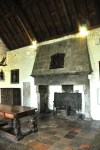
The lower floors of the castle (some pictures shown below) were home to the guards and

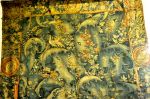
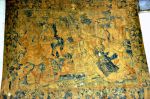
staff.  The Great Hall is reasonably impressive, with old tapestries, wooden angels hovering from ceiling supports, and the remnants of very ornate plaster work that once

decorated the wall.  The absence of a fireplace is one of the more unusual features of the Great Hall; instead of a fireplace, there is a hexagonal area for a fire in the middle of the room – see top horizontal picture – with a shielded exit hole in the roof for the smoke.  Nothing like a good campfire in the main room of the castle!  Marshmallows, anyone?

There are a number of attractive tapestries from the 1600’s or earlier hanging in the great hall; although they’re quite faded, the workmanship is impressive.

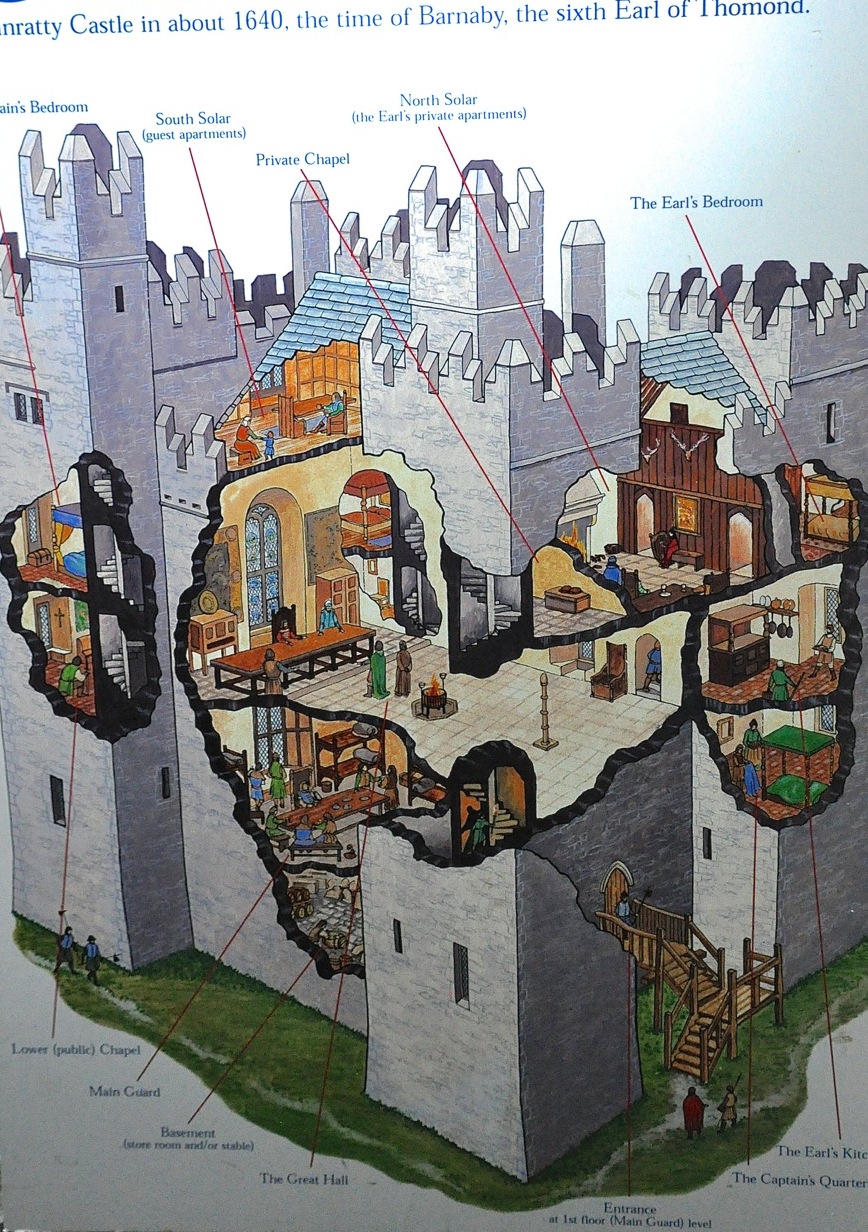
Schematic drawing of Bunratty CastleThe design of the castle is interesting: as shown in this cut-away image, each of the 4 towers of the castle has its own stairwell with small rooms coming off of it on each level.  Each tower can be entered only from the Great Hall or the lower-level guard room/kitchen area.  There is no one way to tour the castle!

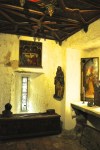
Just off one of the stairwells on the Great Hall level is a small, intimate, but quite impressive public chapel, with more remnants of the ornate plaster from the 1600’s on the wall, shown below.

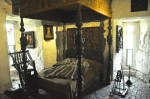
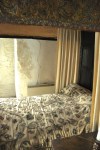
Further up the stairway is a bedroom with a beautifully ornate 4-poster bed, on which a dress from the 1600’s is laid out, shown below;  pretty cool!

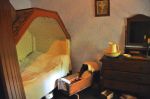
The Earl of Thomand had two towers (and connecting private apartment) all to himself.  The pictures below show his private apartment (with a real fireplace), bedroom, private chapel, and his own kitchen/pantry (!).

There is a lot of stained glass in the windows throughout the castle, and again it’s from the 1600’s or earlier, the really old stuff.  However, much of it is actually a hodge-podge of re-assembled pieces that no longer form a coherent picture, as shown in the latter two

images above.  Other windows, however, are very impressive – either old or gorgeous, as shown below.

The “folk park” adjacent to Bunratty Castle is family friendly, with goats and such to pet, restaurants, gift shops, yada yada tourist stuff, but also some old buildings that were brought here from other areas that offer glimpses of life from several hundred years ago.  We visited a couple of the buildings (pictures below).

We had an interesting conversation with the guy who was repairing a thatched roof – a skill that today is hard to come by.  This fellow was also a skilled stone mason, and

had done a bunch of restoration work on Bunratty Castle itself.  One thing that was interesting about the thatched roof was the story of the thatch itself.  The “good stuff” was available for harvesting by the wealthy; the poor got the leftovers or the less-desirable grasses.  As a result, roofs of the wealthy lasted for about 15 years before they need repair; those of the poor, about 4 years.  The deck is always stacked, isn’t it?  Capitalism or feudalism, those in power make the rules in their favor.

LIMERICK

Limerick is nearby, a city known for (at least) two things, King John’s Castle and a type of poem that is believed to have originated with the Maigue Poets in County Limerick in the 18th century.  Although we saw none of the later in Limerick, I would certainly be remiss if I didn’t share the general form of a limerick poem:

The limerick’s an art form complex                                                                                                    Whose contents run chiefly to sex;                                                                                                      It’s famous for virgins                                                                                                                         And masculine urgins                                                                                                                         And vulgar erotic effects.

I could share more, but Ginger won’t let me.  So we’re off to King John’s Castle.  Lots of

history here to share with you.  The first exhibits in the castle deal with Ireland’s “golden age”, when medieval Ireland was a beacon of light in the dark ages; interestingly,

they defined this golden age from the 500’s to 1169 – that last date being the year when the Norman English intruded (does that suggest an anti-English attitude?).

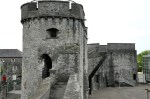
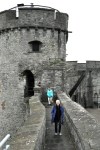
The history of King John’s Castle goes back to when the Vikings built a stronghold at this site in 922 and used it as a base to raid the length of the River Shannon, pillaging ecclesiastical settlements.  The Vikings were eventually defeated and reduced to the level of a minor clan in the area’s endless power struggles.  In a later inter-clan clash, warlord Dermot MacMurrough abducted the wife of Tiernan O’Rourke.  The wife was eventually returned unharmed, but O’Rourke took revenge and forced MacMurrough to flee Ireland.  In England, MacMurrough made a pact with King Henry II, pledging fealty in return for help in recovering his kingdom.  With the help of Welsh and English knights (particularly Richard de Clare, alias “Strongbow”), MacMurrough won back his kingdom in 1167 – but now under the control of Henry II.  This opened a new chapter in Ireland’s history.  The English knights and nobles who aided MacMurrough were paid for their service with Irish land, and Strongbow married MacMurrough’s daughter.  Ten years later, with a strong desire to prevent Strongbow and the transplanted English nobles from usurping his authority – and with the Pope’s authorization to take possession of Ireland – Henry II staged a successful invasion.  He appointed his youngest son John Lackland (without land) to be “Lord of Ireland” (really that small region of Ireland).  In 1199, with the death of his brother King Richard I (“the Lionheart”), John became Lord of Ireland and King of England (this is the villain John in the tales of Robin Hood, and the forced signer of the Magna Carta).  In 1200 King John ordered a castle to be built in Limmerick with troops garrisoned there to King John's castleprotect the city from the Irish kingdoms to the west and from rebellious Norman lords to the east and south.  Limerick became so prosperous under the general peace imposed by Norman rule that King John set up a mint in the northwest corner of the castle.  Apparently the city was quite a sight.  According to a

1574 document:

“Limerick is stronger and more beautiful than all the other cities of Ireland, well walled with stout walls of hewn marble….  “

Or another in 1620,

“… it is built from one gate to the other in one form, like the colleges in Oxford, so magnificent that at my first entrance it did amaze me.”

The good times were not to last.  The Irish Rebellion of 1641 attempted to force concessions for Catholics living under English rule, and fleeing (English) Protestants took refuge in the castle but were put under siege.  Without artillery, the Irish forces dug tunnels to undermine the castle walls, severely damaging them.  The Protestants surrendered when the walls were about to fall.  Four more sieges of King John’s Castle would occur in the 1600’s, as England sent the ruthless Oliver Cromwell and his armies to subjugate the Irish Catholics, with massacres of civilians, a scorched-earth policy causing famine, land confiscation and forced relocations.  In the Cromwell army’s siege of Limerick in 1651, when the defenders expelled starving women and children from the city, the army whipped them back inside, erected gallows and hung some of them as an example.  When the walls were finally breached by artillery, 5000 inhabitants had died.  For all of Ireland during this time, nearly a third of the population died in the fighting or associated plague and famine.  When Catholic King James II came to power in England, Stone on which the ill-fated Treaty of Limerick was signedIreland was treated better, but when King James II was ousted by William of Orange, the Jacobite (or Williamite) War began.  Ultimately the Jacobites lost; their last stand was at Limerick, where they held firm, but their position was hopeless.  They negotiated the Treaty of Limerick in 1691 (signing it on that rock to the left), ending hostilities while giving Catholics religious freedom and secure lands.  The Treaty of Limerick became known as the “Broken Treaty”, as the English parliament subsequently passed laws discriminating against the Catholics and setting the stage for the Great Famine.  Hope this extensive history was interesting!

In spite of the damage to King John’s Castle with so many sieges, it is one of the best

preserved Norman castles in Europe (1200 is, after all, pretty old).  It incorporated the latest in castle design; the gatehouse was the first of its kind in Ireland, and round rather than square towers were used; curved walls offered better protection from attack.  From

within the keep, it’s small size is striking.  It is hard to imagine thousands of people living

within its confines during a siege.

We’re walking to St. Mary’s Cathedral, Limerick’s last pre-Norman building and the oldest building in Limerick still in daily use.  Below are some views along the way.

St. Mary’s Cathedral was founded in 1168 by Donal O’Brien, the King of Thomond, on the site of his palace.  Parts of the palace were likely incorporated into the cathedral, most prominently the great west door, which tradition claims was the original main entrance to

the royal palace.  The north and south transepts were added in the 1200’s, and the tower and a number of chapels were a later addition in the 1300’s.  The cathedral has some history!  According to tradition, during the many sieges of Limerick the defenders of the city used the stones around the west door to sharpen their swords and arrows, and the marks they made in the stonework can still be seen.  In 1651, after Cromwell’s forces captured Limerick, the cathedral was used as a stable by the parliamentary army.  In 1691 the cathedral suffered considerable damage during the Williamite Siege of Limerick (there are retrieved cannonballs in one of the chapels in the cathedral; King William granted £1,000 towards repairs).

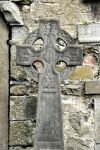
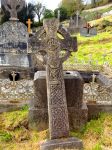
The graveyard at the edge of the cathedral had some beautiful Irish crosses and carvings, shown below.

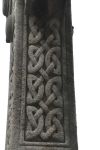
The Celtic detail on the crosses is very impressive – really it has a Moorish quality to it,

intricately geometric.

The cathedral interior is wonderful in it’s massive Romanesque style, contrasting with its

delicate stained glass windows.  Which are gorgeous.  Most are from the late 1800’s, most have names based on the donor’s funding, and many are in side chapels.  I’ll share a bunch

of them with you.  Pretty amazing, yes?  How about some more?

We’ll finish with one last window, which looks older and more crudely done, but beautiful nonetheless.

Well, I’ll show just a few more interesting tidbits.  Below, the large horizontal picture

shows the upper part of the O’Brien (Renaissance) monument.  At its base is displayed the sarcophagus lid of the Cathedral’s founder, Donal O’Brien, who died in 1194.  The last picture shows the “Leper’s Squint” built into the wall of the Cathedral.  In medieval times lepers were not allowed into churches but were able to see and hear mass (and receive communion!) through such narrow openings.

Well, my apologies for such a long post, hope it was worth the wade.  In the next post we return to bonny Scotland’s Lowlands.  Back in March we had introduced you to the fascinating and history-laden town of Stirling (“The City of Stirling, home of Stirling Castle“; post of March 4, 2015).  Our next post picks up from there with Stirling Castle: home of battles and refuge of kings and queens.


Stirling Castle

“He who holds Stirling, holds Scotland”.  The quote refers to Stirling Castle, which was the center of Scottish history for centuries.  The castle was all but impregnable, surrounded on 3 sides by nearly vertical rock cliffs with sweeping “I can see forever” views.  The castle’s importance, however, was due to those sweeping views overlooking a bridge over the River Forth, the primary passage between the Lowlands and Highlands.  Due to its strategic location and  invincible fortifications, it was both a focus for conquest and a safe refuge for royalty.  So much history occurred around this castle that I would be remiss not to mention some.  I promise a rather quick sketch.  In depth, the history reads like a trashy novel – victories, banishment, plotted returns, intrigues, murder, assassinations, a son waging war (and killing) a father, imprisonments, escapes, revolts, beheadings ….  The kings led interesting, if short, lives.  We won’t go there (much), though – just a bit of history of the castle.  This will be a long post, so feel free to skip to the pictures that follow!  However, I think the history provides very useful context.

Stirling Castle’s written history began in 843, when an historian noted that Kenneth MacAlpin, the first King of Scotland, besieged Stirling Castle during his successful fight to unite the Picts and Scots into the kingdom now known as Scotland.  At some point it became the home of Scottish royalty; in 1110 King Alexander I dedicated a royal chapel there, and his successor King David I made Stirling itself a royal city.  Skirmishes with England became common, and Stirling Castle was the football.  In 1174 the Scottish King William I invaded England but was captured at Alnwick (Alnwick Castle, February 14, 2015); to gain his freedom he ceded Stirling Castle to English King Henry II.  In 1189 he got it back when English King Richard I came to the throne.  Then came the Wars of Scottish Independence, which lasted for 60 years.  The outline below shows how the war centered around Stirling Castle.  Notice how the castle ping-pongs between the two countries!!

1296 – Stirling Castle was captured by English King Edward I.
1297 – The Scot William Wallace (a.k.a. Braveheart) defeated a superior English force at the Battle of Stirling Bridge (within sight of Stirling Castle) and later that year took back the castle following a siege.
1298 – William Wallace was defeated at the Battle of Falkirk, and the English reclaimed Stirling Castle.
1299 – The English surrendered the castle to the Scots following a siege.
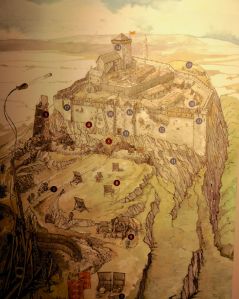
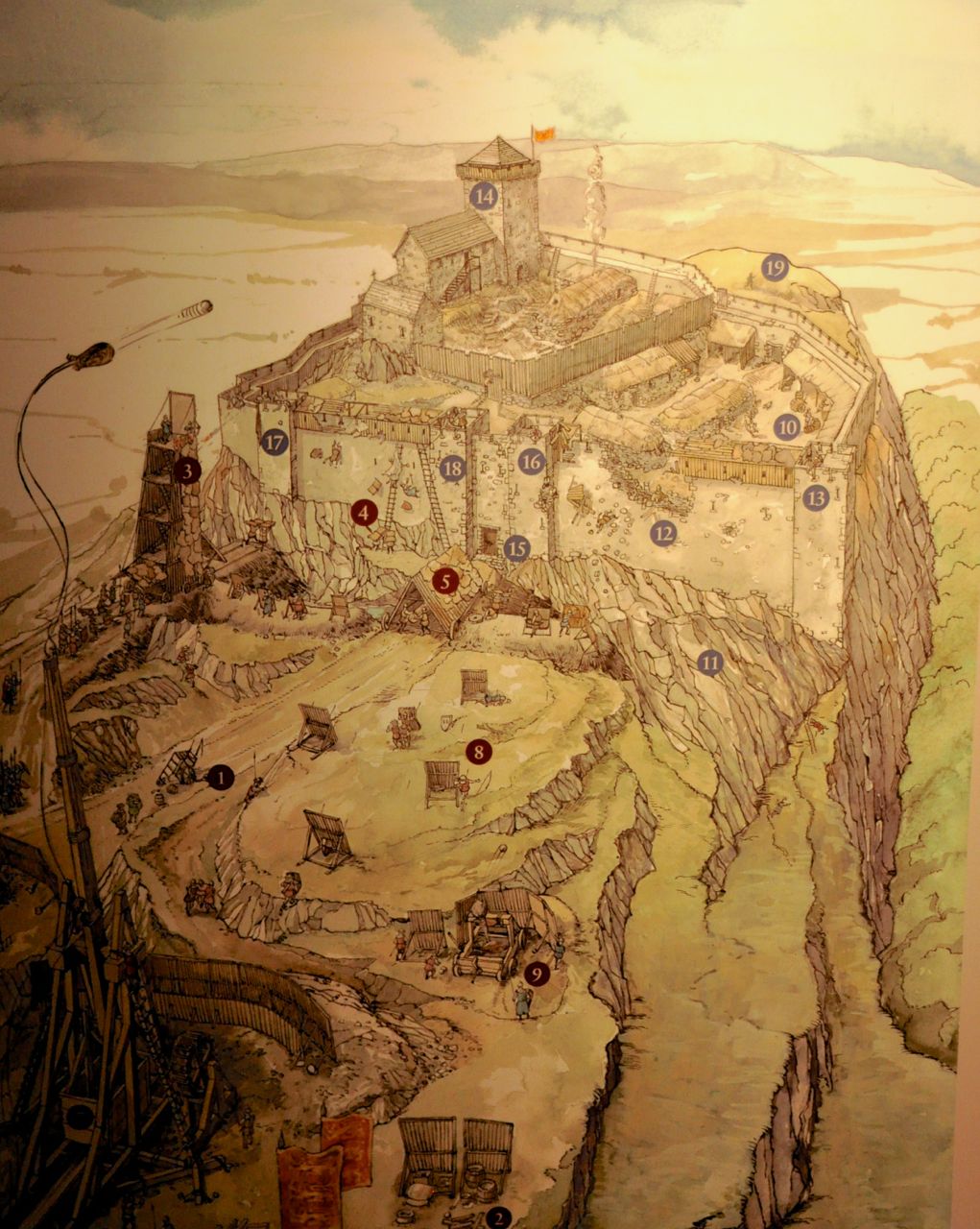
Drawing of the siege1304 – English King Edward I waged war on Scotland for years; Stirling Castle was the last stronghold; it was besieged and bombarded by 17 siege engines for 4 months.  When a massive trebuchet was built (“War Wolf”) capable of hurling missiles weighing 300 lbs, the Scots surrendered and the English controlled it for 10 years.
1314 – King of Scotland Robert the Bruce (Robert I) retook the castle by beating the 3X larger English army of Edward II at the Battle of Bannockburn just outside the Stirling Castle walls.
1336 – Stirling Castle was captured by the English
1337 – A siege of Stirling Castle by the Scots was unsuccessful
1342 – The future Scottish King Robert Stewart (Robert II) retook Stirling Castle in a successful siege.  The castle remained Scottish until the end of the war in 1357.

Two of those battles, the victories of the plucky Scots under William Wallace in 1297 and Robert the Bruce in 1314, both against huge odds, remain a source of fierce pride in a Scotland that still questions its English union.

Before visiting the castle, a little more history (but 400 years worth!) is worthwhile.  The Stewart kings Robert II and III made Stirling Castle their primary residence.  It’s from Robert II’s time that the earliest surviving parts of the castle were built – the foundations of the North Gate, built in the 1380’s.  King James I ascended the throne (then was caught and imprisoned by the English, saw a beautiful lady from his tower prison, wrote a poem about her [The King’s Quair] that we all read in high school, married her [cousin to English King Henry IV], and was released), but was assassinated in 1437, whereupon his queen smuggled son James II into Stirling Castle for safekeeping.  James III was born in Stirling Castle and favored it as his “most pleasant residence” (he was killed in a revolt led by his son James IV).  During the reign of James IV and V, 1490 – 1560 (and beyond), the city entered its golden age; Stirling became the principal royal center.  Almost all the present buildings in the castle were constructed, in grand style, turning the castle into the showpiece of Scotland (i.e., one-upmanship over England).  With James IV’s death, James V was crowned in the royal chapel of Stirling Castle (at age 17 months).  He married the French noblewoman Mary of Guise and had a daughter Mary Queen of Scots.  When James V died, Mary of Guise became Regent of Scotland; with nobles scrambling for power, she brought her daughter Mary to Stirling Castle for safekeeping behind strong walls (she came with 2,500 cavalry, 1,000 infantry, and a baggage train a mile long).  Mary Queen of Scots was crowned (as an infant) in Stirling Castle and spent her early years there, subsequently going to France.  In the face of threats from England, French troops were brought in and the outer defenses of Stirling Castle were built.  Mary Queen of Scots returned to Stirling Castle, wed, and had a son there, James VI (responsible for the King James version of the Bible) in 1567.  The Catholic Mary’s estranged husband was mysteriously murdered, she remarried, there was an uprising, and she was abducted to England and held captive by Queen Elizabeth I.  With various factions plotting for power, Mary was forced to abdicate to James VI, who was crowned king at age 9 months, raised in the safety of Stirling Castle as Protestant, and turned against his Catholic mother.  Stirling Castle became the base for James supporters, Edinburgh for Mary’s.  Attacks were made against Stirling Castle, but failed.  Mary was eventually executed by Queen Elizabeth I.  When Queen Elizabeth died without an heir in 1603, King James VI of Scotland became King James I of a united Scotland and England.  He left for London, returning to Scotland only once, briefly, after 14 years.  With his absence, Stirling’s role as a royal residence declined, and Stirling Castle became principally a military center and a prison.  When James VI died in 1625, the son Charles I inherited a kingdom divided by religion and throne pretenders.  His efforts to impose English liturgy on Scotland led to war – and his beheading, with Scotland choosing son Charles II as their king, who lived in Sterling Castle in 1640, while England got Oliver Cromwell, who turned England into a Republic.  Charles II marched against Cromwell and was defeated; Cromwell’s forces successfully besieged Stirling Castle in 1651, inflicting still-visible shot marks within the Castle.  Charles II fled, but returned as King of England and Scotland a decade later when Cromwell died and the English monarchy was restored.  Religious tension grew, and Charles’ attempted to introduce religious freedom for Catholics was unsuccessful.  When Charles II died and his Catholic brother James VII (English James II) not only ascended the throne but subsequently produced a Catholic heir, war broke out; James, the last Catholic King of England and Scotland, was forced to flee in 1688 and Protestants (William and Mary) assumed the throne.  James continued to claim the thrones of England and Scotland from exile in France and encouraged revolts in his name (Jacobite Rebellions). His grandson the Bonnie Prince Charlie led an ultimately unsuccessful uprising in 1745; the Bonnie Prince bypassed Stirling and captured Edinburgh, but returning to Stirling in 1746 he was unable to capture Stirling Castle.  This was the last time that Stirling Castle was besieged.  The Bonnie Prince’s subsequent defeat ended any chance of Catholicism becoming re-established in England.

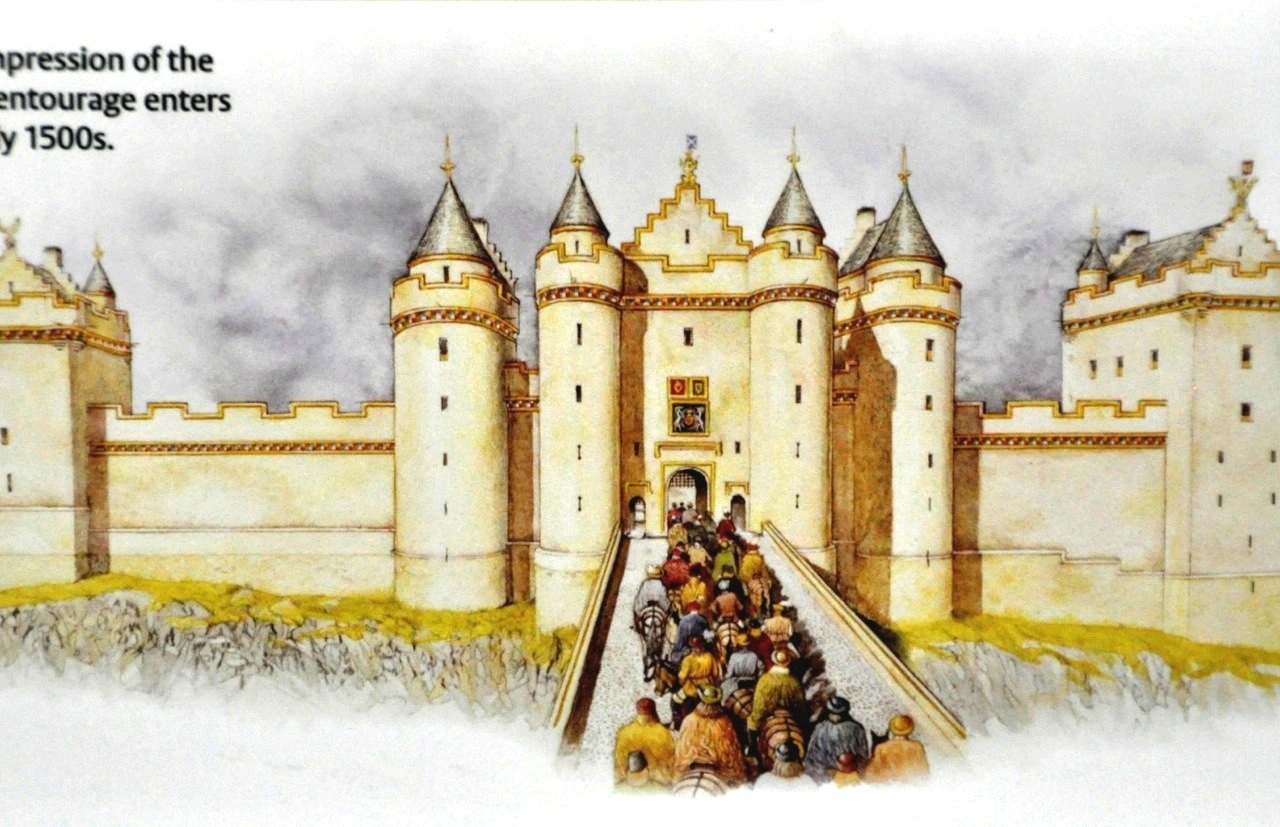
Wow!  A lot of history swirled around this castle.  Let’s take a look at it (finally, eh?).  This Depiction of Stirling Castle entrance, 1500picture is an artist’s impression of the grand entrance to James IV castle, based on a detail from a Scottish map done in the late 1500’s; the gate was among the most magnificent in the UK.  When it was constructed, it both strengthened the castle’s defenses and projected the greatness of James himself.  The gate was probably reached by wooden bridge over a moat.  This original gate was higher than the current one; it had 5-story towers capped with conical roofs, and was probably coated in gold limewash, with carved details painted and gilded.

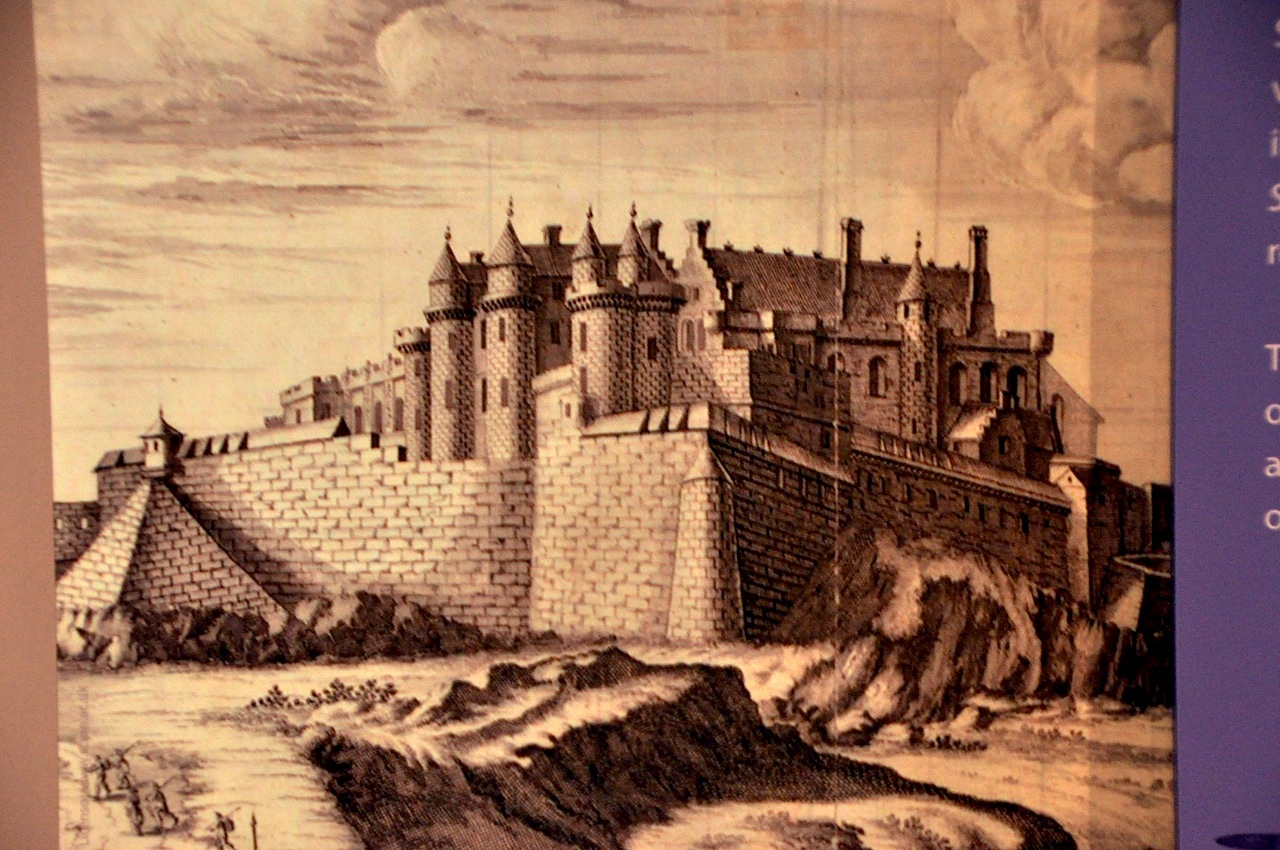
Drawing of Stirling Castle, 1671The first detailed drawing of Stirling Castle comes courtesy of a military engineer in 1671, although the view is not from the gate.

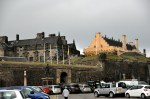
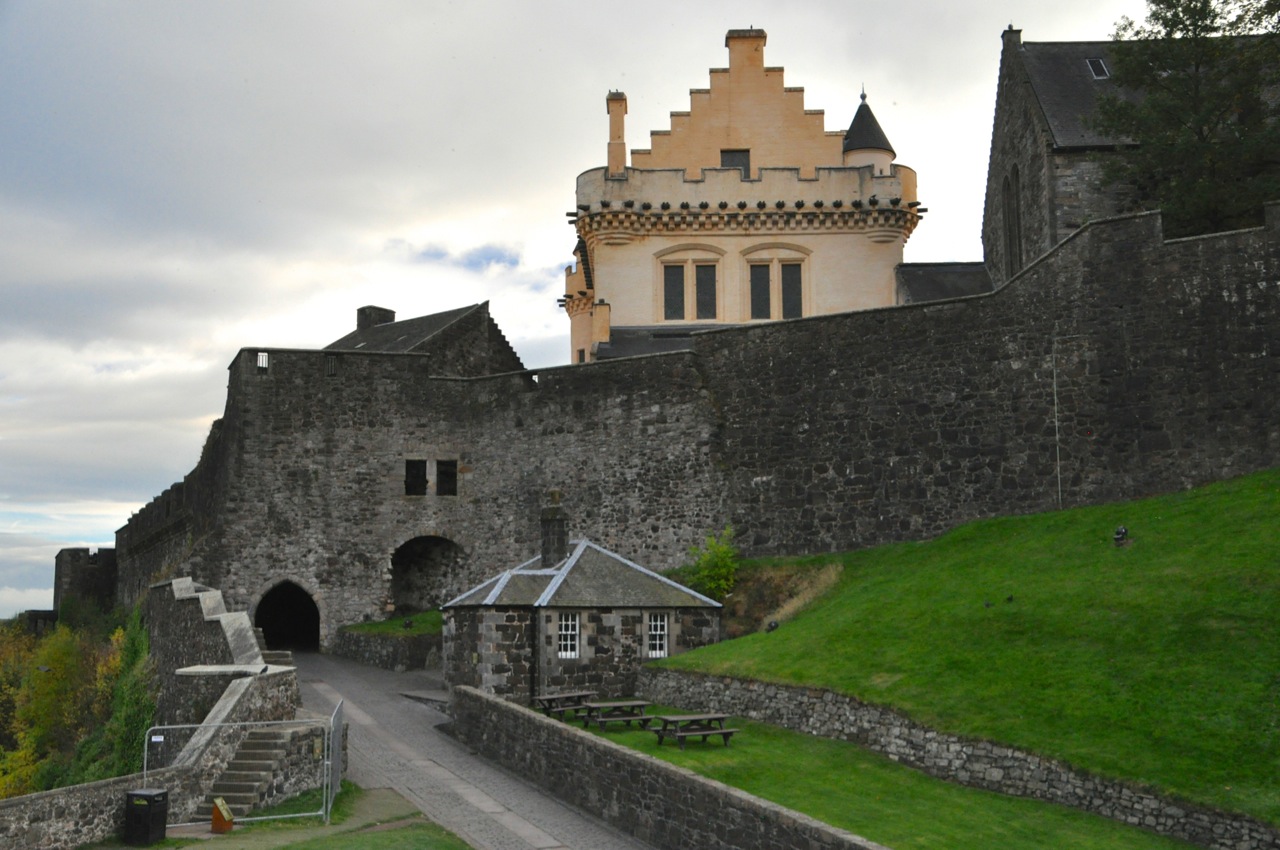
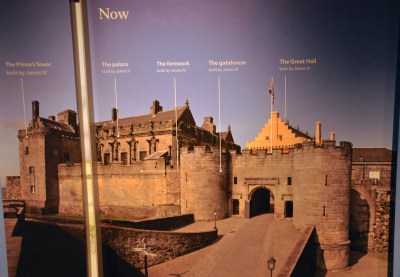
Today the entrance to the castle – the old castle interior – looks like the illustration shown just below, with the buildings built by James IV and Entrance to the Stirling Castle royal buildingsV peeking above the wall.  Comparing this picture with that from the 1500’s above, the current gate is clearly less grand and more military-looking, reflecting its changed role after the departure of James VI (and the impact of siege bombardments!).
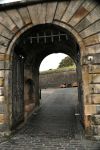
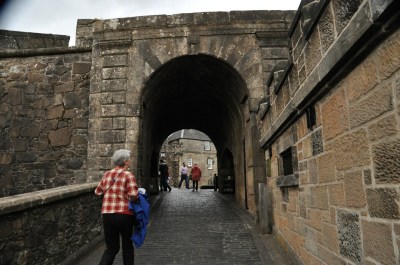
The main entrance to Stirling Castle now takes you into the Map of Stirling Castleextensive outer defenses, built by Protestant Queen Anne (daughter of deposed Catholic James VII) in 1708 after her half-brother contested the crown.  This map of the Stirling Castle fortress shown on the left is a good overview.  The original entrance to the castle, now called the “Forework”, is just below the center of the picture.  The current entrance to the outer defenses is at the bottom left.  That entrance is shown in the pictures below.  The entrance takes you to a
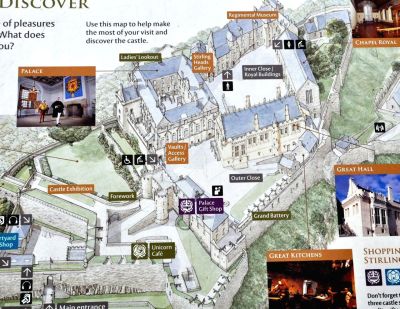
courtyard holding pen, with another gate that takes you to the front of the original castle, shown below.  Entrance to the original front of Stirling CastleTurning left after going through that second entrance (the map of Stirling Castle, above, provides a useful overview), one comes to a formal garden/green called the Queen Anne Garden, shown below, although it was already there in the 1400’s for the royal family to enjoy.  You can begin
to see the amazing vista that the castle provides, so let’s take a look around.  It’s

impressive, and many of the important battles of Scotland would have been visible from here.  You will also note, from the map of the Stirling Castle above, that there are a number of cannon that look out over this vista; those cannon were instrumental in blowing up siege towers in later years.
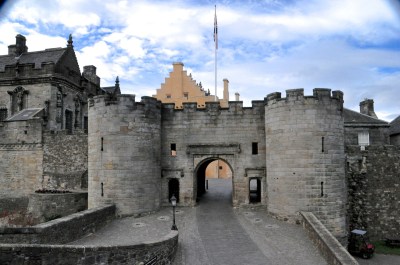
The original entrance to Stirling Castle, much changedOK, in we go through what used to be the grand entrance to the castle.  It definitely looks more military than grand!  The entrance takes us into the “Outer Close” – and mostly to a view of the back ends of the major buildings, the royal palace and the great hall, as well as going downhill to the “Great Kitchens” of the palace.

The Outer Close also had an interesting exhibit on the food of the late 1400’s – as you might imagine, it’s not too different from today.

The Inner Close was the core of Stirling Castle in the 1100’s and continued to be its center (the map of Stirling Castle is again useful).  In its golden age it was surrounded by the trappings of royalty, consisting of the King’s Old Building (private apartments of James IV, 1496), the Great Hall (used for banquets and business, 1503), Royal Palace (built by James V for greater luxury and privacy, 1540), and Chapel Royal (built by James VI for the baptism of his first son, 1594).  These buildings have been restored from their military conversions.

James V built the Royal Palace in grand style, on par with the finest French chateau, in order to impress and “proclaim the peace, prosperity and justice of his reign”.  Here’s what the outside looks like today, and what it would have looked like in 1540:

James V decorated the outside of the palace with over 250 sculptures, including classic gods and goddesses, designed to promote his authority and demonstrate his right to rule.  The statues have weathered (and suffered indignities) over the centuries, but they were clearly nicely done; examples below.  The last picture shows how they would have looked back in the day.

The Great Hall of 1503 was by far the largest banqueting hall ever built in medieval Scotland. Two high windows lit the dais on which the king and queen sat.  Five enormous fireplaces provided heating.  A hammerbeam roof soared above.  It was a grand setting for

the sumptuous banquets of the Renaissance kings, and in particular the two royal baptismal celebrations for the sons of Mary Queen of Scots and James VI.  In the latter, Depiction of the presentation of the fish dish in the Great Hallthe fish dish came on a model ship 15′ long and 36′ high, with a salvo of 36 brass guns.  As you can see from the picture of the Great Hall interior, above, to us the Great Hall really just looked like a big, empty building; it needed the pomp and glitter of tables and tapestry and roaring fires (and roaring cannon) to be impressive.

The Chapel Royal, one of the first Protestant churches built in Scotland, was built for that same baptism for the son of James VI (1594).  The painted frieze in the interior survives from Charles I’s coronation visit to Scotland in 1633.

The King’s Old Building, at the castle’s highest point, was built by James IV for his private residence; the turreted staircase went to his apartment, with spectacular views.  The building has endured 500 years of alterations; the right picture is an artist’s concept of what it might have looked like in the 1500’s.

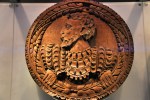
Attached to this building is the Stirling Heads Gallery housing the (fabulous) original carved portraits in oak that decorated the King’s Presence Chamber (a meeting room for honored visitors) in the Royal Palace.  The carvings were taken down following a ceiling collapse in 1777, and of a possible 100 original heads, 38 survive.  They’re beautiful – and they’re not small, about 3 feet across.  They’re divided into themes: heads of royalty (and the right to rule), “worthies” – heroes from history and myth, heads from Roman emperors, courtiers and costume, and Hercules.  We’ll share a bunch, starting off

with Royalty.  The heads below show courtiers wearing the (carefully depicted) fashionable

clothes of the 1540’s.  A few “worthies” are shown below, and Hercules below that.

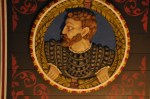
Finally, these heads were recovered with traces of paint on them.  It is thought the heads were vibrantly painted, as you’ll see in more detail when we show you their reproductions in the King’s Presence Chamber (shortly).  For now, let’s give you a flavor for what the heads really looked like!

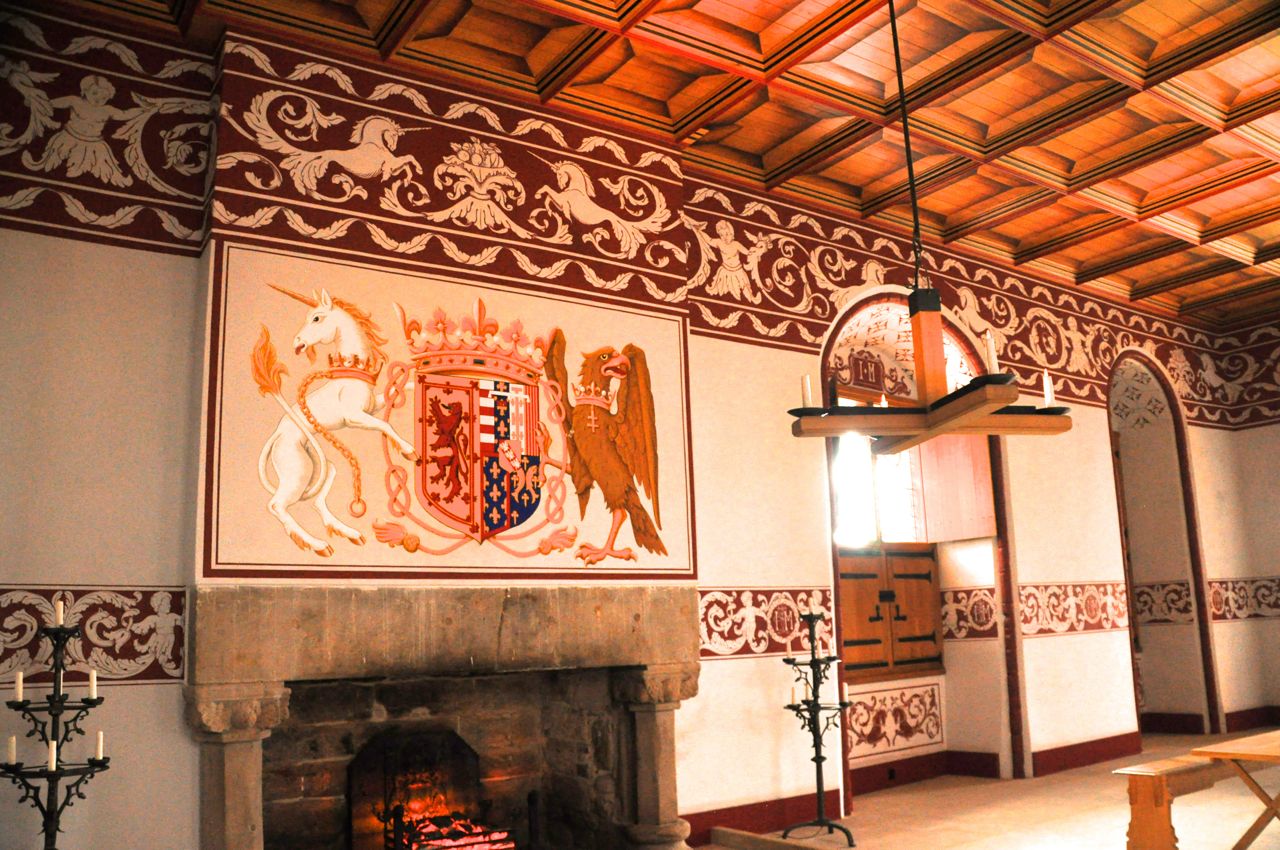
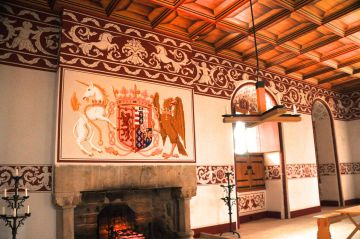
To complete our visit to the Inner Close, we’ll tour the Royal Palace apartments.  To mark the arrival of his (2nd) French wife, Mary of Guise, James V built the Royal Palace to be as fine a residence as Mary would have known in the richer kingdom of France.  Both interior and the exterior were painted in bright colors with plenty of gilding to overwhelm with flamboyance.  The 6 rooms open to the public are the king’s and queen’s apartments.  Each had three spacious rooms – in ascending order of privacy: an Outer Hall‚ an Inner Hall and a Bedchamber.  Access to these rooms was restricted according to the importance of the visitor.  The rooms were on The King's Outer Hallthe same floor, arranged around a courtyard known as the Lion’s Den, and were used for a variety of purposes – taking meals, greeting important visitors, meetings on affairs of state, and dancing and entertainment.  The bedchambers were rarely used for sleeping; the king and queen slept in small private chambers known as closets.
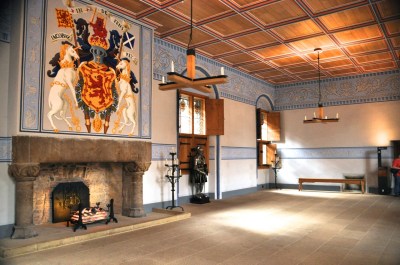
We’ll start with the King’s Outer Hall, shown above.  With sufficient social standing, you would be admitted to this hall to wait for a possible audience with the king.  It was a great honor to be admitted to the King’s Inner Hall, or “Presence Chamber”, shown below.
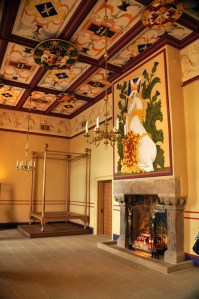
The King's Outer HallYou only made it to the King’s Bedchamber (left picture) if you were really important, or a personal friend.  The king probably dressed, washed and prayed here.

The Queen’s Outer Hall (below) was also a waiting room, Queen's Outer Hall


and it was a similar honor to be invited to her Inner Hall, shown below.

The low stools in the first picture were for the Queen’s ladies in waiting.  The ceiling may also have been covered in carved heads.  Finally there is the Queen’s bedchamber, reserved The Queen's Bedchamberfor the queen and her most important visitors.  The bed was symbolic; she slept in a small room nearby.

Perhaps you noticed the tapestries in the Queen’s Inner Hall?  Like the one over the fireplace, above?  They’re gorgeous and vivid!  Tapestries were extremely expensive and were prized by the wealthy elites of the European Renaissance.  It is known that James V had two sets of tapestries featuring unicorns, and historians of James IV believe the royal collection included tapestries similar to the famous The Hunt of the Unicorn series from 1500.  Accordingly, to furnish the Queen’s Inner Hall as it would have looked in the 1500’s, Stirling Castle is re-creating the 7 tapestries that constitute The Hunt of the Unicorn using traditional hand-weaving techniques, the weaving being done at the castle.  Six of them are on the walls now, but before we show some of them to you, we need to show you how the 7th one is being (painstakingly!) made.

Getting to where the tapestry is being weaved takes us to the North Gate, the oldest part of the castle.  The road there provides a nice overview of the surrounding land as well as the

ancillary buildings of the castle (site of the weaving).  The gate itself does indeed look old;

it was part of a gatehouse built in 1381.  Looking back at the North Gate, below, it is not known how the upper Looking back at the North Gatepart originally looked; the upper regions were leveled in 1511 to provide kitchens for the Great Hall.

Walking into the tapestry weaving room, we were unprepared for the scale of the enterprise.  The tapestries are fabulous on the wall, but we didn’t think about the intricacies of their creation.  It was fascinating, and we hope you’re impressed by the pictures below.  There was only one weaver when we were there, but several are involved.  They wear noise-cancelling headphones, and you are not allowed to distract them.  A separate person is available to answer questions (and enforce the rules).

Now that you’ve seen the scale, back to the Queen’s Inner Hall and the finished tapestries!  The tapestry below is one of our all-time favorites that we’ve seen in books, and it was a delight to see it in real life – a copy for sure, but a copy that probably can not be surpassed.

Another one; we love the detail – look, for instance, at the waves in the water.

We’ll do one more.

Layout of the Great KitchensFinally we’ll tour the castle kitchen.  As shown in this schematic, it was divided into a cooking area, a prep area, and a baking area.  Almost all the kitchen staff were male, while women worked as “hen wives” or “alewives”.  Brewing ale (from barley) was usually the work of women, done within the castle, and ale was consumed with every meal – even by children, as it was safer to drink than water or milk.  It was also highly nutritious and an important part of the medieval diet.  Much of it had a low alcohol level.  A servant working for the royal family was given a daily allowance of about 2 quarts.

The pictures below show the kitchen in order, moving from the cooking area to the bread

ovens.  Those of the upper crust of Stirling Castle – and their servants – enjoyed fine white bread from wheat flour, sieved through woolen and linen cloth to remove the bran.  Most people had coarser flour from rye or barley, with darker and heavier loaves.

There was a decided (social) food train.  The king and queen were served all of the food first, the extra then passed on, in order, to the courtiers, various officials, their personal servants, and finally those who served the food to the tables.  The same system applied among the other servants.

Yep.  I know.  This was a loooong post, but Stirling Castle had a lot of meat on its bones!  The next posts will be (gorgeous) scenery, not history, so you get a break!  We’re off to the Highlands, to Oban on Scotland’s west coast.


SW Ireland Tour VI – An Aran Island, Inisheer

For our last outing we take a boat from Doolin to one of the Aran islands, Inisheer.  Hey, I didn’t realize the Cliffs of Moher were visible from the Doolin harbor!  Cool.

What we see as we approach Inisheer is the incredible number of stone fences that apparently needed to be built to clear the land.  It’s a staggering amount of stone!  As we dock we are greeted by a lone dolphin, happy to see us!

The many stone walls on the Aran Islands are often built in a unique style, I think due to the small plots that they enclose.  In this “Aran ‘gap’ style”, the walls periodically The Aran "gap" style fence with upright stonesinclude tall upright stones, the spaces between them filled with smaller stones.  This construction allows a farmer who wants to move livestock to dismantle a short section of wall as a temporary gate, and then easily rebuild it.  It also allows the winter gale winds to blow through the gaps in the wall, rather than blow the wall over.

One of the sights on Inisheer is the An Plassy, a freighter that wrecked offshore in 1960 (the crew was rescued with the help of the islanders) and was then washed ashore in a

gale a few weeks later.

There is “old stuff”  in Inisheer as well, the oldest being the ruins of St. Caomhan’s, a church that was nearly buried by drifting sand dunes.  From the grass-stabilized top of the sand dune (now a cemetery), you can see that only the very tip of the roof would have been visible before excavation.  Little is known of St. Caomhan, the patron saint of Inisheer,

who lived in the 500’s.  The church was built in the 900’s, and a century later the nave was widened.  The crude construction is pretty cool.  The alter, at the other end of the church,

Tomb of St. Caomhanhas a carved stone above it.  Nearby is the reputed gravesite of St. Caomhan.  Local folklore claims that if you spend the night sleeping on the tomb, your particular illness will be cured (my guess is that sleeping there would be sufficiently uncomfortable that afterwards other parts hurt worse).

A final point of interest is O’Brien’s Castle, the ruins of which dominate the hilltop and are visible from most of the island.  This small castle was built as a tower house refuge around 1400 by the O’Brien clan whom we’ve met before (“Southwest Ireland Tour II – Mizen Head and Killarney National Park“, July 8, 2015).  The castle sits inside the low

wall of a much older Iron Age ring fort.  The (hated) Cromwell’s army attacked the castle

in 1652, leaving the ruins seen today.

This hilltop is an excellent vantage point to view the island and see the incredible number of stone walls that surround the small plots of land; it was obviously easier to build walls

with the stones than carry those suckers down to the beach.

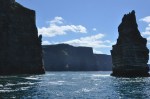
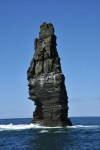
On the way back to Doolin we get an up-close view of the Cliffs of Moher from the sea.

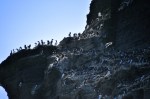
Even better, we get a good look at some nesting sea birds — kittiwakes, razorbillls, guillemots and puffins.  Puffins!  How cool is that!  First, take a look at one of the nesting

sites on this chunk of rock.  It’s a high-rise bird condo!  Each type of bird seems to roost with its own kind (birds of a feather!) but they also have very close neighbors of other

species, as shown in the right figure where kittiwake gulls (on nests) are the upstairs neighbors of the guillemots.  Note that all these birds are nesting!  The guillemots only come to land to breed, and, unlike the kittiwake, make no nest; their single egg is incubated on the bare rock ledge.  Also note the two darker birds in that right picture above; those are razorbills, a species related to guillemots but with a very different beak.   They also only come ashore to breed.  The bird condo houses some species of birds that

I can’t identify – the picture above, on the right, shows two unidentified black birds defending their nest.

The highlight, though, was getting to see puffins!  They were a minority of the bird population, and hard to photograph, but there were quite a few of them in the water,

hunting for dinner with the other birds.  Beautiful!  Ah – that last picture, from the internet, is just to show you how spectacular they really are.

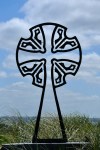
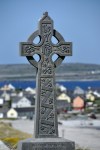
And so the Ireland/music tour winds down.  I’d like to share one last set of pictures with you, of Irish crosses mostly from Skibbereen and Inishmore.   The Irish cross is beautiful, full of Celtic artwork.

Our last professional music event featured a young and gorgeous lady named Tara Howley.  She blew us away with her awesome multiple talents on the concertina, fiddle

and Irish pipes (!!); she also sang ballads with the voice of an angel.

Our very last music event was definitely not professional; after Tara finished playing, the group gathered and each of us had a chance to perform if we so wished.  Of particular note was the penny whistle concert; Jackie Manning of Small Potatoes had taught a bunch of us to play this simple instrument – which is not so simple!!  If any finger does not completely cover its hole on the penny whistle, the instrument squeaks loudly.  So you can imagine how our plucky ladies sounded, with very little time to practice.  Also of note was Len’s

songwriting skill.  Len, along with several others in our group, had suffered through a debilitating stomach bug early in the tour.  His song, “There was a salad in (name of restaurant)”, sung to the tune of “House of the Rising Sun”, was a show stopper.  And of course the Small Potatoes performed, also a great treat!

Thus ends the great South West Ireland Tour with the Small Potatoes.  We saw many

sights, heard great traditional Irish music, drank good beer (Murphy’s was best!) and Irish whiskey (the more expensive it is, the better it really does taste!), had a good time, and met

some wonderful people who were soooooooo knowledgeable about music.  The picture on the right shows us all, on the last day before leaving.

As noted in the first post of our Ireland tour, we’re out of sync with our travels.  We interrupted our posts about our travels in bonny Scotland to write and share this section on Ireland with our new-found tour friends.  The next post will cover our last two days in Ireland.  We visited Bunratty Castle and Limerick with two good friends from Ohio who went on the Ireland tour with us.  After that we’ll pick up where we left off in beautiful Scotland.

SW Ireland Tour V – The Burren and the Poulnabrone portal tomb

Today we’re off to The Burren, a limestone plateau that an officer of Oliver Cromwell’s army described in 1650 as “a savage land, yielding neither water enough to drown a man, nor a tree to hang him, nor soil enough to bury him“.

First we stop for lunch and a fascinating lecture on the role of the Irish (and Irish Americans) in the preservation of folk music/ballads.  Cool stone building, too!

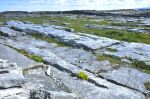
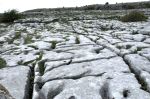
The Burren is one of the finest examples of a “karst” landscape in the world.  This sedimentary rock was formed under the sea, then uplifted, glacier scoured and earthquake-fractured.  Neolithic farmers cleared the trees, promoting soil erosion and stone exposure.  Rainwater expanded hairline fractures in the stone to form deep criss-

crossing crevices (grikes).  That structure, combined with an unusually temperate climate (45 to 60°F), has made the Burren renowned for its remarkable variety of plants.  The moist and variable micro-climates of the grikes support Mediterranean, alpine, and even arctic plants side by side.  Mediterranean orchids, alpine mountain avens and gentian, and arctic ferns all grow here.  Some of them, such as the Irish orchid (first picture below), are

in bloom.  One of the interesting aspects of the Burren is its modern use as pasture land.  Are you nuts, you say?  Pasturing on karst?  Did you see the pictures above??  According to the comments by that officer in Cromwell’s army, “… and yet their cattle are very fat; for the grass growing in turfs of earth … that lie between the rocks … is very sweet and nourishing.”  While most of Ireland is too cold for grass to grow in winter, cattle can graze in the Burren ’til spring.  So the ancient tradition that dates back to Neolithic times is still in use today, and cattle are herded here from all over Ireland for winter grazing.  In addition to producing fat cows, winter grazing is also good for the Burren ecology – it prevents regrowth of scrub and woodland, thus minimizing disturbance to the Burren’s rich flora.

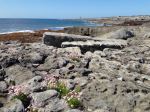
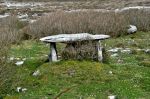
But the Burren is much more than just plants!  There are more than 90 megalithic tombs (large stone above-ground burial chambers) and a number of stone ring forts that were constructed here more than 5,000 years ago in the Neolithic late stone age.  The sites may have had functions in addition to burials; they were constructed at a time that corresponds with the establishment of the first farming communities, and thus may have played a part in territorial and community identity.  We are visiting the Poulnabrone portal tomb, one of the finest and most visited.  It consists of 2 tall portal stones flanking the entrance to a rectangular stone-lined chamber, 2 slightly smaller supporting stones, and a single large capstone.

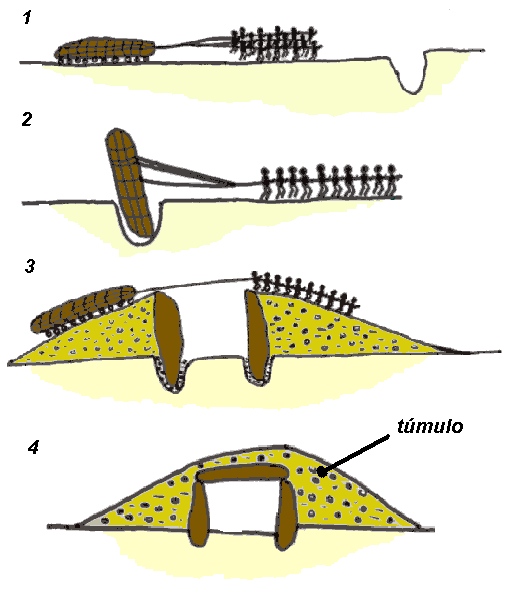
Often a mound of loose stone (cairn) and earth would have surrounded the tomb on 3 sides, stabilizing the chamber, with the space below the capstone forming an entrance; I Hypothesized scenario for tomb buildingfound a possible scenario for creating these types of tombs as shown to the left.  However, for the Poulnabrone, the cairn was originally no higher than it is today, creating the dramatic tomb structure you see now.  Obviously it was built well, since it stands here after 5 millennia (pretty cool!), but how it was built is not known.  Excavation of the Poulnabrone revealed at least 33 individuals were buried in the chamber – infants, children and adults, both male and female, over a period of perhaps 500 years.  Likely the bones, highly fragmented, were initially buried or allowed to decompose elsewhere before being transferred to the tomb around 3800 BC.  Personal possessions buried with the dead included a polished stone axe, a decorated bone pendant, stone beads, quartz crystals, flint weapons, and fragments of pottery.  A thousand years later (~1700 BC), a newborn baby was buried in the portico, just outside the entrance.  The labor required to construct the tomb and its continued use over such a long period of time suggests that this portal tomb, with a dominating presence on the limestone landscape, served a powerful symbolic role – a territorial marker or a center for ceremony and ritual.  We were very impressed!

Time for some traditional Irish music, and Doolin is renowned for that !  As we return to Doolin we pass a much smaller portal tomb near the road, several tower houses (and castle?), and a stormy sea.  Ireland is certainly picturesque.

Stacked peat logs in DoolinAs we walk to our dinner/pub to hear Blackie O’Connell on the Irish pipes, we pass a big stack of peat logs, drying out.  Pretty impressive!  Although I don’t know how anything dries out in Ireland.

Blackie O’Connell did not disappoint!  He was fabulous on the Irish pipes, as was the fiddle player that was with him, Eoghan Neff.  There

were amazing notes coming from that fiddle that I’ve never heard before!  He was awesome.  The guitar player, Cyril, was also quite good.  This trio is a Doolin band called “Foolin In Doolin”.  The next night was a different restaurant/pub but with some of the

same players (Blackie and Cyril), plus a ballad singer (Geraldine).

Well, this is a small post, but enough for now.  Tomorrow, our last day of the tour, we take a boat to the nearby Aran Island of Inisheer – where there is much to see.


Southwest Ireland Tour IV – Slea Head and Cliffs of Moher

We’re off to the coast at Slea Head, the westernmost part of Ireland.  We pass another ruined tower house – they look so cool and King-Arthur-romantic!  Well, cool-looking

now, but then they were a defensive solution to marauders who wanted to rob or kill you, a sobering thought that takes the edge off romanticism.  The times were tough.  And speaking of tough, one of the enduring memories we’ll take from Ireland is the ubiquitous stone fences separating plots of land, attesting to the difficult conditions that early farmers

had to face!  First there was need to clear the rocky land, and the stone fences are monuments to that effort, a physical “tip of the hat – you’re welcome” from the ancestors.  Then there was the law requiring the land to be subdivided for each male child; before the famine each little plot would have had a house and a family on it.  Before the famine of 1845 there were 40,000 people on this peninsula.  Even today it’s home to just 10,000.

As shown below, the coast at Slea Head was indeed attractive, although not as dramatic as Mizen Head (Southwest Ireland Tour II – Mizen Head and Killarney National Park“, July

8, 2015).  This harsh yet starkly beautiful area was the setting for two period films of note, Far and Away (Cruise, Kidman) and Ryan’s Daughter (Mitchum, Miles).

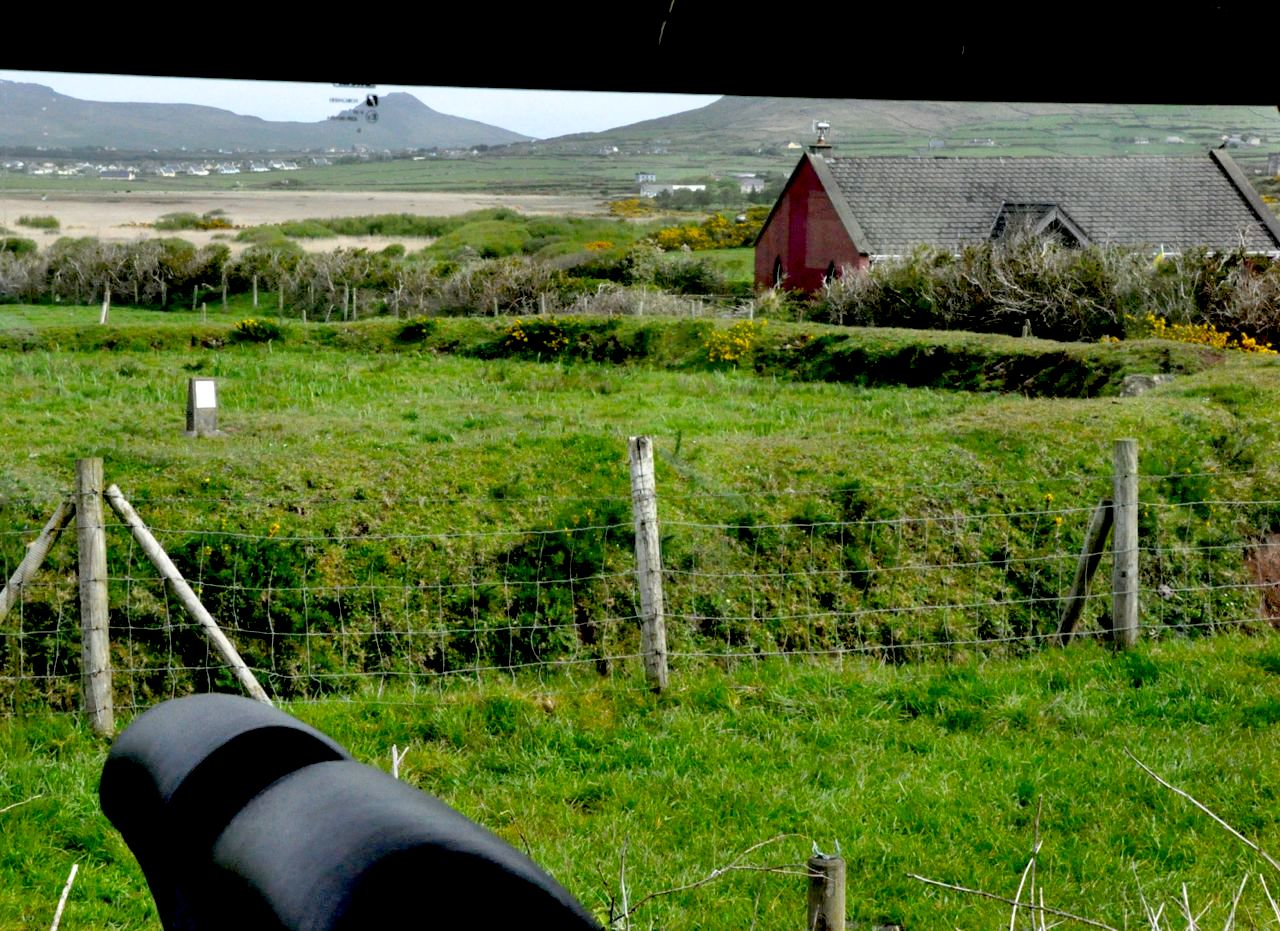
In the pictures above you can see glimpses of Great Blasket Island in the background.  The island was home to a small number of hardy Irish families for centuries.  Life was difficult, the land poor, the weather stormy, and there was neither priest nor pub nor doctor.  Each family had a cow, a few sheep, a plot of potatoes, and fishing skills.  Because they were not entirely dependent on the potato, they survived the famine relatively unscathed. They spoke only the Irish language (which was banned on the mainland).  Considerably isolated, they became a living symbol of a traditional Irish Gaelic culture.  In the 1920’s and 30’s, several of them wrote books (in the Irish language, of course) that recorded much of the islands’ traditions and way of life (e.g., Twenty Years A-Growing by M. O’Sullivan).  The author’s inspirational and vivid storytelling won international acclaim, and the books were translated into many languages.  Although at one time the island

was home to 160 people, over time it dwindled to 22.   In 1953 the government moved them to the mainland, and today the island is uninhabited.

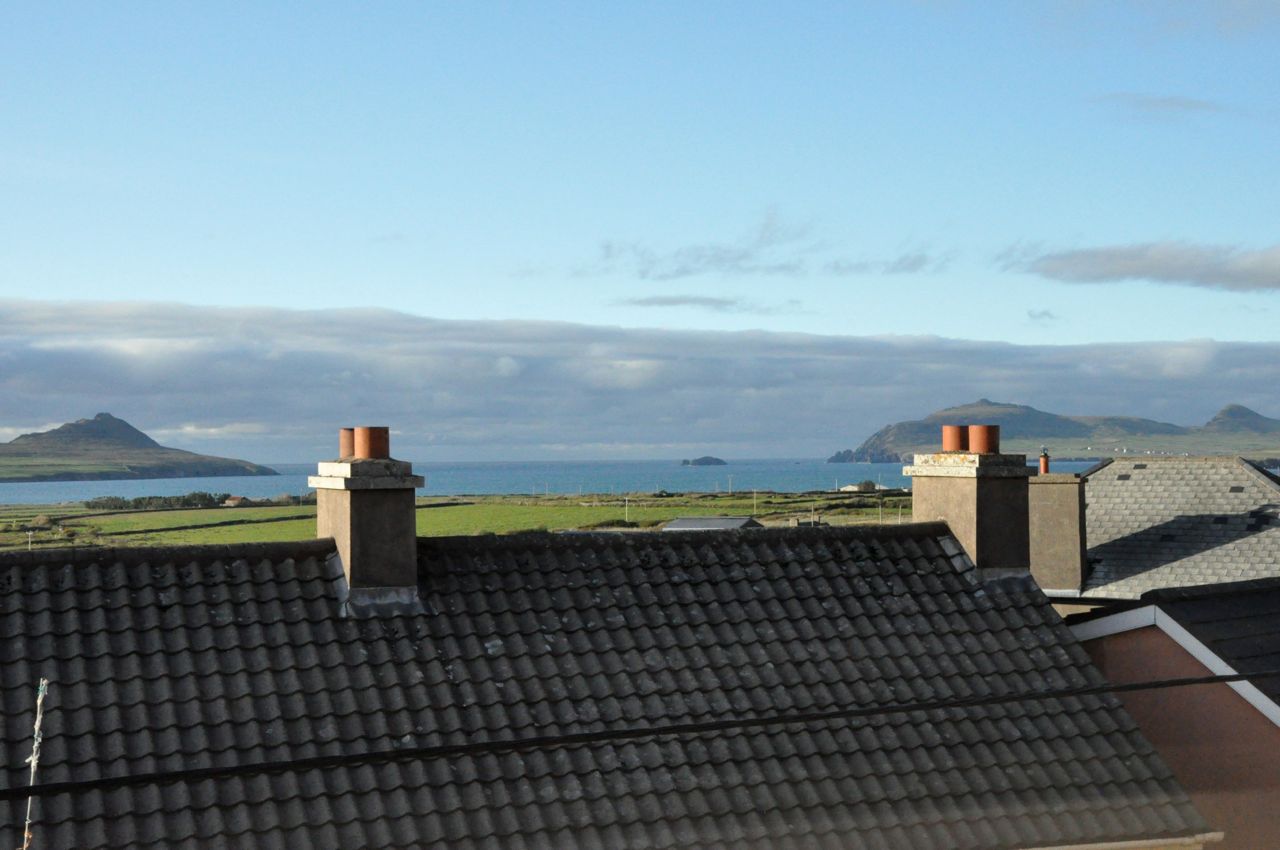
Smerwick Harbor from BallyferriterThe next day is a mostly free (collapse) day, and I and 2 others decide to hike from Ballyferriter to the nearby beach at Smerwick Harbor.  It’s a gorgeous bay, but expansive – and difficult to capture in a single photo.  My only picture of a good portion of the bay comes from a shot out our hotel window over the roofs across the street – not ideal, and not all of the bay, but you get the idea.  Here in Ireland every place seems to have some history associated with it.  When Catholic Ireland once again took up arms against Protestant England (this time Queen Elizabeth I) in 1580, a force of 600 Italian and Spanish troops sent by the Pope to aid the rebellion surrendered to the English at this bay – and were promptly massacred.  Our hike will hopefully be less newsworthy, but it is windy!  The bay is full of whitecaps, and when the waves break in a timed sequence along their front, streamers of mist are blown in the air in an enchanting linear choreography.

In the charming town of Dingle we engage in the noble effort of learning more about triple-distilled Irish whiskey.  This intellectual endeavor is made all the more difficult

due to its intense nature; you can’t study too much without your head spinning.  Breaks are needed, and lucky for us we have an early music concert scheduled at the 300-year-old O’Sullivan’s Court House Pub.  Dingle was re-introduced to the world by the movie Ryan’s Daughter.  It has evolved into a major tourist destination, in part due to its scenic and historical location, but mostly due to its music scene.  Among traditional musicians the town is renowned as a good place to get work (“40 Euros a day, tax-free, plus drink”), and pubs with music are everywhere.  O’Sullivan’s Court House Pub is not the most Ginger entering O’Sullivan’s Court House Pubfamous in Dingle, but it does have homey charm.  There’s a video on its website that offers “a small taste of the music and craic you can find every night” (for you newbies, “craic” means “fun, enjoyable conversation and atmosphere”).  The link below will take you to that video in a separate tab if you want to sample this traditional music (and a spontaneous dance) – Link to O’Sullivans Court House Pub website.  The pub interior is shown below in the upper picture.  The concert starred Brenden Begley, and he was amazing.  He’s the guy on the left in the lower right picture, playing the accordion.  His son is in the middle, and

Tommy O’Sullivan, the pub owner, is playing the guitar.  I’m not a big fan of accordion music, but Brendon made me change my mind.  He was fabulous, and knees were bouncing all over the room.

Back at Ballyferriter, we’re treated to a bit of a sunset on this ever-cloudy isle.

The next morning we’re off to County Clare and the Cliffs of Moher, one of Ireland’s most visited attractions.  We pass more ruined towers – in the first picture there’s even a

tower remnant on a very precarious rock in the center of the photo.  Definitely picturesque!  We have lunch at the seaside town of Lahinch; the day is stormy, and the sea

is absolutely raging, beautifully so.  As we travel on, we see another ruined tower house, and then the ruins of a castle-estate; they’re everywhere!

A few miles away is the ruin of Leamaneh Castle with an interesting history (and a tie-in with our destination, the Cliffs of Moher).  The castle was originally a 5-story defensive tower house, built around 1480 by the reigning King of Thomond, scion of the O’Brien family – and a direct descendent of Brian Boru (Boru is considered to be the greatest of the ancient Irish kings; in 1002 he united Ireland for a decade).  You can still see the outlines of that tower house on the right side of Leamaneh Castle in the pictures below.

One of the grandsons who inherited this O’Brien stronghold was hung for fighting against the English, and the tower went to one of his grandsons, who married the newly widowed, and newly rich, flaming-red-haired Maire McMahon in 1639.  They had 8 children, and around 1648 they expanded the tower into a comfortable 4-story mansion.  Maire accompanied her husband on raids against English settlers, but in 1651 he was mortally wounded fighting Cromwell’s English army.  Maire, realizing that the punishment for rebellion would be the forfeiture of their property, married a Cromwellian soldier and thus retained her estates.  Where there’s a will ….

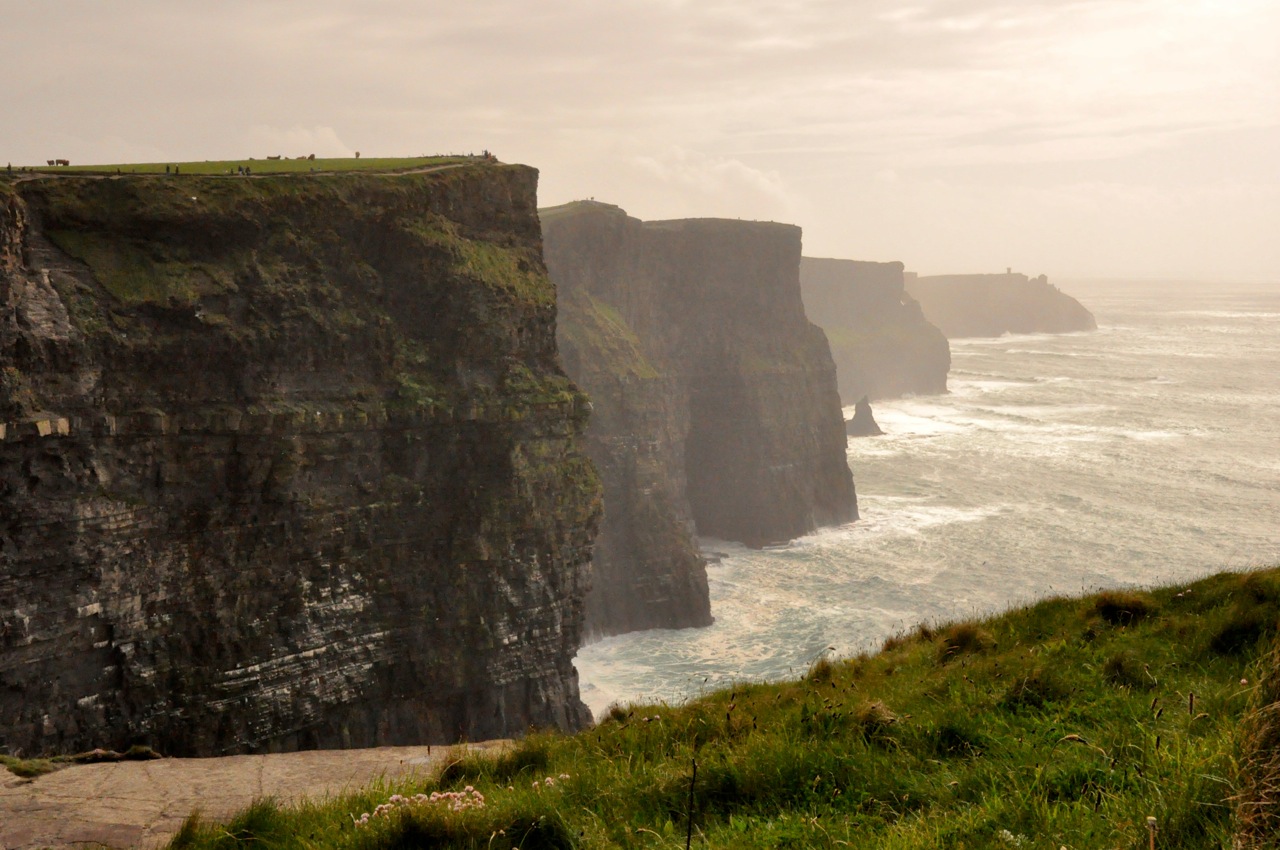
And now, the Cliffs of Moher.  The name Moher comes from the old Irish word for “ruined The Cliffs of Moherfort”; a 1st Century BC fort stood here until the 1800’s.  The cliffs are 700 feet at their highest, and stretch for 5 miles.  On a  clear day you can see all the way to the Blasket Islands in the adjacent (but way further south) Dingle Peninsula – but not today!  It’s threatening rain and incredibly windy.  But still so very beautiful!

So why did we spend so much time talking about the O’Briens?  Because a descendent, Cornelius O’Brien, was a man ahead of his time, believing that the development of tourism would benefit the local economy.  In 1835 he built what is now called O’Brien’s Tower on

the highest point of the cliffs as an observation tower for the hundreds of tourists who visited during that time.  Now it’s a million tourists a year.  And it is a beautiful place,

all cliffs and crashing sea.  While we’re walking around, the sky turns darker and more threatening, as reflected in the series of cliff pictures below.  Still beautiful, of course, but

the fierce wind is getting ever stronger, and the temperature is dropping.  We make a run for the bus and hop in just as the deluge hits.  Good timing!

Sorry about the long post, but hope you enjoyed the pictures.  Next post: The Burren, and a 5,000 year-old tomb.


Southwest Ireland Tour III – Ancient Christianity

Today we’re visiting some ancient sites, starting with Lathair Mhainistreach an Riaisc, otherwise known as the Reask Monastic Site.  Although it’s a ruin, consisting mostly of low stone walls and some inscribed standing stones, it nevertheless illustrates well the layout of a small monastery during the Early Medieval period (the 500’s).  The monastery consisted of a square oratory (small church) and several clochans (bee-hive shaped huts,

some conjoined, in which the monks lived).  The buildings were dry stone masonry – intricately stacked stone fitted together using no mortar; the stone walls would have been slowly cantilevered inward until closure, as we’ll see shortly at the Gallarus Oratory.  On the premises are several inscribed standing stones, some shown below.  The largest and

most impressive (it’s almost 6′ tall), called the Reask Stone, is decorated with an encircled, equal-arm cross, below which are spiral designs.  On the left side, inscribed vertically, are the initials DNE (the “D” looks like “d” to me), short for the Latin Domine (“Lord”).  Some other inscribed stones with crosses are shown above.  The early beginnings of Christianity were certainly a far cry from the magnificent stone Catholic cathedrals that were to come 7 or so centuries later!!

Also found at the site were pieces of Roman amphorae that would have held wine, and a kiln for drying grain and corn – for the monks themselves, and for the locals for a 10% tithe.  After the site was abandoned, the area around the oratory was used as a children’s burial ground.  Pictures of the walls of  the oratory and a conjoined hut are shown below.

We’re now off to the nearby Gallarus Oratory, but first we pass an Irish “fort”.  It is not An Irish ringfort; a circular earthen bank surrounded by a ditchimpressive!  These forts, or ringforts, date from the late Iron Age (~500 BC) to early Christian times. They’re simply a circular earth bank with ditches in front, sometimes topped with wooden palisades; thatch or wooden dwellings would have been located in the center.  The forts survived untouched over the centuries because they were believed to be “fairy forts” imbued with Druid magic; it was safer not to disturb them.

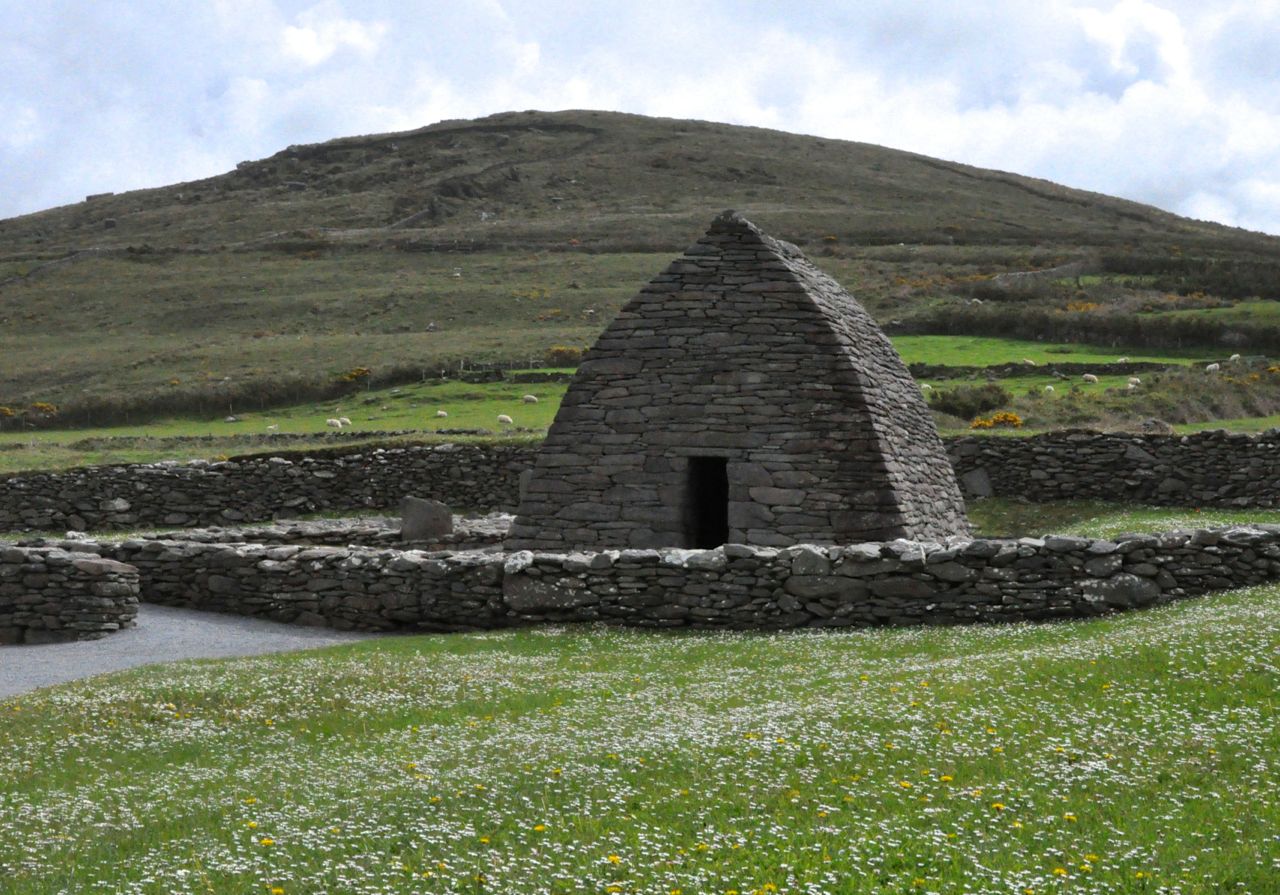
The Gallarus Oratory is one of Ireland’s best-preserved early-Christian churches, built and used by The Gallarus Oratoryfarmers somewhere between the 500’s and 900’s AD.  The visitor’s center says about 700 AD.  The Oratory has such an austere beauty about it, enhanced by its simple architecture.  Shaped somewhat like an upside-down boat, the structure is corbel vaulted – layers of local stone carefully fitted and overlapped using no mortar, each course projecting slightly inward from the course below, and eventually meeting at the apex to close the roof.  The walls were also built with the stones slightly tilted to the outside, resulting in a structure that is still waterproof today; water has to travel uphill to


get in.  The church has not needed restoration – it has withstood the formidable Atlantic storms for some 1300 years with only a slight sagging in the roof!   We are blown away by the workmanship, which we’ll show below.  Hard to believe how well everything fits

together!  Just for perspective, the left picture below shows Ginger leaving the church.  The

door had two projecting stones with holes, which once held a door.  A carved stone marker is also nearby, shown above.  Like most of Ireland, the area suffered from attacks by successive invaders. Vikings and Anglo-Normans burned, pillaged and destroyed the settlements around Gallarus and the oratory was abandoned.

Next on the list, and about a mile away, is the Kilmakedar Church.  A monastery was

founded at this site by a local saint who died in 636.  This church was built in the middle 1100’s and was an attempt by English King Henry II (with the Pope’s blessing) to extend English authority over the fractious Irish territorial kings and to reform the Irish church by replacing the old monastic settlements.  The church consisted of a nave and chancel, the chancel being an addition in the later 1100’s.  The architecture is a mixture of Romanesque forms such as chevrons (zig-zags) and diamond shapes, together with native

Irish structural features such as stone projections at the ends of the church.  One of the doors is a classic round-arched Romanesque doorway, but with sides that slope inwards like older Irish churches.  Inside the church, by the chancel arch, is a stone from the 500’s

carved with the Latin alphabet, the letters DNI (representing Domini), and a small cross.  There is a nice little video of this church at this link,Romanesque Church in the Dingle. Outside the church, a densely populated graveyard holds a large-stone early Christian cross, a much older ogham stone, and an early sundial.  The ogham stone is fascinating.

It had already stood there for 900 years when the church was built.  Those slash marks on the side of the stone are Morse-code-like letters from an early Irish language (Primitive Irish) used from The Ogham alphabet200 – 600 AD.  The picture to the left shows some of the marks and their English alphabet equivalents.  This stone marked a pre-Christian grave.  About 400 of these stones survive in Ireland and Wales.  There are several theories about who created the language: either (1) Irish scholars to provide a secret means of communication in opposition to the authorities of Roman Britain (who would know Latin), or (2) the early Christian communities in Ireland who wanted to write short messages and inscriptions but found the sounds of Primitive Irish too difficult to transcribe into Latin, thus requiring a unique alphabet.

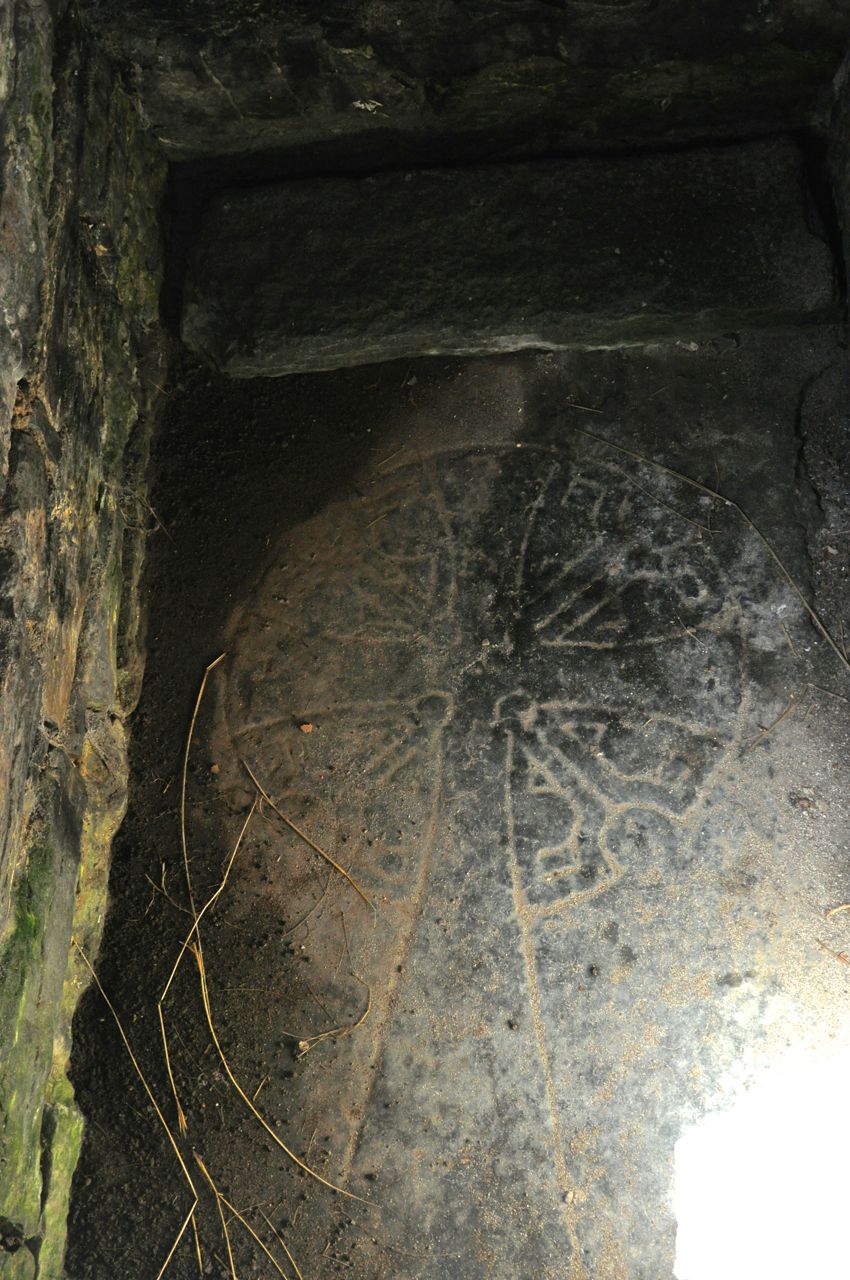
The sundial is also intriguing.  Whose idea was that?  In a region of Ireland where it rains 225 days out of the year, why a sundial?!  But there it is, needing only the horizontal stick

to measure the time of day … in the graveyard … on a rare sunny day ….  Perhaps it was a way to know when a church service would begin?  It may be somewhat odd, but it is still an amazing relic of the long ago past.

From here we’re off to see some scenery, so this is a good time to close this post.  In the next post we’ll drive to the coast at Slea Head, the westernmost part not only of the Dingle Peninsula but Ireland itself.  Then we’re off to County Clare to visit the famous Cliffs of Moher!


Southwest Ireland Tour II – Mizen Head and Killarney National Park

We’re off to the dramatic cliff scenery of Mizen Head, Ireland’s most southwesterly point.  We pass a restored tower house and a gorgeous beach, and then we’re at the Mizen

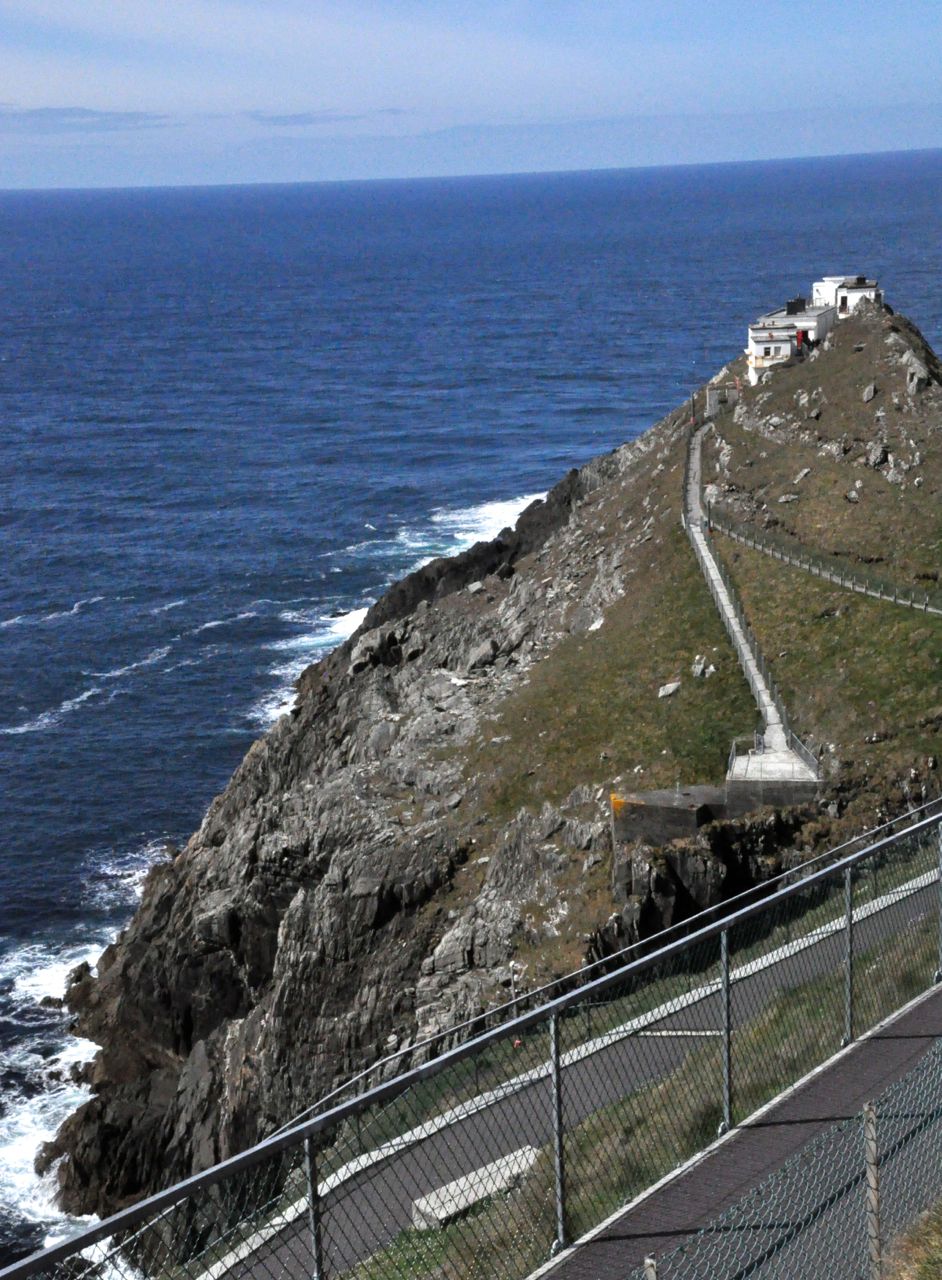
Head Visitor Center.  Historically, Mizen head was important because transatlantic shipping Those buildings clingiing for dear life to the crest are the Mizen Head Signal Stationroutes passed nearby and ships had to contend with treacherous offshore rocks –   “offshore rocks” may not sound very scary, but we’re talking jagged pinnacles, some jutting up 100 ft, lying 6 or more miles out and surrounded by deep water – not a friend to shipping!  The Mizen Head Signal Station, those white buildings clinging desperately to the headland crest, was once permanently manned; now it’s a museum with displays relating to the site’s strategic significance for transatlantic shipping and communications, including Marconi’s pioneering development of wireless (radio wave) communication at the turn of the century.

Visible off shore, 9 miles away, is the Fastnet Lighthouse with its own history.  The rock itself was called “The Teardrop of Ireland” because it was the last sight of the Emerald Isle for emigrants sailing to America.  The original lighthouse was built of cast-iron in the mid 1800’s, but when a similar lighthouse in the area was destroyed in a violent storm, the decision was made to replace the Fastnet with something more structurally sound.  The current lighthouse was built at the turn of the century using an ingenious design of

dovetailed interlocking stones to create a single monolithic structure that could withstand the wild Atlantic weather (see diagram above).  Not long after it was built, Marconi fastened aerials to it to help prove that transatlantic messaging would work.  The lighthouse is still going strong after 115 years.

Mizen Head is beautiful, a place of pounding surf and rocky cliffs diving into the sea.  Exploring here is also great exercise – the paths are either a steep up or a steep down.

There’s a cool bridge on the way to the signal station, the rock is gorgeous, and the views impressive.  Whales and dolphins are sometimes sighted here, but not today.

The cliffs in the other direction are also impressive, with the Fastnet Lighthouse visible in the far distance.  The sea has carved out rock arches from the cliffs, and one path leads

steeply down down down down down to a good view.  But the bus is about to leave!  So I have to run down, snap a couple of quick photos, and (OMG) run back up, and up, and (wheeze) up and (WHEEZE) up; you’d better enjoy those pictures!

We’re headed off for lunch at Crookhaven, a small fishing village.  We pass abandoned houses from various ages, suggesting life was not so easy here, and gorgeous beaches,

suggesting this hard life nevertheless had some pretty nice perks.  Lunch at the water’s edge is crab again (yum), and a pint of hard-earned Murphy’s; the view isn’t bad either!

Those are signal towers in the left image above, a system of in-line-of-sight signal towers built by the English to warn if Napoleon was coming by sea (he never came).

After lunch we’re off to get our feet wet at Barley Cove Beach, and then back to Skibbereen

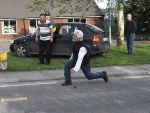
to experience Irish road bowling.  It is what it sounds like, and it’s a serious Irish sport that’s particularly popular in County Cork.  The sport traces its history back to the 1600’s, and it has a national championship and even a world championship.  It’s played on public streets with a heavy iron-and-steel ball not much bigger than a baseball.  With a running wind-up, the ball is launched underhand down the road and, as in golf, the ball is played

again from where it stops.  There is a predetermined course, and somewhat like golf the winner is the one who takes the fewest throws to cross the finish line.  A professional bowler showed us how it’s done – the ball went way down the road to where those “catchers” are waiting – and then a bunch of us took turns trying our hand (the catchers moved closer).  Based on our results, we need more practice before we form America’s Team.

I haven’t talked much about the music, but here are two performers.  John Spillane, there on the left, was a treat;  he’s heavily involved in bringing back the Irish language, primarily

through music that he researches and resurrects.  His second Irish language album, Irish Songs We Learned at School, sold double platinum.  Micheal Murphy, there in the center of the right picture, has a beautiful voice and also did his best to teach the group an Irish line dance.  Luckily no one was seriously injured.  Thanks for the two pictures, Len!

The next day we’re off to County Kerry and the Dingle Peninsula.  First stop is Molly Molly Gallivan’s cottageGallivan’s cottage and farm museum that’s near the top of a mountain pass.  Molly’s Cottage is over 200 years old.  The single story thatched roof section on the left of the picture is original; the right side of the building was raised and a slate roof added in the early 1900’s.  The museum provides a good insight into the simple country life of rural Ireland in the 1800’s.  Alas, it’s raining so hard that we have to forgo the farm tour, but there is a video that’s still quite interesting.  Molly was widowed with seven Molly's poitin (whiskey) stillsmall children and had to make the farm support them.  Which she did with incredible industry!  She sold some of her farm produce on the local market, along with baked goods and hand-spun woolens.  What really helped, however, was her illicit home-brewed poitin (whiskey); it’s still being made, I might add, and is available for purchase.

I’ve been diligent in taking photos of the surrounding scenery, in spite of the rain (although it’s darn hard to keep the lens dry!).  Of course, just as we’re ready to leave the sun comes out, and of course I need to take more photos.  So here you have the pretty

scenery, before and after.

The final leg of our trip to the Dingle peninsula takes us through the edge of Killarney National Park, along a small piece of one of the major sights of Ireland, the scenic Ring of Kerry.  Alas, this tour does not take that day-long loop around the bigger, more famous, and more visited peninsula; instead, we are going a bit further north to the also-historic

Dingle Peninsula and its small-town-charming Dingle, famous for its traditional music pubs.

We actually pass through Dingle; we’ll be staying in the even smaller village of Ballyferriter.  Below is the view from our hotel window, and our private concert by some

local musicians.

Next post – visit to some ancient early-Christian sites, the fabulous Gallarus Oratory and Kilmakedar Church.


Southwest Ireland Tour and Traditional Irish Music I

We’ve been on the road for over two years now, but this is our very first tour ever.  The lure that attracted us is that this tour will highlight traditional Irish music (read: pubs!), and will be led by one of our favorite singer-songwriter duos, Small Potatoes (The link below lets you sample their wonderful music in a new window – http://www.smallpotatoesmusic.com/waltz.html).  We’re touring south-west Ireland with 20 other music “groupies” like us, hailing Most of our tour group, starting outfrom California to Virginia, Minnesota to Texas; most of us are shown in this picture, just before we seriously hit the road.  I should mention the other, non-musical attraction of Irish pubs: triple-distilled Irish whiskey to sample, and real Guinness beer (which is apparently different and better in Ireland).  Let the trip begin!

We’re heading to County Cork.  In the picture above we’re in Adare, an Irish town with a lot of charm, as shown in the pictures below.

One of the disadvantages of a tour is that the bus has an agenda; it’s going A to B, and not stopping when I want to take a picture.  Shooting through the window will have to do.  We whiz by some green, green countryside – and an amazing number of ruined castles.

Yeah, the first two pictures are the same castle, but isn’t it interesting?

Ginger and I lunched on crab sandwiches in the town of Kinsale, near the southern coast – crabmeat in Ireland seems to be a staple and is fabulous.  And then on to Skibbereen.

At this point it’s worth presenting just a little Irish history.  There is good reason why the southern Irish have no great love for England, and why today southern Ireland is a separate country.  The English horribly persecuted the Catholic Irish in the south.  If you were Catholic (about 80% of south Ireland), you could not vote, you could not hold political office or important positions like sheriff, lawyer or judge, you could not own a gun or join the army, you could not speak the Irish language or play Irish music, you could not buy land, you could not send your children to a foreign school, you could not live within a walled city, and you were required to pay tithes to the Protestant Church of England; good land that your family had owned or rented (at onerous prices) for generations was often confiscated and you were forced to the island periphery where land was poor (and forced to move too early to harvest and too late to replant).  If you were fortunate enough to own land, it had to be divided equally among all your sons when you died.  After a few generations, Irish Catholics were among the poorest people in Europe, possessing almost nothing.  However, although they were living off of small parcels of poor land, potatoes could grow in poor soil, and just one acre planted in potatoes could (and did) provide food for a small family.  The population of Ireland grew from 5 million in 1800 to 8 million in 1841, but 3 million of  those people were wholly dependent on the potato for food.  Then the blight destroyed the potato crops.  The Irish population decreased by 25%; a million died of starvation or disease, and a million emigrated.  Yet over the five years of this potato famine, grain continued to be exported from Ireland to England; the government refused to stop exports, fearing that it might upset the market.

“Oh son, I loved my native land, with energy and pride, Til a blight came over all my crops, my sheep and cattle died;  My rent and taxes were to pay, I could not them redeem, And that’s the cruel reason why I left old Skibbereen.”  Skibbereen was the epicenter of this horror, with some of the most harrowing suffering endured by famine victims.  Between

8,000 to 10,000, unidentified souls are buried in the Abbeystrewery graveyard.  The famine story is told well at the Skibbereen Heritage Center museum; as shown above, the mass graveyard is more than simple; it’s just a flat, grass-covered surface.  The coffin-less burial pit somehow looks small for the large number interred there.

The famine was a watershed in Irish history, a dividing line between the Irish and the British Crown that eventually led to Irish independence.

We next visited Bronze Age Ireland – the really cool Drombeg Stone Circle – with burial remains dating between 1100-800 BC.  That’s old!   This is one of Ireland’s most famous

stone circles, and the site has quite a view!  The circle is comprised of 17 pillar stones graded in height from the two 6′ portal stones to the opposing recumbent alter stone, which has two cup-shaped depressions, one with an oval carving around it.  They’re impressive stones; in medieval times, people believed that the stones had been arranged by an earlier race of giants.  The center of the circle contained a buried inverted pottery vessel covering the remains of a cremated youth.  The reason for these ceremonial circles is long-forgotten; currently they are believed to have been solar observatories used in planning critical crop-planting cycles.  On the winter solstice, the sun sets at a point on the horizon that lines up with the axis of the two portal stones and the alter.  The picture on

the right shows Ginger ceremonially toeing that axis.

This location has more than the stone circle.  Nearby is the “fulacht fiadh” (an ancient cooking place) and two conjoined huts.  The picture on the left below shows the proximity of these structures, with the Drombeg stone circle in the upper left.  The picture on the right shows the fulacht fiadh (background) and the hut foundations (foreground).

Fulacht fiadh are the most common archaeological sites in Ireland, numbering over 4,500 (County Cork has 2,000 of them).  They are commonly found with small hut sites like this one.  The fulacht fiadh were built near a water source (or boggy ground) and near a source of wood and stone.  They consist of a mound of stones, a hearth to heat the stones, and a trough, often lined with stone, which was filled with water into which the heated stones were rolled.  Experiments show that 70 gallons of cold water could be heated to boiling

in 18 minutes.  It is believed that meat (as in, a deer) was then cooked in the water.  However, no remains of foodstuffs have been found at these sites; other theories are that the sites were used for bathing, for the washing and dyeing of cloth, for leather working, or even for the brewing of beer.

The huts may also have had a food processing function.  One of the huts contains a

stone-lined feature believed to be a roasting oven, and a pathway links the huts to the fulacht fiadh.

The countryside at Drombeg Stone CircleEnough for one post!  One last look at the countryside.  The rain has stopped, the clouds have lifted, and it has become a sunny, gorgeous day in Ireland.

Next post – Mizen Head, Ireland’s most southwesterly point.


Start of our Ireland tour

Yeah, I’m ‘way behind in my posts; I’ll blame excitement on the health front.  We had planned (and paid for!) our first-ever tour, a singer/songwriter-led tour of Ireland (with Small Potatoes), and by golly we were going to take this tour, even with Ginger recovering from surgery (we’ll backfill some health adventures in later posts).  It was a good time, so let me do this post while it’s fresh (and while friends from the tour still want pictures).

We’ll start with the pics of the plane trip into the “Emerald Isle”.  As you’ll see in these

Irish blogs, that appellation is well-deserved.

We decided to recover from jet-lag in the little town of Ennis, which is not only nearby and not touristy, but also has medieval narrow streets and a bit of medieval history.  We discover that Ennis has some very good restaurants and a vibrant music scene.  We checked out Cruise’s, a nearby pub/restaurant with nightly music.  Pretty fascinating!  There is no cover charge, you’re just expected to buy a pint or two (no problem!).  We first went to hear “Ann-Marie McCormac & Friends”, a regular who plays there frequently.  Typically there are two sets, the first being traditional Irish music (in this case Ann-Marie), and the second being something else by a different group.  The bar was paying for Ann-Marie (flutist) and two others – another flutist and a guitar player.  These three weren’t playing long before another player (unpaid) joined them, playing some kind

of hand drum (the Irish bodhrán?).  Then a violinist arrived, and a bit later another violinist ….  They’re not being paid, they just drop in!  Why do they do this?  Duh, this is the Irish life!  The majority of traditional Irish music (“Trad”), is dance music – reels or jigs – and it is impossible to listen to it without your knee bouncing up and down in time with the beat.  It has elements of jazz to it (in my uneducated opinion), with individual players taking a a leading role during the playing.  We visited Cruise’s again a few nights later to catch a “local lads made good” band that has been touring the world – US included – called the Hayes Brothers.  The band consists of a guitar, a flute, and the amazing

uilleann pipes (related to the Scottish bagpipe, but sweeter and quieter with a wide range of notes).  Oh my, what an instrument!  The player’s left armpit/arm holds a bellows that, by pumping, feeds air to the bag held between the right elbow and side, which by squeezing feeds air to the 2-reed flute-like tube played with the fingers of both hands; it plays the melody with a two-octave range.  Oh, but we don’t stop here!  There are three drones, each an octave apart, which may be switched on or off.  And just to make it challenging, there are three other double-reeded tubes (regulators) fitted with keys that provide chords and harmonic support for the melody, which the player plays with his right wrist!  And of course his knee (and everyone else’s) is bouncing like crazy to the music, so just about every part of his body is engaged.  It is amazing, and amazingly good.

The history of Ennis starts with the O’Briens, the Kings of Thomond, who in the 1100’s built a royal palace on an island between two courses of the River Fergus (Ennis comes from the Irish word for “island”).  Franciscan monks arrived in Ireland in the early 1200’s and were mostly wandering preachers of the gospels.  In 1240 the Thomond king invited them to stay in Ennis, and a monastery (friary) was built, around which the town grew. Students came in great flocks to study at the theological college – until Henry the VIII’s Dissolution of the monasteries around 1540.  Like most monasteries, the friary is in

ruins now.  The earliest surviving parts date from 1285.  In its heyday it was the principal burial place of the Thomond kings and nobles; today it mostly boasts its limestone carvings that decorated the MacMahon tomb of 1470.  Although the carvings were exposed to the elements for centuries, they’re now protected inside; I’ll share a few.

There are quite a few carved figures set into the friary’s stone.

Well rested, our first real Guinness under our belts, we head off to Shannon to start our tour – next post.  Oh boy!