A Quick Visit to Paris

We of course have been to Paris before – and loved it.  It’s such a wonderful city, with its beautiful buildings and parks and inviting bistros, and of course the food.  Why not spend a few days there?  And see more Impressionist paintings?  And meet a friend who will join us there?  Oh yeah.

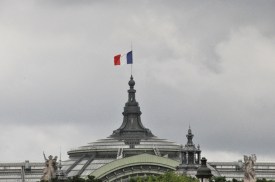
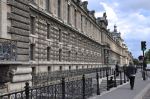
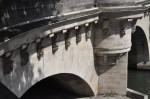
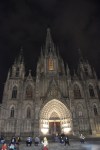
We’ll visit two museums in subsequent posts, the Musée d’Orsay and the lesser known Orangerie Museum.  We’ll also take in a church (they’re everywhere, they’re everywhere), the Church of Saint-Séverin, one of the oldest churches of the Latin Quarter (1200’s – 1500’s).  But first, let’s walk around the wonderful downtown area.  It’s all beautiful!  Paris is a remarkably flat city with essentially no downtown skyscrapers to block views.  The buildings share an unusually coherent architectural appearance; the later, more modern

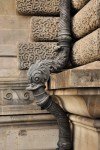
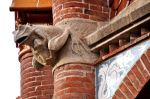
buildings developed gradually from earlier styles.  And everywhere there are architectural flourishes, statues, fountains, parks, bridges, the meandering Seine, old churches, museums, palaces, cool bistros – eye candy everywhere one looks.  A good example of art that decorates so many buildings is shown here – a part of the Louvre that faces the Seine, along Quai François Mitterrand.  Notice that even the building downspout is a work

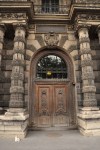
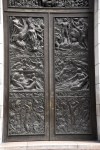
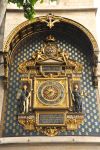
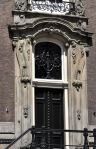
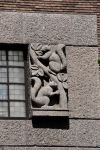
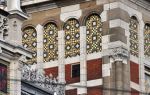
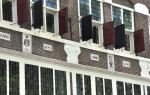
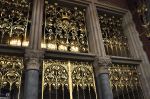
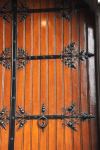
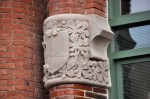
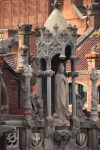
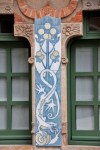
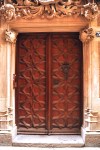
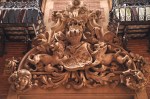
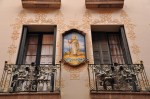
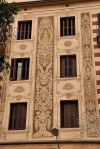
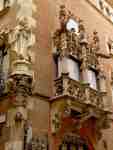
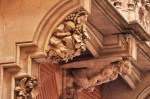
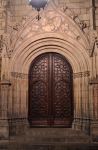
of art – a stylized dolphin/fish connector on an intricately decorated pipe.  Art is everywhere – in the windows, balconies, doors, lampposts, towers, church steeples – a quick sampling shown below.

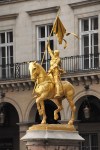
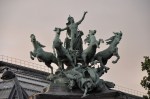
Statues are everywhere, a few examples below;

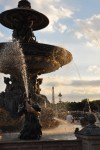
as are fountains everywhere.

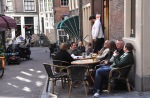
It’s a place for leisurely strolls along the Seine, or past the sidewalks and parks lined by

interesting street vendors.  There are, of course, many very attractive restaurants, such as

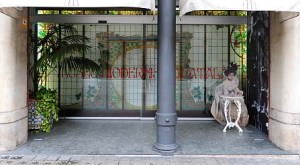
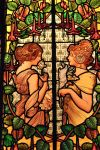
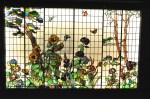
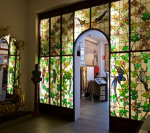
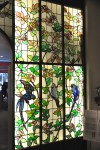
the ones above; and some outstanding Art Deco restaurants like this one shown below.

We should not forget to mention the ubiquitous – and well patronized – Paris bistros

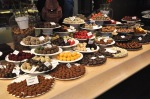
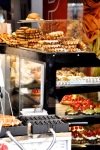
practically on every corner.  And of course there is French food for sale just about

everywhere, looking oh-so-appetizing.  How about a store dedicated to nougats?  With a

choice from over a dozen different ones?

After seeing these pictures, isn’t it hard not to want to book a flight into Paris NOW!  And cram that wonderful food into your mouth?

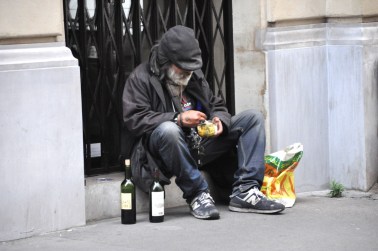
Finally, in addition to French cuisine, there is much to say of French wine.  It’s truly classic.  Although tastes may have evolved in some of us, those of a certain age tip their hats to the French.  They elevated wine to an art form, and taught the world its pleasures.  I’ll only note that in France, even the homeless need 2 bottles with dinner.

I hope you enjoyed this quick stroll through downtown Paris.  It’s a remarkable city, and

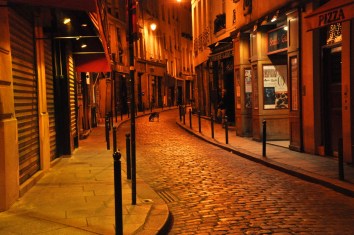
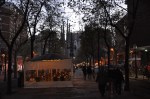
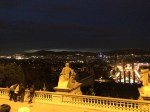
it’s hard not to absolutely fall in love with it.  Interestingly, if you stay up late enough (on a week day), you can almost have the city to yourself.  It’s captivating!

The next post is a visit to the Musée d’Orsay to view some spectacular Impressionist and Post-Impressionist paintings.

Amsterdam’s Rijksmuseum, III

OK OK, I’ve shown a bunch already, but there is so much more wonderful to see at Amsterdam’s Rijksmuseum.  This last (promise!) post on the Rijksmuseum is mostly on the Impressionists, and Henri Matisse in particular; the museum had a special exhibit on his career, particularly his latter years, with paintings on loan from throughout the world.  It’s interesting to see his artistic development, so let’s start with him!

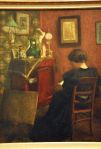
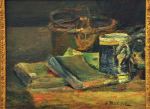
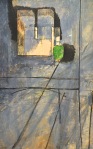
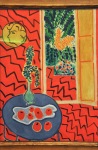
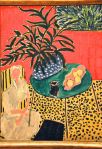
It’s 1895, and Matisse has an academic style – a mostly realistic representation of objects

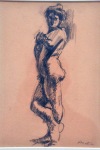
and a subtle, dark palette, as illustrated by the first two paintings above.  His studies of nudes are also classical, as shown in the last picture above.  However, Matisse has a ceaseless quest for innovation.  He becomes acquainted with Impressionism, and from an extended visit to the island Corsica and its Mediterranean light, his palette is transformed to bright colors.  He dabbles in the Pointillism of Seurat and Signac, then develops a new

approach, creating areas of pure, super-saturated color, a style that came to be known as Fauvism, and of which Matisse was one of the main leaders.  As the art world entered into the modern times of Picasso and Cubism, Matisse begins to work in his characteristic “pure line”; he does countless studies of the female form, executed in a few seemingly

effortless lines, and produces paintings that reduce shapes to their most elementary forms.  During the horrors of WWI, Matisse returns to Paris and paints in highly abstract,

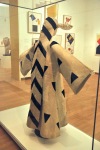
geometrically constructed works.  Commissioned to do stage and costume designs for a ballet, Matisse continues with his geometric patterns.  In search of the most effective compositions, he cuts shapes out of paper and arranges them in patterns; the process impresses him, and later in life he exclusively returns to this technique (as we’ll see!).

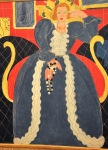
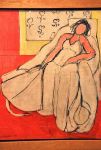
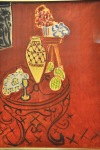
Following a trip to Morocco where he encountered the world of the odalisques (concubines or harem slaves, particularly in Turkey), Matisse features them in his paintings and returns to a more figurative, naturalistic style.   In his words, “I make odalisques so that I can paint nudes.”  Hmmm.  We’ve noticed this propensity!  Increasingly he incorporates

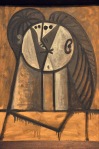
props and has his subjects pose in clothing made from expensive fabrics in order to create a dream-world of exotic women in seductive poses.  That last painting, you will notice, is a ringer from Picasso.  It’s a tribute to Matisse, done shortly after his death: “When Matisse died, he left his Odalisques to me.”

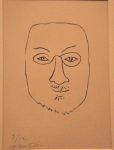
Below are charcoal/pencil sketches, one of his assistant Lydia Delectorskaya (who helped

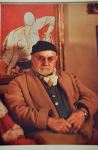
make many of the costumes for his models), one sketch from an envelope, and the other clearly a self-portrait (as you can see from the subsequent photo).

The last phase of Matisse’s explorations as a painter occurs following the German invasion of France and Matisse’s move to a reclusive life near the French Riviera.  He

adopts a flat style with simplified lines and dazzling color.

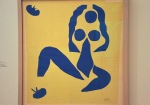
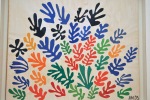
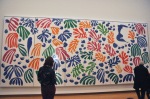
The most interesting part of the Matisse exhibit was his transition to cut-outs.  As noted earlier, his use of cut-outs in creating costume designs had intrigued him.  He further played with this technique in his design of Dance II, a triptych mural for the Barnes

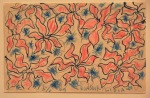
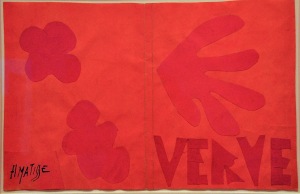
Foundation in Philadelphia (which we’ll show you in a future blog), and in his design for a cover for the journal Verve, a modernist Parisian art magazine.  Now, in the mid 1940’s, he sees this technique in an entirely new light, and he dedicates himself to it.  Matisse was one of the few Impressionists/Fauvists/Modernists who continued to innovate well into old age.  He was the first to employ cut-outs on a grand scale, and they are a vibrant grand finale to his life.   Some early – can we call them paintings? – are shown below.

The transition from painting to cut-outs is actually rather seamless.  Check out the work below, Mimosa, and compare it to the fern in the painting Interior with Black Fern, the

last painting shown 3 panels earlier.

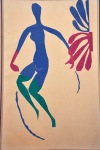
Matisse obviously loved the female form, and of course he goes back to his nudes, as

shown above.  Gradually his cut-outs expanded to a monumental scale, as shown below, although by now Matisse is 84 and in a wheelchair, needing an assistant to mount the

cut-outs.  That last work, The Parakeet and the Mermaid, Matisse says “I have made myself a little garden all around me where I can walk.”

This last piece, to the left, was done the year of his death (1954).  It’s again a design for the cover of the journal Verve; Matisse did a number of covers for them.  The Fauvist tendencies are still there, and still interesting.

One of the delights of this exhibition on Matisse was the juxtaposition of his work with other artists of his time, allowing one to see how they influenced each other (such as the Picasso shown earlier).  Duplicating that exhibition in this post would be too much, but I will show you some of the paintings of these Impressionists and Modernists, which I’ll group not by artist but by year.  We’ll start, as did the exhibit, with paintings that predate Matisse.  They’re too good to miss!

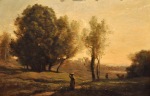
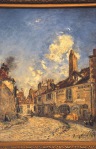
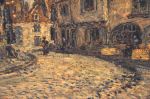
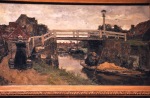
Here are a few early Impressionist paintings:

I really liked the picture by Jongkind, The House of Master Adam Billaud at Nevers.  I was not familiar with Jongkind; he’s regarded as a forerunner of Impressionism, a link between the works of Corot and Monet (and Monet was one of his pupils).

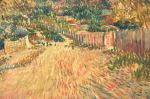
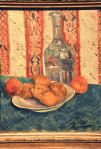
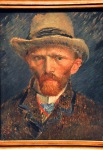
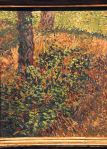
And here are some Van Gogh paintings (mind you, Amsterdam has a whole museum devoted to Van Gogh, so there are only a few Van Gogh paintings at the Rijksmuseum).

OK, just a few more pre-Matisse paintings:

The following paintings are from Matisse contemporaries:

As are these:

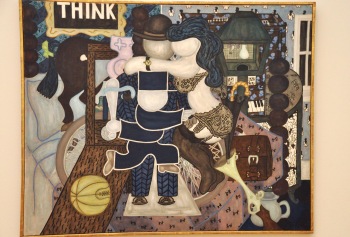
I’ll end with a later, cute work by William Copley, Lady Chatterley’s Horse, from 1960.

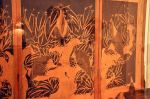
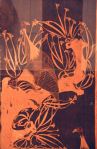
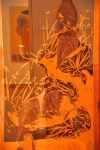
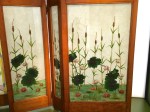
As noted in the previous post, there is more to the Rijksmuseum than paintings, and I’ll share a few more of these treasures with you.  The first, shown on the first line below, is an amazing folding screen called Guineafowl, made by G. W. Dijsselhof in 1894 from cotton batik (the technique involves drawing on cloth with wax; when dyed, the drawing is left uncolored).  Batik was the

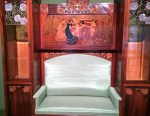
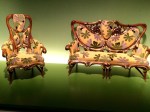
Dutch contribution to art nouveau.  Although reflections from the protecting glass made photography very difficult, I think you can still see how amazing this work is.  The two other wood items are beautiful in their own way.

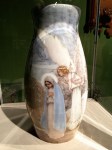
The fascinating items below are all ceramic.

I’ll close with this work of art, shown below.  How interesting to find this allusion to

American politics in an Amsterdam museum!

Alas, I have a sad story to tell.  Also in Amsterdam is the Van Gogh museum, which we thought was truly fabulous.  I did not realize he only painted for 10 years (!).  His evolution from his first crude paintings (The Potato Eaters) to his subsequent style is remarkable.  We loved this museum, and I had some amazing pictures to show you.  Past tense.  They unfortunately got overwritten.  If you get to Amsterdam, don’t miss that museum.

Next post, Paris.

Amsterdam’s Rijksmuseum, II

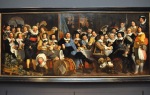
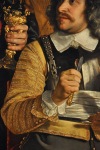
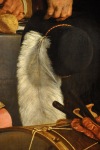
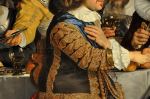
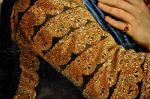
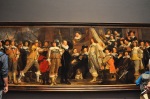
This post is a continuation of the previous one, Amsterdam’s Rijksmuseum ILet’s start with another painting by the Bartholomeus van der Helst.  We saw him in the previous post; like Rembrandt, he was a leading portrait painter of the Dutch Golden Age.  In fact, although he and Rembrandt were contemporaries in Amsterdam, it was van der Helst who became the more popular portraitist in that city due to his flattering portrayals combined with Rembrandt’s drift towards more dark and introspective works.  This 1648 painting, Banquet at the Crossbowmen’s Guild in Celebration of the Treaty of Münster (marking an end to the war with Spain), is marvelous.  It captures the shadings of black, the reflections

on glass, the stiffness of lace, the look of metal, the feel of felt and feather – all those elements of technique that make the Dutch Masters so incredible.

Below are some paintings from Franz Hal, an early master of portraiture.  The first is Portrait of a Couple, Probably Isaac Abrahamsz Massa and Beatrix van der Laen, 1622.

The couple are celebrating their marriage (the garden of love is at their right).  The other two paintings are Portrait of Lucas de Clercq, 1635, and Portrait of a Woman, 1635.

A couple more portraits from the Dutch Masters, with their stunning renditions of black garments and white lace, are shown below – Portrait of Laurens Reael, by Cornelis van

der Voort, 1620, and Portrait of Maria van Strijp by Johannes Cornelisz Verspronck, 1652.

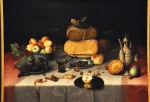
Painters of this time tended to specialize, confining themselves to a single genre.  One such Dutch Master was Floris Claesz van Dijck, who invented the breakfast still life.  The paintings are nearly photographic.  The painting below is Still Life with Cheese, 1615.

You can almost touch that plate with the apple, and the nearly invisible wine glass in the background is exquisite.  Another such painter was Willem Claesz Heda, who specialized in near monochromatic still life.  The painting below is titled Still Life with a Gilt Cup, 1635.

That lemon is soooo realistic!  And the detail on the fancy gilt cup is amazing – as is the beautifully rendered napkin.  Another master of still life was Pieter Claesz, an example of his painting, Still Life with a Turkey Pie, 1627, shown below.  I love the distorted

reflections in the metal pitcher!

Another area of specialization is the fruit and flower (and insect!) still life.  These painters beautifully (and colorfully) captured minute observations of each flower and insect.

They’re amazing.

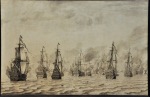
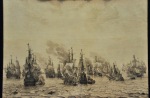
A final area of specialization that I’ll visit is marine painting.  Examples are the depiction of sea fights (ink on canvas) by Willem van de Velde I, and the marine paintings of his

son Willem van de Velde II, who portrayed marine vessels with such photographic

accuracy that they are regarded as the most precise guides available to the appearance of 17th-century ships.

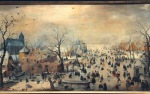
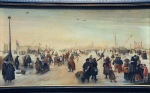
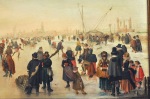
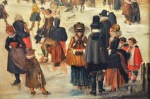
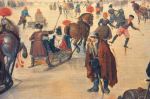
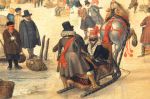
One of the first Dutch landscape painters was Hendrick Avercamp, who specialized in painting the Netherlands in winter.  His paintings are narrative, with anecdotes.  This painting, Winter Landscape with Ice Skaters, 1608, is a busy scene showing people on the ice – most for pleasure, some working out of necessity – along with tongue-in-cheek

real-life details, such as a dog and crow feasting on a dead horse, a couple making love, bare buttocks visible in a barn, a peeing male ….  Life is not just a carefree skate!  In a similar vein, Avercamp’s Enjoying the Ice near a Town, 1620, shows the well-to-do

amusing themselves on the ice, while the needy – the beggar, the fisherman – toil to make a living.


Let me close the Great Masters with a variety of interesting paintings from the 1620’s to

70’s.  I’m always impressed.

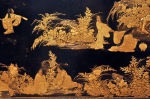
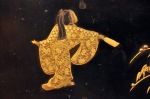
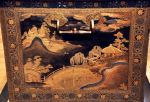
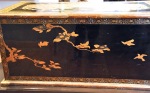
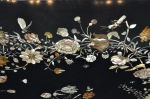
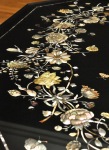
There is more to the Rijksmuseum than paintings – for example, this lacquer chest attributed to the Koami workplace in Kyoto, Japan, about 1635.  Only the Dutch East India Company had access to Japan, and they commissioned such works for the wealthy.  The details on this chest are amazing; for instance, each kimono is exquisitely different, and

the flowers and foliage are fabulous throughout (and interesting!  Drops of silver on the foliage, e.g. in the 2nd picture above, represent dew).  Similarly, look at the fabulous

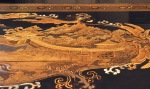
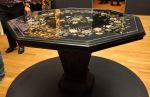
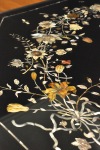
resolution and detail of the inlay of this table!  It’s spectacular.  Equally fabulous is this vase from the Sevres porcelain factory, 1908, influenced by Japanese art (yes, we have suddenly jumped to the early Art Deco period, but there it is).  This tall hand-painted vase features clematis (the vines after the flowers are gone) with ochre-colored thistles in the

background.  It’s stunning!

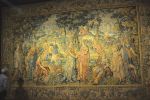
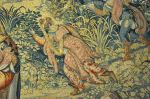
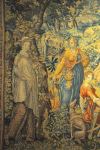
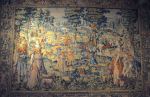
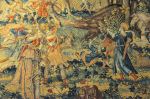
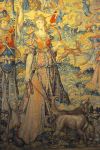
I’ll close this post with some tapestries from the (early) Dutch Golden Age.  We love tapestries from this age, often coming from Brussels, but typically the colors of these tapestries are sadly faded.  They’re left with mostly dulled green shades, requiring a lot of imagination to visualize their original splendor.  Not these Dutch tapestries!  They’re faded, to be sure, but a lot of color is still there, helping that visual leap to splendor.  The tapestry below is from the workshop of François Spiering and shows a part of a series on the life and times of the goddess Diana.  This one is titled Cephalus and Procris, from about 1593.  Cephalus has disguised himself to test the faithfulness of his wife Procris,

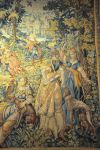
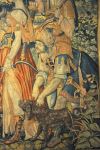
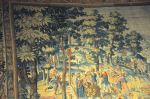
and the tapestry shows the story at different points in time (Procris runs to the goddess Diana, who intervenes; the two are saying farewell in the foreground).  Look at that color, and exquisite detail!  The last tapestry is from this same series, titled Meleager and Atalanta, also 1593.  Offended by the King of Calydon, Diana took revenge by sending a huge wild boar to ravage his kingdom.  The huntress Atalanta first wounded the beast,

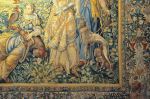
and the king’s son Meleager then killed it.  Meleager, in love with Atalanta, presents the boar’s head to her as a trophy (next to last picture).  It’s really wonderful; even the border around the tapestry is a work of art (last picture).

That’s enough for now!  There’s one more post left on the Rijksmuseum.  We’ll leave the Dutch Golden Age and move on to everybody’s favorite genre, the Impressionists.  There was also a special exhibition on the later work of Matisse that’s quite fascinating.  Don’t miss it!


Amsterdam’s Rijksmuseum, I

The Rijksmuseum is the largest art museum in Amsterdam and one of the richest in the world, with a collection exceeding a million pieces covering the years 1200 – 2000; it is not something to see in a single day!  Or for that matter, in a single post!  I hope you’re ready to look at a lot of paintings.  Your reward for this slog?  They’re amazing paintings.  You’ll see.

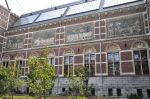
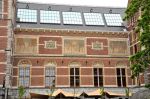
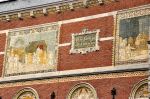
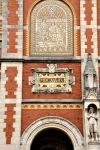
The Rijksmuseum was founded in 1800 at the Hague, and moved by the King (Napoleon’s brother) to Amsterdam in 1808.  The current Neogothic building opened in 1885, and as shown below, it’s impressive.  In that last picture, I can just see the horses and buggies of

yesteryear delivering their well-dressed owners!

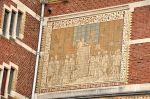
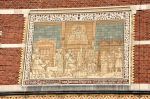
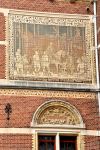
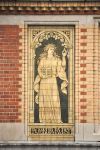
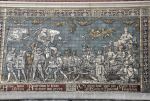
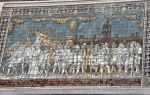
The museum is surrounded by fountains and gardens and statues, as shown below, but what intrigued me most was the artwork incorporated into the building itself, primarily

tiles of historical events, shown below.

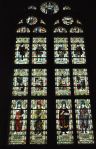
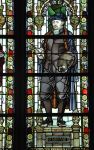
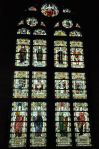
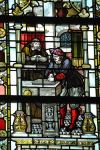
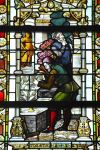
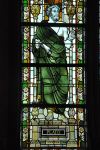
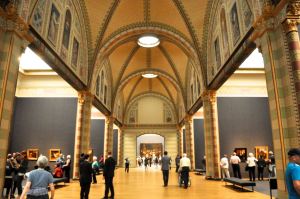
Very classy!  As is the interior.  Below is a quick look at the formal entrance hall, with paintings that mostly depict scenes from Dutch history.  Those stained glass windows

of the entrance hall are also pretty cool.

Now, the main reason for visiting this museum! The Rijksmuseum has the best collection of Dutch Masters paintings in the world!  The Dutch Masters – such as Rembrandt, Vermeer, & Frans Hals – painted during the Dutch Golden Age, from about 1600 to the end of that century.  I am in awe of these paintings for two major reasons; they interestingly depict life – often ordinary life – from a very different time; and they display incredible, perhaps unmatched technique with their 50 shades of black, their depiction of starched lace that makes your eyes feel scratchy, their painting of transparent glass, their capture of light’s reflections, and the ethereal quality of the light in which they bathe their subjects.  The combination is simply breathtaking.  HOWEVER, the museum of course covers a lot more than just those years, so let’s start with a quick look at some earlier art from the 1400’s.

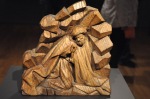
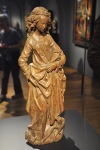
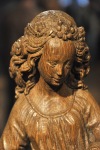
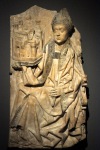
Medieval art was chiefly related to Christianity, made (and paid for) to serve needs for worship and veneration – and needed to fill the many spacious Gothic cathedrals being built.  Art from the 1400’s were done in a style called “International Gothic” reflecting its widespread distribution and marking the end of the medieval period, to be followed by the Renaissance.  The wood carvings and statues from this time are impressive, as shown

here, as are the paintings, shown below.  That first painting was done by a favorite of ours, Fra Angelico, a monk who – somewhat scandalously – often painted Madonna with

the face of his lover.  The other marvelous painting shown above is by Carlo Crivelli, done near the end of the International Gothic style.

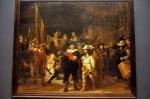
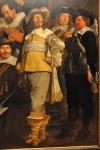
OK, off to the good stuff!  Let’s start with one of the highlights of the museum – one of the most famous Dutch Golden Age paintings from the greatest portrait artist of the time, Rembrandt van Rijn’s Night Watch, 1642.  It’s sufficiently important to have its own room, and it’s placed just so; the painting is at the visual center at the end of the hall in this picture.  The Night Watch is a group portrait of the city’s civic guard getting ready to move out.  Until this painting, group portraits showed people sitting or standing stiffly.  Not here!  The picture is an action shot; motion is everywhere.  Furthermore, details of the

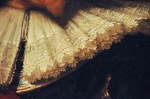
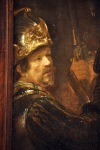
guards’ attire are stunning.  Look at the uniform of the dude in the light outfit!  He’s depicted in such exquisite detail, with a strong 3-D component, that you would hardly be surprised if he walked out of the painting.  And, of course, there’s a selfie that Rembrandt incorporated at the left edge.  Cute!

Below is another civic guard painting, Militia Company of District VIII under the Command of Captain Roelof Bicker, 1643, this one by Bartholomeus van der Helst, one of

the leading portrait painters of the Dutch Golden Age.  Like Rembrandt’s painting, it’s huge, filling an entire wall (and including a selfie at the far left, as well).  And like Rembrandt’s painting, it’s gorgeous.

There are soooooooooooo many Rembrandts here!  The good news is that it’s not possible to be bored by them.  Here’s a sampling, starting with the young Rembrandt.  This first

one is Tobit and Anna with the Kid, 1626.  The story is that Tobit is blind, condemning him (and wife Anna) to grinding poverty.  When Anna comes home with a goat, a reward for hard work, Tobit thinks she stole it and prays for his quick death.

The first painting below is Rembrandt’s Musical Company, 1626, followed by his Self-

portrait, 1628.  For Self-portrait, even at just 22 years of age he’s experimenting, with the light interestingly just glancing along his cheek, the rest of his face veiled in shadow.  The curls of his hair were made by scratching the wet canvas with the butt end of his brush.

This next Rembrandt is An Old Woman reading, Probably the Prophetess Hannah, 1631

(according to the Gospel of Luke, Hannah was an elderly lady who worshiped God day and night).  It’s amazing.  Look at that wrinkled hand!

Rembrandt painted only a few landscapes – here’s one of them, Landscape with a Stone

Bridge, 1638.  It’s pretty cool, with the dramatic sunlight contrasting with the approaching storm.

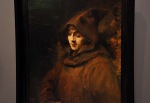
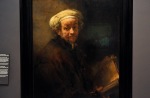
We’ll finish this Rembrandt section with some of his later paintings.  We’ll call these next two paintings ‘family portraits’; the first is Rembrandt’s Son Titus in a Monk’s Habit, from 1660, and Self-portrait as the Apostle Paul from ’61 (it was common during this time to

portray people as historical personages).  Another later painting is historical, The Conspiracy of the Batavians under Claudius Civilis, 1661, depicting the one-eyed Batavian

chieftain entering a treaty to overthrow the Romans (69 AD).  The picture below is The Wardens of the Amsterdam Drapers’ Guild, Known as ‘The Syndics’, 1662.  The syndics inspected the quality of dyed cloth, and here Rembrandt enlivened the scene by

portraying them looking up from their work as though disturbed by our arrival, a clever artistic device attesting to Rembrandt’s creativity even in his later works.

Our last Rembrandt is Isaac and Rebecca, Known as ‘The Jewish Bride’, 1665 .  Note how this painting glitters, helped by the use of a palette knife and by painting reflections off the jewelry.


Leaving Rembrandt (alas!), below is a quick look at more Dutch landscapes.  The first painting is River Landscape with Ferry by Salomon van Ruysdael, 1649.  van Ruysdael

was famous for his pictures of the flat, watery Dutch landscape; here the small ferry contains 4 horses, 5 dogs, 2 cows and 11 people – yikes!  Must be rush hour, as the other boats are fully loaded as well.  The two paintings to the right are The Entrance to the Woods by Philips Koninck, 1665 and A Watermill by Meindert Hobbema, 1664.  Hobbema studied under Jacob Isaacksz van Ruisdael, the pre-eminent landscape painter of the Dutch Golden Age, represented by the underlying two pictures, Landscape with Waterfall, 1668.

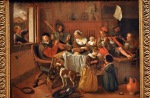
We’ll move on to Jan Havicksz Steen, known for his paintings of daily life – often involving a tavern (his parents owned a tavern, and at times he himself owned a brewery and a tavern); he’s also known for his sense of humor and psychological insights.  The paintings are a delight!!  His scenes often depict lusty life that approaches chaos, so much so that a Dutch proverb, “a Jan Steen household”, meant a chaotic surrounding.  So let’s see some of these paintings!  The first is The Merry Family, 1668, depicting a family making LOTS of noise – and also drinking and smoking.  There’s a moral – the note hanging from

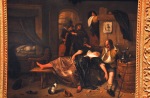
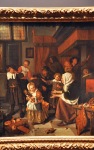
the mantel reads “As the old sing, so shall the young twitter”, suggesting less than ideal parenting (and presaging today’s internet?).  The next is The Drunken Couple, 1655.  After a night of revelry, the two individuals are so drunk they don’t realize they’re being robbed.  The owl print above them contains the moral; considered a stupid bird in the 1600’s, the owl can’t see by day (even with the help of a candle).  The following picture is The Feast of St Nicholas, 1665, which captures the elements of this holiday; the little girl has a bucket of treats, while the naughty boy gets a bundle of twigs in his shoe.

Continuing with Steen, the first picture below is Interior with a Woman Feeding a Parrot, Known as ‘The Parrot Cage’, 1660.  The next painting is The Sick Woman, 1663.  Is the

weak young woman pregnant?  To test this, the old-fashion-attired doctor has put a strip of the woman’s clothing in a brazier to smoulder, the smell revealing her status; and the discredited technique identifying him as a quack.  The last painting is Adolf and Catharina Croeser, Known as ‘The Burgomaster of Delft and his Daughter’, 1655.  This is a portrait of a wealthy grain merchant sitting I think unattractively outside his house, where a poor woman and child beg him for alms.  A rather strange portrait!  Interestingly, 2 years later Mr. Croeser helped Steen deal with serious debt.

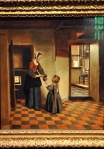
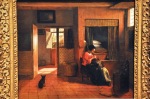
There’s a lot more of the Rijksmuseum to see, so I’ll have to do another post – or two?  I’ll close this one with two popular painters from the later Dutch Golden Age, Johannes Vermeer and Pieter de Hooch.  Who is Pieter de Hooch, you ask?  Both painters specialized in interior scenes of domestic middle-class life, both had a sophisticated treatment of light, and both were keen observers of life’s everyday details.  Vermeer was only modestly successful, dying in debt and historically ignored.  Rediscovered in the  1800’s, he is now acknowledged as one of the greatest Dutch Golden Age painters.  de Hooch, on the other hand, was more successful at the time, painting more and painting for wealthier patrons.  Both had slightly different strengths, but Vermeer had the better technique.  Let’s see them, starting with de Hooch.  The first painting is Woman with a Child in a Pantry, 1656.  de Hooch effectively creates interior space via doorways

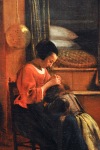
and windows.  The other painting is A Mother Delousing her Child’s Hair, Known as ‘A Mother’s Duty’, 1658, and uses the same technique to create depth.

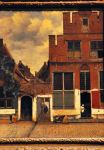
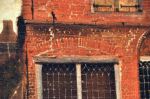
The first Vermeer painting below, View of Houses in Delft, Known as ‘The Little Street’, 1658, is not your typical Vermeer subject; although the two figures doing chores in this painting are perfectly framed by doors, as if by actual picture frames, the subject is

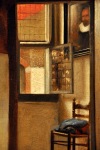
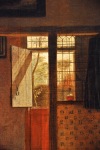
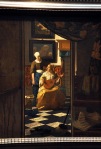
clearly the carefully rendered detail of the old buildings.  However, the next painting, The Love Letter, 1669, certainly is typical Vermeer with its domestic scene (in spite of its unusual vantage point).  In this picture, the seascape on the wall behind the two ladies alludes to the letter’s content – in the 1600’s, the sea was often compared to love, and the lover to a ship.  The last picture below, Vermeer’s The Milkmaid, 1660, is almost photographic, with glistening light on the crusty bread (and the milkmaid’s forehead).

The light gradations and the primary colors are treated with a virtuoso hand.  Bravo.

The next post continues our Rijksmuseum tour with Old Master paintings.  You’ll love them!


Amsterdam, the city

Amsterdam is not a city founded by Rome; Rome wanted nothing to do with those unhealthy, marshy lands. It wasn’t until 1200 AD that a small fishing village was built around a castle on a dam at the mouth of the Amstel river, called “Amstellredamme” – translation, dyke (dam) on the Amstel. With time it was a city built entirely by intelligent town planners working with rich traders. In the 1600’s, during the Dutch Golden Age, local merchants established the Dutch East India Company, which became the strongest trading organization in the world.  At its height it had 150 ships sailing the oceans escorted by 40 warships and an army of 10,000 men. Amsterdam became the leading port in the world (it’s still Europe’s fifth largest), and its riches led to greatness  It supported artists like Rembrandt and Vermeer. Van Leeuwenhoek invented the microscope here, and Boerhaave founded clinical teaching and the modern academic hospital. Its diamond cutters became world famous.  Amsterdam’s decline started in the 1700’s following wars with the other major sea power, England, and continued with Napoleon’s conquest, the World Wars, and Nazi occupation.

Today Amsterdam is known for its multi-cultural tolerance – including it’s early embrace of marijuana in coffee houses and it’s red-light district.  It has more than 60 miles of delightful canals that divide the city into about 90 islands linked by more than 1000 bridges, giving it some resemblance to Venice.  We’re here mostly for the museums, but first a peek at the city.

One of the first things to notice in this city is that bicycles and bicyclists are everywhere; everyone seems to commute by bike.  If bikes aren’t zinging past you, they’re parked in

row after row or head to toe on every available street or bridge.   Cars are outnumbered and do not rule the road; bikes do.  When biking in the US, I warily watch what a car is going to do, ready to react.  Here it’s the other way around; cars warily watch the bikers, who do just about anything they want.  And I must say, pedestrians also have to be wary about bicyclists; there’s definitely a pecking order, with bicyclists at the top.  Consider crossing the street – OK, jaywalking really, but it’s a common event.  Between the sidewalk and the road is a bike lane.  So you look down the road to see if a car is coming – but wait!  You’d better look down the bike path first, because there’s a lot more bike traffic and you’ll be flattened in an instant!   So you wait for the bike lane to clear, recheck the road, and start across the road.  HOWEVER, before getting off the road to the other side, there’s a bike lane to cross, with a lot of bike traffic.  So you stand in the road waiting for the bike traffic to clear so you can dash to the sidewalk.  Definitely trickier.

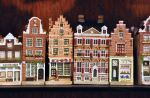
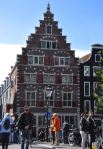
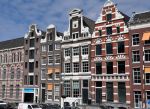
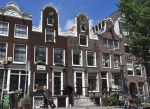
A distinctive feature of Amsterdam is its many buildings from the 1600’s.  During the height of the Dutch Golden Age, numerous canals were dug around Amsterdam for defense and transport purposes, and many wealthy merchants had new houses built along these canals.  These houses were generally very narrow with ornamental façades that

extolled the owner’s status.  In Amsterdam, stepped gables were a popular flourish.  These houses were both home and workplace, with attic and basement spaces to store goods like cotton or cocoa.  Hooks were affixed to the top of the narrow houses to hoist furniture and

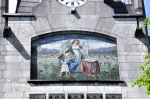
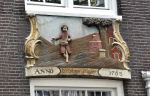
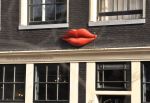
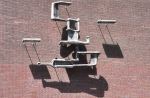
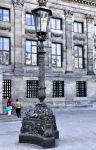
goods up and through the windows, a tradition still employed today.  The buildings of Amsterdam are also often decorated with art, both old and contemporary.

OK, the comparison with Venice was a stretch, but still the many canals and bridges bestow on this city a delightfully pleasant and scenic tranquility, illustrated below.  That

last picture shows the Magere Brug drawbridge spanning the Amstel.  It’s the last of what were once hundreds of wooden bridges crossing the canals; its mechanisms are still worked by hand.

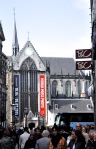
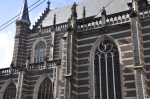
Let me show you some of Amsterdam’s more famous buildings, like the Nieuwe Kerk, or New Church.  Of course there is an Oude (old) Kerk that was a small chapel in 1306, undergoing many alterations until its final form in the 1500’s, shown here (now used for non-religious purposes).  The Oude Kerk became too small to serve the expanding Amsterdam, so a new basilica was started about 1400, dividing Amsterdam into 2 parishes – and subsequently centuries of competition.  The Nieuwe Kerk was damaged by fires in 1452 and restored to its final late Gothic structure, shown in the pictures below.

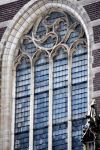
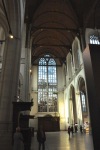
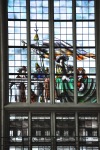
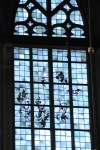
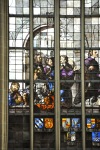
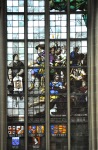
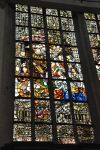
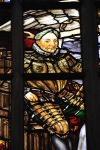
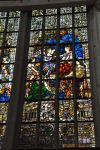
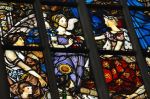
The interior of the Nieuwe Kerk is lit by 75 windows, a few shown here.

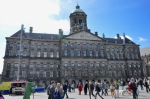
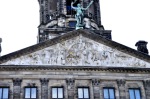
Nearby is the Royal Palace, originally built in the mid 1600’s as a town hall in keeping

with the power and prestige of Europe’s commercial capital (it required 13,659 piles in the marshy ground to support it).  When completed it was the largest and most expensive town hall in Europe.  In the 1800’s, Napoleon’s brother crowned himself King of the Netherlands and transformed the building into a royal residence.

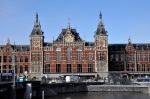
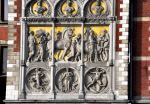
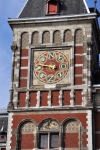
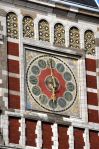
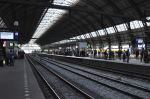
Amsterdam’s Central Station is not really old – it was built in the late 1800’s – but it is gorgeous.  Built on 3 artificial islands facing the port, and 8,687 piles, this huge building

had to be a challenge to build.  Pictures of the exterior are shown above; the interior is no less  impressive, examples shown below.

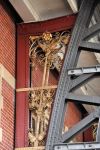
Even the boarding area is attractive, particularly the metal art.

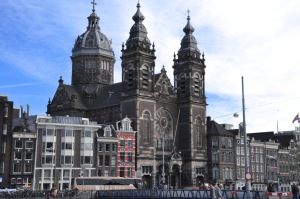
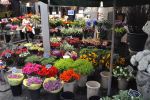
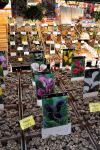
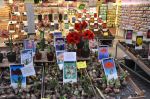
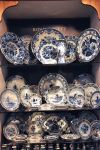
Well, there’s certainly a lot more to see, such as this basilica (Church of St Nicholas) – and let’s not forget the red-light district (where photos are not encouraged) – but let’s close this post with a quick look at Amsterdam’s ambiance, which is quite delightful. The ubiquitous canals and bridges of this large city divide it into domains that give it a small-town feel that’s palpable.  And yes, there are touristy shops around – flowers, bulbs, china, wooden shoes – but they feel like part of the town rather than a tourist mecca.  I hope the pictures below give you that feel.

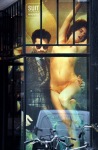
Ah, humor me for one last topic before closing this post.  The (very liberal) Amsterdam does not shy from using the (poorly clothed) human form in its advertising, which to this American is always a bit shocking, followed by my introspective amusement at my being shocked, followed by my appreciation of the often clever tongue-in-cheek thought behind

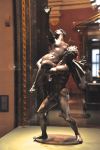
the advertisement.  For example, the window advertisement in the first picture above, advertising stylish men’s clothes, is a clear reference to classical art showing men that are – ah – sweeping women off their feet (I’ve added an example of classical art in the next  picture).  I can’t imagine the outcry in the US with such advertising, but I do think there’s a sly cleverness to be enjoyed.

We enjoyed Amsterdam the city, but the real reason to visit is its museums.  Next post – the Rijksmuseum.


Barcelona XI: Interior of the Amazing Sagrada Família

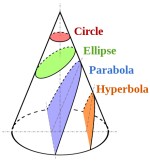
To start, let me review Gaudí’s unique architectural designs that we mentioned in the last post (Barcelona X).  Gaudí incorporated many geometrical forms in his designs, particularly hyperbolas (more accurately, their 3-D rotation that forms hyperboloids, illustrated in pictures below).  Hyperboloids like that shown in the last picture below

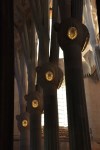
essentially form the Sagrada’s ceiling.  In addition, for Gaudí, religion and nature – God’s creations – were intertwined, and he used a number of nature’s designs in his own architectural solutions.  For instance, in nature, the cellular elements in the trunks of trees are often joined together and oriented not linearly but spiraling upward, giving the trunk and branches greater strength.  Gaudí uniquely took this approach, allowing his very tall columns to be more slender and producing a more harmonious effect.  Besides his columns branching tree-like to support their load, the column surfaces are the result of intersections of oppositely turning geometric forms.  The simplest example is that of a

square base twisting clockwise and a similar one twisting counter-clockwise, evolving into an octagon as the column rises, then a sixteen-sided form, and eventually to a circle. Depending on the position of the column in the basilica and the weight load, the columns start with different geometrical cross sections; the taller the column, the more points in the polygon at the base.  The tree-like columns, as well as having a structural function, reflect Gaudí’s idea that the inside of the temple should be like a heaven-reaching forest that invites prayer.

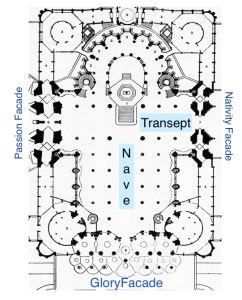
With that preparation, let me introduce you to the interior.  To the left is the floor plan of the Sagrada Família with the Nativity entrance on the right side.  Following my visit to the Sagrada interior, I was very much surprised by this floor plan.  Usually medieval cathedrals are cross-shaped with long and narrow naves and transepts.  The Sagrada also incorporates a cross shape, but it looks positively short and squat, with truncated nave.  The dwarf cathedral!  However, inside the Sagrada, Gaudí’s “forest of columns” absolutely hides that wide and short nave; the columns define a long and narrow space very much like the Medieval cathedral.  Besides, as you’ll see, with everything else that’s happening, the nave’s length is the last thing that’ll capture your attention!

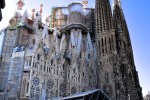
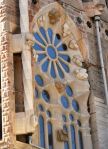
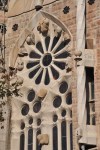
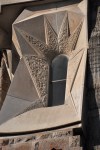
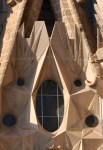
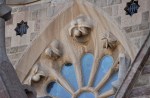
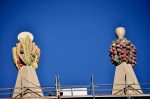
Well, one last observation before we go inside.  When I look at the Sagrada Família, what I mostly see is this huge towering stone structure, and secondarily a bunch of small decorating windows, as shown in the first two pictures below.  However, a  closer

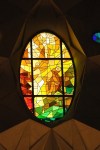
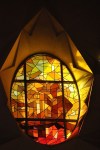
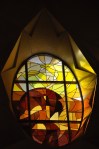
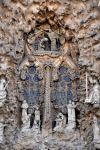
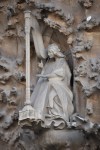
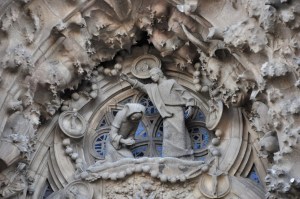
inspection suggests there are in fact a fair number of those small windows – and many more windows to which we previously paid no attention, such as those we saw in the previous Barcelona X post lurking behind the statues of Christ crowning Mary in the Nativity facade, or those hiding in plain sight behind the singing angels, shown below.

So the Sagrada Família has more windows than you might think!  And you’ll see that in the interior.

Entering from the Nativity entrance, across the transept is the Passion facade entrance.

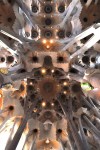
Isn’t that first picture awesome?  We’ll come back to those gorgeous branching columns; for now we’ll look overhead at the ceiling vaults over the transept, shown below.

That is a ceiling!  There are no straight lines, just smooth curves and jagged incised arms of intersecting hyperboloids.  The complex structure is somehow magically supported by the branching columns.  The pictures below continue the scan across the transept, looking

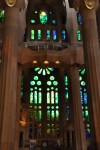
back now at the Nativity entrance.  Pictures of the entrance’s stained glass windows, and those off to the sides of the entrance, are shown below.

Turning to the left we face the choir, which soars upward, the leaning columns adding

perspective to the heavenly stretch.  Isn’t that first picture impressive??!

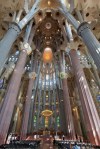
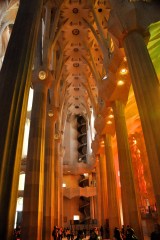
And now the nave.  Oh yeah.  If you remember from the floor plan, there is a central column-lined aisle bounded on each side by another column-lined aisle.  The central aisle is higher.  Below are two  pictures from the internet, the first taken from the rear of the nave looking toward the choir.  The wide-angle lens used in that first picture skews the

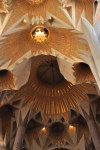
perspective on the right and left sides, but this picture does illustrate Gaudí’s “forest of columns”.  It’s a gorgeous interior!  The 2nd picture shows the incredible ceiling over the nave.  It’s stunning!  The hyperboloids on the left and right sides presumably represent the leafy canopy of the column “trees”.  Some see those hyperboloids as representing stylized sunflowers, a flower Gaudí loved and incorporated in a number of his architectural projects (in a subsequent post we’ll show you a Gaudí house that is sunflowers from one end to the other!).  Whatever those hyperboloids represent, the ceiling is just awesomely beautiful!

As exciting as those pictures of the nave are, they don’t capture it’s magic.  Did you notice the colors in the ceiling in that last picture above?  The ceilings in those side aisles are lower than that of the main aisle, and that color comes from light reflected upwards after passing through the lower stained glass windows.  Just a reflection?  What does that portend for direct viewing?  Let me show you the view you get looking down the first nave side aisle when entering from the Nativity entrance, first 2 pictures below.  The color that

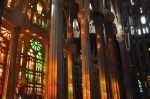
is streaming in is stunning!  It’s natural lighting delivered by the nave’s lower stained glass windows, as illustrated by that last picture above.  Not to be outdone, the other (Passion) side aisle continues the color spectrum, green to red, as shown below.  It’s

breath-taking.  Wandering down the aisles is like being in a jewel box or a light show, as shown below.

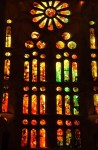
The nave aisle windows causing this light show are shown in more detail below, first for the red side.  There are two levels of windows, as shown in the first picture.

Those last two windows you saw from the outside (at night) in the previous post, Barcelona X.  The nave windows on the blue side are shown below.

The windows with their patterns and colors are stunningly beautiful.  Gaudí planned for the graduated spectral tones of light inside the Sagrada Família to create an atmosphere conducive for introspection.  For me, it wasn’t introspection that I experienced but awe – and a child-like wonder at being transported to a fairy world.

Below is another look at the beautiful hyperboloid ceiling in the nave aisle, with its tree-like columns and flower/leaf canopy.  In keeping with Gaudí’s design of columns as trees, the bulge that supports the branching columns alludes to stubs from cut limbs.

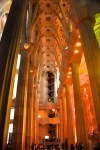
The ceiling in the central aisle of the nave is higher and has a very different hyperboloid design.  It’s also much brighter.  How so?  Unlike the lower stained glass windows, the

upper windows use uncolored glass, as shown above, providing more light to the higher-ceiling “heavens”.  Below are views of this upper ceiling; the hyperboloids are gorgeous.

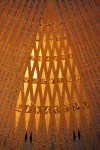
Notice the presence of small lights in the ceiling, looking like light bulbs.  They’re not.  To both lessen the load of the ceiling and bring yet more light into the building, Gaudí designed skylights in the roof (again based on hyperboloids).  He also added linear elements of gold and green glass and tiles to reflect the daylight inside.  It all adds up to spectacular.

There are many more amazing elements of beauty in this basilica, such as the spiral

staircases in the corners. Everywhere there are arresting perspectives and visual delights, as shown below.

I hope you are as impressed by the Sagrada Família – and by Gaudí – as we are.  Gaudí’s position in the history of architecture is that of a creative genius who, inspired by nature, developed a style of his own.  His methods continue to be considered revolutionary, a century after he devised them (!).  The Sagrada Família was and still is a constructional challenge: it is one of the largest testing grounds for construction methods in the world.  Describing Sagrada Família, art critic Rainer Zerbst said “it is probably impossible to find a church building anything like it in the entire history of art”.  Yep.

In earlier posts I hyped the heck out of this cathedral.  If you’re not blown away by the Sagrada Família and its interior, I can only attribute it to the inability of still pictures to capture it’s awesome, innovative, courageous beauty.  Perhaps it would help to look at a short video of the interior, such as the one here: https://www.youtube.com/watch?v=-17MPSCnnDU.  Still – we have to ask – is that the interior that one would wish for in a religious service?  Would you not be distracted by that interior?  Does it really promote introspection, as Gaudí wished?  We touched on the emotional relevance of religious interiors in a previous blog, when we visited Córdoba’s Mezquita with its unique juxtaposition of mosque and Roman Catholic church (Córdoba).  We think the Sagrada Família is a wondrous monument to the Christian religion, and a true milestone of human achievement with its daring vision and execution.  We’re just not sure about its ultimate role as a place of worship.

We leave Spain now, although we’ll return later for Spain’s Basque region.  Our next post will be from Amsterdam – and its great museums.


Barcelona X: The Amazing Sagrada Família Basilica

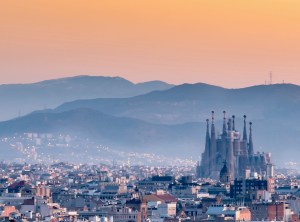
The Basílica i Temple Expiatori de la Sagrada Família – or simply La Sagrada Família (translation: Holy Family) – is a Roman Catholic church designed by Gaudí that, 130 years later, is still under construction.  As shown below, it’s big!  Although parallels with Gothic

cathedrals of the Middle Ages are obvious, there is one major difference; in today’s world, I can’t imagine another such church ever being built.  If things stay on schedule, it will have taken 144 years to reach completion.  That makes this basilica the Last-of-the-Mohicans special – and is it ever!  Gaudí’s grand masterpiece is structurally innovative, wildly creative, incredibly bold, and unmistakably organic in architecture and decor.  The interior is spectacular, and like nothing you have ever seen.  Literally.

Before we explore this masterpiece by Gaudí, let me give you some history (ah … actually a bunch of history).  Construction on the basilica started in 1882 with a Neo-gothic design by the architect Francisco de Paula del Villar y Lozano.  However, due to disagreements,

the architect resigned and Antoni Gaudí took over in 1883.  A few years later Gaudí proposed a more grand design, abandoning the Neo-gothic plan for something more monumental and innovative, both in structure and in construction.  It would be a large church with a Latin-cross floor plan and soaring towers, and be immensely symbolic both architecturally and sculpturally, conveying teachings of the Gospels and Christian Church.

In 1914 Gaudí decided to concentrate exclusively on Sagrada Família; he undertook no other major work in the later years of his life.  On a summer day in 1926, while taking his daily walk to church, he was struck by a passing tram and knocked unconscious.  Assumed to be a beggar due to a lack of identity documents and shabby clothing, he did not receive immediate aid.  Eventually transported to a hospital, he received rudimentary care.  He was finally recognized the next day but died 2 days later at the age of 73.  He had worked for 43 years on the temple.  “It is not a disappointment that I will not be able to finish the temple. I will grow old, but others will come after me. What must be always preserved is the spirit of the work; its life will depend on the generations that transmit this spirit and bring it to life.”  A. Gaudí.

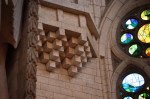
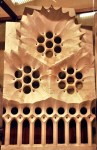
After Gaudí’s death in 1926, the construction of Sagrada Família was continued by architects and craftsmen who had worked with him, following his plans and plaster models.  I think it worth spending a little time to understand how novel Gaudí’s design was (and continues to be).  In his desire to overcome defects he saw in Gothic structural systems, he developed a new architecture based on organic and geometric forms of nature to create balanced and self-supporting structures.  Nature often incorporates in its structures such geometrical forms as the ellipse, parabola and hyperbola, and Gaudí adapted these and – when using two together – their intersections to be integral structural forms of his architecture.  An example of Gaudí copying from nature is shown below, comparing the structure of a plant pollen grain to windows in the Sagrada.

Gaudí rarely drew detailed plans of his works, instead preferring to create them as 3-dimensional scale models, as illustrated below and as shown incorporated in the

Sagrada (Note: Isn’t that last picture, showing the interior, absolutely breathtaking??).  Some of Gaudi’s evolving models of La Sagrada are shown below.  They show an evolution from a neo-Gothic structure to a model based on the parabola to the final design using

hyperbolas.  The models are reconstructions, alas.  At the beginning of the Spanish Civil War (1936), anarchists broke into La Sagrada, wrecked a crypt and chapel, and destroyed and burned Gaudí’s studio. His drawings did not survive, but the mobs left behind many broken pieces of his original models which were painstakingly restored.

Gaudí also used the catenary arch; a catenary is the curve that a string or chain assumes under its own weight when supported only at its ends.  Gravity gives it that shape.  Flip it upside down, and it’s a weight-bearing structure with only compression forces.  In Gaudí’s time it was used only in the construction of suspension bridges; Gaudí was the first to use it in common architecture.  He would attach a drawing of the building floor plan to a ceiling, from which he would attach strings (representing columns, arches, walls and vaults) with bags of birdshot (for the weight of small building parts).  He would then take a picture that, when inverted, showed the structure for columns and arches that he was looking for.  Using this technique, Gaudí arrived at the revolutionary idea of using inclined columns that subsequently branched out like trees.  The leaning columns better resist the perpendicular pressure that they experience, and the branches support a structure of intertwined hyperboloid vaults.   Space is divided into small, independent and self-supporting modules without needing the buttresses required with the neo-Gothic style.  Further, the hyperboloid vaults have an empty center, allowing natural light to enter, in contrast to Gothic vaults with their keystones that resulted in closed, dark cathedrals.  Where Gothic vaults have ribs, the hyperboloid design allows the intersection between vaults to have holes, which Gaudí employed to give the impression of a starry sky.  Further, Gaudí conceived the branching columns of the church to have not only a structural function but to represent a forest, a natural temple that invites prayer; and like sunlight filtering through leaves, to create a space of magical lighting conducive to intimacy and meditation.  Isn’t that picture on the left gorgeous?  Wait ’til you see the Gaudí interior!

One last architectural point.  To achieve greater stability and a slender and more harmonious effect, Gaudí designed all the branching columns to have a double-turn helicoidal shape (right turn and left turn) similar to those in the branches and trunks of

trees.  The base of each column has a cross-section that is a polygon or star which, as it twists to the right and left, transforms into a circle higher up.  Depending on the position of the column in the basilica and the weight load, the columns have different cross sections, as shown schematically in the last two pictures above.

OK, after talking about Gaudí and the bones of Sagrada Família, maybe now you want to actually see it?  And I want to show it!  But first let me give you the overview of this complex basilica.  The Sagrada Família could be used to give a crash course on the Catholic religion, given the wealth of Christian symbols that Gaudí placed on the facades.

First of all, just look at the model to the left, and be amazed.  That’s a church?  At this scale it almost looks like a Disney fairyland castle run amok.  However, up close, surrounded by the cathedral’s details, the structure is overwhelmingly, undeniably religious.

The basilica has three monumental entrances, each one representing one of the three crucial events of Christ’s existence: his birth (Nativity facade); his Passion, Death and Resurrection (facing us in this picture); and his present and future Glory (facing to the right in this picture). The Sagrada has 18 towers, each with a special significance.  The middle tower is dedicated to Jesus Christ; around it are four towers representing the Gospels.  The tower above the apse, crowned by a star, represents the Virgin Mary, while the remaining 12 towers – 4 over each entrance – represent the Apostles.  Christian symbols, as well as Modernista nods to nature, are present everywhere on and in the basilica, too numerous to mention but including the main symbols of the Old Testament.

We’ll start at the current entrance and the oldest facade, the Nativity, begun in 1892 (when the Sagrada is finished, this will be a side entrance).  This facade faces the rising sun, symbolic of the birth, life, and light of Jesus.  It’s decorated in a style I would call

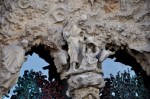
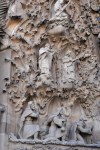
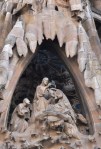
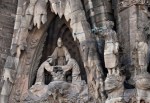
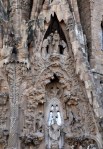
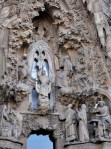
“too busy”.  The facade’s decoration includes over 100 plant species and an equal number of animals (!).  It attempts to communicate and celebrate man’s journey from creation through the old testament, then Christ’s birth and youth, and at the highest niche, visible in the last two pictures above, Christ triumphantly crowning Mary.  Starting at the bottom of the Nativity facade – you might find it helpful to refer back to the right 2 pictures above – this facade has 3 separate entrances each nestled inside a grand parabola (or portico), each portico representing one of the theological virtues of Hope, Faith and Charity.  Two massive columns flanking the central portico rest either on a turtle or a tortoise, representing dominion over land and sea.  The central and largest portico, Charity, has fabulous bronze double doors inspired by nature, full of metal leaves, flowers and insects, as shown below; perhaps suggesting that you are about to enter Gaudí’s reverential forest (of columns) mentioned earlier.  Note that the statuary surrounding the doors (the Adoration

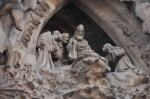
of the Magi and the Adoration of the Shepherds) practically includes you in it as you enter (details shown below).  The scene in the middle above the doorway celebrates Jesus’ birth and the “Sagrada Família” – the holy family of Mary, Joseph and baby Jesus in the

manger.  Arrayed just above the Holy Family is a chorus of young angels with angel

musicians flanking them (and the star of Bethlehem atop a central pillar between the windows).  Above the angel choir is a depiction of the Annunciation, with the Archangel Gabriel announcing to Mary that she will be the mother of the Son of God.  Finally, much higher than all of these decorations and at the apex of the Charity portico’s parabola is the beginning of a spire, the Tree of Life, which at its base opens out to form a large and commanding niche showing Jesus Christ crowning Mary as Queen of Heaven, as shown below.  Interestingly, Joseph is present in this Coronation scene – an

unusual detail.  The Tree of Life sweeps upward, pointing towards the heavens with many symbols of Christianity and with doves of peace nesting in its branches.  Among the Christian symbols is the pelican, based on an ancient legend that it will pierce its own breast with its beak to feed blood to its hungry babies, a symbol of Christ sacrificing himself for man.

Some details of the Nativity facade’s Hope and Faith portals are shown below.

There’s more to this side of the Sagrada Família than just that ornate Nativity entrance, as shown in the first picture below.  There’s a looooong extension to the left, with a very different architecture!  Here geometry won over ornate story telling; there’s still religious symbolism, but basically the windows are simply amazing, with each vertical level wonderfully different.  Windows on the first two levels, shown below, are relatively

conventional; the next level is simply awesome.  In the first picture below, there’s a lot going on – plant statuary on the triangular roofs, interesting spiral columns, alpha and omega symbols, statues of religious figures – but mostly there’s a fascinating array of

windows formed by the intersection of hyperbolic planes, as shown in the pictures above.  The window glass is planar, but the surrounding structures show all kinds of energetic angles!  Those angles remind me of the flying planes formed by ejecta when a water droplet falls onto flat water, shown in the last picture above.  For me, the window array is wonderfully exciting.

Windows at the highest level are equally fascinating and are also formed largely by the

intersection of hyperbolic planes.  They are so cool!  Look at the intersections at the bottom of those pictures where several windows converge!  Love it!

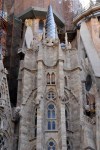
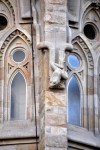
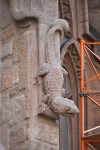
The side of the Sagrada Família to the right of the Nativity facade (shown obliquely in the first picture below) has no grand entrance and generally has a more conventional Gothic-like architecture; however, there are a lot of very interesting and unusual details, like the huge animals that can be seen slithering half-way down the side of the building.

The pictures below show details of these man-sized animals.

There are also plants hanging out here and there.

The left side of the Nativity facade is – or will be – the main entrance, the Glory facade.  It will be the largest and most striking of the facades.  Alas, it’s under major construction and not much to see now.  Ultimately the facade will represent how the soul navigates Death and the Final Judgment, avoids the pitfalls of Hell, and finds the eternal glory of God.  Expect the Seven Deadly Sins, the Seven Heavenly Virtues, demons, idols, purgatory, etc.

Opposite the Nativity facade is the Passion facade, addressing Christ’s death and resurrection.  And oh my, is it different!  The Nativity facade was built first because, as Gaudí put it, “If, instead of building this decorated, richly ornamented (Nativity) facade, we had started with the hard, bare and skeletal Passion facade, people would have rejected it.”  The Passion facade’s 4 spires were designed by Gaudí, as were the lower bone-like archways.  Gaudí intended the facade to be grim and terrifying, but with his (few) original plans destroyed in the Spanish Civil War, trustees had to piece together what they perceived as Gaudí’s vision.  Not surprisingly, what’s being done has been controversial (in 2008, more than 100 members of Barcelona’s art and architecture community protested its direction).  The overall appearance of the facade is stark – and

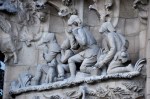
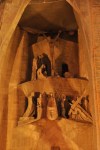
contemporary.  Details of some sculptures are shown below.  This side of the Sagrada is

sooooooooooo different from the Nativity facade!  But absolutely arresting.  A few more pictures of this side of the Sagrada are shown below.  I should point out that whereas the

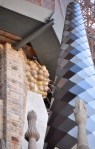
Sagrada gives the impression that it is mostly gray or tan stone, it does have some fascinating color decorations – often fanciful, and typically on its upper levels and spires –

as shown above.

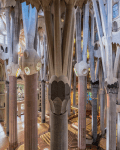
That covers what we could see of this fascinating basilica from the outside.  It’s amazing, yes?  Designed in the early 1900’s but avant-garde even today.  Gaudí was amazing.  And really you haven’t seen anything yet!  The interior is the mouth-gaping OMG part.  My intention was to also show off the Sagrada interior in this post, but due to my enthusiasm the post is already too looooong!  So you’ll have to wait to be blown away.  The next post will be the Sagrada interior; the picture to the left is just a small taste of what’s to come.  Don’t miss it!

I’ll close with a few pictures of the Sagrada exterior at night.

Stay tuned for the Sagrada Família interior, next post!


Barcelona IX: Art Museums

There are lots of museums in this beautiful city, and we’ve touched on a few already – the Maritime Museum (Barcelona V: La Rambla) and the Museu D’Historia de Barcelona (Barcelona VII: The Old City, called the “Barri Gòtic” or Gothic Quarter).  In this post we’ll visit the small but wonderful Museu D’Modernisme de Català, and then briefly visit Barcelona’s main art museum, Museu Nacional D’Art de Catalunya.  Somehow we still managed to miss a bunch of museums here, like the Picasso Museum, the museum (Fundació) of Joan Miro, and the Chocolate Museum (we missed a chocolate museum!!?.  Must be an excuse to come back).

Museu D’Modernisme de Català

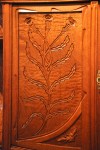
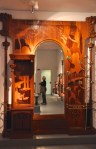
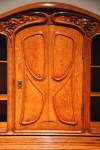
This small museum is dedicated exclusively to Catalan Art Nouveau (or Modernista) from the late 1800’s and early 1900’s.  It’s located in the Eixample neighborhood (Barcelona I, the Eixample) and is fittingly in a Modernista building, a former textile factory built in 1902.  A lot of the decorative art in this museum is simply the furniture from the trendy houses of the newly rich during this period.  Furniture, you sneer?  Oh, wait and see, you skeptic! These furniture makers took art and function to a new level.  As an example, the picture on the left shows an umbrella stand (!).  It’s different, functional and beautiful.

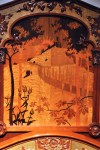
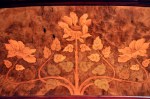
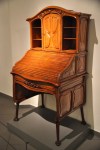
The rich in Barcelona were very rich, and the artists were very, very good.  In addition to the Modernista style of curved lines and emphasis on Nature, much of the furniture I’ll show you employs marquetry (wood inlay).  Using up to 40 different types of wood, the furniture decoration can look like a painting; don’t be fooled, it’s inlay.  There’s a lot of gorgeous furniture here, by many artists, but I’m going to show you just pieces from the cabinetmaker Joan Busquets i Jané, who also did that umbrella stand.  There’s a lot of his work here, all of it stunning.

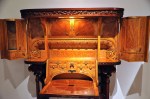
Below is a writing desk that Busquets made around 1896.  That base may look a bit stodgy, but that hinged desktop!  It’s amazing!  The marquetry of the lady weaving a tapestry is

spectacular; her dress is fabulous, the entire design exquisite.

The pictures below show a 3-panel screen.  It’s really nice, but I’m showing it now because

the one below, a 4-panel screen, is incredible.  Its marquetry is spectacular, but I don’t want you to think that Busquets was defined by this technique.  He was very inventive, and

marquetry was just one of his tools.  Below is an oak piece labeled “office furniture”, with interesting carving.

The coffer-writing desk shown below is spectacular and has a lot going on (maybe too much?), but individual details are wonderful.  That last picture above of the stylized cat

I find quite interesting. Busquets experimented a lot within the world of decorative arts, and his work is considered by many as the precursor for Art Deco, the style that followed Modernism.  That cat is very much Art Deco!

I hope you’re not tired of Busquets, because there is much more!  Below are two display

cases with beautiful decorations.  I personally think the piece shown below is awkward, but I love its rose motif inlay, including what I think is a clear depiction of black spot

(a fungal disease of roses) on one of the leaves.  If true, isn’t that cute??

The item below is called “Hall furniture”.

Humor me with just a few more items from Busquets, an oak dining room table, a

buffet, and one last display cabinet.  Of course there’s a lot more of the decorative arts from other artists in this museum!  A few are shown below.

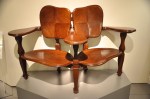
Some of the furniture in this museum was designed by Gaudí for his famous buildings.  Gaudí designed not only the buildings but also the smallest details in the buildings, including furniture.  The picture on the left is a hat rack of oak and wrought iron from

Gaudí’s Casa Calvet, the first residential building he built in L’Eixample (alas, we did not visit it – not sure you can).  On the right is a “boardroom bench” from Casa Calvet.  The chairs below are from Casa Batlló (Barcelona III: Casa Batlló), along with a photograph of

some of the original furniture in that amazing house.  Interestingly, the secretary shown below was a collaboration between Gaudí and Busquets.  It didn’t say what house the

secretary was from, but the design would have fit in nicely with Casa Batlló.

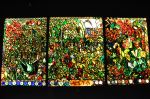
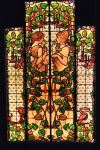
This museum also has some beautiful paintings, stained glass and sculpture.  Some of the stained glass is shown below.  The first two pictures, depicting a garden, are of a window

from Casa Trinxet, a L’Eixample Modernista building by Josep Puig i Cadafalchin (demolished in 1965 despite public outcry).  The first picture on the 2nd row is just an overview to show that these windows are not small!!  The last picture is cloisonné rather than stained glass.

The paintings aren’t bad either.  The pictures below are from the Spanish painter Gaspar Camps.  What?  You never heard of him?  We hadn’t either; he was born just a decade after

the Czech Art Nouveau painter Alphonse Mucha, whom we love (and the subject of a post once we write about our Czech visit), and Camps was clearly influenced by Mucha – to such an extent that he was called the Mucha Catalan.  If you like Mucha, you might want to check him out.

Another painter you know by now is Ramon Casas i Carbó, one of the backers of Els Quatre Gats (Barcelona VII: The Old City, called the “Barri Gòtic” or Gothic Quarter), and a big man in the intellectual and cultural scene of Barcelona at this time.  The first two pictures below are very nice charcoal/pastel drawings by Casas.  For the other two

pictures, obviously influenced by the Impressionists, I liked the water in the first and the very Toulouse-Lautrec-ish-ness of the last.

The sculpture was also impressive, as shown below.

Museu Nacional D’Art de Catalunya

Well!  This is developing into a long post!  I spent a lot of time showing you the small Museu D’Modernisme, so I’ll compensate by spending less time at this big one, housed in the grand Palau Nacional (built for the 1929 World Expo).  In truth, part of the reason we spent less time here was an incident involving Barcelona’s high-crime gypsy population.  I’ll tell the story in hopes that readers who travel might be better prepared.  Walking up the subway stairs that lead to the street in front of the Palau Nacional, 3 Romanians tried to steal my camera which (I thought) was hidden in an outer compartment of my backpack.  The theft was well-planned.  With the 3 walking more-or-less abreast right behind me, the middle guy unzipped the compartment holding my camera (without me noticing).  His plan was to yank out the camera and run down the stairs toward the subway, where the passageway splits into different tunnels.  I would instantly notice the change in weight, if nothing else, turn to catch the guy, and bump into the remaining two “innocent” guys right behind me.  What saved me was Ginger lagging behind on the steps, seeing the middle guy unzipping my bag, and screaming for the police.  I whirled and grabbed the middle guy, the other two running up the steps.  I asked Ginger if this was the guy (I didn’t know exactly what was going on, and he wasn’t protesting), but suddenly he whirled out of my grasp and ran down the (marble) steps.  So I tried to tackle him on the steps, from above, but either because my backpack shifted or he turned his shoulders, I was thrown off onto said steps, dislocating my shoulder.  The (plainclothes) police were there almost instantly and caught the other two Romanians (beautiful Barcelona does have a big petty crime problem that they’re addressing).  So the camera was fine, but we spent some time in a hospital and in a courtroom dealing with this issue.  The point: I think we would not have been a target had the camera been in an interior compartment of the backpack.

Back to the museum; in addition to a lot of art, much of it Catalan, it also has magnificent views of Barcelona from its terrace, as shown below.  Often called “the Prado of

Romanesque art”, it holds Europe’s best collection of Romanesque frescoes, mostly saved from remote Catalan village churches.  There’s also a lot of painted wooden alter fronts and ornate statuary.  Alas, those topics, mostly from the 1000’s to 1400’s, are not our favorite.  To be sure, there are paintings from José de Ribera, Diego Velázquez, El Greco, Fra Angelico, Salvador Dalí, and Pablo Picaso, but we made a bee-line to see more of the Modernisme decorative arts.  Interestingly, they weren’t better than what we had seen – but, of course, they’re still beautiful.  Below are some pretty spectacular pictures of

cloisonné stained glass.  And below, more furniture (and a vase).

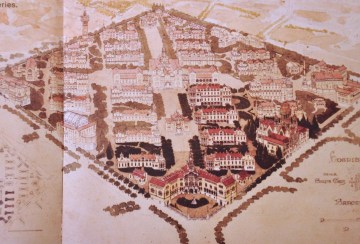
I’ll finish this post with some night pictures from this museum and the “Magic Fountain”.  The area in front of the Palau Nacional was the fairgrounds of the 1929 World Expo, with 3 squares on different levels, waterfalls in  the center, and the Magic Fountain in the first square (all designed by the modernisme architect Josep Puig i Cadafalch).  The Magic

Fountain takes its name from the impression it created in ’29, and it is absolutely mesmerizing even today.  The fountain has a large number of different water jets, a huge number of different combinations, and impressive lighting options.  It’s a water ballet.   I’ll give you a taste with a whole bunch of pictures.

OK!  The next post is not to be missed.  We’ve been saving it for last.  The building of the Sagrada Familia (translation: Holy Family) Roman Catholic church was started in 1882 and taken over by Gaudí 1883.  Today this magnificent Gothic/Art Noveau/Modern incredible basilica is nearing completion (well, within a decade anyway).  Designed 130 years ago, it’s still futuristic.  As one art critic said, “It is probably impossible to find a church building anything like it in the entire history of art”.  And that’s an understatement.  It is breathtaking.  Below are some teasers, pictures from the internet.


Barcelona VIII: Hospital de la Santa Creu i Sant Pau

Another Barcelona post?  We loved Barcelona, and we’re leading up to showing you the amazing Sagrada Familia – which was recently profiled in Time magazine, even.  Fear not – only this post and one other before we visit that incredible cathedral.

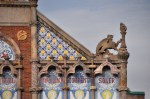
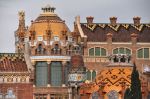
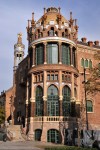
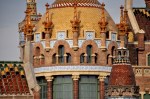
The Hospital de la Santa Creu i Sant Pau (Hospital of the Holy Cross and of Saint Paul) is a masterpiece of Catalan Modernisme, the turn-of-the-century architectural style that pervades Barcelona and that I’ve been showing off yea these many posts.  The hospital’s construction was started in 1902 by Lluis Domenech i Montaner, one of the Modernisme architects that we’ve met in previous posts (Barcelona II: Casa Lleo Morera, 1905, ; Barcelona IV: Palau de la Musica Catalana, 1908).  Twelve pavilions were finished by Montaner (who died in 1923), with another 15 finished by his son (but only 4 in Modernista style); the hospital complex was opened around 1926.  Although you might think “Sant Pau” stands for Saint Paul the apostle, you’d be wrong; the primary donor for the hospital was Pau Gil, a Catalan banker who left money in his will for a health center bearing his first name.  Somewhere I think there’s a sly sense of humor at play.

The hospital complex that Montaner designed was a “city within a city”, isolated by interestingly turning the square hospital site 45° to the existing street plan of Barcelona.  Clever!  The ground plan of the hospital is centered on intersecting vertical and horizontal axes that create a cross, the emblem of the former Hospital de la Santa Creu.  The individual pavilions are arranged symmetrically along the axes, each pavilion dedicated to a medical specialty (but linked together via underground pedestrian galleries that are pretty spiffy, as shown below).

Montaner was sensitive to the emerging theories of public health, and central to his plans were large open-air areas for patients’ enjoyment and well-being, with two gardens per pavilion.  Each pavilion was named for a patron saint, their statue presiding over the entrance.  With Victorian sensibilities in place, pavilions on the right were for men (with statues of male saints) and pavilions on the left for women (with statues of women saints).  The hospital complex is famous, however, not for its layout but for the pavilions’ fabulous and pervasive Modernisme designs – artistic flourishes of brick, stone, tile and ceramics in spectacular floral patterns, as well as emblems of Barcelona and Catalan history.

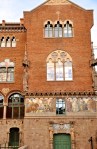
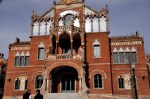
So let’s see it!  We’ll start with the entrance pavilion, which housed the hospital administration.  It’s the largest building and has the richest ornamentation.  As shown in the pictures below, the central building is crowned by a slender clock tower (one of Barcelona’s iconic landmarks), with the building’s lateral arms curving in a welcoming

embrace.  In a nice touch, note that the entrance doors (pictured below) are protected by guardian angels, two of which are shown below.

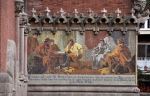
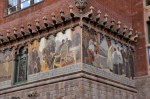
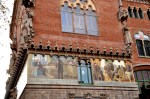
The outside of this building is adorned with other angel statues, statues of Catalan historical figures (mostly at the corners), and 16 impressive mosaic murals that encircle the building and depict events in the Hospital de la Santa Creu i Sant Pau’s history, a few

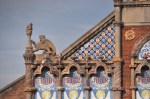
shown above.  Modernista detail is lavishly applied to the exterior (examples below), but the art is sufficiently separated that it manages to avoid the “too much” effect.

We’ll come back to view the amazing interior of this building, but first let’s look beyond the entrance pavilion.  Views of the hospital pavilions as seen from the Administration Pavilion are shown below, as well as an example of a garden.  In the first picture, the main

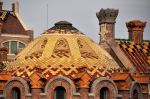
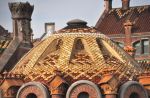
thoroughfare leads to the Operations Pavilion and behind that the Sister’s Convent pavilion.  Look at the open space!  This very roomy hospital/garden concept was a new one in the evolution of medicine, the idea being that trees and plants would provide better air, shade in summer, and a cheerful, optimistic atmosphere for recovery – far different from the previous medieval Santa Creu hospital that it replaced, which dated back to 1401.  The open area of this hospital far surpassed that of any other European hospital of its time.  Although the overall hospital layout is impressive, it’s mostly the Art Nouveau (eg, Modernisme) artwork that makes this a World Heritage Site.  Referring back to the first picture just above, note that the hospital pavilions have a similar structure and appearance – but that uniformity is deceptive; the art on each is a distinct riff on a theme.  As an example, below are the domes on a number of the pavilions; there is very little real duplication.

So let’s look at those pavilions!  We’ll start with the distinctive Operations Pavilion in the center of the main thoroughfare.  As the name implies, it was the surgical center.  Two of

the men’s pavilions are shown below.  The first picture, of roof tops, shows the Pavilion of Saint Rafael in the lower right corner and St. Manuel behind.  The Pavilion of Saint Rafael itself is shown in the next picture, and details of its colorful roof after that.  The Pavilion

of Saint Manuel (from 2 sides) is shown in the next pictures.

Crossing over to the women’s pavilions, the first picture below shows the roofs of the Pavilion of Our Lady of Montserrat, with the dome of the Pavilion of Our Lady of Mercy in

the foreground.  I’ll just show off some of the sculptures from the latter pavilion – the sculptures are always interesting, and all different; and although they’re everywhere, they

fit in nicely with the buildings.  And of course the tiles (examples below) are delightful.

Yes, I’ve shown a bunch of Modernista/Art Nouveau detail on the pavilions, but I can’t resist showing off a bit more of the wonderful art that’s everywhere.

Most of the pavilions are not open for tourists, the major exceptions being the Administration Pavilion and the Pavilion of Saint Rafael (named for Rafael Rabell, who helped pay for it).  The Pavilion of Saint Rafael originally housed the trauma department and had 44 beds.  It retains its original essence today; it has not been renovated or

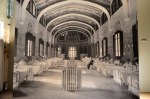
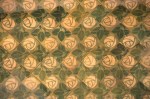
redesigned.  The pavilions included a broad lengthwise ward for the hospitalization of patients and a circular “day room” in which patients not confined to bed could be with their families.  The walls and ceilings were covered in ceramics for hygienic reasons, since ceramic materials are easy to clean.  Interestingly, in that last picture above, the ceramic tile roses are so very similar to the signature stylized roses of Charles Rennie Mackintosh in Glasgow from around this same time (Glasgow I, The City).

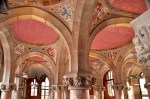
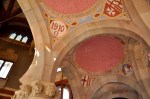
The other pavilion we can enter is the Administration Pavilion, and it’s the opposite of the very plain Pavilion of Saint Rafael; this Pavilion is gorgeous!  For instance, below are pictures of the foyer, with 9 circular or elliptical vaults clad in striking pink tiles.  The columns aren’t bad either, with their Modernisme flower motifs.  The vaults are decorated

with major symbolic elements, such as the dates (1905 [α] and 1910 [Ω]) of the building’s construction, coats of arms of Barcelona and Catalonia, the cross of Barcelona Cathedral and St. George, etc.  The beautiful stairwell that leads up from the foyer is located

underneath a cupola with a stained glass skylight, exemplifying Modernisme’s focus on light and color.  The cupola is beautiful, and worth a closer look.

Another short set of steps off the foyer leads to this corridor with an impressive tiled

ceiling of many flowers.  The rooms that open to the corridor are also striking (below).

Even more beautiful is the 2nd floor, reached by the main staircase.  Here the vaulted ceilings are 2 floors high, with huge windows.  This first room has 3 gorgeous vaulted

ceilings, shown above (and a view of the Sagrada Familia from the window [it’s coming, it’s coming, promise!).  The adjoining room is even more spectacular; it’s too big for me to capture in an overview, so I had to crib the left image below from the internet.

The floor-to-ceiling windows provide a great overview of the pavilions, as shown in the right picture above, a view I showed you earlier.  The windows themselves are quite attractive, as are the vaulted ceilings overhead.


There’s lots of other artwork to show off in this room, such as the impressive wall shown

above.  I’ll end with a few more pictures of this room’s art.

Well, another long post.  There was so much art jammed into this hospital, but somehow it managed to be balanced; beautiful everywhere, but not overwhelming.  Hope you enjoyed it.

Next post – Barcelona’s art museum highlighting the amazing wood inlay art of the Modernista period.

Barcelona VII: The Old City, called the “Barri Gòtic” or Gothic Quarter

The Gothic Quarter of Barcelona, the Barri Gòtic, was the center of the Roman city of Barcino and, subsequently, of medieval Barcelona; it’s still the site of several government buildings, including City Hall.  Once confined by city walls, its maze of narrow streets periodically open out onto secluded squares ringed with delightful cafes and boutiques.  Happily, much of the Barri Gòtic (“El Gòtic”) – an extensive area – is closed to regular traffic, making it a haven for pedestrians.  However, although several buildings date from medieval times, most of the Barri Gòtic was rebuilt in the late 1800’s and early 1900’s when it underwent massive restoration projects for the 1888 Universal Exposition (international fair) and the 1929 International Exhibition.

We’ve seen some of the west edge of  El Gòtic when we did side excursions from La Rambla (post Barcelona V); we visited the Temple of Augustus, the church Santa Maria del Pi, and the plaza La Placa Reial.  In this post we will pretty much walk down the middle of El Gòtic, enjoying fanciful ironwork on its balconies, painted tiles, sgraffito and sculpted

wall decorations (examples above).

Starting from the elegant main Barcelona plaza (the Placa de Catalunya), we’re taking the road Portal de L’Angel into the heart of the El Gòtic, and the pictures shown above are from the early part of that road.  Our first stop is the cafe Els Quatre Gats (The Four Cats, derived from a Catalan expression referring to people who are outsiders or a bit strange).   Time for some history!  Señor Pe Romeu had worked in a French cafe and decided to open one just like it in Barcelona.  He had 3 backers who were major modernist Spanish artists, among them the painter Ramon Casas.  In 1897 Els Quatre Gats opened in a modernist building designed by Josep Puig i Cadafalch (you met him in the Barcelona I post).  The owners wanted the cafe to be known for its good and inexpensive food, but also for its “food of the spirit,” a place of music and ambiance where artists could meet to discuss their work or news of the day.  The cafe quickly became a popular haunt for artists (and architects, such as Gaudí).   It hosted performances, concerts, art exhibitions and literary gatherings.  The 17-year-old Pablo Picasso frequented the cafe and held his first solo exhibition in the main room.  So let’s see El Quatre Gats!  The exterior is pretty impressive, with Hobbit-like doors and windows and stone carvings everywhere.

Picasso himself made a poster advertising the cafe, shown below, and inside the cafe hangs a large painting of Ramon Casas and Pe Romeu on a bicycle (the painting by Casas).

Unfortunately Romeu was not a businessman, allowing tabs to go uncollected, and Els 4 Gats went out of business in 1903.  It wasn’t until 1978 that the famous cafe was again reopened to the public; shown below are pictures of the interior of the restaurant as seen today.

Further down we come to the plaza Placa Nova and two Roman towers flanking the main street, shown in the first picture below.  The towers once guarded the entrance gate to

Barcino.  Although much has been reconstructed, the big stones at the base are original.  Before going down that narrow street between the two Roman towers, if we were to look above the wall of buildings to the left of that first picture above, we would see the towering Barcelona Cathedral, shown below.   Let’s go see it!  Walking down that narrow street into the heart of El Gòtic, we pass underneath the attractive Carrer el Bisbe bridge that connects Catalan government buildings, shown below.  Although it looks old, it’s only from

the 1920’s.

The area where the Cathedral now stands has been a center of worship since the 300’s, but the Barcelona Cathedral (real name: Cathedral of the Holy Cross and Saint Eulali) dates from the 1300’s.  The facade was added in the late 1800’s in Neo-Gothic style called

“French Flamboyant”.  It’s not the most impressive cathedral, but it does have some gorgeous medieval artwork.  We visited it in the evening, so lighting was a bit dim.  We entered directly into the cloister, which was completed in 1448.  Its courtyard is startling – rather than your manicured, mostly open formal-garden-like courtyard, this one is

practically a dense lush forest, with tall trees (including palm trees) and a fish pond/fountain that you can dimly see above.  Pictures of the cloister and some interesting doors are shown below.

It’s hard to capture the layout of the cathedral interior.  The vaulted ceiling covers 5 aisles, but the outermost two aisles are not passageways; they’re divided into 28 chapels.  Interestingly, these chapels function not only as places of worship but also as interior buttresses supporting the roof (note the absence of typical Gothic buttresses on the external walls in the picture of the Cathedral facade above).  Below are pictures of one of the aisles and a view back to the Cathedral entrance.  It does have a rough charm to it.

Views to the alter are shown below, with its 9 radiating chapels.

The decoration covering the point where ceiling vault ribs join is called a “boss”, and the bosses here are intricate and gorgeous, some examples shown below (they’re also hard to photograph with a hand-held camera, in dim light, upside down!).

The ornately carved choir is impressive, with the choir stalls retaining the coats-of-arms of Charles V’s knights of the Order of the Golden Fleece, from 1519.  The nearby organ (1538)

and other details are pretty spiffy.

Now to the good stuff, the art in the many chapels.  There are 28 chapels, so I’m not going to show you all of them!  Besides, many of these chapels feature very large, busy, gilded, ornately carved alterpieces, such as that shown to the left.  They’re not my favorite; over-the-top exuberance can just be too much.  I prefer the old medieval paintings, with their fledgling relearning of perspective, patterned gold, beatific faces, and gorgeously painted vestments.  I hope you like them too, because I’m going to show a bunch of them!

Below are pictures decorating the Alterpiece of St. Gabriel the Archangel, painted in 1390.

I love the general lack of perspective, which wasn’t introduced in medieval painting for another couple of decades.  And Christ ascending into heaven in the next-to-last picture – there go his feet!  Another impressive alterpiece is The Alterpiece of Bartholomew and St. Elisabeth, from 1401, shown below.

I think it’s beautiful, as is the Alterpiece of the Transformation of San Benito from about 1450, below, that the Cathedral considers one of its more important Gothic pieces.  The

artist is Bernat Martorell, who did some really cool stuff (eg, see his painting “Saint George Killing the Dragon”, at the Art Institute of Chicago, at this link:

https://www.artic.edu/artworks/15468/saint-george-and-the-dragon

Another impressive alterpiece is The Alterpiece of St. Clair and St. Catherine, from about 1456, shown below.

Increasingly sophisticated technique is shown in The Visitation, showing St. Luke and St.

Sebastian, painted around 1470.  Lastly I’ll show the Alterpiece of St. Sebastian and St. Tecla, from around 1490.  The paintings are great, as shown below.  It’s always a treat to see art in the space for which it was designed.

OK!  We’re done with alterpieces!  Hope you enjoyed them.  The Cathedral is a veritable museum.

Below are a few more treasures to show off: a chapel with some gorgeous frescos, a baptismal from 1433, and a stained glass window, small and high up, from 1495, – and I think impressive for its time.

We’ll end our visit to Barcelona’s Cathedral with a view of the facade at night.  And with all that walking, how about a tapa or two?

At the start of this post I mentioned that the Barri Gòtic was the center of the Roman city Barcino, so you might guess there are Roman ruins here.  Yep, and they’re pretty cool.  In an earlier post you saw the ruins of the Temple d’August (Barcelona V: La Rambla).  Well, there’s a lot more, thanks to a city renovation that relocated a 1400’s gothic palace to a plaza near the Cathedral, the Placa del Rei, where ruins from a large section of Barcino were discovered underground.  The museum (Museu D’Historia de Barcelona) is centered on the Palau Reial Major (the Grand Royal Palace, shown below) that consists of 3 edifices from 1302, 1360, and 1549.  The picture on the right is the Palace’s main hall, built in 1360, the arches founded over vaults from the 11th century (which were built over a

monumental structure dating from the Visgoths’ rule [5th to 8th century]).  Interesting in its own right, over time the Palace was the residence of the counts of Barcelona, the Kings of Aragon, site of the Inquistion, and the royal administration.

Just for overview, I’ll start with representations of Barcino, shown below.  The excavated

ruins beneath the Placa del Rei date from the 1st to the 6th century and include an extensive area of workshops and an “episcopal ensemble”, the bishop’s residence and other buildings devoted to Christian worship (me – showing a remarkable transformation from paganism to Christianity within 200 years).  We’ll visit a piece of the city wall, ruins of a laundry and a dyeing workshop, a factory for salting fish and making fish sauces like garum, an important wine business, and some of the episcopal ensemble.

We’ll start with the inside face of the city wall, from 15-10 BC; originally 26 feet high, what we’re dealing with here are short sections and foundations, but they are the unaltered real

deal.  The last picture above shows the interior of one of the 78 towers that was built on the outside of the wall; notice the extensive use of recycled material.

Although we’re seeing just short walls and foundations, they’re still pretty revealing, as you’ll see subsequently.   The picture here shows a wall, a door, and a sewer.
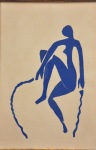
The workers’ homes and shops opened to a street, as shown below in the schematic  visualizations.  In the last picture, the street had a portico for pedestrians and led from
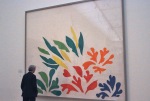
the city wall to the forum.  The stone structure in the front is a sewer, reformed in the 3oo’s.
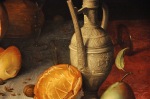
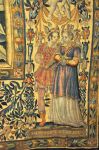
The following workshops are essentially small factories!  We’ll start with the laundry and dye shops from the early 100’s.  The drains and vats contained preserved colorants, lime

and starch for bleaching and sizing, and ashes and ammonia for detergents.  Note: the Romans were not acquainted with soap, and used instead different kinds of alkali.  The most common ingredient was the urine of men and animals, mixed with the water in which the clothes were washed.  The urine was typically supplied by vessels placed at the corners of streets, filled by passers-by.  We’ve come a long way, baby.

Nearby was a factory from the 200’s for salting fish and making fish sauces like garum.  Garum in particular was very popular in Roman times, made by macerating fish offal in

salt, sometimes adding anchovies, oysters, or other shellfish.  We mentioned it before in a (much) earlier post (Malaga, Costa del Sol).

Most impressive is an extensive wine-making facility, used from around 250 AD into the 300’s.  There were several vats for settling and pressing the grapes, transfer ducts for the

must (using gravity flow), and vats for fermentation of the must.  Subsequently the wine was processed and aged within dolia in the cellar, where honey and sea salt were added.

The two smaller vessels embedded in the floor in the pictures above were used to hold the honey and salt.

Also preserved in this Roman area is part of the peristylum (porticoed garden) of an important Roman house – probably the proprietor of the winery and garum factory.

The house is important because in the AD 300’s its owner gave part of his property to the emerging church, making it possible to build a basilica and baptistry in 343 AD.  In the AD 400’s with the increasing power of the bishops, an episcopal palace and hall were built (the city had been conquered by the Visigoths, but they tolerated the practice of Catholicism).  In the 500’s a cruciform church was built within the “episcopal ensemble”,
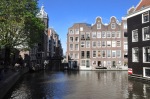
leading eventually to today’s Cathedral.

Some of the Roman art found in these ruins is impressive for this part of the woods.
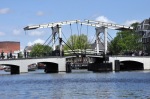
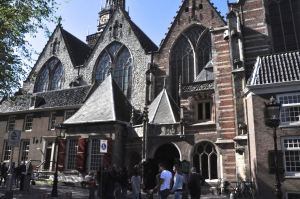
Finally I’ll end this oh-so-long post with a walk through El Gòtic just looking at the interesting art on the buildings and the small medieval streets.  It’s an interesting area of this city, and I hope you enjoyed it!

Next post – Hospital de la Santa Creu i Sant Pau (Hospital of the Holy Cross and of Saint Paul), designed by Lluis Domenech i Montaner and considered to be one of the best Art Nouveau complexes in the world.  You’ll be impressed.