Isle of Harris

The “Isle of Harris” is a misnomer; it’s not really its own island.  This largest of the Outer Hebrides Islands is actually called Lewis and Harris, one island, Harris being the southern part.  But what the hey, let’s go with convention and call it the Isle of Harris.  We’re going there in part for the scenery and in part because that’s where they weave the famous Harris Tweed – we’re hoping to buy some.  Sports coats and hoodies, here we come!

We mentioned the Lewis part of the island previously – remember the Lewis Chessmen (post of Edinburgh I)?

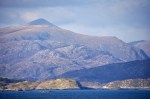
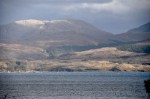
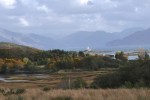
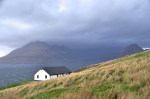
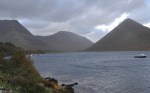
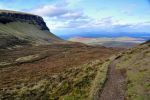
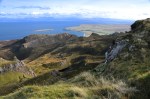
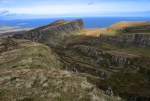
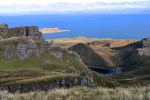
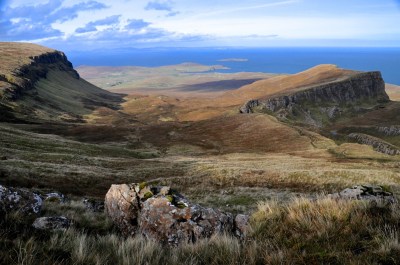
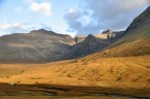
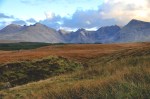
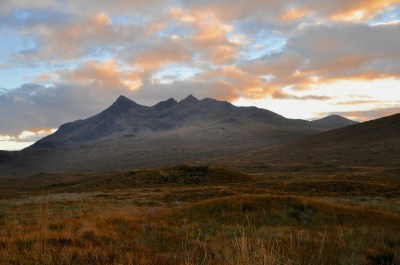
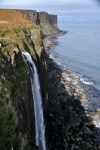
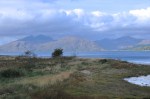
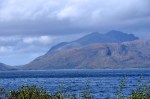
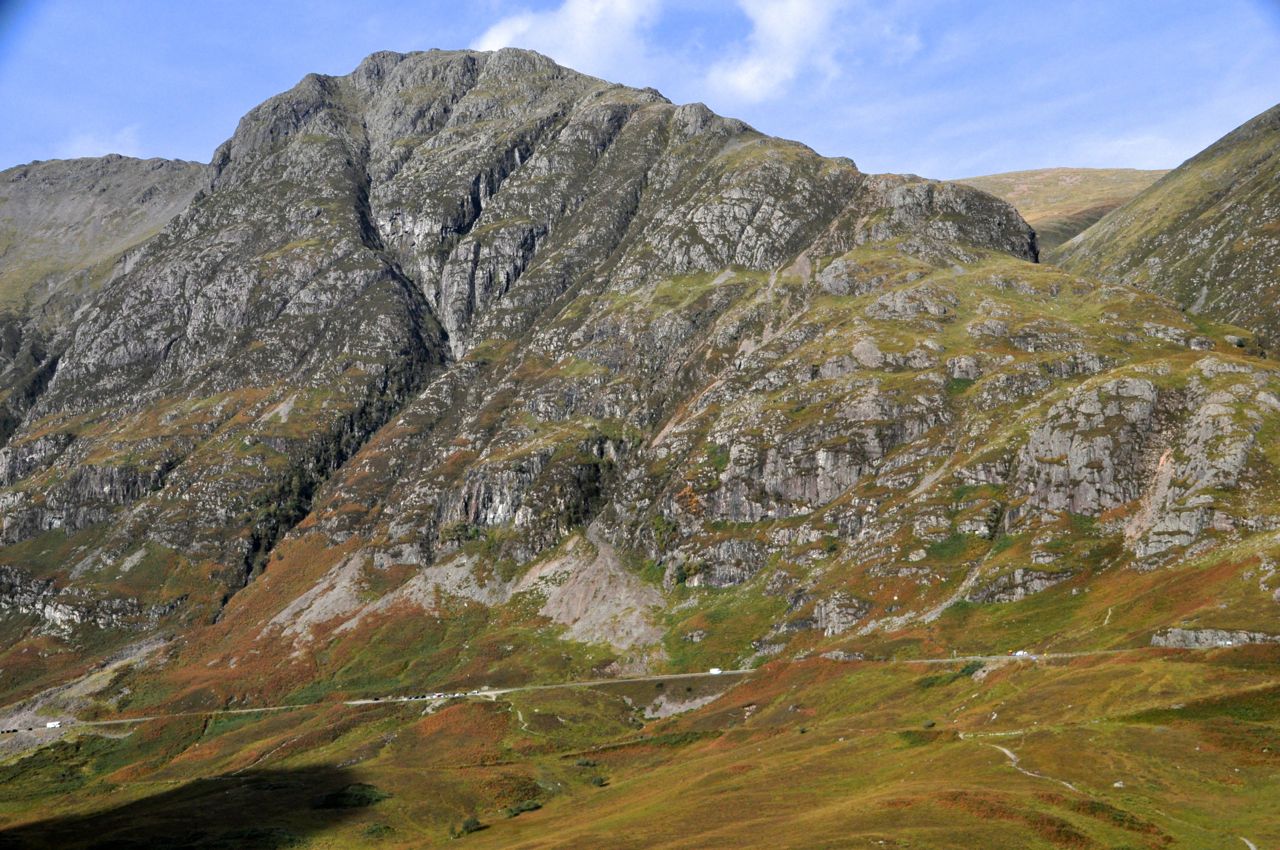
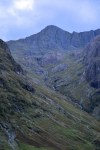
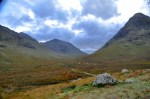
Coming from the mountains of the Isle of Skye, we were unprepared for the Isle of Harris.  It is so different!  Below are pictures of the coastline as we approached the city of Harris.

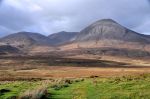
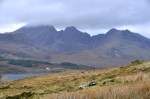
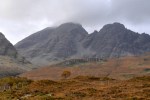
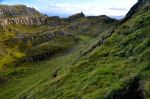
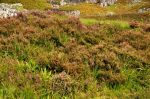
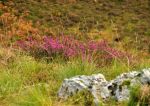
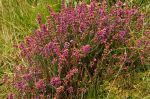
The mountains are anything but craggy; they’re weathered, with a very speckled appearance.  It does not look like good farm land!  As we travel inland, it’s all the same; mostly rock, with a little bit of heather and grass thrown in for contrast.

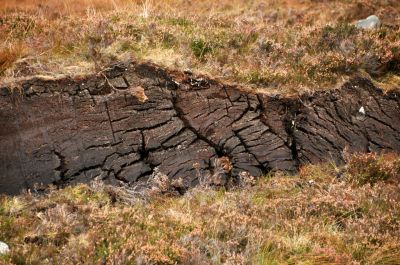
Layers of peat under that grassActually, at least in spots it’s not all solid rock underfoot.  Some exposed areas show deep layers of peat.

This southern part of Harris has a number of gorgeous unspoiled beaches, one of them shown below.  I think it’s pretty cool to see beach, sea and mountains all in the same view!  The beach goes on forever, and we practically have it all to ourselves.

Also in southern Harris is the medieval church Tur Chliamain (St. Clements Church).  The

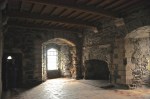
church was built around 1520 by the MacLeod clan chiefs of Dunvegan and Harris as their future burial place.  Like most things that old, it’s not exactly the original structure.  The church fell into ruin after the Protestant Reformation of 1560; it was rebuilt 200 years later by a MacLeod, and restored again in 1873.  Still, it’s believably old, and beautiful in its simplicity, as shown in the first two figures below.

The church contains a number of tombs of important MacLeod chiefs outfitted in their battle armor.  The bottom left picture (above) shows the tomb of Alasdair MacLeod, 8th Chief of the MacLeods, who personally commissioned his tomb and its carvings and was buried here around 1545.  The last picture above shows 4 stones with sword carvings dating from the 1400’s and 1500’s that once marked the burial places for members of Clan MacLeod.  The swords represented strength and power.

In the pictures below you can see how picturesque this place can be, as well as to show that there are a few areas that aren’t covered by stones.

The northern part of Harris is more mountainous, as shown below.

The (very) small village of Arnol on the west coast of the Isle of Lewis used to be a thriving township with 40 crofts; now there are far fewer.  Crofts were plots of land rented to tenant farmers in the early 1700’s; rents were high, tenant rights were non-existent, and most were barely making it.  More than a century later their land was given to them via special legislation.  Here on Lewis the houses on a croft are called blackhouses, and Arnol has a lot of them – but most are deserted ruins.  One that has been preserved is now a state-owned Blackhouse Museum, shown below.  Alas it’s closed, but it is still interesting!  It’s huge!  But the doors are small – even Ginger would have to stoop to enter.

There’s an interesting attached circular “beehive” structure in the back; maybe a kitchen?  The next-to-last picture shows how small the beehive door is.  That hole in the roof just above Ginger’s head must be some sort of exhaust, unusual in these structures.  Finally, in the back there is a decent supply of drying peat logs.  A historical sign says that the peat fire was the center of family life in a croft and was never allowed to go out.  The smoke rising into and through the roof had benefits: it killed bugs, and when the roof was replaced, the smoke-ladened thatch made excellent fertilizer for the fields.

A coo, working hard to keep the grass lowNearby we spot another coo.  Isn’t she cute??

Further down the road we encounter the larger Gearrannan Blackhouse Village, consisting of 9 restored traditional thatched cottages.  The good news is that they’re open!  The bad news is that most of them are self-catered apartments for rent, not for sight-seeing.  However, the oldest blackhouse is a museum, and a chance to learn

more.  The low profile and insulating thatch of these houses were designed for the Hebrides weather, and for 300 years people eked out a living here; they paid their rent or were quickly evicted if they didn’t.  When the crofters were given their land in 1886, their approach to the houses – now theirs! – changed.  The blackhouses in this village date back only to those late 1800s (they seem much older).  Of note, these particular cottages were continuously lived in until 1974, when the last few elderly residents decided they no longer wanted to put up with the annual maintenance of thatch and stonework.Model of blackhouse interior

In earlier years the blackhouse  accommodated livestock as well as people.  People lived at one end and the animals lived at the other with a partition between them (the livestock would also add to the warmth of the house).  A model of such a blackhouse was in the museum and was pretty cool.  The central room contained the kitchen.

On to something different!  For those who do not know about the famous Harris tweed, here’s a little history.  For centuries the islanders of the Outer Hebrides wove cloth by hand, and by the late 1700’s cloth production was a stable industry for crofters.  With the industrial revolution, mainland manufacturers turned to mechanization, but not the Outer Hebrides, where the high-quality handmade fabric was ideal for protection from their cold, wet climate.  Because the cloth was hard-wearing and water resistant, a Countess of a north Harris estate had clothes made in the family tartan for her staff.  She was quick to see that the jackets would be ideal attire for the pursuit of country sports and the outdoor lifestyle that was prevalent among the landed gentry and aristocracy.  With promotion, it soon became the fabric of choice for the wealthy, and the rest is history.  Today, to be called Harris Tweed, the cloth must be made from pure virgin wool dyed and spun in the Outer Hebrides, hand woven on a treadle loom by the islanders at their homes in the Outer Hebrides, and finished in the Outer Hebrides.  Every 50 yards of Harris Tweed are checked by an inspector from the Harris Tweed Authority before being stamped for approval.  As we drive around Harris and Lewis, we spot a sign from a weaver welcoming guests.  He’s in a small shed adjacent to his house.  Heating is by peat fire.  The encounter
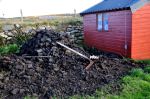
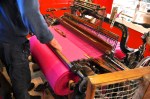
was fascinating.  The treadle loom looks its age, with gears and many moving parts working in the best Rube Goldberg fashion, spinning and turning and clattering away.  The work seems slow and tedious; no wonder the weaver wanted company.  Alas, the particular cloth he was weaving was a single (vibrant!) color, and not our taste.

Those familiar with Harris Tweed know that one of their distinguishing characteristics is the use of a complex blend of colors.  What looks like a gray or brown jacket could easily have 20 or so colors in it, including deep red, purple, rusty orange, green, etc.  Clothes from Harris Tweed are amazing.  Take a look at that brown sport coat I bought.

On closer inspection, the cloth seems to have every color in it except brown!  Isn’t that cool?  We will be sooooo stylish in our dotage.
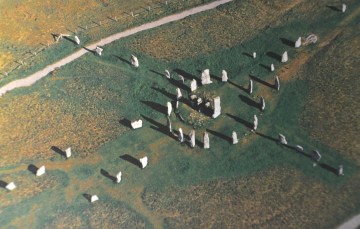
Callanish StonesOur last topic is the amazing Callanish (Gaelic: Calanais) Stones on the west coast of Lewis.  That aerial view to the left is a picture I took of a postcard.  I would describe the site as a low ridge on which there is an arrangement of standing stones placed in a pattern of a cross, with the long arms oriented north-south, encompassing a central stone circle.  Yeah, but that kinda misses the fact that they are 5000 years old and likely a focus for prehistoric religious activity for at least 1500 years (!).   The ritual landscape was wider than this site; within a radius of 3 miles are 12 other standing-stone sites, a couple of them just visible from here.  The stones were erected in the late Neolithic era, starting around

2900 BC (just for perspective, the earliest known Egyptian pyramids were started about 300 years later, around 2630 BC).  Up close, these silent vigil stones are impressive in

their massive size, ethereal beauty and mysterious function.  The purpose of the site is not known, although there are a number of folklore, religious and astronomical theories (petrified giants who would not convert to Christianity, a prehistoric lunar observatory …).  Note in the next-to-last picture how big those suckers are compared to Ginger!  That largest central monolith weighs about 7 tons (requiring a Herculean effort to transport, position and erect) and has an almost perfect north-south alignment.  The chambered tomb, or what’s left of it as shown in the last picture, was built somewhat later than the stone circle and contained ceramic pots holding cremated bodies dating between 2000 and 1700 BC.  Somewhere between 1500-1000 BC the complex fell out of use and was despoiled by later Bronze Age farmers.

Although the stones are stunning – almost haunting – it is not clear to me why our Neolithic people chose this particular site; the area is pretty, as shown below, but nothing

extraordinary.  Of course this is 5000 years later …..  I have to think these remarkable monuments from our ancient European ancestors attest to their – and humankind’s – need to better understand the world and their place in it.  We’re still asking those questions, aren’t we.
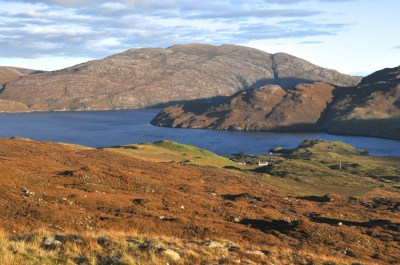
The Isle of HarrisThis is a last shot of the Isle of Harris.  It is a pretty place.  The next set of posts, and the last from bonny Scotland, will be from Glasgow with its fabulous Mackintoshes.


Isle of Skye IV – Strathaird and Sleat Peninsulas

This post is a brief tour of the southern part of the Isle of Skye. I don’t have any stories to tell about the area, so I’ll just show you some pretty “drive-by” pictures. We’ll first make a quick visit to the Sleat Peninsula, then drive to Elgol (at the end of the Straithaird Peninsula) to view the Cuillin Hills from the other (east) side.  Previously we had visited these hills from the west (Isle of Skye II – Fairy Glen, Dunvegan, and the Cuillin Hills).

View of the mainland from the Sleat PeninsulaSleat is mostly flat, but it has great views across the water to the mainland (picture on the left). The series of pictures below capture Sleat nicely. They were taken from a single location, although the first picture was taken on a different day than the rest.
 

The pictures below are of the Cuillin Hills again, but this time from the eastern side.

On our way back we come across “Cill Chriosd” (Christ’s Church), a ruined parish church.

It’s small and simple, but the ruins are old.  Written records announcing the replacement of a chaplain for the church date back to 1505.  It’s interesting to compare these simple rural structures with the overwhelming, grand cathedrals of the cities, many of them built even before this parish church.  The impressive cathedrals are a testament to what humankind can achieve, given a purpose; these parish churches, like the beautiful Gallarus Oratory in Ireland (Southwest Ireland Tour III – Ancient Christianity), to me question what that purpose was.  Really, they’re both beautiful in their own way.

Have I mentioned that it rains a lot in Scotland? But there is an upside, as you’ll see in the pictures below, taken on this rainy day – the hills come alive with waterfalls!

Below are two final pictures as we leave the Isle of Skye.  I hope you enjoyed this beautiful island as much as we did!

Next post – the Isle of Harris (and Harris Tweed).

Isle of Skye III – Return to the Quiraing

Because that bit of the Quiraing hike we took in the Skye I post was pretty fabulous (Isle of Skye I – The Trotternish Peninsula), I’m off to do the entire loop hike, expecting great things.  However, the trail has some pretty tough parts as we discovered in Round I, so Ginger is having none of this adventure and is opting for R&R.

Sgùrr nan Gillean in the morningThis morning I’m greeted by the Sgùrr nan Gillean peak looking quite spiffy.  It would be fun to climb that beast, but not this trip; I kinda doubt it’s a day hike, plus there would be mutiny.

The trip back to the Trotternish Peninsula is picturesque, with views of Raasay Island and behind it the mainland (below).

Here we are, and off I go.  You’ll perhaps recall this stunning scenery that one sees immediately at the trail start.  No long walk to the pretty parts here!

I want you to remember that long wall of cliff-face rock off to the left in the images above.  It’s impressive, but there is more to the story that I’ll come back to later.  The view ahead is gorgeous, but the view to the right is dazzling, as you may recall.

Those mountains are the Trotternish Ridge, receding into the distance.  OK, time for new territory!  I’m now where no Warner has gone before, making it to The Prison (many of the

rock formations have names).  Now over the ridge – and it’s beautiful.  That’s probably the

Outer Hebrides (islands) there in the distance, which we will be visiting.  The view on the left is all rock cliff, imposingly close, as shown below.  That thin vertical rock formation in

Narrow trail with crumbled edgethe first picture above is called “The Needle”.  As you can see in the other two pictures, we’re following the cliff wall to new mini-mountains up ahead.  The trail is easy enough but it’s narrow, and occasionally when the hillside is quite steep, the downhill edges of the trail become a bit unstable.  The trail shown in the left picture is less than a foot wide; walking across it is not unlike walking a gymnast’s balance beam, with consequences for slipping off.

The trail continues counter-clockwise around the rock cliff, and I’m in the shadow of that cliff surrounded by a jumbled but interesting terrain – and a nice spot for a lunch break.

The trial rounds the bend and starts steeply up – below is rock cliff, above is grassy slope.  Then, Voila! – I’m through a notch, and turning left I’m at the base of a huge ridge.

Really it’s more like a very long sloping plateau; this is where the trail starts to loop back.  The trail heads to the top of the cliff and continues along the cliff edge.  Before long I reach a spot where I can look down and see where I ate lunch.  From here, the combination of mountain, lake, sea, island and rock create views that are amazing, as shown in the first two pictures below.  They were taken while standing in the same spot, the second one

turned 90°.  Wish I had taken the 360!  Even better, the higher you hike up that sloping plateau, the more awesome the views become (last picture above).

Near the top of the sloping plateau, looking back downI love this picture!  The view is fabulous, but it also helps you appreciate the huge “sloping plateau” I’m on, which is very much like one to the far right in this picture, but much bigger.

A surprising observation is that, in spite of the plateau’s steep slope and the lack of rain today, the ground is a marsh, even near the top!  I’m trying to walk on clumps of grass to keep my feet dry.  If the ground is usually that wet, it might help explain the relatively low diversity of plant life.

View from the topI’ve finally reached the top; this high up, there’s a commanding view, shown on the left.

There’s not much of a trail anymore.  As I continue along the edge of the cliff, I’m surprised to discover that I’m not on the cliff I thought I was on.  In front of and some distance below me is a secluded green plateau that’s hidden from the first part of the trail by vertical rocky projections.  Those projections are the back side of the long rock cliff the trail followed at the beginning of this hike – it’s a cliff in front of the cliff I’m on!  The secluded plateau is called “The Table”, and I discover later that

“Quiraing” is from Gaelic (“cuith raing”) meaning “a pillared enclosure”.  It is that!  I’d like a better picture of the Table, but the ground slopes down ever more steeply toward the cliff edge.  So, discretion being the better part of valor, I’ll have to be satisfied with the pictures above.  Besides, Ginger would kill me if I slipped over the edge!

It’s pretty up here, as shown below.  The two hikers in the first picture below should

provide some perspective.  Distance and height are greater than they seem.

Finally, a last view from on high, looking down the Trotternish Ridge.  Impressive, isn’t it?  A spectacular finish to a spectacular hike.  That last picture shows the trailhead parking

lot at the far right.  Still a ways to go, bushwhacking down the mountainside.

Hope you enjoyed this long description of the Quiraing Loop.  As you can tell, I certainly did.

Next post: Isle of Skye IV, Strath and the Sleat Peninsula


Isle of Skye II – Fairy Glen, Dunvegan, and the Cuillin Hills

FAIRY GLEN

We’re off to explore some of the Dunvegan Peninsula, but first we’ll detour to the Fairy Glen that we’ve heard about.  As we find out, it’s not so easy to find those fairies!  We’ve driven Waterfall on adjacent hills near Fairy Glento a rural setting, and after traveling back and forth on a narrow winding road devoid of signs or parking lots, we decide that two cars parked at the edge of the road must mark the spot, and off we hike up some hills.  Behind us in the distance is a pretty impressive waterfall!
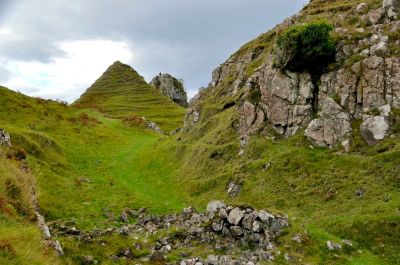
Scrambling up through ferns The Fairy Glen coming into sightand scrub trees, we begin to see a unique landscape of furrowed conical hills.  The glen itself is a small secluded area – fitting for small fairies, right?  It has a rocky pinnacle that will provide an overview, so up I go.  The scramble is a bit precarious, with edges on both sides, and Ginger decides to explore from below.
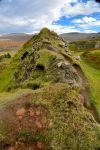
Well, climbing the pinnacle was fun, and the textured hills are interesting, but I don’t

see any fairies, alas.  Ginger is in the glen below, still looking for fairies while waiting for me to come down.

Based on what we saw in New Zealand, I believe the interesting texture on the hills is nothing more than years of sheep walking more or less horizontally across the hills.

DUNVEGAN

Share the roadNow on to the Dunvegan Peninsula!  The roads here – like many of those on Skye – are one lane, making driving more interesting.  Usually the roads are paved, but not always.  And as shown in this image, I think “traffic jam” on this island means nose to butt sheep on the road.

The Dunvegan Peninsula doesn’t have the bigger hills, but it’s pretty enough, as shown below.  We’re off to hike to the Coral

Beaches.  That’s the name, but in reality this is just UK wistful thinking; coral isn’t quite right (have you heard of the coral reefs of Scotland?  No?  Truly, their closest thing here to a tropical fish is called a “herring”).  As you can see below, the beach is distinctively white,

and indeed attractive, but it’s actually composed of white shell and calcified seaweed.  We hike further to an overview of Lovaig Bay, but the most interesting thing is simply the abandoned wall shown below.  Whatever it contained is no longer there, but the wall itself

is beautifully constructed.  Returning home, we pass Dunvegan Castle, home of the MacLeod clan, and continuously occupied by them for 800 years.

THE CUILLIN HILLS

On the road to the Cuillin HillsWe’ve relocated further south to be near the Cuillin Hills, shown here off in the distance.  Notice that these “hills” are on the big side.  They’re only about 3000 ft high, but they’re as craggy and jagged as any alpine range.  They dominate the skyline of most of Skye.  I’d say they’re at least mini-mountains, yes?  Can’t wait to go climb one.

We’re staying at the Sligachan Hotel, a 100-yr old hotel that is a haven for hikers.  Other than a very impressive view of some of the hills, there’s not much here – it’s pretty isolated.  Below are two views from outside the hotel – not too shabby.

Other views below.

Today we’re off to climb Coire Lagan, a hike from the south side of the Cuillin Hills.  Another view of Cuillin Hills“Coire” is a Scottish (Gaelic) name for a cirque, an amphitheater-like basin gouged from a mountain by glaciers – see the first picture of the Cuillins a couple pictures above – the Sgùrr nan Gillean peak.  To get to Coire Lagan we have to circle around the Cuillins, enjoying the views of the mini-mountains such as those shown here.

Our hike starts at a pretty point on a beach, the first picture below.  Actually, we’ve already

hiked up a pretty steep hill to get to this vantage point.  Where we’re going is Coire Lagan, the right picture (above); notice in that picture that the trail is tough – it’s uneven and laced with protruding rocks; you really have to watch where you put your feet.  Below are

looks back out to sea, one with Ginger chugging along.  The only sign of life, other than us, is a single sheep in this wide expanse.  The views keep getting better as the trail goes

unrelentingly up.  The hike approaching Coire Lagan is shown below.  Notice how quickly the sky changes from overcast to sunny!  This is Scotland, and the weather can turn on a

dime.  Also note there is a rock wall up ahead that’s going to have to be climbed!  The last picture above shows another sign of life, a deer.  Unlike the US, they are not prevalent here.

The trail has been a lot steeper than it looks in the images above; perhaps the first picture below gives a better perspective.  Now we have to scramble up that rock wall, and it too is

going to be a lot harder than it looks from that last picture above.  Ginger decides she will wait at the base and let me tell her about what I see (it hasn’t been an easy hike!).  I’m hoping there will be a small but beautiful lake at the cirque base, which is usually the case.  Water sluicing down says there should be.  And there is, although it’s quite small and a bit

disappointing.  Still, it’s pretty enough.  The view from up here is quite a window on the world.  It feels like being half-way up to the space station, even though I know I’m just a

few thousand feet high.  One last look, and then back we go.  Ginger is really tired, but is

still enjoying the view back down, with a setting sun.

The Cuillin Hills, driving home, are pretty in this light, as shown below.

This last shot is of Sgùrr nan Gillean back at our Sligachan Hotel.
Our next post will feature a return visit to the beautiful Quirang.  The little piece of it that we saw in the last post was just too outrageously gorgeous not to revisit for the full loop hike.


Isle of Skye I – The Trotternish Peninsula

ISLE OF SKYE

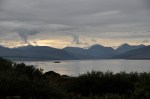
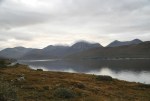
The word “skye” means “cloudy” in Old Norse, and for those not familiar with Old Norse, this island is also fondly known as “The Misty Isle”.  We did experience its namesake conditions, but we were lucky; the weather was good most of the time.  The island is gorgeous, atmospheric and dramatic, with stark mini-mountains dotting the landscape.  Although the island is large, the shoreline has many lobes that jut out into the sea; no spot is more than 5 miles from a beach.  Even better, with the mountainous mainland nearby (previous post), and a number of small islands scattered offshore, views off to sea are pretty awesome.  Below are pictures from our drive into Skye.

That last picture is the view from our B&B; off in the distance is the Old Man of Storr; we’ll visit it tomorrow.

THE TROTTERNISH PENINSULA

We’re going to do a circuit around one of the island’s loops, the Trotternish Peninsula, which sports a rugged, unique landscape formed by massive landslides thousands of years ago.  Our first stop is The Storr, the highest Storr, and the Old Man - on a sunny day(2400 ft) mini-mountain on this peninsula, anchoring the southern end of the Trotternish Ridge.  In particular we’re visiting the Old Man of Storr, that little spike of rock on the right side of this picture.  During the landslides, the Old Man landed on its end; after much weathering it’s still a 160 ft high vertical chunk of stone.  This picture of the Storr, by the way, is from a different day that was sunny.  Today it’s overcast and gloomy, as you can see in the pictures below.  However, even in these misty

clouds The Storr is a strikingly beautiful sight – and The Old Man is pretty impressive.

Traveling further, we are treated to beautiful views that combine the sea, off-shore islands and mainland.  The mountains behind us aren’t bad either.

A bit further we come to ruins of an old tannery (below), abandoned during the Highland Clearances that began in the 1800’s; many residents were forced off the island by aristocratic landowners who wanted more room for their livestock.  Nearby is Kilt Rock, a 200 ft cliff; its vertical lava columns look like pleats on a skirt, and paired with those horizontal striations, it resembles a kilt.  There’s also the spectacular Mealt Waterfall doing its lemming thing off the cliff.  The views are awesome.

For a change of pace, we dip down to stroll on the beach at Staffin Bay.  It’s a pretty place.

Next we take an inland road to Quirang, a name from the Gaelic for “pillared enclosure”.  The road rises steeply, and we’re now at the upper end of the Trotternish Ridge.  The view is stunning, and we decide to investigate further by hiking the trail that starts from the road.  The trail is a loop, about 6 miles long but with 1400 feet of climb, and we’re not

at all sure we’ll do it all, since time (sunlight) and effort are an issue.  We think we’ll go at least to that center rock formation in the right image (above), called “The Prison”, and look over the edge to see what we can see.  As we walk, the views to our right become

increasingly stunning, as shown above.  Alas, we will not make it to The Prison.  It’s not an easy trail.  From the first and last pictures just above, you will note that we’re on a really, really steep hillside – sometimes disconcertingly steep.  Worse, parts of the trail are quite difficult to navigate, particularly where the water flowing from those waterfalls cuts though the trail, requiring a transition from hiking to (wet) rock climbing over a crevice.

Those traverses are tough, and after doing the first one, Ginger decides she has had enough and heads back.  I decide to push on to The Prison, but after awhile I realize it’s further than it looks, and I too turn back.  The view going back is just spectacular, as you can see below.  Note to self – do this loop hike another day!   It’s too pretty to miss!

Near the tip of the peninsula are the crumbling remains of Duntulm Castle (below), built in the 1300’s and 1400’s when the area was subject to feuds between rival MacLeod and

MacDonald clans.  In the 1600’s the castle was the seat of the chiefs of Clan MacDonald.  It was abandoned in 1732 when the MacDonalds built a new castle further south on Skye (taking much of this castle’s stone for the new one).  As shown below, the mountains are still gorgeous even way out here near the peninsula tip.

A bit further on, we encounter the Skye Museum of Island Life consisting of several thatched stone huts, some of them original (200+ yrs old), illustrating how a typical Skye family lived back then.  Alas, the museum was just closing as we arrived.  The largest hut, The Old Croft House shown below, consists of 3 rooms: a kitchen, also serving as the main

living area (where a peat fire would be lit every minute of the year); the parents’ bedroom off the kitchen; and beyond that the children’s bedroom (for as many as 12 kids).  Note the clever design; the stones that hang from the roof keep the thatch from blowing away, and the edges of the buildings are curved to redirect the wind.

Crofts in the village of UigWe’re nearing the end of the loop, here looking back at the village of Uig.  Note, near the center of the image, the parallel strips of land with a house at the top.  In the old days the land was owned by Scottish clans or English aristocrats who divided it into these crofts and rented it to tenant farmers who eked out a bare living.  Today they’re privately owned plots, but their history is still visible.
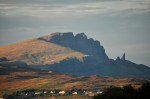
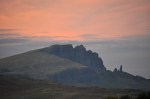
Back at our B&B, I take a few final shots of The Storr as evening sets in, and then a couple of night shots of the nearby city of Portree and its Loch.


Next post: Isle of Skye II – Fairy Glen, Dunvegan, and The Cuillin Hills.


Highlands III – Scotch Whiskey & Eilean Donan Castle

WHISKEY

We’re off to see Scotland’s Isle of Skye – taking yet another path through the Highlands – and whiskey distilleries are on the way!  I’m excited: I love learning experiences.  First stop is for whiskey, in the small town of Pitlochry.  Just outside the town is Blair Athol Distillery, which makes a 12-yr old single malt – but in very limited quantities.  Almost

all of the production of this smooth and mellow scotch is used in their Bell’s Blend whiskey, probably the most popular blend in the UK – it’s prominently featured in all the bars.  Like almost all Scotch distilleries, pictures of their internal processes are forbidden, but I’ve included a picture of two of their stills (above ) from their website.  I’ve described the process of making Scotch in an earlier post (“Oban, and the Highlands I“, Aug 31, 2015).

But wait!  There’s another distillery nearby, the Edradour Distillery, the smallest in Scotland.  It’s maybe an hour walk uphill, through woods, and off I go (Ginger opts out since the skies are threatening).  It’s a great walk through pretty woods and includes a side

trail to the “Black Spout”, a nice waterfall (shown above).  The fields here are beautifully pastoral, and in this gloomy light are not just green but impossibly green.

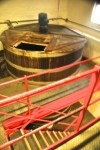
Edradour Distillery is as charming as a distillery can be, nestled in a picturesque setting in The Edradour Distillerythe middle of nowhere.  It’s one of the few independently owned distilleries left in Scotland, and prides itself on using a minimum of machinery.  Unlike other distilleries, this one allows photos!  So now I can show you the interior!  The first two pictures below show the two-story vats where mashing and fermentation occur.  The vats are wood!  I’ve only seen stainless before.   Fermentation goes to about 8% alcohol (and has a strong beer aroma).  The fermented “wash” then undergoes double distillation.  The two

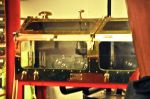
stills in the following pictures (stills for the 1st and 2nd distillations) have noticeably different shapes.  The first distillation produces a “low wine” condensate, alcohol content around 20%.  That picture of glass chambers shows where the condensate from the second still is separated into “cuts” – the stillman physically throws a lever to direct the flowing distillate to different places.  The lower alcohol 1st cut (the “head” and the higher alcohol 3rd cut (the “tail”) are returned to the still for further distillation; the middle “heart” cut is the good stuff, which goes to American bourbon barrels to age for about a decade.  One of the distillery’s clever use of resources is the creek that zooms through their property.  It’s the source of their water, of course, but it’s also used to form the still’s condensate; the cooling pipes from the still are looped into the steam’s running water.  Now, with yummy

Scotch in my tummy, there is a nice downhill walk home through that luscious green landscape.

The edge of Cairngorms National ParkWe travel onward, and we’re back in the Highlands for sure, at the base of Cairngorms National Park.  It’s beautiful, but also stark, treeless, barren, empty.  Further on, still at the edge of Cairngorms, what do we find?   Whoppeee, Dalwhinne Distillery!  It’s one of the highest in Scotland (at 1200 ft above the sea, Scotland thinks it’s high.  But let’s be clear; it’s not much higher than Cleveland).  Another whiskey tour, another tasting,

another great learning experience!  Good stuff.

THE HIGHLANDS

On! On!  We’re now on a  Mountains in the distancebroad plain, but mountains beckon in the distance.  As we enter a hilly region, we encounter our first coo, a hardy breed of shaggy, red-coated cattle that survives well in these hostile Highlands.  With their long hair and rakish look they’re adorable!  Not often one can say that about a cow.

We’ve left the national park, but the landscape keeps getting more beautiful, with lakes and rivers everywhere.

We come to a long lake (Loch Laggan? Lochy?) and decide to take a short hike.  It’s pretty, with birch trees, ferns, moss and even a small waterfall.

As we travel further there are even more lakes, but in the distance we begin to see the bare, spare hills of the Highlands.

And then we’re in a Highland moor, defined by its openness, poor drainage, and

ubiquitous heather.  It has a rugged, other-worldly beauty.  Have you noticed that the skies are threatening in all of the pictures in this post?  Apparently that’s the norm; the inn shown above has a brochure that reads “And when you’ve had a long day on the hills, you can relax in warmth and comfort in our lounge and whisky bar … and get a refreshing night’s sleep while your equipment dries off, ready for the next day’s activities.”   My italics.

More Highland scenery.

EILEAN DONAN

In the early 1200’s the Eilean Donan Castle was built on a small island at the strategic junction where 3 sea lochs meet, likely as a defense against Viking raids.  It became a stronghold of the MacKenzie Clan and their allies the MacRae Clan.  Today it’s one of Scotland’s more beautiful castles due to it’s picturesque location; indeed, it has become

an iconic image of Scotland.  It comes with some history (of course; this is Europe).  When James IV of Scotland tried to exert his authority over outlying clans in early 1500, sending an Earl and garrison to take Eilean Donan, they were defeated by the Mackenzies (10 years later son James V was peacefully hosted at the castle).  In 1539 Clan MacDonald sent 50 ships against Eilean Donan, attempting to claim “King of the Isles”, but just 3 men within the castle repelled the attack (two surviving).  In 1719 Eilean Donan was used as a supply base for the Jacobite army and a garrison for its Spanish allies, but government frigates (48-gun and 44-gun) bombarded it, captured it, took the castle’s own gunpowder and blew it up; a month later the Jacobite army was defeated just a few miles away.  200 years later a MacRae descendant restored the castle to its present state.  The pictures below show a peek inside.

These last pictures show Loch Alsh and the mountains (big hills, really) of the Isle of Skye in the distance.

Next post – the beautiful Isle of Skye!


Edinburgh II – the castle, St. Giles’ Cathedral, and the Hogmanay

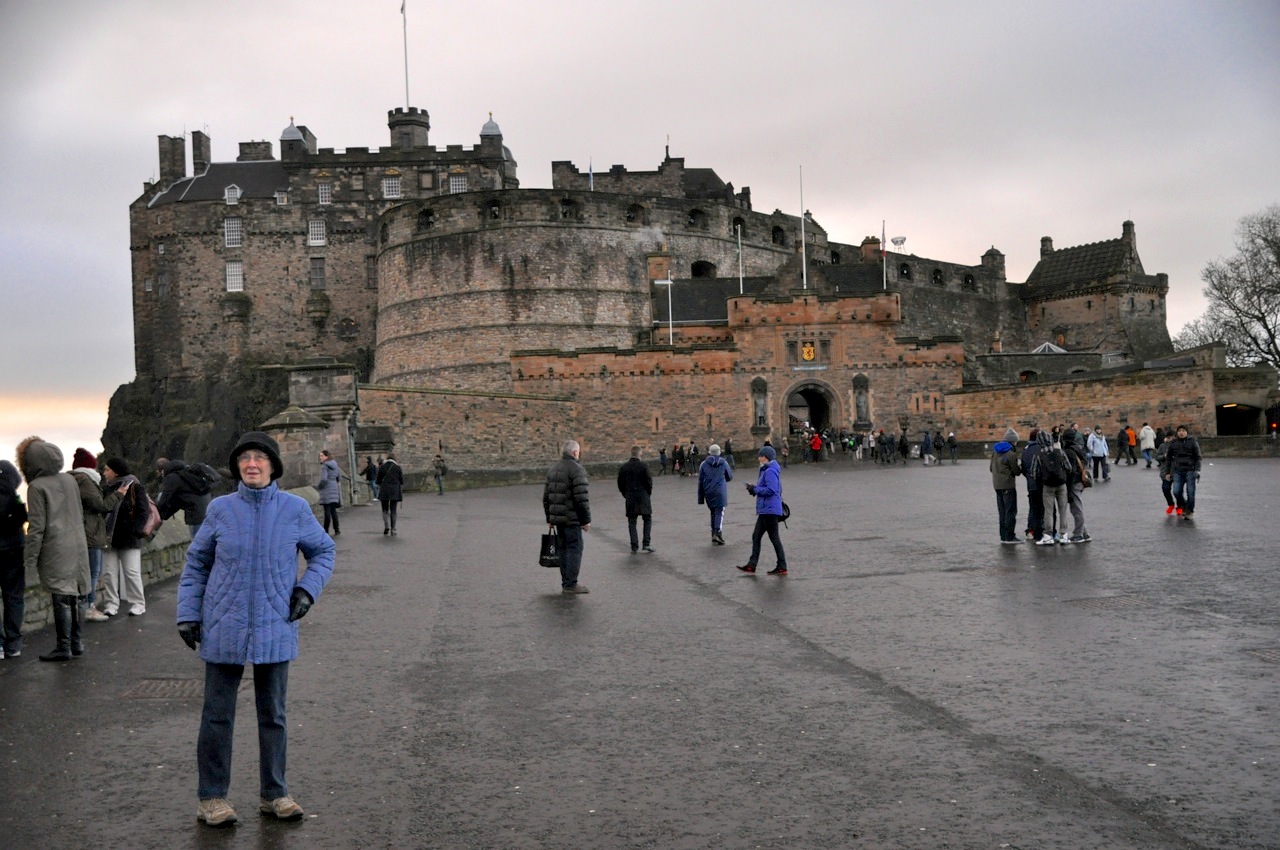
Edinburgh Castle (and Ginger posing)We’re off to tour Edinburgh Castle.  From the craggy heights of Castle Rock, this mighty fortress dominates Edinburgh’s skyline.  It is believed that a stronghold existed atop this volcanic rock since 600 AD; there has been a royal castle on the site since at least 1100.  As one of the more important strongholds in Scotland, Edinburgh Castle was involved in numerous historical conflicts, suffering through 26 known sieges in its long history.  It claims to be the most besieged place in Great Britain (and one of the most attacked in the world).  I’ll illustrate by covering just 45 years.  In 1296 English King Edward I invaded Scotland during the First War of Scottish Independence, capturing the castle when it surrendered after 3 days of bombardment.  Nearly two decades later in 1314 it was recaptured in a surprise night attack by the Scots, who scaled the near-vertical north cliff face; the castle’s defenses were destroyed to prevent re-occupation by the English.  Twenty years later in 1333 the English King Edward III occupied and refortified the castle during the Second War of Scottish Independence.  In 1341 the Scots, disguised as merchants bringing in supplies, retook the castle and killed the garrison of 100.  And so it went.

The castle was both royal residence and fortress, but beginning in the 1400’s it was increasingly used as an arsenal and armaments factory.  The The monster cannon, Mons Megmonster cannon Mons Meg was delivered to Edinburgh in 1457, and by 1541 the castle had a stock of 413 guns.  Increasingly the royal family stayed not at the Castle but at the Holyrood Abbey. In 1501 King James IV built the Holyroodhouse palace by the abbey at the end of the Royal Mile (see the previous post Edinburgh I) and made it his principal Edinburgh residence.  Edinburgh Castle was then used by royalty only for safety or state functions.  Pertinent to what the Castle looks like today was the Lang (long) Siege of 1571, precipitated by the reign of Catholic Queen Mary – a reign opposed by many of the Protestant Scottish nobility.  A year after giving birth to King James VI at Edinburgh Castle, Mary was forced to abdicate and fled to England (well, not only was she a Catholic, but soon after her husband’s murder she did marry the chief murder suspect …).  Her infant son was now King, but Scottish loyalties were divided; some supported the Catholic Queen, others the Protestant Regency that ruled for the infant King James.  The Keeper of the Castle, Sir William Kirkcaldy of Grange, switched sides to support Mary and occupied the Castle and the town for the Queen.  The town was put under siege by forces loyal to the King over the course of a year (for a month here and there), with occasional skirmishes; the castle was blockaded, and the Palace of Holyroodhouse was garrisoned by the King’s men.  Grange destroyed homes outside the castle to create a “killing ground”.  The King’s supporters, lacking resources and fearing that Grange would get help from the French, petitioned English Queen Elizabeth I for aid (Queen Elizabeth I ultimately had Mary Queen of Scots executed).  A truce was negotiated that lifted the blockade, gave Edinburgh to King James and confined Grange to the castle.  However, when the truce expired the following year, Grange began bombarding the town.  The King’s men responded by laying siege to the castle.  Grange’s  supplies of powder and shot were running low, there were only seven gunners available to man the 40 cannon, and the castle’s well had been poisoned.  All other supporters of Queen Mary had surrendered, yet Grange continued to resist and the garrison continued to bombard the town, killing a number of citizens.  Sorties were made from the castle to set fires, 100 houses were burned, and anyone attempting to put out the flames was fired on.  Finally 1,000 English troops arrived with 27 cannon and, over a 12 day period, 3000 rounds hit the Castle.  Walls and towers collapsed.  Grange finally sued for peace, but when informed he would not be freed, he resolved to continue resistance; the garrison had other ideas, and threatened mutiny unless he surrendered.  He and several others were subsequently hanged (at the Mercat Cross described in the Edinburgh I post).  The Castle suffered considerable damage; only a few buildings remain from the period before the Lang Siege, the most notable being St. Margaret’s Chapel from the early 1100’s (the oldest building in Edinburgh), the Royal Palace, and the Great Hall from the early 1500’s.  From the 1600’s on the Castle was principally used as military barracks with a large garrison.

OK!  Into the Castle!  In typical castle fashion, once you get past the gate, there is a long,

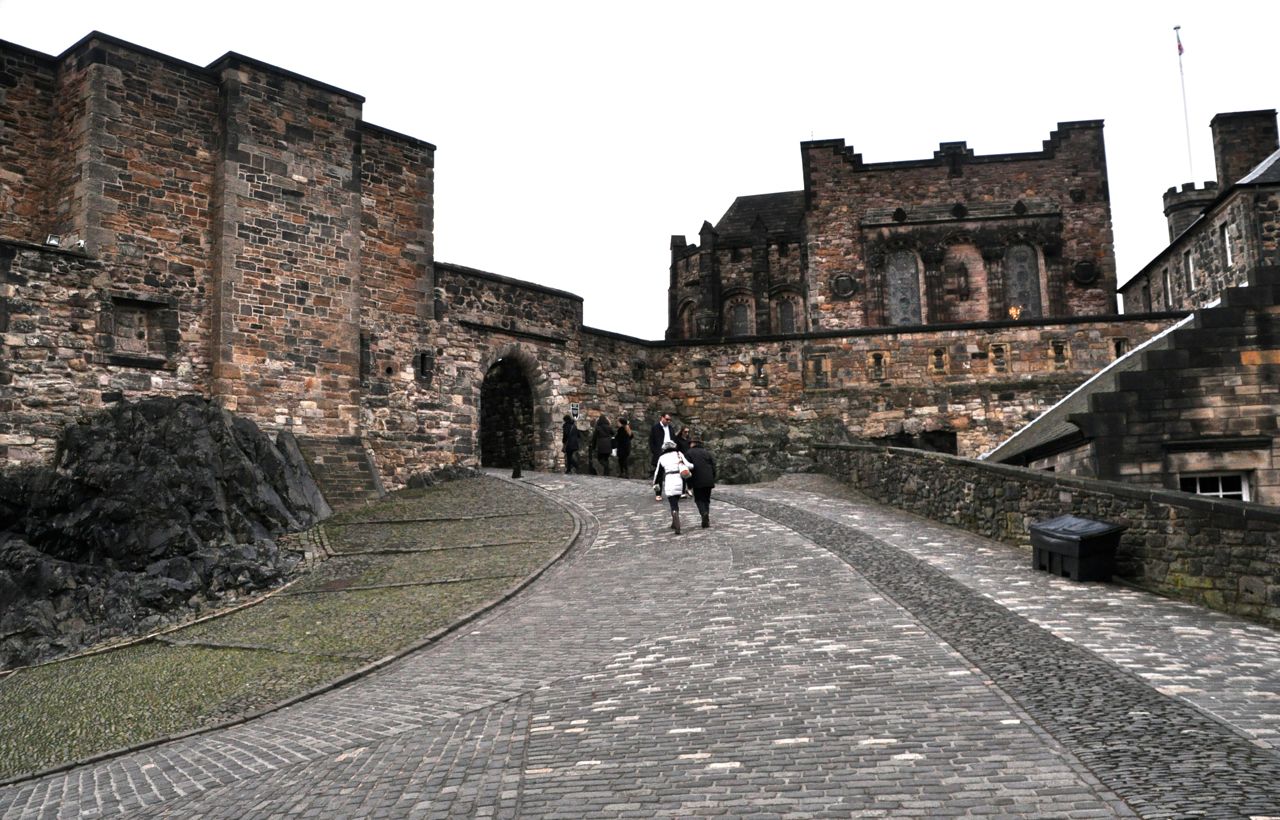
walled, and exposed corridor to another gate, in this case the Portcullis Gate built in 1574 as the main entrance to the castle after the Lang Siege (that different-colored top Heading up to the buildingsstory added later).  And then of course there’s another gate, Foog’s Gate from the 1600’s.  It leads to the highest point and heart of the old castle, Crown Square, laid out in the 1400’s (James III) and formed by Scotland’s National War Memorial, the Royal Palace, Great Hall, and Queen Anne Building (previously the site of kitchens for the Great Hall, now a 1700’s building, extensively remodeled).  They’re shown below.

Below is a peek at the Royal Palace interior.  Scottish royalty lived here until James IV built the Palace of Holyroodhouse – and thereafter whenever safety or protocol was

required.  That last room is Laich Hall, created in its present form in 1617 to serve as an outer reception room and dining chamber for James VI.  Also at the Royal Palace were Scotland’s crown jewels consisting of crown, scepter and sword.  Joining a long line, we weaved past replicas (poorly made) where we could take pictures, and then (keep walking) zipped past the originals, no pictures allowed.  I should note that Scotland’s crown, scepter and sword of antiquity were taken by England and melted down when Edward I captured Scotland in 1296 (noted above); the current crown jewels are from two centuries later, and only survive because they were hidden from Oliver Cromwell when he defeated Scotland in 1652.

Below are pictures of the replicas.  The first is a silver-gilt scepter; the original was given to

King James IV by the pope in 1494; it was refashioned for James V in 1536.  The sword is also a papal gift, presented to James IV in 1507; the handle is silver gilt.  The origin of the crown is uncertain; it was refashioned for James V in 1540.  It’s made of Scottish gold, engraved and enameled, and ornamented with diamonds, garnets, amethysts, quartz and  pearls.  The bonnet is velvet and ermine.

The Great Hall was the castle’s ceremonial meeting place, built by James IV beginning in 1503.  Following Cromwell’s seizure of the castle in 1650, the Great Hall was converted into a barracks for his troops, and after more conversions it became a military hospital. Restored in 1897 as medieval (with Victorian sensibilities), it nevertheless has it’s original

hammerbeam roof, one of only two in a medieval hall in Scotland.

St. Margaret’s Chapel is the oldest building not only in the castle but in all of Edinburgh.  It was built in 1130 by King David I as a private chapel for the royal family, dedicated to his mother, Saint Margaret of Scotland, who died in the castle.  It is wonderfully simple, in

classic Norman style such as the zigzags decorating the arch between nave and sacristy.  The chapel was used as a gunpowder store from the 1500’s – it is well positioned near the cannon batteries.  The small windows feature St. Margaret and St. Columba who brought Christianity to Scotland from Iona.

In order to build the Crown Square in the 1400’s, a foundation had to be laid that took the form of vaults.  These vaults were used to hold prisoners of war during a number of conflicts from the mid 1700’s through WWII.  They have been re-created to look as they

would have in 1781.  Objects made by prisoners at that time were also on display.

Finally, a look over Edinburgh from the castle heights, and a look back at the castle.

St. Giles’ Cathedral

St. Giles CathedralSt. Giles’ Cathedral is Scotland’s most important church, functioning similar to that of England’s Westminster Abbey.  Its oldest part dates from 1124; much of the current interior was built in the very late 1300’s after the English set it on fire in 1385.  Subsequently many chapels were added, enlarging the church but giving it an irregular plan.  The Scottish crown steeple, a proud part of Edinburgh’s skyline, was added in 1495.

In 1559 at the height of the Scottish Reformation, the firebrand John Knox was chosen to be minister at St Giles.  In addition to founding an austere Scottish Presbyterianism, Knox was also a great reformer.  His insistence that every person should be able to read the Bible forced Scotland’s education system to be 3 centuries ahead of Europe (Subsequently Scotland led the way in math, science, engineering and medicine).   Under Knox the

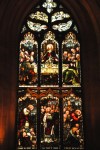
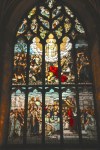
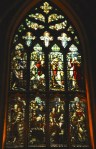
church was simplified, with an emphasis on sermons rather than rituals.  He replaced the medieval stained glass with clear glass windows (darn it!) – to allow people outside the packed church to participate in the service.  The last picture above, a new window from the 1800’s, shows Knox preaching to a standing-room-only congregation.

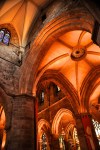
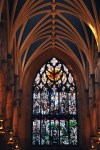
In subsequent centuries St Giles Cathedral was subdivided into as many as 4 separate churches, and by the 1800’s it was in poor condition.  Extensive renovation in the 1800’s, including installing its beautiful stained glass windows, gave us the church we see today.  Pictures of the impressive interior are shown below.

In the center of the nave are 4 massive pillars from 1124, shown below.

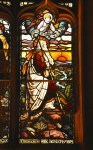
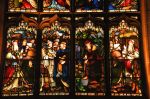
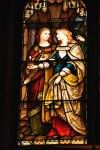
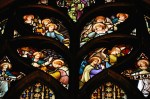
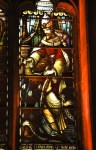
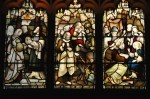
Stained glass windows are everywhere, and gorgeous.  Beginning with the restoration in the 1800’s, the clear windows of the Reformation were replaced by what we see today – involving considerable controversy.  Stained glass was a radical move for a Presbyterian church abhorring flippant decoration; they were finally allowed if they illustrated Bible stories.  You know that I love stained glass windows, so I’m going to show off a bunch (there are many many more I’m not showing!).  So feel free to skip forward if you – ah –

don’t do windows.  Above are three examples, along with a panel detail from the 2nd and 3rd windows.  The gorgeous window below is from the end of the nave.

Really, almost all of them are pretty spectacular, another example shown below.
There are just an amazing number of beautiful windows here.  I’m going to simply dump a bunch of pictures into one large grouping showing windows with their panel details.  I hope you’ll agree they’re fabulous.

Finally, the Thistle Chapel within St. Giles is relatively new (1911), built for Scotland’s “Most Ancient and Most Noble Order of the Thistle” (the order founded by King James VII in 1687).  The chapel is exquisite, as shown below.

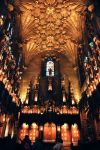
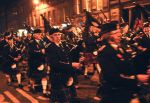
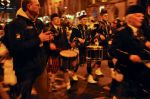
We’ll end this looooooong post with the finale, the Hogmanay.  This is Scotland’s celebration of the New Year that lasts until the morning of Jan 1, and in some cases Jan 2 (grin).  It goes back to the celebration of the winter solstice among the Norse, along with Gaelic celebrations.  Hogmanay is more traditional than Christmas, which was not celebrated here as a festival – likely for being “too Papist” during the Protestant People on a bridge, waiting to join the paradeRevolution.  The Edinburgh Hogmanay is BIG – its celebrations are among the largest in the world; the Guinness Book lists it as the world’s largest New Year’s party in ’96-’97 (approx. 400,000 people).  That picture on the left shows people on a bridge (center of picture), waiting for the line to move in a parade that has been going on for some time by now.  We’ve left that parade for the comfort of our hotel’s roof.  So here we go, back to the start.  It all begins with bands and a Viking parade – torches are always a part – and
continues with a lot (LOT) of Vikings.  You can get a better experience of this parade from the following link – Hogmanay Parade (son Brian showed me how to do this; we have a lot to learn from our kids!).  And then come the people.  LOTS of people.  The river of people is hard to capture from our vantage points.  Most of the people are going up to Calton Hill (previous post) for the overview of fireworks both at the castle across the

city and at this hill (overhead).  And here we go!  Happy 2015!  (Note that I am a year

behind in writing these blogs!  Hey, quit your bitchin’.  I’m still doing it, right?).  And then the fireworks start.  They are spectacular, and we’re between the two sites; the castle in the distance, and Calton hill nearby on our other side.  Below are some shots, both directions.

So we’re off by a year, but it’s almost timely!  Happy 2016, everybody!

Next post – back to the Highlands!

Edinburgh I

We went to Edinburgh twice, once a quick in-and-out to catch the Scottish Ballet, and once at Christmas to explore this city more fully and, wonderfully, to share it at New Year’s with the kids, who came to visit.  So this is Edinburgh in two parts; Part I will include all our first visit and a bit of the second.

Edinburgh castle looms over the city

Edinburgh Castle looms over the city

Edinburgh has been the capital of Scotland since the 1400’s.  With a commanding 10th century castle, it was a medieval powerhouse in its time.  It was once the most crowded city in Europe; with rich and poor living on top of each other, it was famed for its medieval skyscrapers – and for its filth and stench (its nickname was “Auld Reekie”).  In the 1700’s it expanded into “New Town”, an area of magnificent Georgian buildings where the upper crust could separate themselves from the rabble.  The Old and New Towns are both listed as World Heritage Sites.  Today Edinburgh is the home of the Scottish Parliament and is the second most popular tourist destination in the UK after London.

In our whirlwind 1st trip we barely saw the city, but we were impressed; impressed not only by the city itself, but also by the number of tourists there in October!  Below are pictures of New Town and Old Town (on the Royal Mile, which goes from Edinburgh

Castle to the Palace of Holyroodhouse).  The Royal Mile in particular is lined with historic buildings, including St. Giles’ Cathedral, Scotland’s most important church.

That impressive crown steeple is from 1495; the exterior is Neo-Gothic from the 1800’s.  We didn’t go inside this time – but just wait, we’ll visit it later!

Interior, National Museum of ScotlandWhat we did take in was the National Museum of Scotland (interior shown on the left), which had some really cool stuff.  Its primary focus is Scottish arts and history, but there are amazing things from other places, such as those shown below.  On the left is a relief from Assyria – gorgeous, isn’t it?  It’s from the late 800’s BC, from the palace of King Ashurnasirpal II, showing the King as a bearded high priest facing a court official and listing some of his military victories.  It was excavated in 1840 and owned by a Scottish obstetrician.  On the right is a fabulous Chinese vessel depicting a battle scene – alas, I don’t know it’s age.

OK, back to Scotland’s history.  At the beginning of the first century AD, much of Britain was occupied by Celtic Britons; and above them in Scotland, the Picts.  When the Romans invaded in 43 AD, they pushed the Britons west but had little success against the northern folk they called “Picti”, or “painted people”.  Thwarted, they instead built Hadrian’s Wall to keep the Picts out (post of Feb 1o, “Hadrian’s Wall“).  In the AD 5oo’s, Angles from northern Europe invaded and pushed the Britons further west (eg, Wales), but the Angles also had no luck against the Picts.  It would take centuries of warfare before the Picts and the descendants of the Britons and Angles would form a more or less united kingdom.

Pict symbols from the 600's or 700's.Not much remains of the Picts.  Their language survives only in the names of places, but evidence of a developed culture can be seen in their art, which consists of symbols (of unknown meaning) engraved on metalwork or carved on stone (shown on the left).  The purpose and meaning of the carved stones are poorly understood.  Earlier stones may have served as personal memorials or territorial markers; after Christianity spread to the Picts, the stones fell more easily into categories like gravestones.  In the AD 800’s, stone markers were commonplace in Scotland (examples shown below).

And now my favorite from the museum, the Lewis Chessmen.  They were carved from walrus ivory in the 1100’s, and they’re fabulous.  They were found (700 years later) on the Isle of Lewis, one of Scotland’s Hebrides islands that was still under Norse rule in the

1100’s (it had been captured by Vikings in the 800’s).  When found, the hoard contained 78 chess pieces; 10 are here, the rest are owned by the British Museum.  Aren’t the pieces gorgeous??!  I love them!

I’m going to group these next items due to their similar age.  The distinctive tall cross from the 1300’s is from the Argyll Islands of Scotland, where Gaelic tradition held fast.  The middle picture is called “The Declaration of Arbroath”, from the “Letter of the Barons of

Scotland” to Pope John XXII, 132o, “in the name of the whole community of the Realm”, declaring their determination to maintain Scottish independence and support King Robert Bruce.  It reads “As long as only one hundred of us remain alive we will never on any conditions be brought under English rule.”  This sentence is written in big letters on a wall of the museum!  No hand-written letter under a glass case here!  There is definitely an undercurrent of Scottish nationalism that we encounter in many small ways.  The last picture shows a two-handed sword from the early 1500’s called a claymore (from the Gaelic for “great sword”); its distinctive hilt was used only by the Highlanders.

I’ll close our museum trip with 3 more pictures.  The first is a painted ceiling from Rossend Castle, done in 1617 in honor of a visit by King James VI (post August 4, 2015, “Stirling Castle“).  The clothes are a doublet and trunk hose, in silk and silver, from 1660.

The last is actually relatively modern – 1904 – a harp case with Celtic designs carved in Art Nouveau style.

I should also mention the museum had the stuffed body of Dolly the sheep, the first successful clone of a mammal from an adult cell.  But y’know what?  It looked like a sheep.

These next few pictures are from our return trip in December.  We’re staying at the edge of New Town (Princess Street), and from our apartment window we can see into this

fascinating, really old cemetery at the base of Calton Hill – so off we go to visit.  One of the finds is the resting place of David Hume, an extremely influential  Scottish philosopher (eg, his “A Treatise of Human Nature”, 1739, written at age 23, is regarded as one of the most important works in the history of Western Philosophy).  Actually born David Home, he got tired of the English screwing up the Scottish pronunciation of his name and so had it changed.  Also visible is the Palace of Holyroodhouse, parts of it dating from the 1300’s.  Scottish royalty preferred it over the blustery castle on the hill.  The last picture shows a view of Calton Hill from below.

Calton Hill also gives a nice overview of this part of town, as shown below.  The picture

on the left shows how hilly this city is.  From Edinburgh castle on the top of the hill, the (obscured) Royal Mile in Old Town moves off the picture to the left.  New Town starts with Princess Street, angling down to the lower right corner.  Between them is a valley, now the Princess Street Gardens.  Previously this valley was a lake – the town’s water reservoir, sewer, and place to drown witches (~17,000 in 250 years; if you survived the tied-to-a-chair dunking, you were clearly a witch and were burned at the stake).  The clock tower in the picture on the right (above) is a historical building, now a (very) expensive hotel.  The triangular building behind it is the impressive Sir Walter Looking up at Princess StreetScott Monument.  And behind that, perhaps you can see the very large Ferris wheel, part of the holiday celebrations at the Princess Street Gardens.  Now let me show you hilly!  Doesn’t Princess Street look like “street level”?  It certainly seems to be when you’re on it, but remember earlier in talking about Edinburgh I said “… rich and poor living on top of each other …”?  That was literal!  There’s another whole city below your feet, as shown by the picture to the left.  It’s taken near our apartment – that’s Princess Street up above, with the columns!  The poor lived in underground warrens – often without windows – accessible down (literally down) alleys (where chamber pots were emptied).

Today Edinburgh is quite a delightful city, full of life (and tourists).  The pictures below

give you a feel for its architecture.  Below are some interesting buildings, including the

purported “John Knox house” from 1490.  Given the city’s age, there are of course a lot of historical structures, such as the ones below.  The first picture is the Mercat Cross,

where royal proclamations were read since the 1300’s (and many an execution was held).  This structure is actually from the later 1800’s, but is close to the original site.  The Scots do love their traditions – in 1952 a town crier proclaimed from here that Britain had a new queen, 3 days after the event took place – (traditionally it took 3 days for a horse to gallop here from London).  The other two pictures are of a neighborhood wellhead, no longer used.  Before buildings had plumbing, citizens got their water from these wells, piped from a reservoir near the castle.

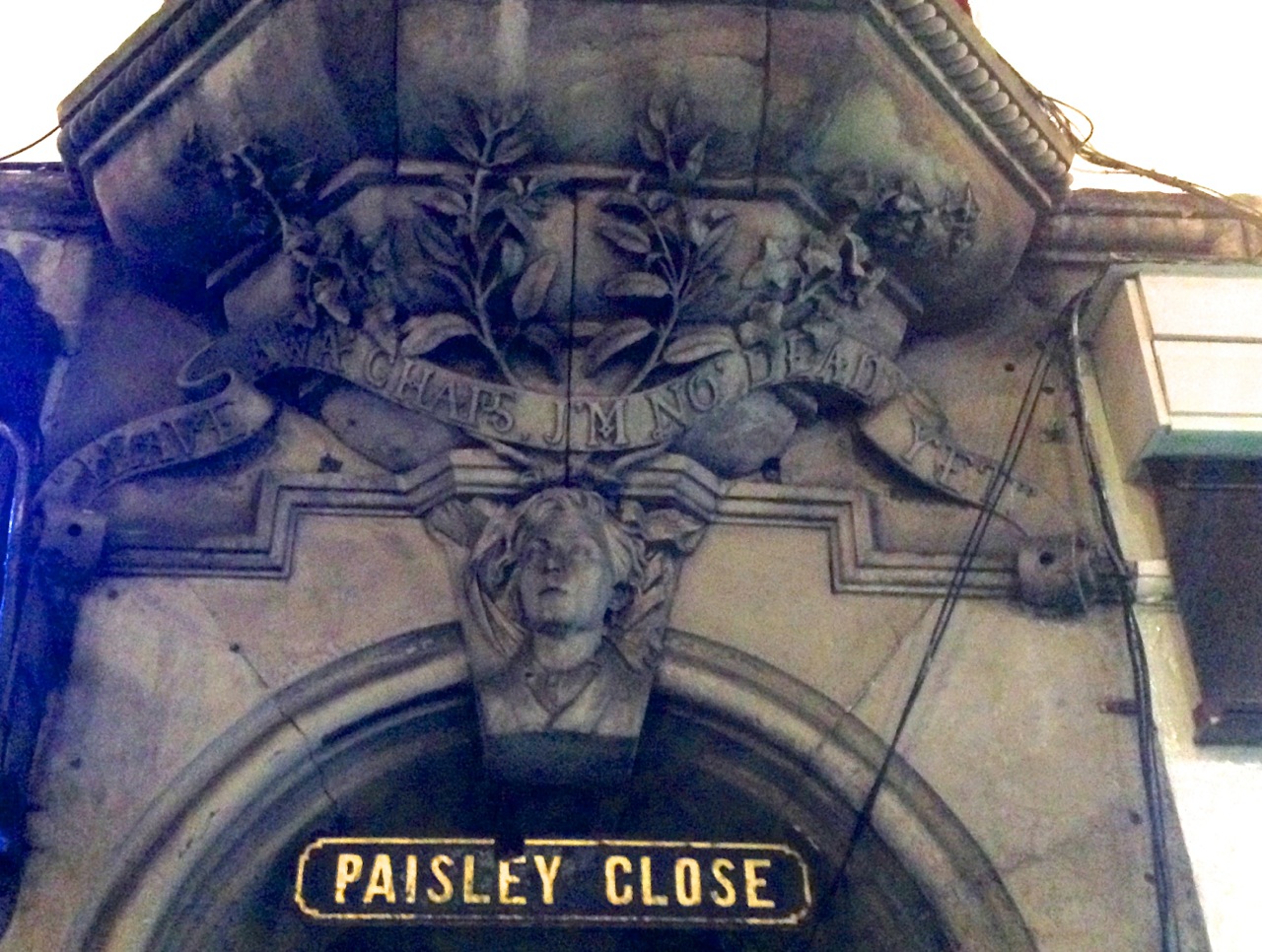
Embellishment over an alley ("close") built in 1861Our last historical picture is an embellishment over a “close” (tiny alley between buildings).  Here, just off the Royal Mile, in one of the worst slums in 1861, several 250-year-old houses collapsed, killing 35.  As the debris was being cleared away, came a shout from a young lad underneath: “Heave awa’ chaps, I’m no’ dead yet”.


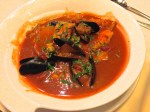
I haven’t mentioned Scottish cuisine yet.  It is very good!  Scotland is everywhere close to the sea, and we took advantage of that, as shown below.

To finish, this last picture St. Giles' Cathedral spires at sunsetshows the top of the beautiful St. Giles’ Cathedral off in the distance, kissed farewell by a beautiful sunset.

Next post: Edinburgh’s Castle, St. Giles Cathedral, and the Hogmanay, Scotland’s world-famous New Year’s festival.


Doune Castle

Doune CastleWe loved Doune Castle, not because it’s grand – it isn’t – but because it’s “real”.  Yes, it’s ruined, but it’s still one of the best-preserved medieval castles in Scotland.  By escaping restorations in later years, particularly those done with Victorian trimmings in the late 1800’s, it has remained true to its original plan, and thus allows us to see what “home life” was like for a very important man in the late 1300’s.  We should note that we are not the only ones enamored of the “realness” of this castle.  Back in 1975, the famous British comedy film Monty Python and the Holy Grail was filmed here; more recently, exterior and interior shots of the castle were used for Winterfell during the Game of Thrones’  first season.

Although Doune Castle is only about 5 miles from Stirling Castle (the “crossroads of Scotland”; see the Stirling Castle post), it’s nowhere close in terms of historical importance.  Still, history swirled around Doune Castle.  The castle is thought to have been built in the 1260’s but damaged during the Scottish Wars of Independence (also described in the Stirling Castle post).  It was rebuilt in its present form by Robert Stewart, the second son of Scottish King Robert II and great-grandson of Robert the Bruce.  The castle was at least partially complete by 1381.  Set on steeply sloping ground and surrounded on three sides by two rivers, the castle was strong and defensible, yet it was also built with luxurious accommodation. In an age when the conspicuous display of wealth and status were seen as vital in maintaining authority, no expense was spared on Doune.

The early Stewart history is pretty interesting, so I’ll share a bit of it here.  King Robert II, an aging and unpopular king, was removed from direct rule in 1386; his eldest son was politically weak, so his second son, Robert Stewart, became Regent (Guardian of Scotland), making him basically King of Scotland in all but name.  Doune thus became a virtual royal castle.  Then the intrigue began!  With Robert II’s death in 1390, Stewart’s older brother ascended the throne as King Robert III.  However, Stewart’s astute (read: ruthless) political maneuvering allowed him to retain his role as Regent.  In 1393 power was returned to King Robert III, who was to rule with the assistance of his eldest son, David.  In 1399, owing to the King’s “sickness of his person”, young David was appointed Guardian of Scotland in his own right for a period of 3 years; but, due to his youth (did you guess it?), he was supervised by a special parliamentary group dominated by Robert Stewart.  David, however, did his own thing, including circumventing proper procedures and confiscating various revenues in different parts of Scotland.  As soon as David’s Guardianship expired in 1402, he was arrested and imprisoned in Stewart’s Falkland Castle where he died from neglect and starvation; somehow Stewart was cleared of blame in his nephew’s death.  King Robert III feared for the life of his 12-year-old son James, now heir to the throne, and decided to send him to France for safety.  However, before James could reach France his ship was captured by pirates, who delivered him to King Henry IV of England (no, I’m not making this soap opera up!).   Robert III died two weeks after James’ capture, making the imprisoned boy King James I of Scotland; by default Robert Stewart once again became Guardian of Scotland.  James was imprisoned in England for 18 years; Stewart, of course, was not eager to ransom him back to Scotland and thus ruled as “Scotland’s uncrowned king” until his death in 1420.  His son Murdoch Stewart succeeded him as Guardian.  When King James I was finally freed in 1425, he executed Murdoch and Murdoch’s two sons for treason for failing to ransom him earlier.  Doune Castle was forfeit and became a royal possession.

Subsequently the royal family used Doune Castle as a royal retreat from the burdens of state and a pleasant summer residence where they could relax and hunt in the nearby forests.  Later it was also used as a “dower house” for the widowed wives of Kings James II, III and IV.  Both Mary Queen of Scots and King James VI stayed at Doune castle on several occasions in the 1500’s.  However, wars and strife began to take their toll.  Doune was held by forces loyal to Mary during the brief civil war which followed her forced abdication.  The Castle was involved in a number of religion-inspired conflicts with James VI and Charles I, and was the site of plots and captures and imprisonments.  Only when King James VI left for London in 1603, to become James I of England, did Doune’s role as royal retreat effectively come to an end.  Royalists occupied the Castle in 1645 during the English Civil Wars, and a skirmish occurred there against Cromwell’s occupation of Scotland.  Government troops were garrisoned within the Castle during the Jacobite Risings of the late 1600’s and late 1700’s.  The Castle was occupied by Bonnie Prince Charlie and his Jacobite Highlanders, and it was used as a prison for captured government troops.  By 1800 Doune Castle was a roofless ruin.  Well!  Hope you enjoyed that brief history of the intrigue that swirled around Doune Castle!  Back to our visit.

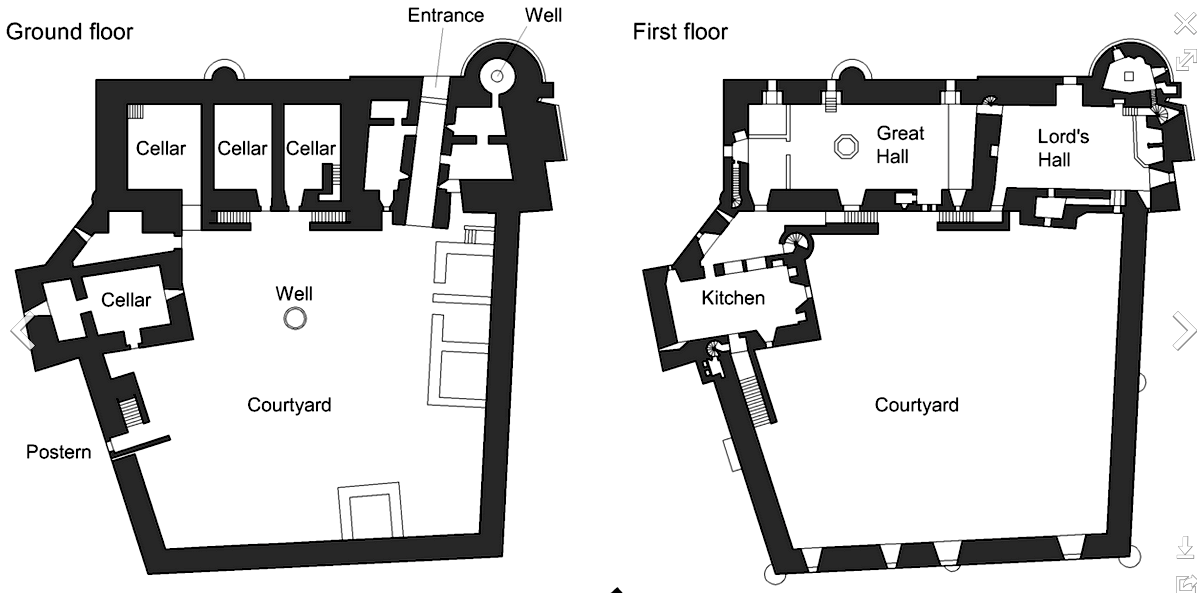
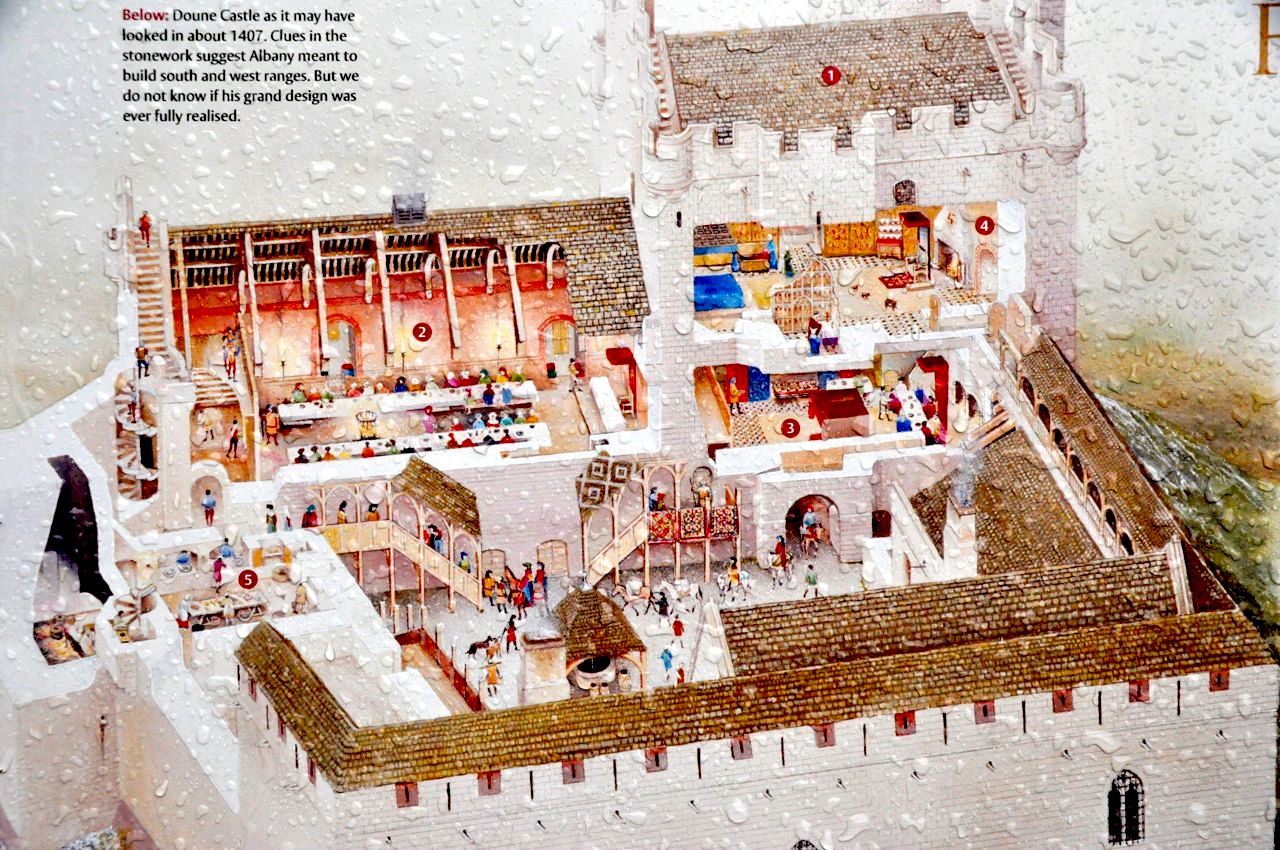
Happily the castle was structurally still in good shape.  Restorations in 1880 primarily repaired or replaced structural elements (the timber roofs and some internal floors) without adding too many “Victorian” details.   The Castle was originally planned Doune Castle Floor Planas a courtyard with buildings on all sides, but only the buildings on 2 sides were completed.  As shown in the castle floor plans, there was a tower house over the entrance containing the rooms of the Lord and his family, and a Artist's view of Doune Castle in 1407 (ignore the raindrops)separate tower containing the kitchen and guest rooms.  The two were linked by the Great Hall.  An artist’s rendition of what the Castle would have looked like in 1407 is shown to the left.

So let’s go look at this cool castle!


The most striking feature of the castle from the outside is the 100 ft high gatehouse (or The Duone Castle "Lord's tower" (and entrance)“the Lord’s tower”) shown in the first picture of this post and again in this picture.  In addition to being the entrance to the castle, the tower also houses, vertically, the Lord’s Hall and three further stories of chambers that were the duke and duchess’ apartments.

The gatehouse entrance was well defended with 2 solid wooden doors and a massive cross-barred steel gate that could be raised and lowered.  Alas, I missed getting a picture of the entrance, but I cribbed

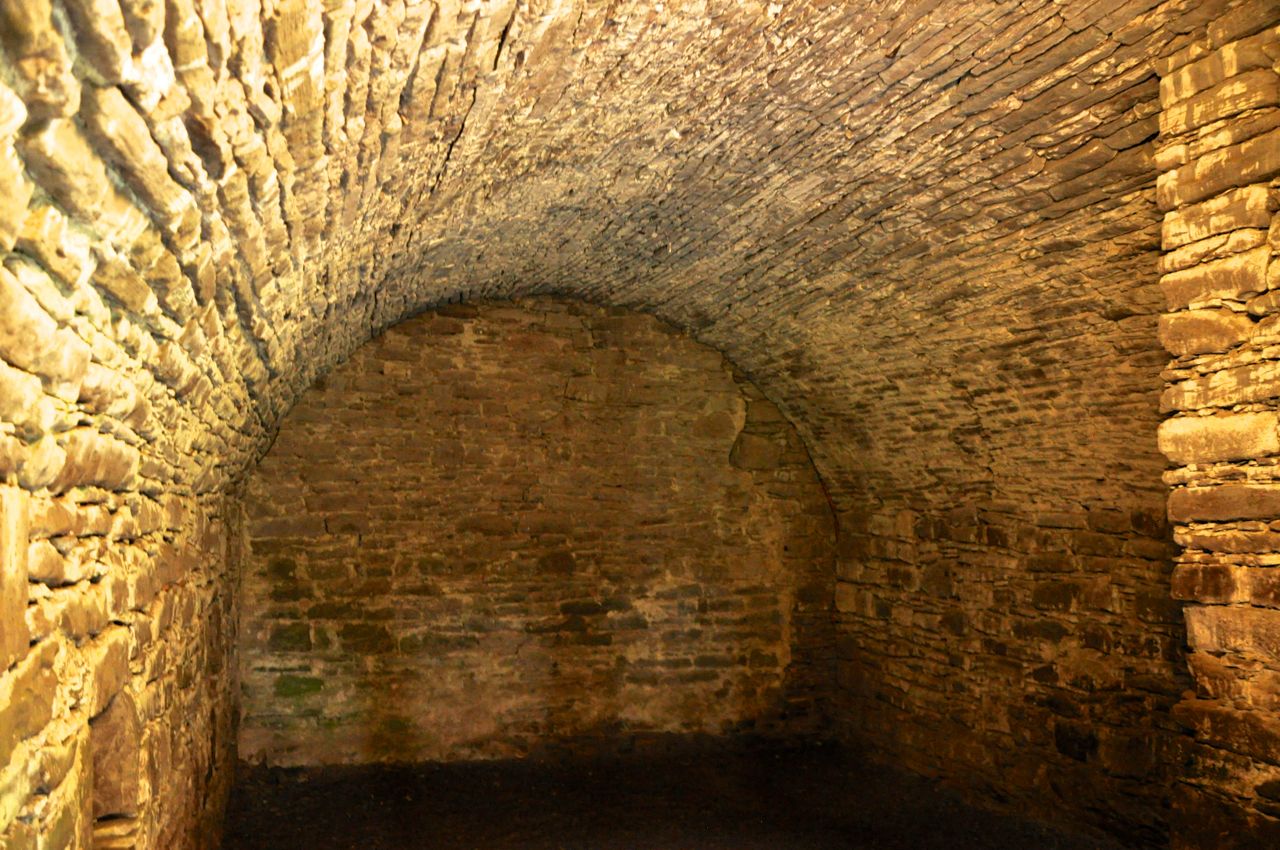
one from the internet, shown above.  The entrance is quite long and has guardhouses on both sides.  The courtyard picture above shows entrance stairs leading to the kitchen on the left and to the Great Hall on the right; it also shows one of the two wells in the Storage Cellarcastle.  All the ground-floor arched doorways visible in that picture, such as the two at the far right of that image, are storage cellars; an example is shown to the left.  In fact, the entire ground floor of the castle building was taken up by storage cellars.

The stairs from the courtyard lead to a triangular lobby, shown in the first picture below.  On your right is an arched entrance that leads to the cathedral-like Great Hall, the main reception room used for

feasts and large gatherings.  It’s one of the best preserved Great Halls in Scotland.  Heat for this large room was provided by a central “fireplace”, an area in the middle of the floor for burning fuel.  There was no chimney – only a smoke hole in the roof.

From the Great Hall one could enter Robert Stewart’s “Lord’s Hall”, shown below.

It has an unusual double fireplace. The floor tiles and paneling are additions from the 1880 restoration.  This room may have been Robert Stewart’s sleeping quarters, but his

private chamber could also have been the room above (although that room might have belonged to the duchess).  There is another nice room or apartment above this one, including an en suite bathroom.

A really cool kitchen is conveniently located just across the triangular lobby from the Great Hall.  The kitchen is virtually a tower house itself, and was one of the best-appointed castle kitchens in Scotland in its day.  It has two large serving hatches with unusual elliptical arches for passing food from the kitchen to the Great Hall.  In the picture below, you are standing inside the kitchen looking through the lobby into the Great Hall.  Think

big feasts!  The kitchen had an oven and an incredibly wide (18 foot) fireplace, shown

above.  Think REALLY big feasts!  The distance from the fireplace to the serving hatches is just a few feet, so the food would arrive piping hot in the Great Hall, for sure!  A stair turret leads from the lobby to two stories of guest rooms – probably warmed by the kitchen fires on cold winter nights.

Finally, there are cool gargoyles on the castle walls.  The ones below are on the Lord’s Tower, on the courtyard side.

We hope you enjoyed this castle like we did.  Although it is a ruin, there is so much of it left, unchanged from 1381, that we could very much imagine what it was like to live in a castle in those times – secure, but far removed from the comforts of our modern life!

Next post – Edinburgh, Scotland.


The Highlands II – Glencoe Valley

Having traveled across Scotland through the Highlands to Oban on the west coast (Oban and the Highlands I), we now turn around and hightail it back to the Lowlands and the east coast, to Edinburgh.  Why do that, you ask?  Well, we do want to see more of the Highlands, for sure, but we also want to catch the Scottish Ballet, which, like us, travels around.  We’re feeling a bit culture deprived here on the road, and getting the Ballet and us in the same city at the same time is a challenge.  So we book ballet tickets and head off to the big city, deciding to backtrack by a different Highland road that goes through Glencoe Valley.  Edinburgh is far south of us, but to get there via Glencoe Valley we have to go north.  It’s not too bad, though, because it takes us Stalker Castle, with a view of Loch Linnhepast pretty Lochs Creran and Linnhe.  As an example of the surprises that Scotland has to offer, we stop at a roadside restaurant for lunch in the middle of nowhere and discover, off to the side, this unanticipated view!  It’s a tower house; no sign, no path, just part of the Scottish scenery.  Wouldn’t it be cool to wake up to that view?  And wouldn’t it be a great fixer-upper?  Your very own castle?  I just had to go looking for this castle on the internet – it’s called the Stalker Castle, built around 1446, and now in private hands.  When the tide is in, it’s totally surrounded by water, making pictures of it even more evocative.  The castle and this area have a long history of wars between the clans Stewart, MacDougall, MacLaren and MacDonald, mostly precipitated by murders or raids.  Later, King James IV often stayed at this castle on hunting and hawking trips.  It seems everything in Scotland has an interesting history, though you might have to dig a bit for it.  Scotland and England do not allow billboards along the roads, unlike the US where it’s hard to see the scenery for the flashing roadsigns saying “George Washington Slept Here”!

Below are some other gorgeous views as we head north along the Lochs.

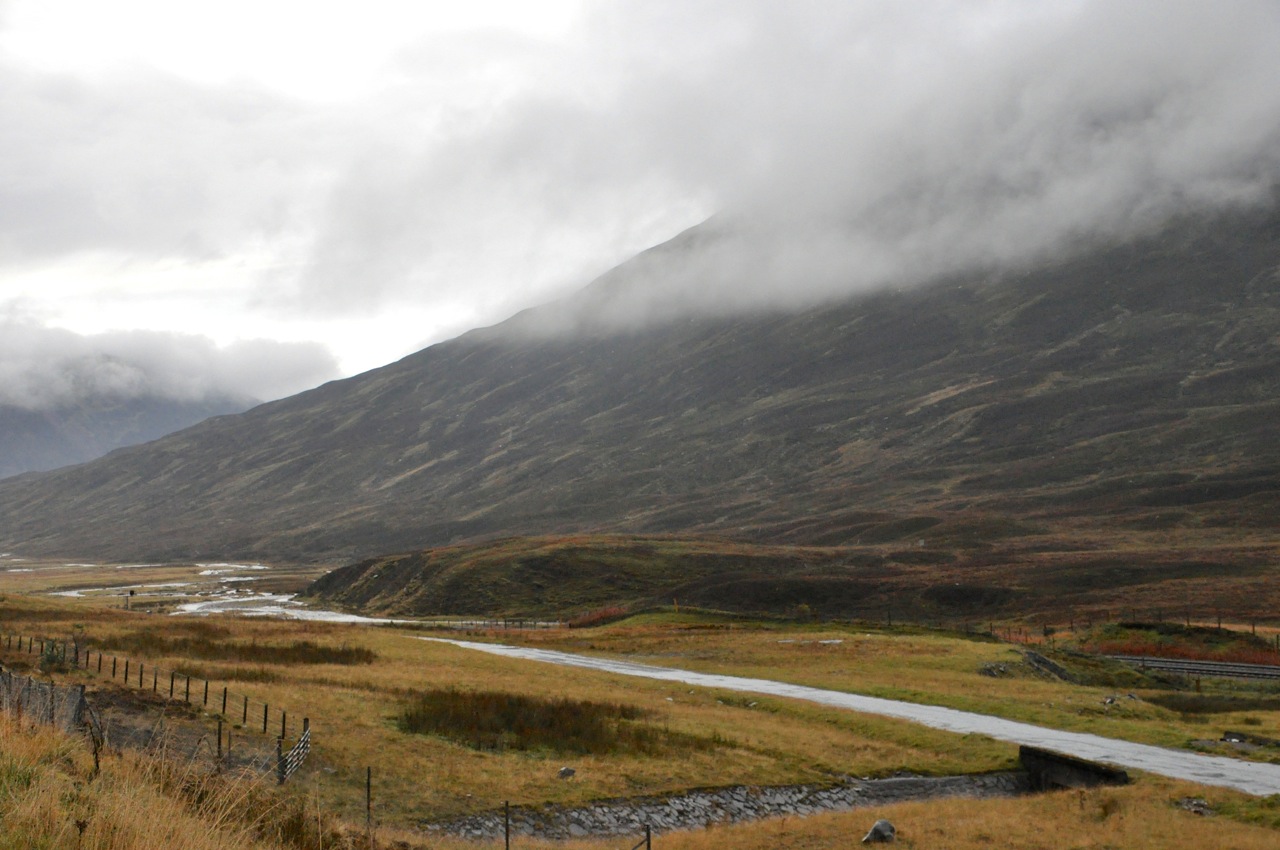
Glencoe ValleyAt last we turn south and head inland into Glencoe Valley and the Highland moors with their craggy hills and heather.  The nearly complete lack of trees on the hills is remarkable; consequently, people burn peat here, not wood.  As you can see, the view is on a grand scale, quite striking in its austere way.  Hopefully you’re as impressed as we were.  It’s beautiful!

Part way through Glencoe Valley, we decide to do what’s billed as a 3-hr hike to the Lost Valley of Clan MacDonald.  The View of area to be hikedtrailhead is poorly marked on a gravel pull-out directly off the main road, and there are not many hikers in sight.  It looks more like a spot for gawking than for hiking as we start up the trail.

We were hoping to see the mountainsides covered with heather, but we’re here at the tail-end of its season.  The extensive heather patches – they’re everywhere – are mostly covered with dead flowers and seed heads, as shown in the first picture below.  There are occasional patches still blooming here and there, and it is pretty, but clearly we have missed the “Wow!” time.

The trail goes down to a beautiful stream,

then starts seriously up.  Pretty, though!

At this point the trail alternates between being reasonable (first picture below) to being uneven and dicey (sometimes very dicey!) as indicated by the two vertical pictures both above and below; actually, there’s more of the dicey than the reasonable.  Scotland’s

trails are far removed from the highly engineered, trenched and staired trails we found in New Zealand!  These Scots are tough!  Like their whiskey, their trails are not for wimps!

We find occasional unexpected flowers along the trail – not many though, since it’s early October and a bit late for blooms.

A look back at the trailheadThe trail is steep and we’re going up fast.  This is a look back at the trailhead.  The trail there at the lower right snakes back to those parked cars on the road.  We’re already pretty high up!

As we enter the notch between the mountains, the trail stops being just “up” and now becomes up and down.  Oh joy.  Going down can be quite tricky, as Ginger demonstrates.

The trail follows a very pretty and a very happy stream as it bounces and burbles down the mountain that we are struggling up.

There are numerous small waterfalls coming off the mountain that add to our stream in picturesque ways.

Unfortunately, the clouds overhead are now dark gray and moving fast, and Ginger is concerned about rain.  The Eternal Optimist doubts it, but if it does rain, the steep parts of the trail will be really tricky to negotiate as we head back down, and remaining daylight is getting short.  Surely, though, we’re near the “Hidden Valley”?  We’ll go just a little further.  Soon the trail arrives at a spot where we need to ford the fast-moving stream – and for

sure we’ll get our feet wet since the few stepping stones are too far apart (and there’s not a friendly log in sight).  Getting across isn’t that bad at the moment, mind you – probably just a single foot kerplunk, maybe two – but if we get some rainfall it will be a lot trickier coming back.  Witness what’s feeding this flat spot, just 2 feet upstream, shown in the right picture above.  So discretion wins over valor, and we decide to turn back.  We meet a couple coming down from a higher, diverging  trail (1 of only 2 couples we meet the whole trip), who describe our intended destination as simply a level meadow nestled between the mountain peaks.  So the “Hidden Valley” doesn’t sound hugely exciting (and the grapes were probably sour anyway).  Really, the hike has been pretty enough to keep us happy.

The bank is made of peat, many feet thickAs we hike back, we note this bank of solid peat on the left.  The stuff is many feet thick!  It fascinates me that one can burn what looks like dirt for fuel here, but as noted earlier, with few trees, there’s not much alternative.

As we retrace our steps, note the dwindling light, shown below!  Hmmm.  With the mountains in the way, twilight comes pretty early here.  Glad we turned back.  I suspect there are times when optimists should be shot on sight.

As we drive further through the Highland moors, the landscape becomes increasingly stark and desolate, but still awe-inspiring.  This is Rannoch Moor, a large expanse of boggy land

that is unrelentingly bleak, almost hostile.  For long distances the only man-made thing is the road;Beginning to leave the Rannoch Moor apparently just building a road across this stuff was really difficult.  The scenery only begins to look a bit more friendly when we enter Trossachs National Park again.

That’s it for this part of the Highlands.  Hope you enjoyed it.  We’ll see the Highlands one more time, when we traverse a different part later in our travels.

Our next post will be a visit to one of the best-preserved medieval castles in Scotland.  Doune Castle, near Stirling Castle and Edinburgh, is our favorite so far.