Rotorua – Geothermal Wonderland

The main reason tourists flock to Rotorua is to experience the otherworldly nature of the reality of this world.  Here in Rotorua one can glimpse the inhospitable forces that lie under our feet, Moving Tectonicsthe monster that lurks under the bed.  Remember me telling you that Auckland was built on top of 50 old volcanoes?  There are a bunch of volcanoes in NZ, picturesquely so, like a Mt. Fuji look-alike (Mt. Egmont) here on the North Island (it’s off to the side and we’ll visit it another day).   Rotorua is near the middle where a band of tectonic plate intersections cross the island.  The world has been impacted by this region in the past; the picture on the left below shows NZ’s largest lake, Lake Taupo, which is over 350 square miles in size and was once a volcano.  When it blew in 186 AD, it released more ash and debris than Krakatoa and Mt. St. Helens combined – and then multiplied by ten (!!).  The Chinese noted a blackening of the sky, and the Romans recorded that the heavens turned blood-red.  Need I point out that neither of those countries is even remotely close to NZ?  The picture on the right shows one of the 3 nearby remaining volcanoes  (located in the area used for filming Mordor and Mount Doom in Lord of the Rings) that is visible from Lake Taupo.
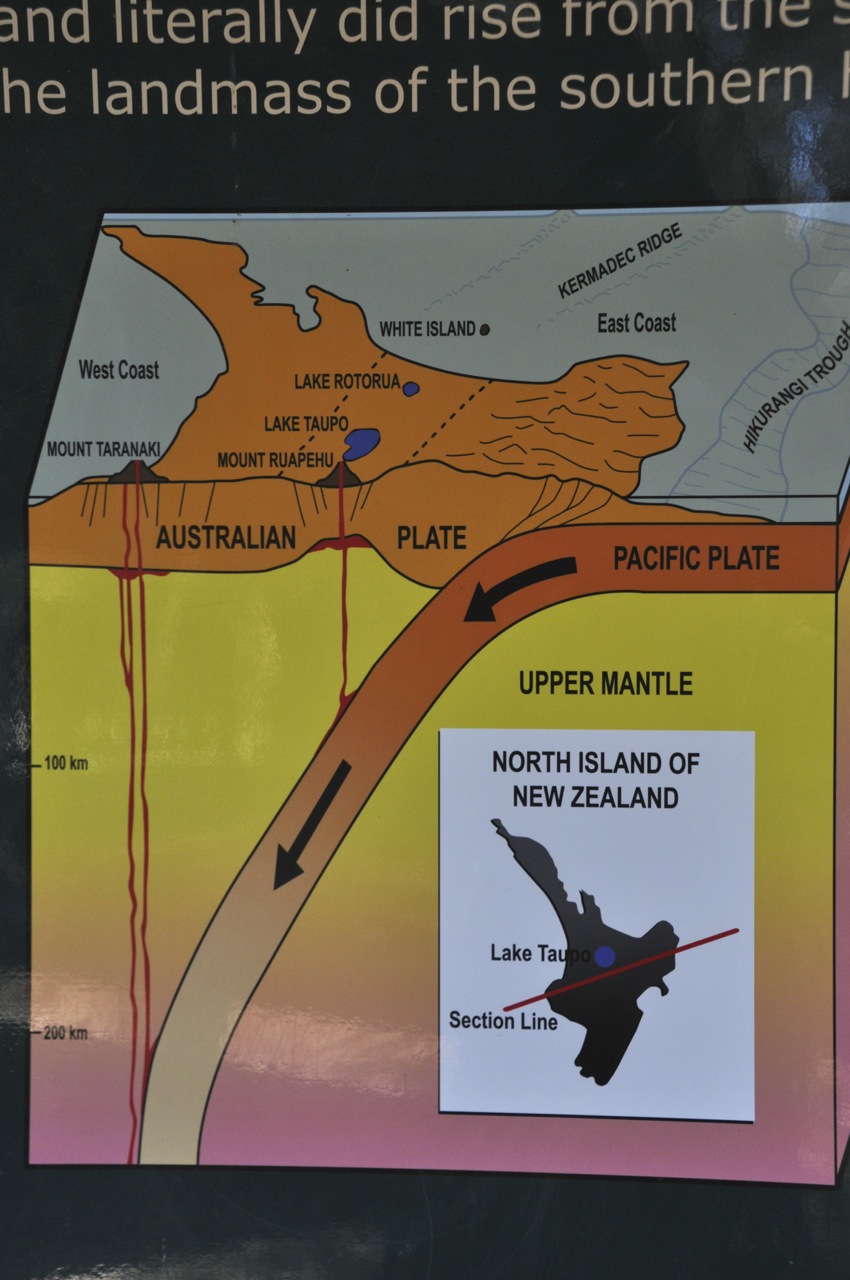
Rotorua is special because it is the world’s most concentrated and accessible geothermal area.  Part of “world’s most concentrated” label means there are plenty of geothermal hot spots to visit around Rotorua, most with entry fees.  And of course the place abounds with spas and natural hot pools at different temperatures (do you want to emerge pink, vermillion or crimson?), along with historic Priest pools (cures arthritis and rheumatism), private rock-lined romantic pools with champagne and lake view, or Rotorua hot mud treatments, etc etc etc.  Think tourism and lots of dollars!  (Side note: New Zealand in general is very very good at offering viable enticements to separate you from your money).  We opt to see some geysers at Te Puia (of the last post) and a colorful area called Wai-O-Tapu.  Below are the Te Puia geysers.  Unlike Yellowstone’s Old Faithful, these guys go off frequently and stay going for 45 minutes or so, so they’re mostly “on”.

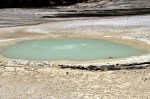
Wai-O-Tapu is fascinating, and very colorful.  There are many fumaroles (holes that emit steam and mineral-laden gases), bubbling ponds or puddles blissfully simmering away, mud pools farting blobs that audibly plop back down, strange-colored pools, whitish solid silica flows, etc.  Signs tell us the colors of the ponds are due to the metal chemicals that boil up in them – that blue means chloride (must be funny chlorides; not part of my analytical chemistry course), orange means antimony and arsenic, gray/chocolate means sulfur and carbon, yellow/green means sulfate, and green/yellow means sulfur and arsenic, etc.   Let’s start by looking at the bubbling mud pools making disgusting sounds.

The amount of rain determines mud consistency and therefore surface patterns; pictures at the site show interesting circular, concentric designs on the smoking surface.  Alas, we’ve had a lot of rain and the surface is less texturally interesting, but the flying ploops are fun to watch.

Fumaroles are everywhere, belching clouds of vapor and making the place look ominous.  It should be noted that you smell Rotorua well before you see it, although the intensity varies.  George Bernard Shaw stated when he visited an area of Rotorua (Hell’s Gate) that it “reminds me too vividly of the fate theologians have promised me”.  There is a Bosch-like feeling to the landscape for sure, and vapors and smells cleverly add to the impression; nice marketing, Rotorua!  Back to fumaroles, often the vapors are coming from some pretty deep pits, formed when the vapors ate away the rock and the ceilings collapsed.  Often we can not see the origin of  the smoke, it’s hiding below the rims of the

pits.  We’re on a path, frequently with a fence, and instructions are everywhere saying not to leave the path because the ground is not stable.  The deep pits before us reinforce this message that the terra may not be firma, and everybody is on very good behavior; no one leaves the paths to walk to an edge for a better picture.  Even without Ginger threatening to kill me if I even think about it, I am sufficiently convinced.  I (and the other tourists!)

are good not only because the holes are deep but because we see small pools of boiling fluid near our feet that by extrapolation must lurk in bigger quantities troll-like at the bottom of these daddy holes.  I’ll just stay on the path, thank you.

Sulfur is a frequent component of the released vapor, and it plates out as crystals on the pit walls, as shown.  The image on the left has more color than just yellow, so the emitted gas must be pretty complex.

Sulfur knobEarthquakes sometimes tilt this region to a different level, draining areas that were once fluid and leaving domes of sulfur behind.  The one shown here is about 4 feet tall.

Many of the pits seem to specialize in particular elements.  The pits below are carbon pits, with an asphalt character to them.  Some regions of the pit are boiling, and the whole pit is slowly turning over with new yucky patterns emerging, almost as if it

were being stirred.  If this were hell, one might imagine that in the antithesis, heaven, this would be hot fudge sauce.  There is certainly nothing sweet-looking about the stuff in pits in front us.
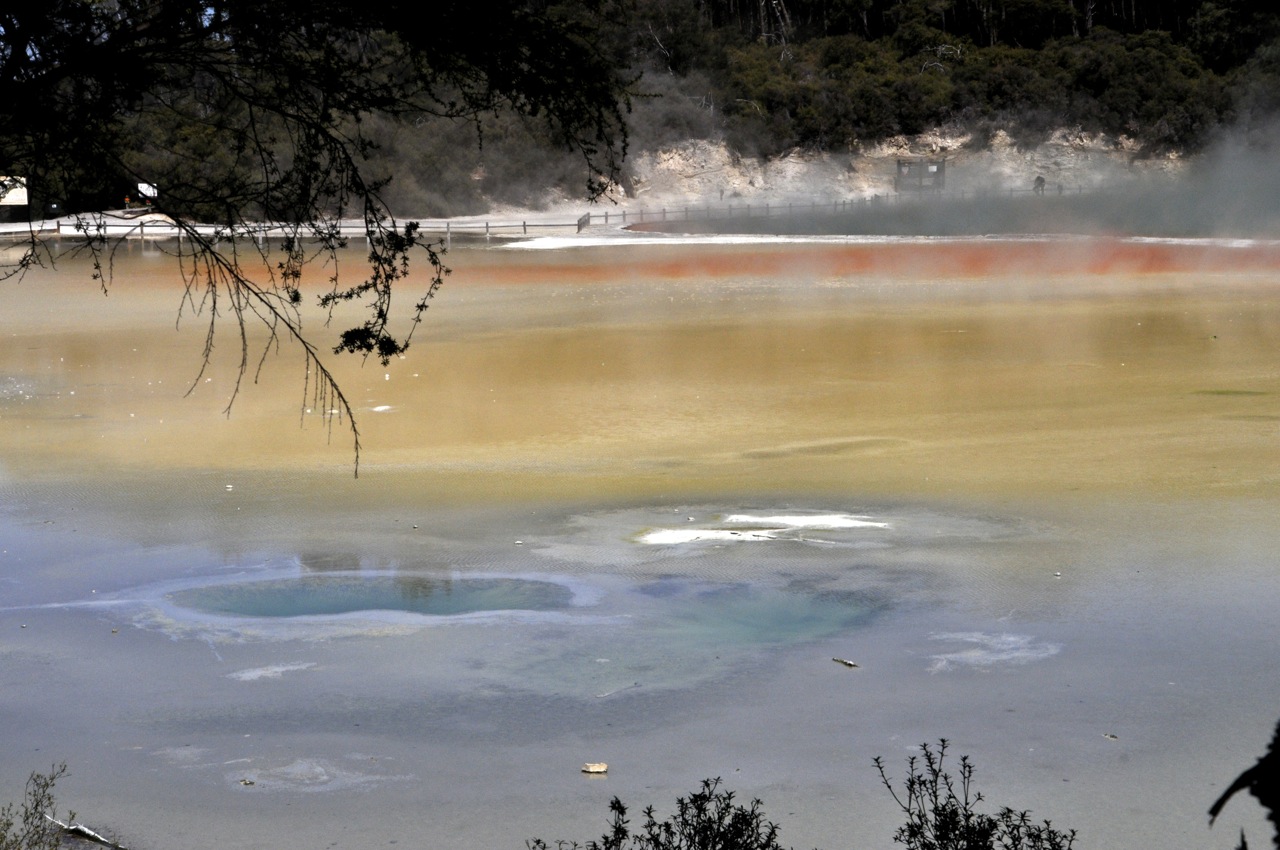
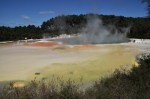
Artist's PaletteAs we walk the trail, we come to a spectacular overlook of the Artist’s Palette – a very apt name!  As you can see, the colors are amazing, and made magical by the escaping wind-blown steam providing an ethereal, shifting dominance in the visible color scheme.

Let me show you some overviews as one hikes down to the Palette (click on an image).

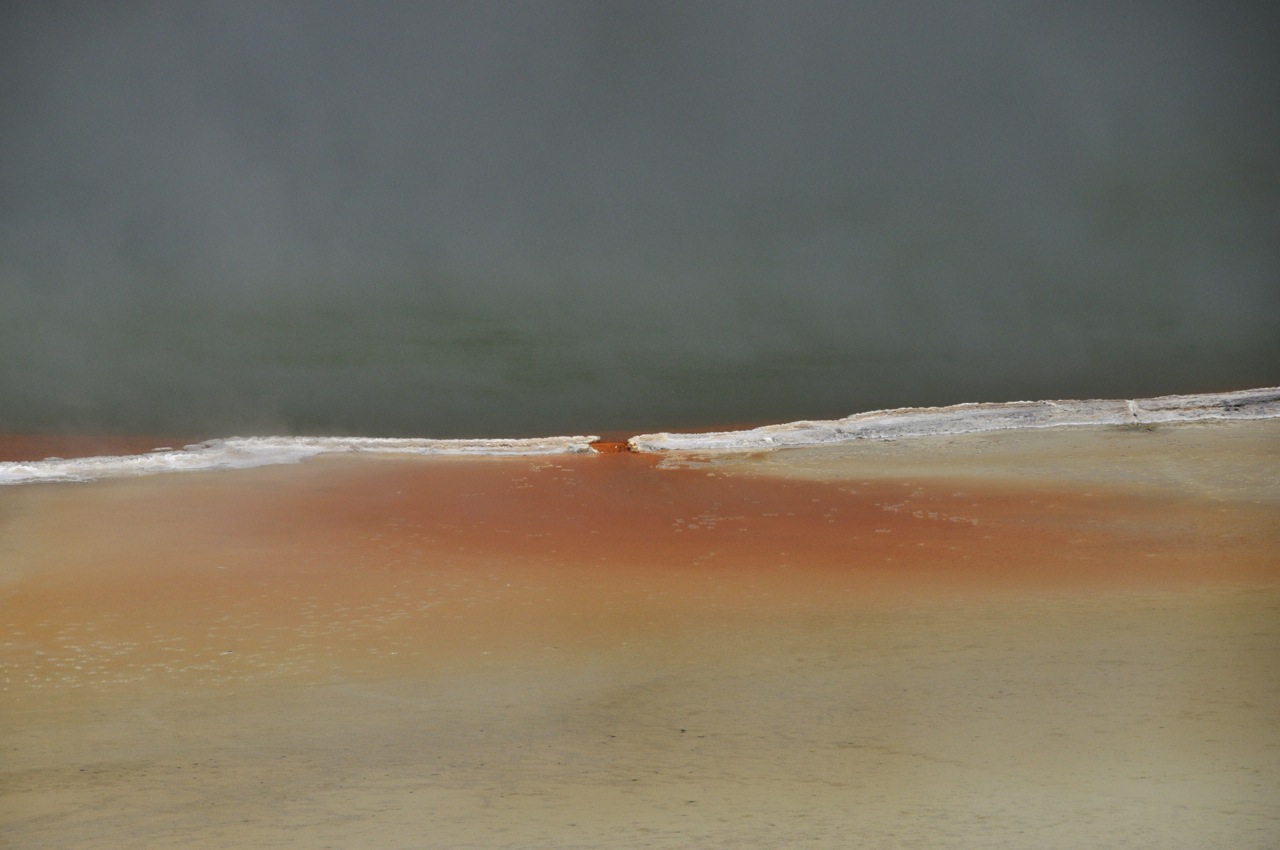
The large green pond in the first two images is the Champagne Pool, the largest of the hot water springs here, so named because of the bubbles of CO2 that percolate up and float on the surface (show you later).  This pool has tilted due to earthquakes, and it now leaks water off to the left, forming an extensive solid silica “river” (show you later).  Wow!  The whole vista is amazing.  The yellowish area leading up to Champagne Pool is quite variable and interesting in its own right.  It looks solid, but I would not want to walk out there – some of it seems to be just a crust over water.

When you finally get to the Champagne Pool, surprise!  It is a green pond – but with an orange perimeter!  Awesome!

As shown below, the CO2 bubbles bubbling up and bouncing on the green pond surface are everywhere (best seen if you click).

I shot the sheriffThe many colors also lead to whimsy, as in the picture to the left.  How about “I shot the sheriff”?

What is hard to appreciate from these pictures is the movement, the swirling white clouds above this technicolor fantasy.  The wind blows the clouds around, and one moment much of the pond is clear and sharp, the next a lot of the view is in soft focus, and the next you can’t see anything but cloud, which you are standing in.  This must be what dreams are like, or madness, with reality coming and going.  The clouds also greatly affect the color, muting and blurring the tones, then just as quickly snapping them into sharp vividness.  I’ve tried to capture an inkling of the color-muting and blurring below.

Now realize that you go from that first picture to the last in just a couple seconds, and back, and you’ll get an inkling of the disorienting but mesmerizing effect on the senses.

There is more to see, so we leave this misty kaleidoscope and head down the path.  It’s a strange world of ponds and rivers of off-green colors.
As we walk along we encounter moss on a bank.  Are you kidding me?  Kaleidoscopic moss

now?  Are we smoking something?  Is it in the air?  Maybe we’ll be orange when we get back?  Maybe we’re in a Beatles movie?  We press on.

Little (and big!) pools and ponds are bubbling like crazy everywhere.
Just as it can’t get any more weird, we turn a corner and suddenly the small creek beside us is filled with some form of algae, with some spectacular greens.

This stuff can live in this water?  It’s very localized, so there must be something unique about this particular environment.

We come to the far end of our hike, the lake with normalish green water.  A stream is emptying cream-green water into it (I wonder if these colors change day-to-day?), but it

seems like an ordinary green lake, even though it is green, with ducks and such having a good time.  I test the water in the stream feeding the lake and the steam is only tepid in temperature, so somewhere cool water has been entering.  In the distance are a major geothermal power plant (that supplies something like 10% of NZ’s power needs) and a volcano (Maungakakaramea, or Rainbow Mountain), looking somewhat sinister off in the distance.

The walk back is a big loop that borders the Primrose Terrace, a solid silica river that grows from the runoff of the Champagne Pool.  The Terrace is impressive in its size (we walk along it a loooong way), although it’s not particularly pretty.  Up close one can see the details of “arrested flow” as water evaporation deposits silica as “siliceous sinter”.  The vapor seen in the last picture is from the Champagne Pool, located just over the crest of the hill.

Near the end of our trip and close to where we started, high up over the collapsed-ceiling boiling pits, we encounter some reds that have no obvious source.

A little further and we encounter our final amazing sight, a large pond in the most amazing and vibrant yellow/chartreuse you can imagine.   It’s dazzling.  Your mind thinks this can’t be real, surely this is a trick by Sherwin Williams, but it’s a very big pond and must be real.

We’ve reached the end of a pretty amazing visit.   I’ll leave you with one last image.  We Hot silica meets streampassed this spot at the beginning and end of the walk;  steaming water flows over a solid silica “creek” into a rushing fluid stream, a juxtaposition of three distinct phases in this wacky wonderland.

There are more nearby geothermal sites hawking their virtues, but it is hard to think they could be better.  If you have stayed with me through this very long post, I hope you have been as amazed as we were.  We were amazed by the strange beauty, certainly, but we were also confronted with the hellish and powerful reality beneath us.  We pretend the earth is solid all the way to China.  It is not.  We walk on a thin crust, and even that crust is not what we imagine.  Just over a mile below your feet, right now, the rock at that depth is too hot to touch.  Each mile deeper and the temperature goes up another 75ºF.   Further below our feet is a seething, restless hell-monster of magma and pressure, seeking weaknesses in the crust, building strength, and biding time in a very sinister way.  How tenuous is our presumed mastery of this planet!

Rotorua – Te Puia

Rotorua is a big tourist attraction, similar to Yellowstone Nat’l Park. It’s a geothermal area with geysers and smoking holes, sulfur and bubbling mud, hot springs and spas.  It’s also a Maori center; they own some of the thermal sites and take advantage of the influx of tourists to promote traditional cultural performances including hangi, a Maori feast where the food is cooked by burying it underground over hot rocks. We’ve done the cultural thing before (Bay of Islands post) but wanted the hangi, so we’ll look at another iwi”s (tribe’s) traditions. There are several performances/hangi available from different groups; we choose the one that houses the Maori Arts and Crafts Institute for teaching and preserving the Maori carving and weaving arts.

Yes, I’ve shown you Maori culture before, and so some of this post will be repetitive; my apologies, but it is an interesting culture.  In spite of the frequently barbarous practices of these Stone-age, fierce, warring tribes (eating the vanquished was real), they created some exquisite works of art.  I’m just going to share the art.

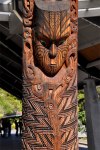
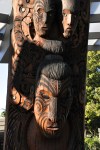
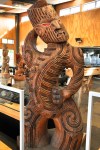
I’ve shown you this type of carving before. These are from an outdoor atrium of Te Puia, produced by the carving school, and they’re pretty impressive.

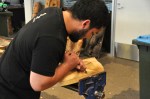
Our tour includes some geothermal wonders (next post!), and we get to their arts school pretty late; only one student is still working away, but the place is interesting even without any explanation.  Beautiful stuff!

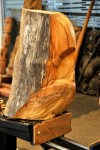
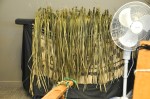
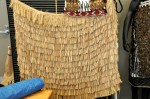
The weaving is also fascinating, but here everyone has left the premises.  Weaving was/is done using the NZ flax plant.  It’s a big plant, kind of like our Spanish bayonet.  The (long!) leaf is cut and used for weaving, or the flesh carefully scraped away (with shell!) to obtain the internal band of strong material and then soaked and beaten to get fiber – apparently a process that is an art in itself.  That and feathers make up the clothes.  From the look of things, this is NOT easy.

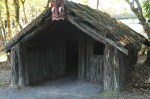
Before quickly covering the ceremony and hangi, I’ll show a replica of an early Maori village; pretty simple wood huts similar to our Pacific Northwest Indians.  The carved, elevated storage building kept the food away from rodents.  The last picture is the village entry; a village was no bigger than the fence protecting it.  Such was the life.

The meeting house looks pretty much like others we have seen.  Before contact with Europeans, the Maori had no written language; oral tradition, facial tattoos, and wall carvings recorded their ancestry and history.  The style of carvings and wall weavings varies between tribes, so what we see in this marae are different than what we’ve seen before, but the nuances are lost on us  Those in the know would recognize the tribal differences.

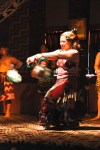
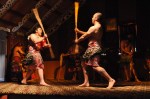
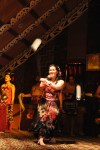
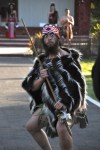
Finally, the ceremony and hangi.  The “welcoming” and other traditional Maori ceremonies to us was  similar to the one in we saw at Waitangi.  Apparently tribal differences are pretty small in this area, perhaps because it was an important part of communicating intent and respect – get it wrong and risk war.  Because this is a big tourist center with competing productions, we were expecting a very polished and professional performance.  Instead, we ended up thinking the more intimate one in Waitangi was better.  Pictures below.

One of the different parts of this ceremony, however, was the chance to be taught some of the traditional dances.  We, of course, were terrific at this.  (Not! ed.)

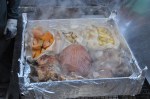
Finally, the hangi.  It was indeed a feast, with the traditional food of several kinds of potatoes, chicken, pork and lamb, but no longer is this a dirt hole-in-the-ground affair!  Now they use firebrick pits and steel covers.  Pictures below.

The dinner was very good, supplemented by soup, salads and desserts, but a bit disappointing.  We had done a Hawaiian luau many many years ago where pork was cooked in the ground after wrapping with banana leaves, and the taste was unique and wonderful.   The hangi had a lot of good food, but alas with ordinary taste, and at a not-ordinary price.  But Hey!  Done a hangi?  Check.

Next post will feature the real attraction of Rotorua, the geothermal activity where hell and the devil appear to be too close for comfort.

Glowworms

To make up for the length of the previous post, this one will be much shorter – helped by the fact that I was not allowed to take pictures on the tour.  Tour of what, you say?  We’re visiting the Waitomo Caves.  Now, I’m not a big fan of caves anymore.  I’ve done some really stupid things exploring caves as a youth, luckily surviving, and I’ve seen some major caves later in life, and for me there’s a certain sameness to them now.  Is this Old Fartdom happening?  Does one get increasingly jaded in life as one “sees it all”?   Boy I hope not, but let’s keep an eye on this attitude.  Anyway, we are not here to see the caves but to see the glowworms.  We will do that by going on a boat ride on an underground river.

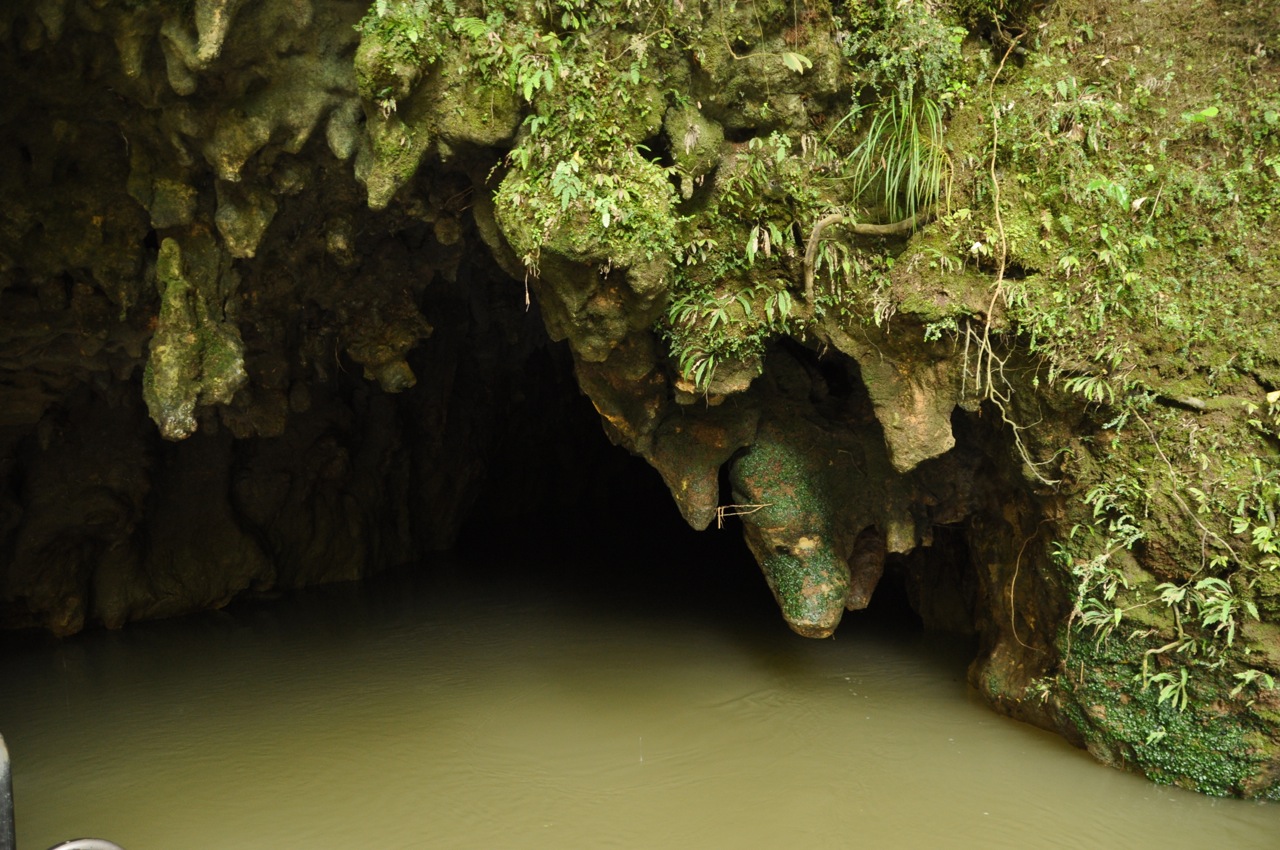
The Waitomo area is limestone, the weather rainy.  Whole streams disappear down funnel-shaped sinkholes.  The rocks are often fluted.  Caves abound, as do tour companies helping you explore them.  Some tours look really cool, such as one involving an abseil (“to rope down”) 300 feet down a yawning, spectacular vertical-sided fern-draped pothole (cave exploring follows).  Others are a wet-suit-clad inner tube ride through an underground river and over small waterfalls.   We’re doing the short 45 min tour that doesn’t allow for pictures; we’re taking it because Ginger is not feeling her best and the longer (and more Waitomo Cave exitexpensive) trips that allow photos are quite a bit longer, 3+ hours.  And really, in all cases the major attraction of these tours is the glowworms, which we’ll get.  We start by walking into a cave, then hopping in a boat for a short drift through the glowworm region.  Cave exit is shown in the picture (which I’m allowed to take).

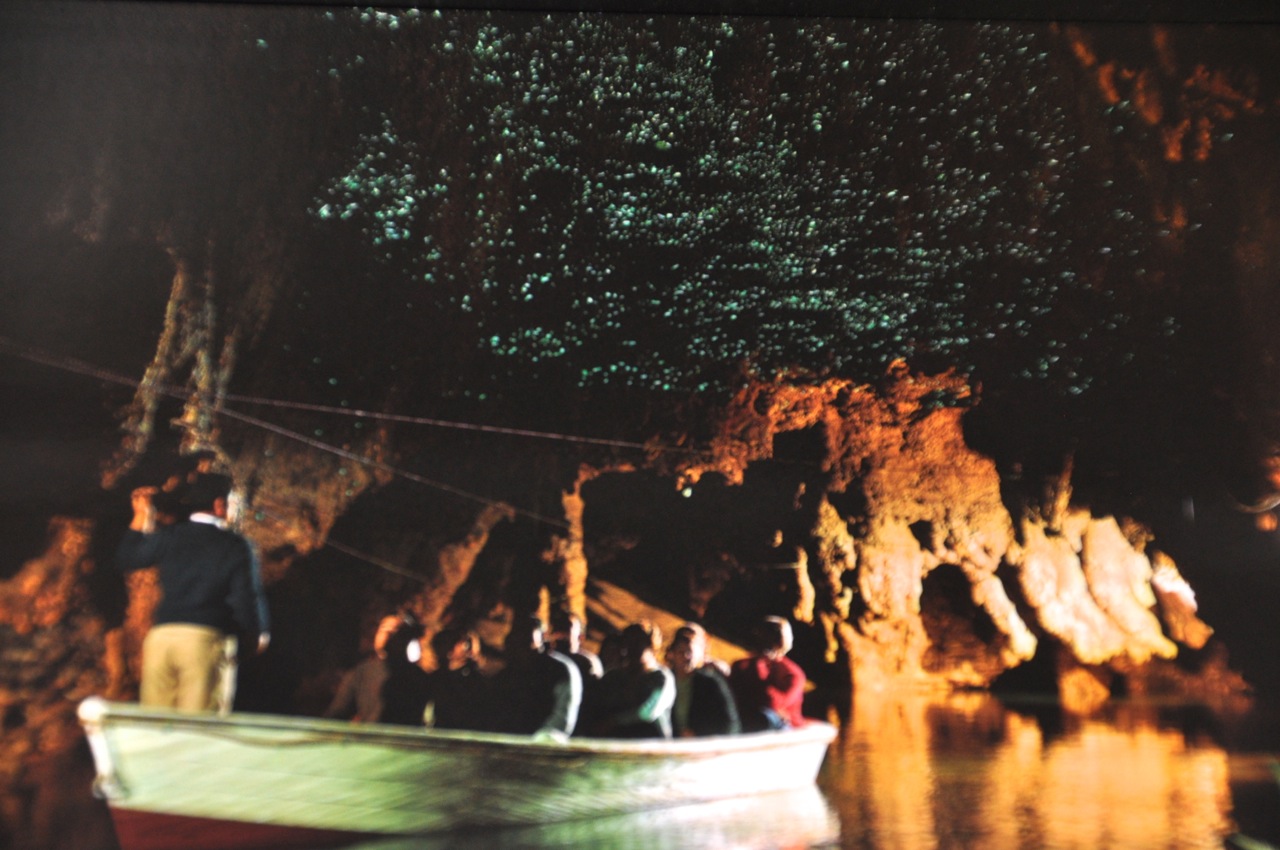
Glowworms exist throughout NZ, mostly in caves (where we can see them in daytime).  Glowworms, in the adult form, look like large mosquitos; they live for  3 days, not eating but having lots and lots of sex, finally dying of exhaustion but with big glowworm threadssmiles.  The female multi-tasks and finds time to lay eggs during the orgies, the eggs hatch, and the small 3mm larvae attach themselves to the cave roof.  They then lower 20-30 basically invisible mucus-and-silk threads (like fishing lines – more later).  The picture to the left shows them, illuminated from the side.  How did I take this photo? Alas, I took it directly from the brochure, but it might as well be my “live” picture.  It looks like this, folks!  Without side lighting, however, they are invisible.  Caves, you may know, are dark.  Normally.  But glowwormsglowworms are bioluminescent, producing a mostly blue, greenish-tinged glow.  When your eyes adjust to the dark, there they are, everywhere, shining like blue stars.  Pretty cool.  The brochure picture to the left gives you the idea of what you would see, but it is much better in the flesh in the cave with the shining stars just a few feet over your head.  So what is the story here?  The bioluminescence attracts flying insects in the dark cave.  They encounter the hanging mucus threads and get stuck.  The larvae pulls up the line, eats the ensnared prey, and drops down another line.  The larvae grow from a few mm to the size and shape of a matchstick, so this process works pretty well.  It’s scary out there, folks!  It’s The Blob of the insect world (old SF movie to you newbies).  But for us, these Blue Meanies are just really, really fairy-like magical.  Sorry I don’t have better pictures to show you, but it probably would have been hard to capture them without a tripod.

To Inhabit a Hobbit Hole, or Not?

That was the question.  Not as momentous as “To be, or not  …”, but still, it’s $75 a pop for a 1.5 hr tour of the Hobbit movie set, and c’mon, is this a made-up tourist thing or what?  And we’re guarding our sheckles in this expensive country.  So we said “No”, and then we thought – “We’re this close?  Would our inner kids ever forgive us?”  So here we are, not at all sure about our decision as a very rickety 1950’s repainted and frequently rehabbed school bus on its last legs lumbers and wheezes up, gears grinding, to take us to Hobbiton from the Shire’s Rest Cafe-and-souvenir-shop (just after a pouring rain ….).  Hobbiton is the set left behind after filming the first Hobbit film.  The Lord of the Rings filming built the place, but that Shire was made of plywood and styrofoam, meant to be removed.  However, in the process of tearing it out the rains came and stopped the work, and then the locals starting showing up to see the location, and thus was born a tourist industry.  For the first installment of the Hobbit, the Shire was rebuilt with an incredible (can I say maniacal?) attention to detail, and here it stands, expanded in fact for the 2nd Hobbit installment (but we’ll get to that).

The beautiful area was and is a very large sheep farm, chosen by Peter Jackson from

The sheep farm

View of the area from Shire’s Rest.

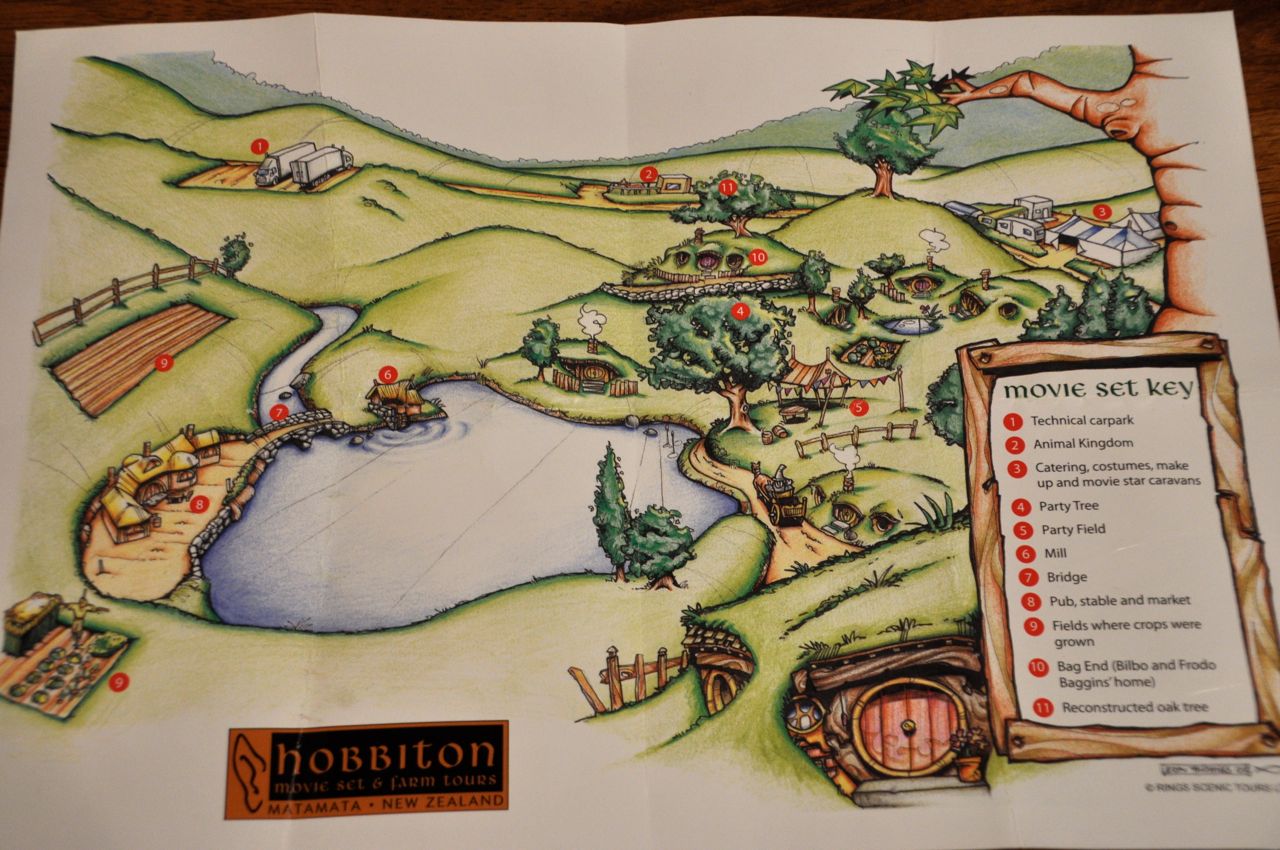
an aerial search of this idyllic hilly land to correspond with Tolkien’s description.  I’d like to show you an overview of the Shire, but the bus doesn’t stop, the road is bumpy, and the bus has no springs.  Staying in the seat is hard enough, much less shooting a picture, and the view comes and goes.  The best I can do is take a picture of the schematic on their brochure, so there it is in all its glory.  Sigh.  A real picture would have been cool.  DSC_0046

Anyway, back to the choice of the Hobbiton site; the existing lake already had a “party tree” in front of it, and importantly, there were no roads, buildings or electrical lines to mar the view.  Peter Jackson got the NZ government to volunteer the NZ Army to spend 9 months building the road and site.  At its peak, 400 people were on site for the filming of the few minutes of the Shire in the Lord of the Rings series.

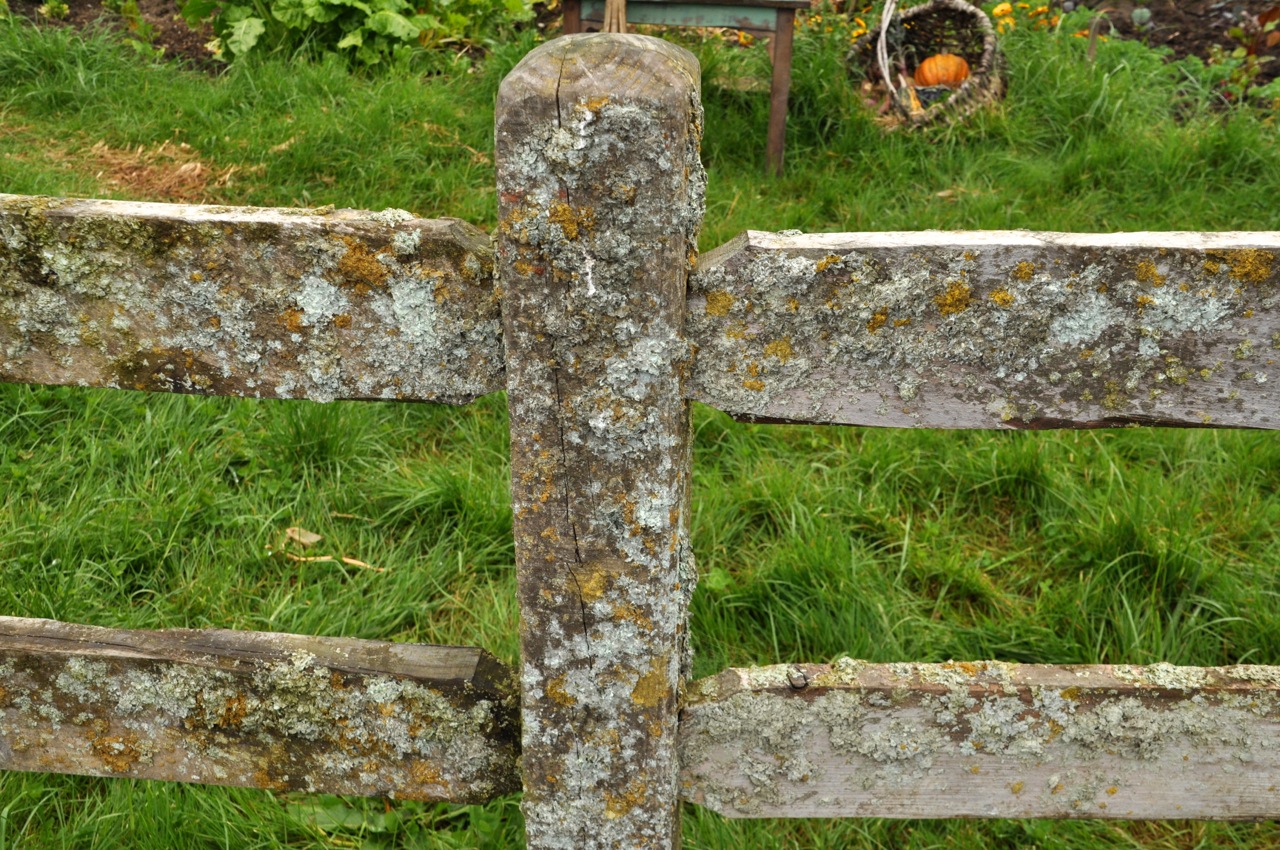
On the bus our guide tells us we have to stay with him at all times and to keep on the trail that winds past many of the Hobbit houses.  So there are real limits to picture taking – particularly Hilltop Tree (fake)overviews!  I will not be able to walk back up this road, for instance.  Groan!  And we paid how much money?  And then we’re there, and the doubts melt away, because it’s fabulous.  Peter Jackson’s attention to detail is stunning.  Perhaps this is a requirement for movie directors?  The budget for this movie was astronomical, yet Jackson managed to overspend by quite a few million (the movie,  of course, was in the black after opening day, so there weren’t many complaints).  As an example of Jackson’s approach, he needed an oak tree on top of Bilbo’s house (Bag End) at the top of the Shire, so he found the one he wanted elsewhere, had it cut down, the branches numbered and cut off, and transported and re-assembled at Bag End.  He then imported artificial leaves from Taiwan and had them individually wired onto the dead tree.  And there it is today, unchanged, as shown in the picture.  Similarly, Jackson creates a small orchard of plum trees since Tolkien writes of a child under a tree eating plums with pits piled up; but the tree shapes are all wrong to Jackson, so he has them pulled out and “Hobbit-like” apple and pear trees planted.  However, with the shooting sufficiently delayed in spring, the trees are leafing out and they are not plum leaves.  Well, that won’t do, will it?  So for filming he Lichenrepeats his tree trick, plucking the leaves off an apple tree and wiring plum leaves from Japan in their place.  I can roll my eyes at this perfectionist thing, but it works; all this detail makes Hobbiton magical, and almost alive.  Jackson had to make the place look like it had been around a while, so the wood was artificially aged, the fences sprayed with artificial “lichen” (some substance mixed with wood chips), etc.  And it is all wonderful.

I took a LOT of pictures of this exquisite place, and I don’t really want to choose among them, so I will simply show you most of the bazillion pictures I took.  Sorry about that, you do the work!  Will this post be long?  “You betcha”, as a famous lady once said.  To help readers who might be only peripherally interested in this topic, I have arranged this blog in three parts.  There is a looooonng section on the Hobbit houses, a short segment on the upcoming Hobbit sequel out next month, and then a section on the delightful Green Dragon Inn.

HOBBIT HOUSES!  OH MY!

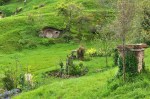
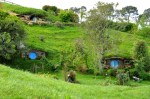
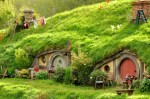
There are 42 hobbit-hole facades on the hillside, of different sizes for filming, and they are charming.   I’m not going to show all 42 (alas, I didn’t get to see them all!), but I will show many (and I think you will want even more).  Before I do that, let me show you some overall pictures of the Shire; although I’m in the Shire and it’s in my face, it’s impossible to get more than pieces of it.  The first one is looking up from near the bottom, the second is looking down from near Bag End.  Alas, the snippets don’t really capture the magical feeling of the place.

The next picture is another piece of the Shire, near the “river” (lake); the last near the entrance to the Shire marking the directions of three of the four Farthings (great name, that).

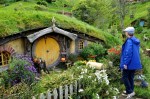
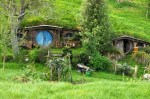
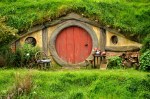
We are enthralled by this place because of the detail.  It is the essence of quaint and cute!  The place is alive!  Hobbits live!  It convincingly looks like all the Hobbits have left for a meeting or something, and will be right back.  One expects to see the tobacco pipes left behind to be still smoking.  As an example, take this Hobbit house: The broom, the flower pots, the coat on the bench, the rug airing out on the fence ….

Add the scale, which makes it quite adorable.

Here’s another one, with us nearby for perspective.  It looks inviting, sure enough, but the pull-away view shows all the props that make the place seem so real.

The emphasis on detail is everywhere: dormer windows poking up, chimneys with soot on them, laundry on the line.

Or this example, with the carpenter’s (woodworker’s?) house and tools, and next door the wood shed.

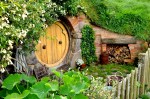
OK, this last example.  Carving on the door frame, items showing through the window, potted plants on the ground.  And then step back and see the whole picture of this house – laundry on the line, the basket of washed clothes just below, a water bucket by the fence ….  At whatever distance you view the place, it is captivatingly homey and charming.

Just to play, I decide to hide in the house below and see if Ginger can find me.  Well, it wasn’t so hard to do; the Hobbit holes only go back a few feet before they end, just enough to very comfortably store stuff (remember to click for the slideshow).

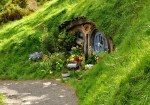
I hope you’re ready to see more Hobbit houses, because here they come. These are paired images of 3 houses.

This is a study of one house:

A couple more pairs:

Another.

Another.

Getting tired of this?  A last set …..

What you haven’t seen in all this is Bilbo’s house, Bag End.  That’s because, irritatingly, it has been pre-empted by a publicity shot for the upcoming Hobbit sequel and the area is blocked by people and cameras.  Below are three shots, one glimpsing the interior of Bag End (which actually has a small section of finished interior, which is visible when Bilbo meets Gandalf at the door).  The other pictures show the side of the house (we weren’t allowed any closer).

BAG END AND THE HOBBIT SEQUEL, “THE DESOLATION OF SMAUG”

So I’m grumpy because we aren’t going to see the interior of Bag End, and I’m talking to one of the crew milling about, and she says “Yes, when we were filming The Hobbit….”  Hmm.  So this is no pick-up crew.  The filming is for publicity of the Hobbit/Smaug film (you need marketing for THAT film?) here in NZ (although the guide tells Ginger it’s for an ad for Air New Zealand), and there are 3 actors in costume, pretty much hiding away inside Bag End.  Apparently there is a lot of secrecy around the new Hobbit film that I am unaware of, and my camera is eyed suspiciously, and we are not invited anywhere near Bag End.  Below are the shots I get.

We leave (we’re the last tour of the day), and the filming crew move down for a shot as we Publicity for Smaugdepart, so I hightail it back to sneak in my own picture of the actress, who I guess will be in the Smaug film?  We’ll see.  Actually, before getting to Bag End our guide pointed to a couple Hobbit Houses off to the side that he will not take us to, since they were just recently built for the Smaug sequel and Peter Jackson doesn’t want people to see them until after the film (why?).  I take pictures with the telephoto lens.  They should be in the Smaug movie; I’ll look for them (and say I was there!  Sort of).

THE GREEN DRAGON

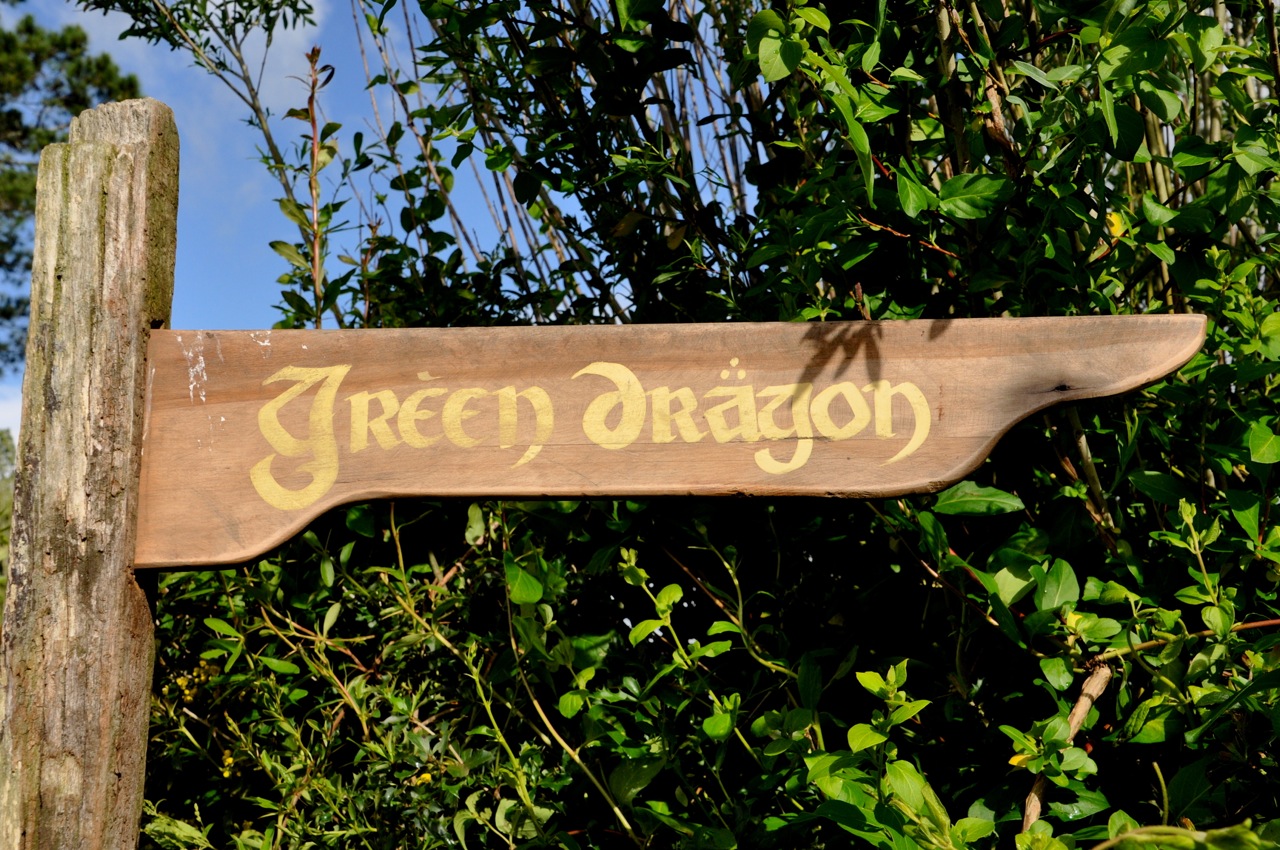
Green Dragon SignThe Green Dragon – and the mill and bridge – were rebuilt, exactly replicating the first temporary structures.  This is a functional restaurant and bar, catering only to the tourists.  They serve specially brewed (just for  them!) ales and ciders, as well as “Hobbit fayre” like beef-and-ale pie or cold-pork pie.  And a boatload of atmosphere!  Below are overviews, and as you can see, this is one big inn!

So – to the Dragon!  And let us not forget the cute mill.

Below is the Green Dragon exterior – too big to get it in one image!  It is impressive.

Again, up close there is a lot of detail to see, such as the carving on these two different bays:

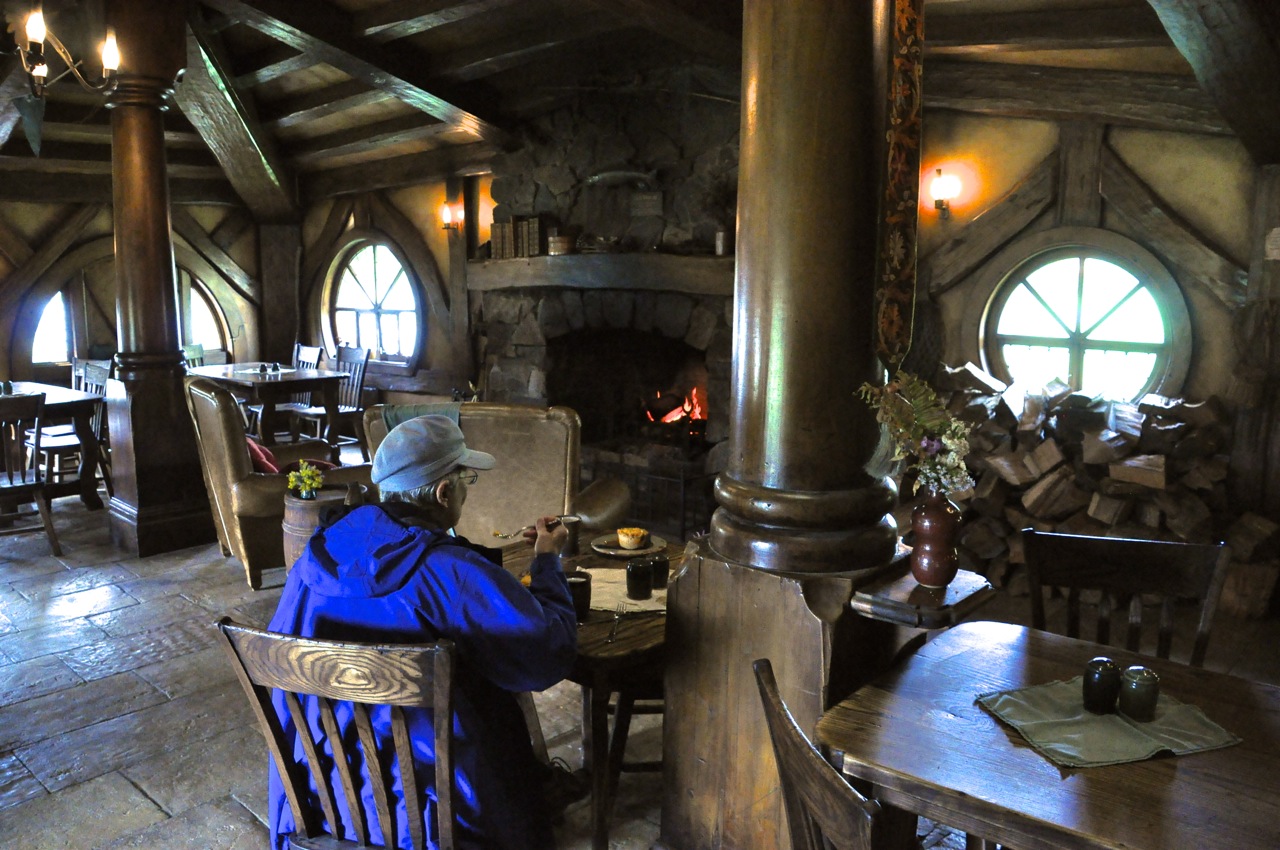
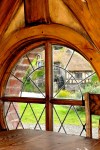
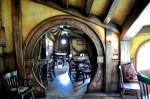
Inside partakingAs charming as the outside is, thatch roof and all, the inside is even better.  It successfully makes you feel like a Hobbit yourself, with its circular windows and doors.  Isn’t that a Ginger Hobbit there, partaking?  Everywhere inside are huge  (huge and real!) beams and cross timbers, all smooth and polished.  The subdued lighting gives the impression there are candles behind the glass.  The pictures below don’t quite capture the ambiance, but you’ll get the idea:

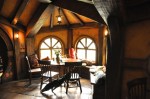
Although the place is huge and has some larger rooms, it is also nicely broken up into smaller, cozy corners, as shown:

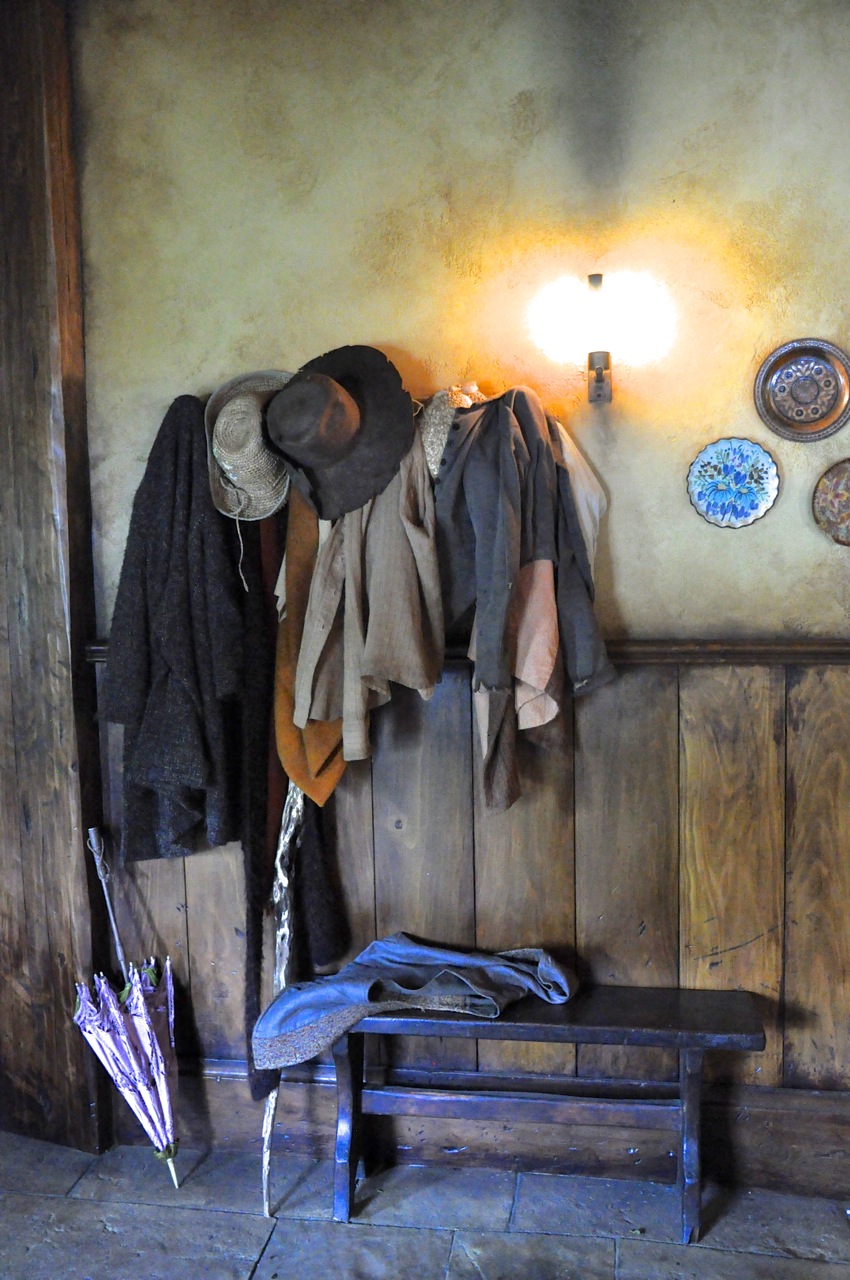
Details - coatsThe attention to detail is also present inside, evident in things like hanging jackets and (Hobbit) portraits on the walls. Details

And let’s not forget the Inn’s namesake Green Dragon: It’s truly gorgeous.

Finally (were you despairing?), the inn’s food and drink.  Serving the trapped tourists at the end of the tour (you get a free drink), what would you expect for prices and quality?

We had low expectations, but the prices looked good, so why not?   Besides, it was an excuse for savoring the interior (and the fireplace).  We ordered beef and ale pies.  I had an ale, Ginger the cider.  The pies were small, to be sure, but extremely good, as were the drinks.  Surprise!!  We would happily have had more, but the day was over and the bus was leaving.  It was indeed a delight to almost believe in the existence of Hobbits for awhile, and to visit the Shire.

Piha Hike

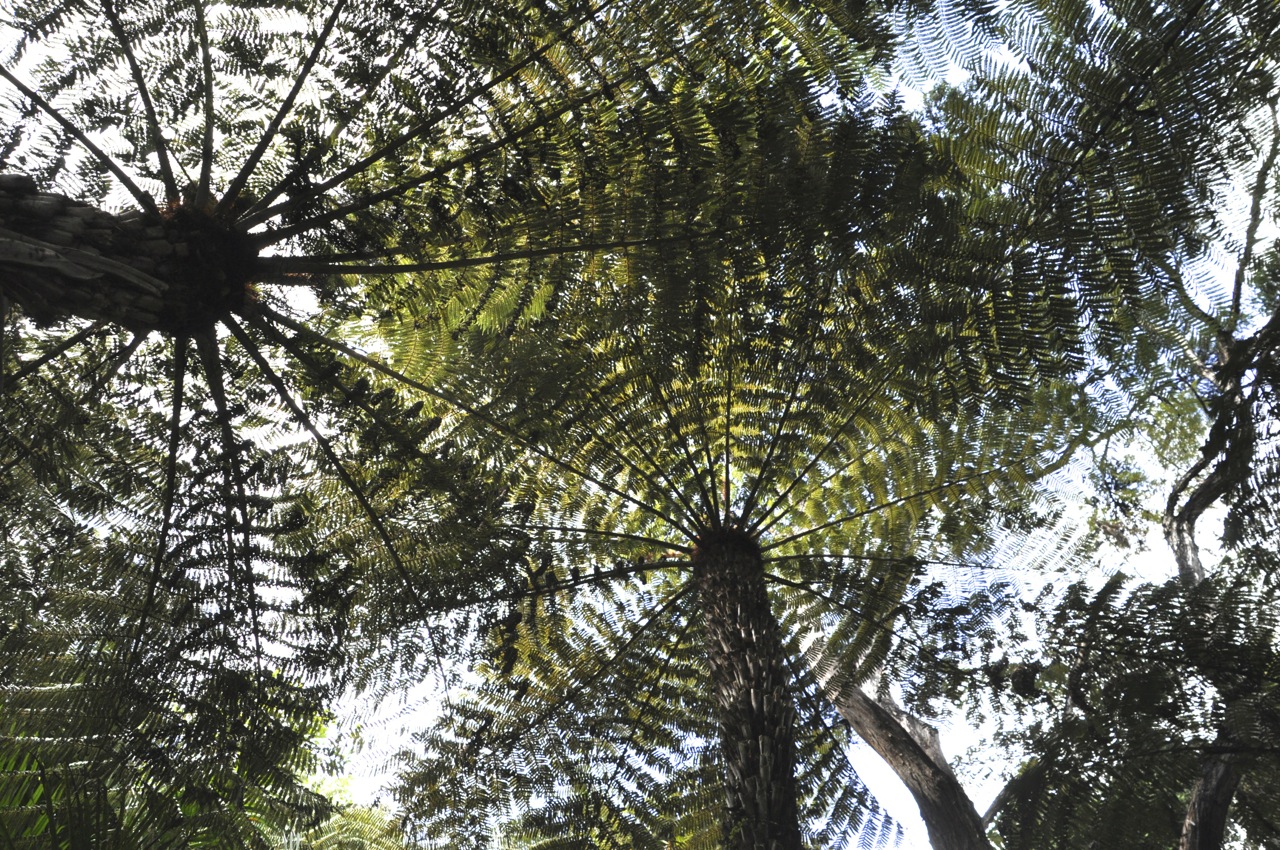
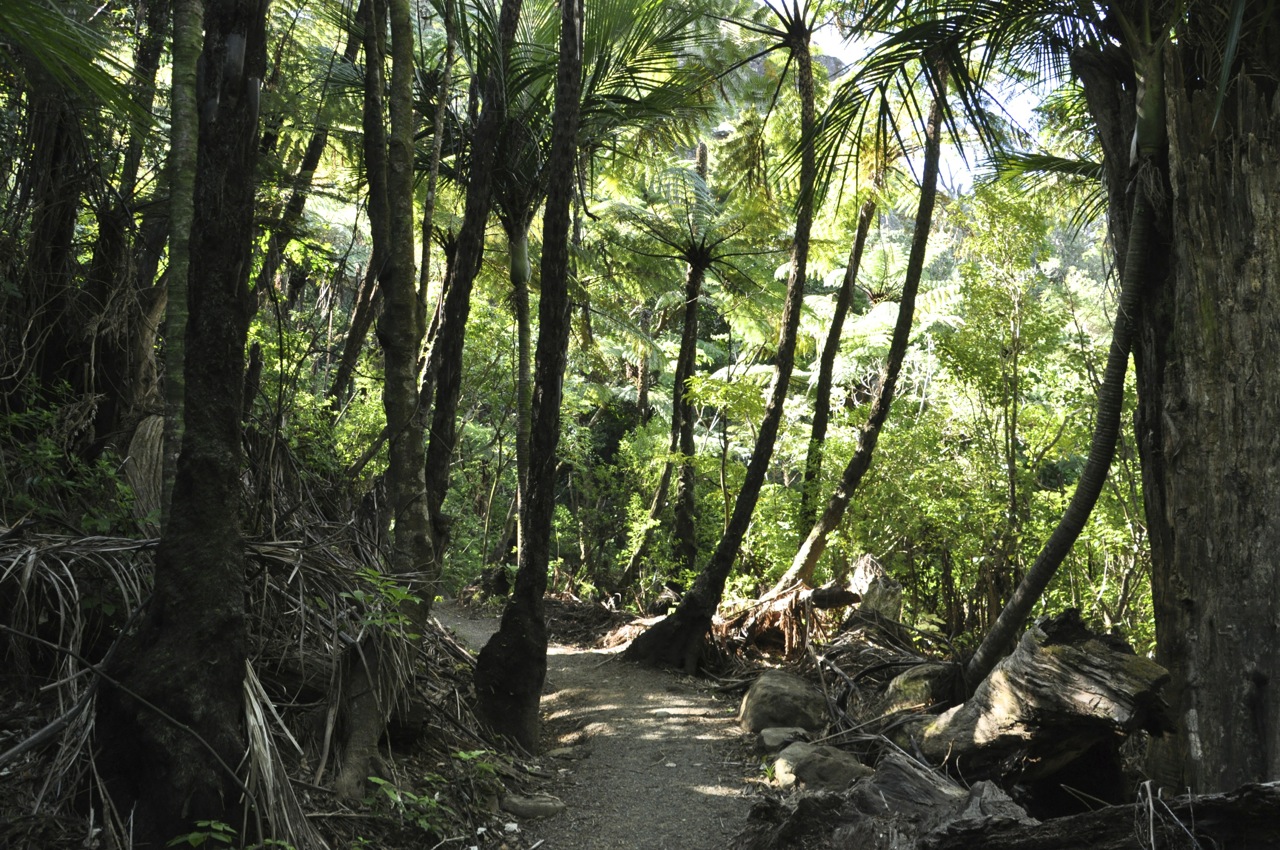
We’re off to see a waterfall.  It’s a nice day, not raining for a change.  The trail, like others before, is pretty amazing.  As for instance, the overhead shot here of fern tree “umbrellas”.  Fern UmbrellasI note to Ginger that it feels like we have been shanghied into a Star Trek episode and here we are, beamed down on this wild planet, and there are probably dinosaurs around the corner.  She says, no, it’s more like “Honey I Shrunk the Kids”.  Well, I don’t remember seeing that movie, but I get her point.

Below are pictures of the trail.  Not bad.

FlowerThe flowers are interesting as well, such as this one.  Whooo boy, those are stamens!  Making a statement!

I’ll end with the waterfall.  Not spectacular, but definitely pretty.  Kauri were logged here years ago, there are some old pictures.  The loggers built a dam near the top of this waterfall to float the kauri trunks and then flush them down this river – over this waterfall! – to the shore.  Turns out the logs were so dinged up from the fall that they had to find another way.   Duh!

NZ Birds, Birds, Birds

If you aren’t very interested in our fine-feathered dinosaurs, you might want to skip this post, which is mostly just a big dump of NZ bird pictures.

New Zealand was basically a bird sanctuary during most of its existence.  Other than a couple types of bat, it had no mammals of any kind, and therefore no predators of birds.  Birds thus evolved in strange ways, such as several flightless types like the moa, an ostrich-sized bird now extinct.  When mankind arrived, bringing big appetites as well as dogs and rats, the birds took it on the chin (I love metaphors!); particularly the flightless big birds.  Well, other birds have since arrived (including the house sparrow, darn it), but there is a huge effort here in NZ to protect the native birds from predators (which are still very limited in type: feral cats, mice, rats, stoats, wild pigs, possums, ferrets).  And except for privately owned dogs and cats, there is quite a strong eradication program for those mammals.  Dogs are popular here, but interestingly, in many places they are simply not allowed to run free.  Many parks/forests have fences and metal gates to keep dogs out.  If you take a dog into the forest, he has to be on a leash.  So I guess you’d have to say that birds still rule, here.

We took a guided tour to Tiritiri Matangi, a predator-free island.  The island had been farmed for a century before being abandoned, and was essentially devoid of trees.  In a textbook example of citizens working with the government, the island was planted with a quarter-million native trees (read – trees producing food for birds), mostly by volunteers, with explicit instructions on how to do it to get a “real” random forest.  Today it is solid forest indeed, and the songs of birds everywhere is impressive.  Below are some shots from the island.  As you can see from the first picture, we’re still close to Auckland.

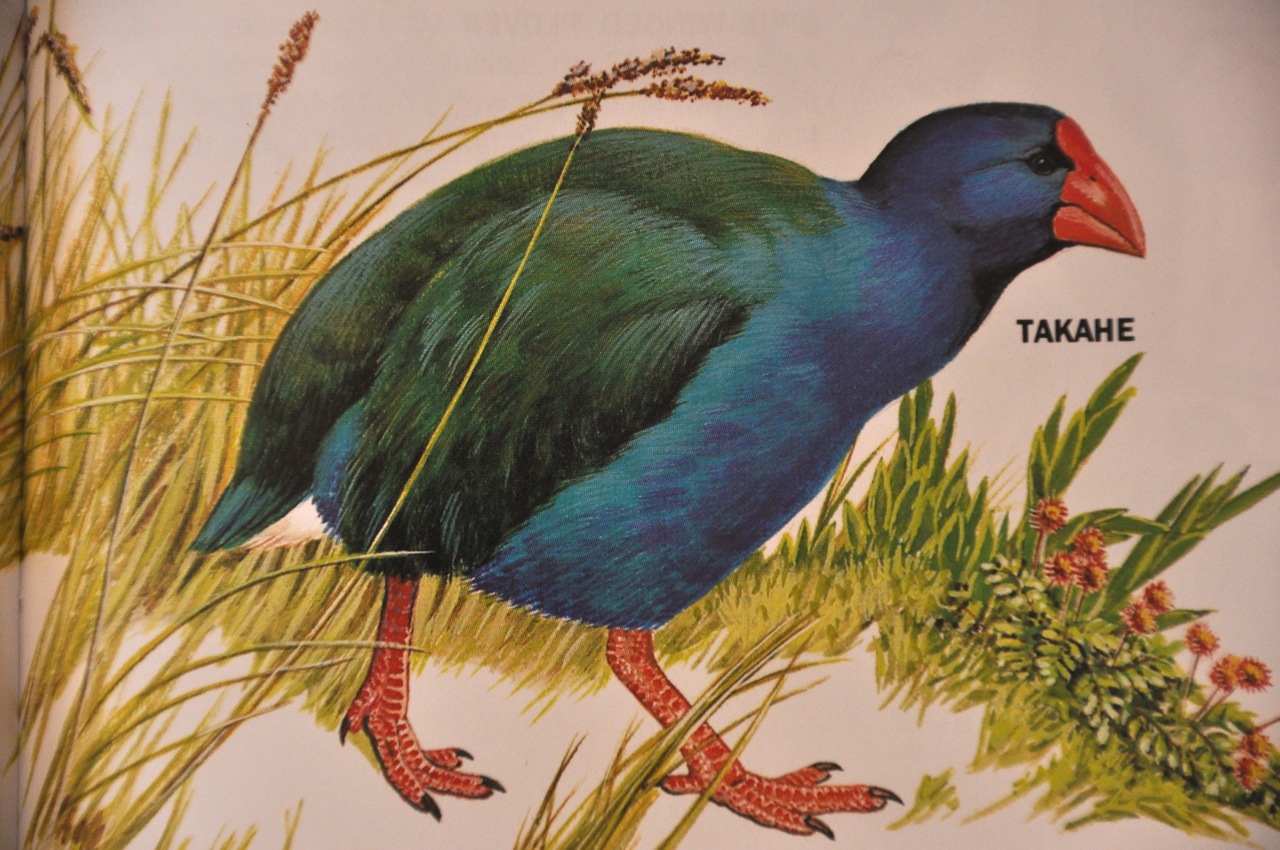
I hoped to see a Takahe, a turkey-sized flightless bird named from fossil bones and Takahethought to be extinct until discovered in 1948.  Today there are 150 of them still living, 7 on this island.  From their pictures, they look spectacular.  And on arrival, our guide hears one calling in the forest near the wharf, unusual for them.  Whooppeee!  And there are signs around saying “Please do not feed the Takahe”, another good sign.  Unfortunately it’s a pretty large group of visitors today, the ferry being cancelled the day before due to rough seas and today a (Grayhound-sized) bus of Kiwis from Whangarei arriving in the nick of time (groan).  There are plenty of guides, and our group with guide is only about 10 people, but the groups are everywhere walking around the paths making noise.  Not such a good sign.  We do see a Kokako, a pigeon-sized bird that is rare.  Alas, no Takahe show up for us.

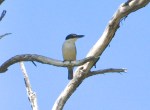
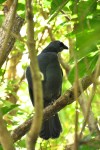
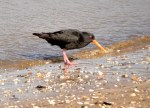
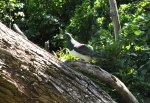
Below are the bird pictures from our month in NZ.  Some I have included more than once, if I thought they offered something extra.  The Tui, for instance, are pretty fantastic.  These birds are everywhere in the woods, a large and aggressive bird almost the size of a magpie.  They are quite pretty, with two white balls at their throats, a shawl-like patch of feathers on their shoulder, and black going to blue/green iridescent feathers everywhere else.  What is really cool is their call(s).  They have two voice boxes (really!), and their call is something you’ve never heard before.  It reminds me of glass breaking in the most melodic way imaginable; it’s quite beautiful.  Ginger says my descriptor is all wrong, it is instead unbird-like otherworldly beautiful (and sometimes ending with a caw-like high-frequency gate creak that breaks the spell).  OK, there you have it.  Now you know what they sound like.  They are also incredible mimics, and seem to be able to duplicate the calls of other birds well enough to confuse the guides.  Below the bird pictures.

That’s if for the birds!

Piha

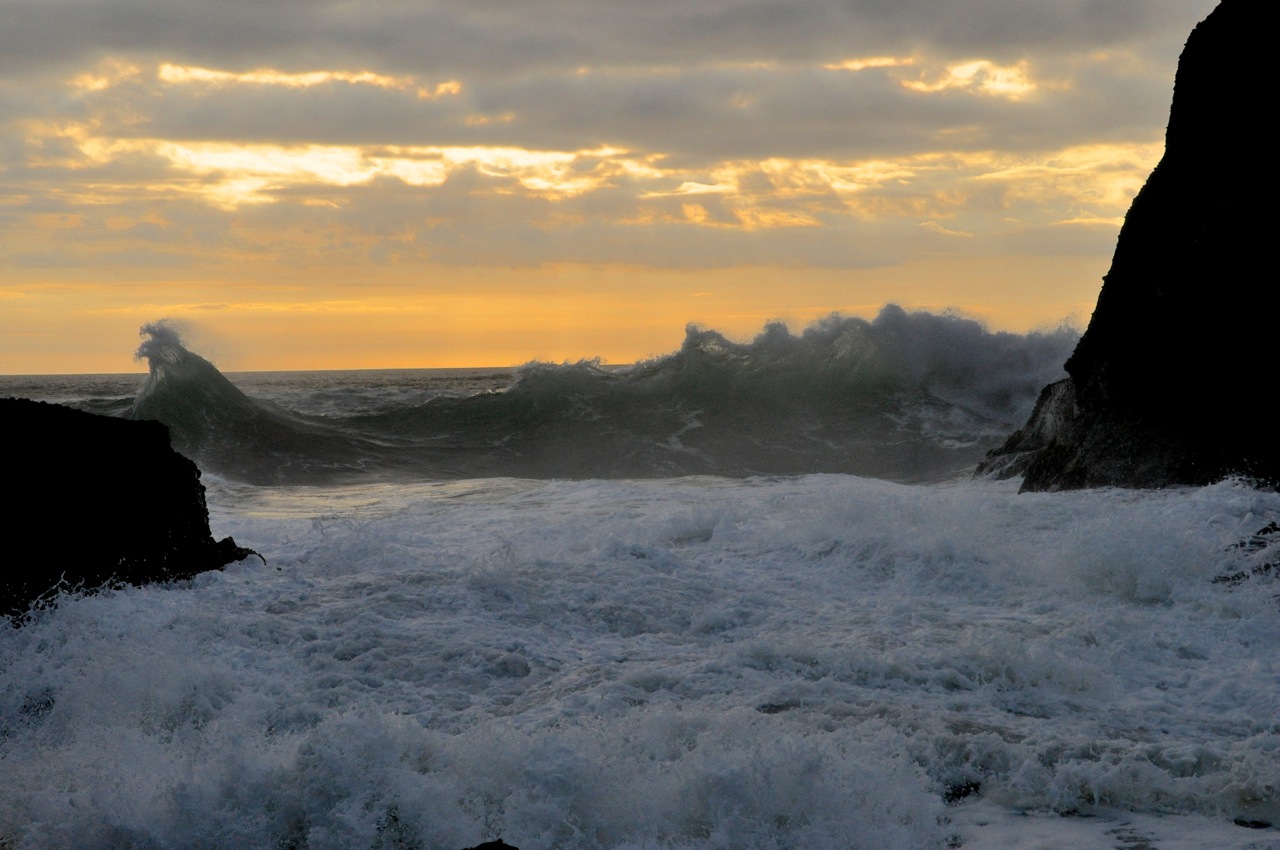
We’re off to see the stormy west coast again, but catch a sunset this time.  The NZ west coast is truly wild along its entire length; the term is “tempestuous shores”.  There are lots of signs saying to swim at only certain spots, and to be careful that waves don’t come over the boulder and wash you off.  Yeah, sure, until you stand on a boulder admiring the view and suddenly the 20th or so wave comes in and sends you scurrying for your life!  Rip CurrentThe warnings are not idle. If you look at this picture, you’ll see a wave right-center coming at you that’s just about to crest.  However, click on this image to make it bigger, and if you look to the left of that cresting wave, you’ll see a smaller one about to crest at an angle 90 degrees from the first!  The water swirls and crashes and tries to suck the sand away.  And yet the beaches often have surfers hard at work (in their wet suits), making you wish you could do that too.

I’ve booked us into a lodge almost on the beach – a 2 minute walk.  The web site looks great, and my NZ guidebook says “suite with big deck, French doors and quality furnishings and bedding.  $220/night. ” Well, the price was accurate.  The furniture is 1950’s, the kitchen pots and pans are older, the bathroom is away downstairs along with the shower that has a trickle of hot water, and there’s not much heat down there.   Message to self: stiffen upper lip.

However, the Piha beach is gorgeous, and I am going to bombard you with photos from this place.  First, a LAST look at Northland scenery.  In your mind you should join these two images to get a better feel for the view.

Now a look at where we are.  We’re at the top of a hill (visitor center; we arrived 5 minutes

too late, but I’ve stopped and so need to take a picture).  Looking east (left picture), Auckland is in the distance (the beach we’re heading to is a popular weekend getaway).  Then turn 180 in the direction of the beach, and you see primeval forest.

I can’t help but take advantage of some tourist attractions, so here are the pictures.  Isn’t the picture on the left a pretty one?  The Maori carving on the right shows tattoos in some of the most unlikely places ….

OK, time to get serious.  After navigating narrow twisty roads going down, Piha appears.

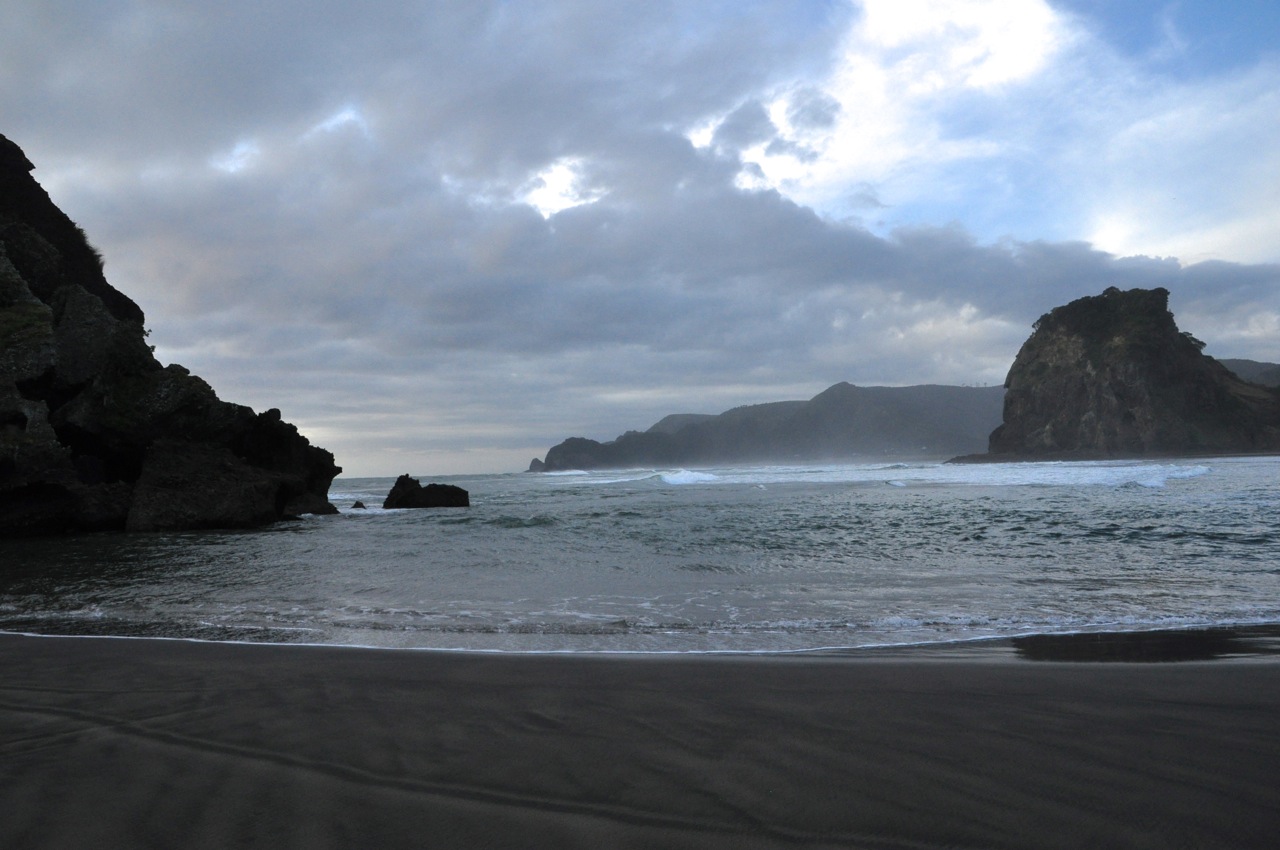
It’s pretty.  I’m showing you this beach over several days from several heights.  Although Piha is a town, there are no stores and there are no gas stations (there is one restaurant of sorts).  The road to Piha does not subsequently link with any of the other towns along the shore.  It’s there and back.  If you want to buy anything, you go back up the twisty narrow road and then quite a ways further to civilization, at least an hour away.  But who wants to go back to civilization with these views?  The beach is a black sand beach, which is kinda Black sand beachcool, but I wonder about it’s allure under a hot sun.  In my experience even white sand can get pretty ouchy.  Still, it’s gorgeous.

Of course, being on the west side, there are sunsets over the ocean.  We didn’t get a great sunset, but a couple weren’t too bad.  Let me show you one of these.  You do know to click on one of the images for the show, correct?

Finally, a quick retrospective of the other (lesser) sunset, as the light fades.  Please click.

Well, it was more red than that, but I won’t complain.

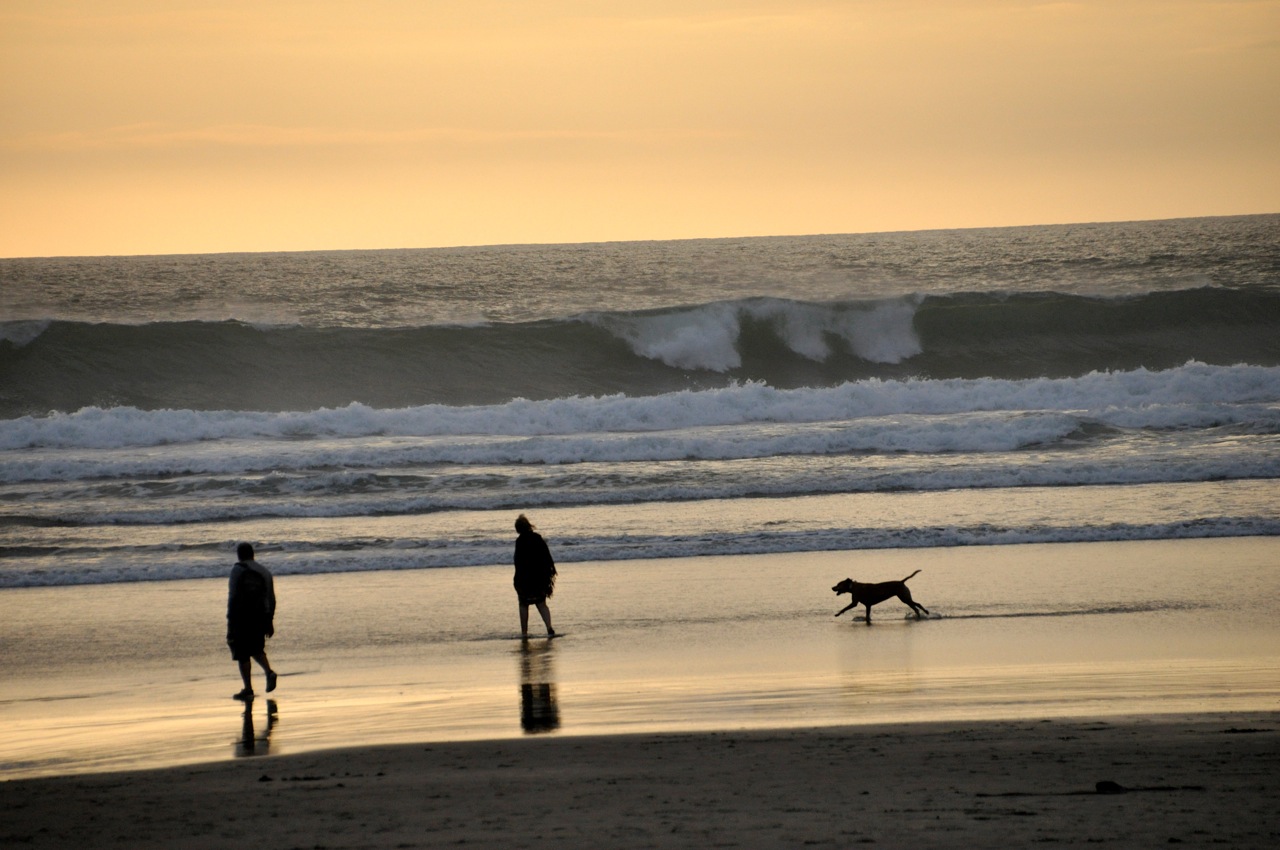
Let me leave you with one last picture of what one should be doing Chillin'in this beautiful country, and what the Kiwi seem to think they should be doing rather than “getting ahead” or “making more”.  We call them “laid back”. They seem to think enough is all they need.  We’d probably be opening up a gas station on the corner … hey, with a mini-mart, a two-fer.  Big sign.  Make a killing, no competition ….  Be open 8 – 8.  Retire at 70 and … get a place on a beach like this ….  Are we missing something here?

Gannet Colony, Muriwai

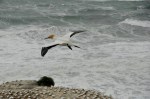
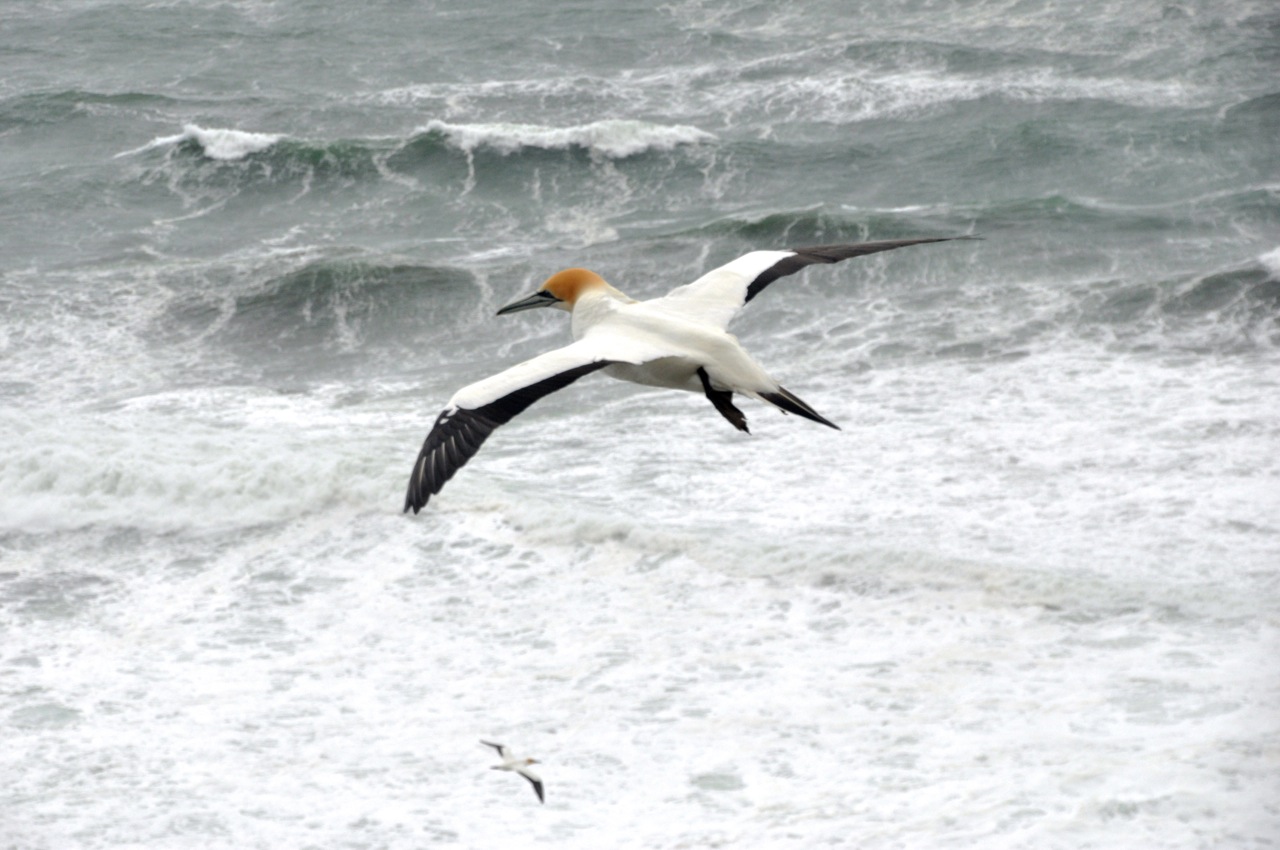
Gannets are interesting birds.  They normally breed on islands, but there are a few places Gannet In Flight where they nest on the mainland instead, and return every year.  Muriwai is one of those places; a place of thundering surf, cliffs, and howling wind.  When we were there, we had jackets zipped and were leaning into the gale off the Tasman, cold as could be.  The birds, instead, looked like they were sunning themselves on a beach, happy as a lark.  Um – wrong metaphor.

The pictures below show you this Muriwai coast.  Part of that wave action is due to the wind, let me tell you. The churn is impressive.

Now let me show you where the gannets nest.  Pretty picturesque, eh?  They’re on 3 separate flat areas at the edge of cliffs (there are two separate cliffs in the first picture, a

third in the second).  Each is a separate cliff.  There is also some spillage of nests up the side of the headland in the second picture, not shown.  Probably from overcrowding, or maybe the nests were cheaper out there.

Let me digress and regale you with some gannet lore.  They catch fish by diving into the sea and pursuing their prey underwater.  They can hit the water at a speed of 60 mph (Ouch for the bird!  And for the poor fish, it must seem like you’re being chased by a bird in a porsche).  When juvenile birds get kicked out of the nest, it’s a one-shot jump off the cliff.  Once airborne, the young gannets leave the colony and cross the Tasman Sea to Australia (about 1500 miles), no one knows why.  Two years later, they return for good to secure a nest site at the same colony, home.

OK, back to my story.  As you can see from the images above, gannet nests are very close together, so landing (in high winds!) is an air traffic controller’s worst nightmare.  Landing birds have to glide over the raised beaks of their neighbors – so getting it wrong is a bad idea (we watched an interesting “whoops”).  These are big birds with a wingspan of six feet, landing on something like two square feet of open space, and their mastery of the onshore updrafts (gales?) is impressive (er – most of the time).  We did note that it’s a

convivial group down there, as shown above.

As mentioned, we watched some take-offs and landings for awhile (a take-off means spreading your wings, and the wind lifts you up…).  One landing went awry, and the bird did this ignominious kerplop summersault face plant.  Sorry I missed a picture of that!  Expecting some Bronx cheers from the neighbors, we were surprised at zero reaction.  The bird gets up unruffled and steps over to a nearby bird, and they proceed to smooch and snuggle!  I can imagine her saying “Oh honey, that landing was soooo much better than the last”.  I’m sure that’s what Ginger would have said.  Pictures of the “Honey I’m home” event below.

Well, all for now.  We’re off tomorrow to one of those predator-free islands to see (hopefully) some rare birds.  Next post maybe I’ll show you some bird pictures?

Muriwai

Kiwi House

Kiwis are the iconic bird of NZ, but bordering on extinction.  These flightless, nocturnal birds occupied a mammal niche here in NZ, and then mammals got introduced – mice, rats, stoats, dogs.  Signs say one dog killed 150 kiwi in one night; apparently a kiwi smells like chocolate to a dog.  Now there is an enormous effort within NZ to preserve these (and other) threatened birds (and lizards).

We wanted to see a kiwi, and so went to a Kiwi House (and museum).  There are a lot of these houses around NZ, part of the breeding program.  The houses switch lighting by 12 hours, so the confused animals think daytime is nighttime, and we can see them (maybe).  Our bad luck, the female had been sent for release and a new young one had just arrived and was experiencing jet lag; the male’s territory was cut in half, and he was hiding.  We came back another time and another day, and fared no better.  We did see the resident Morepork (owl).  Below are pictures, including my shot of the kiwi (or rather his beak, poking from his lair).

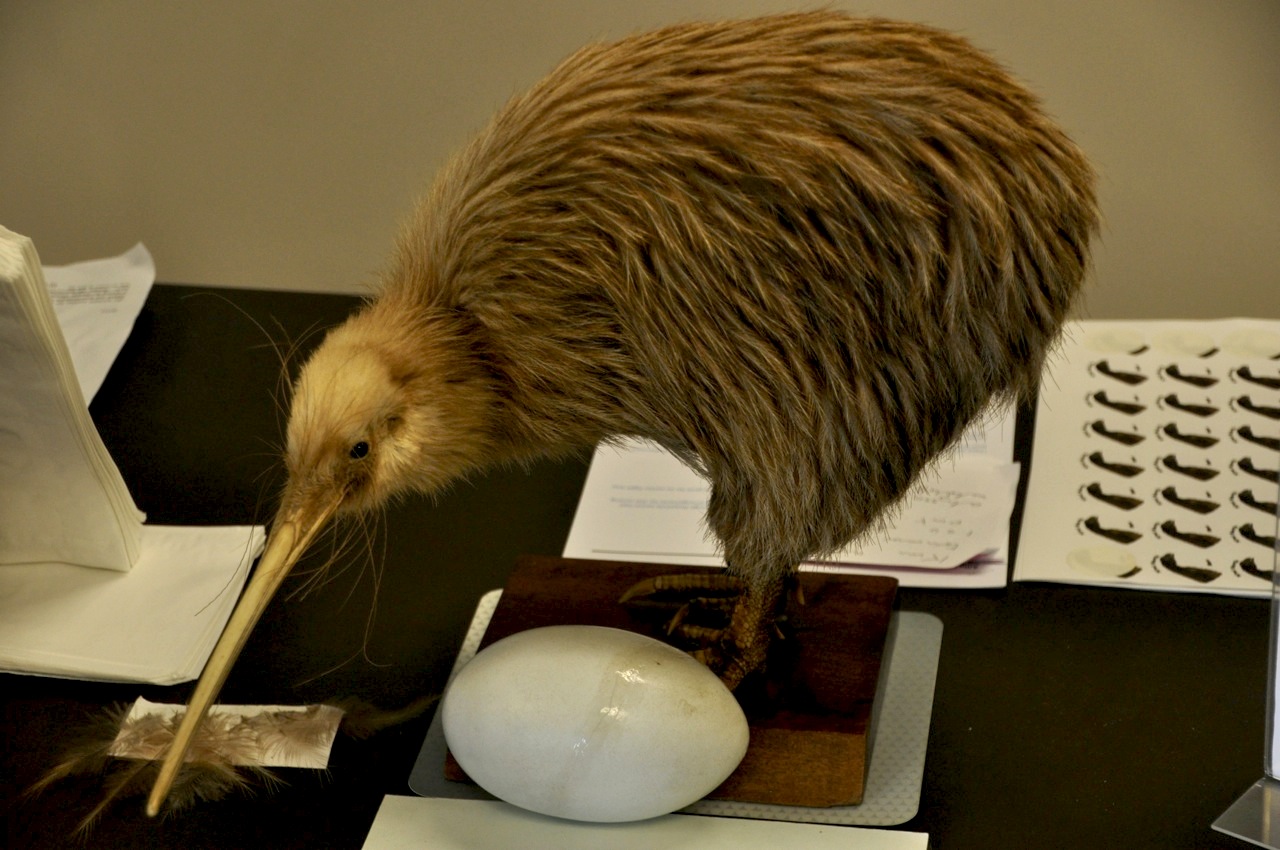
Stuffed KiwiWe’ll visit more of these houses, because these birds are ‘way too cute!  A stuffed kiwi is shown here (from the  museum), along with the single egg the female lays.  She lays a single egg for obvious reasons.  Ouch!

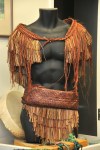
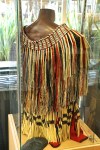
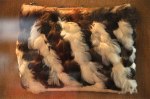
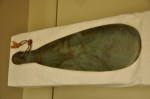
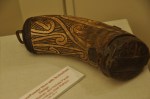
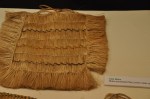
The museum had a number of interesting Maori artifacts that I’ll show off.  The first is a “Mere”, a Maori club typically made from NZ jade called “greenstone”.  It’s basically in the shape of a flattened tear drop, with sharp edges.  It’s about a foot long; hand-to-hand combat are us!  Mere must have been very popular, because they are in many (most?) of the Maori carvings.  Then there is a Maori powder horn, a purse made of flax, an instrument used for tattooing (the cutting part made of bone), and a cloak – a flax garment with feathers woven into it.

These are basically Stone Age people doing all their cutting with jade (sometimes obsidian), but they did have talent!

Whangarei Head

I wanted to climb one of the small mountains on a headlands, and Whangarei Head looked like a good place.  Besides, the area has some wineries worth visiting (our version of multi-tasking).  We found a good-looking B&B on the internet, but y’know, those sites often don’t give you the full story, as we have discovered quite a few times.   The surprise with this B&B was getting to it; we had to travel on a narrow, twisty, steep, cliff-edge, white-knuckled road, much to Ginger’s dismay.  Even then, the gravel, rutted, pot-holed up-and-down driveway to the B&B was a challenge.  Once we arrived at the B&B it was quite pleasant, and certainly quiet!  However, the specter of doing that drive twice a day was a bit daunting – and going out for dinner meant returning at night. B&B View This travel stuff is always exciting, requiring a certain amount of stiff-upper-lip fortitude, and maybe a good sense of humor.  The picture is the view from the B&B’s back yard (notice we’re high up?).  The peak with the jiggles on top, just left of center, is the one I’m going to climb tomorrow – Mt. Manaia.

Ocean Beach

Ginger, bless her heart, has decided to accompany me on the mountain climb, but we miss the trailhead turnoff and end up at Ocean Beach on the other side of the little peninsula (I realize we’re on the wrong road, but there’s no easy way to turn around on the narrow road, and besides we’re exploring).  Not a bad little beach, eh?  They’re a dime a dozen, and at least for this time of year they’re lonely, looking for love.  But we have hiking to do, so back we go.  Between us and Mt. Mania is a promontory, Busby Head and Smuggler’s Cove, Busby Head and Smuggler's Covereputed to be scenic, so we decide to hike here first.  That little chunk of land with a hill on it, protruding into the bay, is where we’re hiking.

It’s a nice, sunny day – rare for us!  And the hike is very pleasant, with lots of birds to see.  Swallows zipping by on the ocean breezes, impossible to photograph – they’re haulin’.   I’ll show you some birds I did manage to catch a bit later.  Pictures of the hike follow.

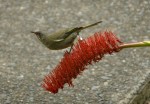
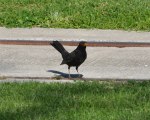
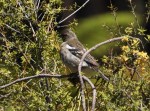
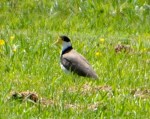
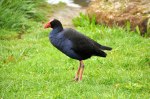
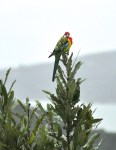
Here are the birds, or at least some of them.  Some you’ve seen already – Pukeko and Tui are everywhere, but I don’t need to show them again.  Others I haven’t identified yet, but hey, there’s enough here to keep you entertained, yes?

So now on to Mt. Manaia!  On, on!  I have twisted my ankle on Busby Head by stepping into a hole while walking off trail beside Ginger, but I will not be deterred!  It’s the same ankle that I sprained in Brussels, where I walked miles on it every day, and it was just now getting better (it takes longer to heal at this age, I note).  The trail marker says the hike is very steep and will take 2 hours round trip, and Ginger decides she has had enough hiking and that only an idiot would do that climb with a sprained ankle.  Yep, she is right.  The trail doesn’t start out that steep.  I meet a couple of people coming down the trail, but it’s late afternoon and I am all alone now.  It’s a pretty trail, and it is increasingly steep.  Mt. Mania trailThe Dept of Conservation (DOC) here is amazing.  The parks and hiking trails and bird sanctuaries and mammal pest removal programs are everywhere and done very very well.  I wish we had trails like these at home!!!  They’re gorgeous, well-maintained, I could say perfect.  On this hike they have installed what seems like a million wood stairs going up this steep mountain.  A little wierd; I came here to hike, not climb no stinkin’ stairs!  But then I get it.  Brilliant!  The switchbacks that we would have had in the US would have made this hike about 3 times as long, with all the erosion problems inherent in switchbacks.  These stairs have a water channel on one side leading to pipes going under the trail.  Impressive.

More pictures of the trail, above.  That tree in the middle is a kauri, growing all by itself.  The last image shows 3 stair sections going up, the last one maybe lost in the sunlight, top of image, center.  The trail is steep!
Finally the last scramble up some rocks.  Views from the top are a little disappointing; the

view is NOT 360.  There are vertical stone outcroppings that block the view front and back (those “jiggles at the top” I mentioned in the initial picture from the B&B), and moving around them is impossible – the end of the climb is a small piece of slanted rock with a steep drop all around, the wind is blowing like crazy, and the sign says if you even try to get around the crags you are trespassing on sacred Maori land.  Nevertheless, the view isn’t too bad, eh?

On the way down, there is a small unmarked side trail that I had noticed going up, and I take it, and it leads to an outcropping that has even better views.  The picture on the right shows that Busby Head again, where we took the earlier walk.

I am pleased that I make it down in 1 1/2 hours, a bunch less than posted.  Now to look like I’m not limping when I approach the car, otherwise I’ll get an “I told you so, idiot” from my adoring wife ….